Few individuals have altered the course of European history as profoundly as William the Silent. He did not possess the tactical brilliance of Gustavus Adolphus, the relentless ambition of Napoleon, or the battlefield genius of Alexander the Great. Instead, his greatest strength was something far rarer. He endured.
For nearly two decades William fought what often seemed an unwinnable struggle against the greatest military power of sixteenth century Europe. He suffered defeat after defeat, saw allies abandon him, watched cities burn, endured bankruptcy, and buried members of his own family. Yet he refused to surrender.
By the time of his assassination in 1584, the Dutch Revolt had become impossible to extinguish. Spain eventually recognised Dutch independence in 1648, long after William’s death, but without his persistence there may never have been a Dutch Republic to recognise.
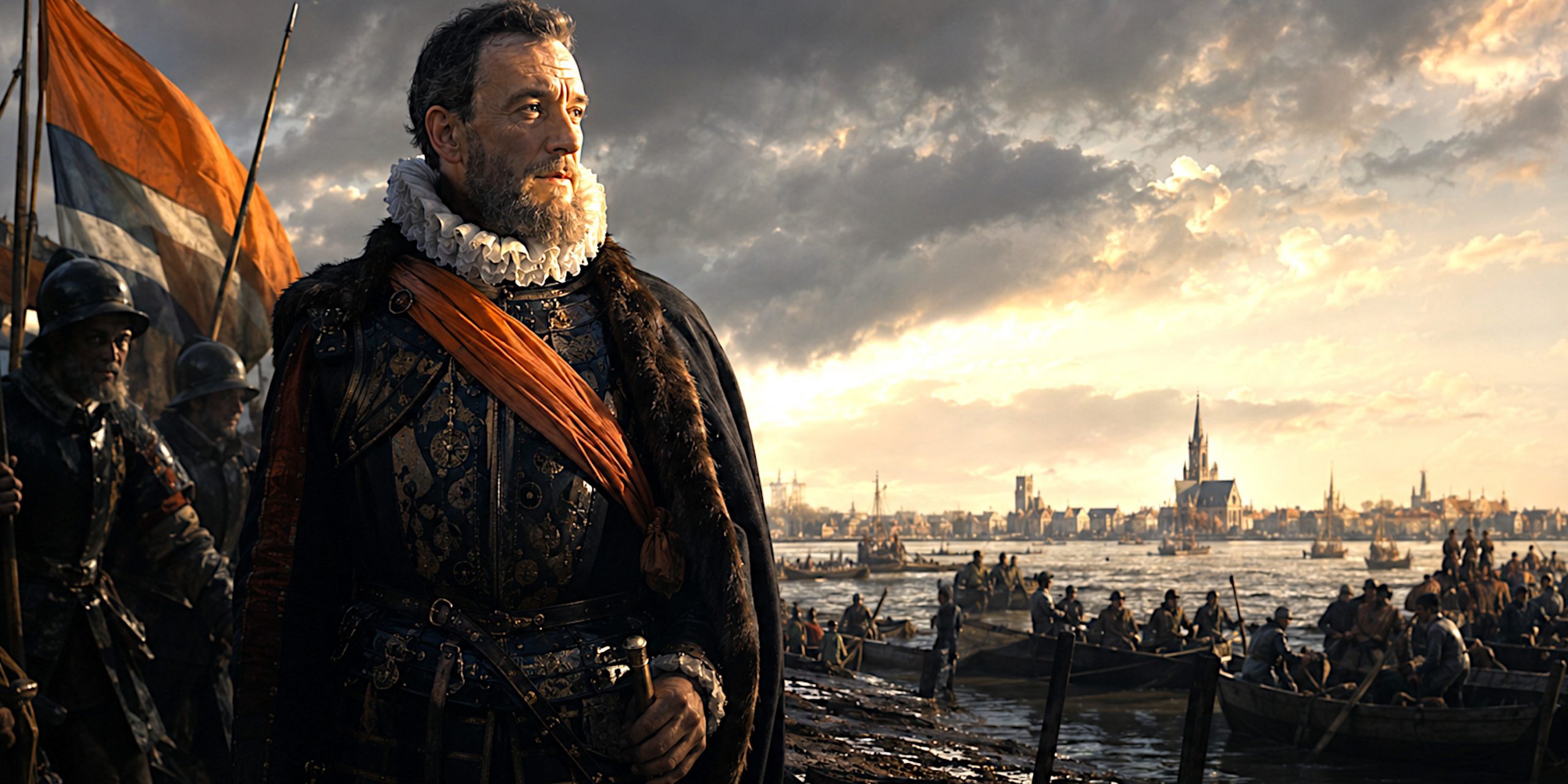
As a historian, William fascinates me because he rarely appears larger than life. Contemporary portraits show a thoughtful nobleman rather than a warrior king. Yet beneath that calm appearance was extraordinary political resilience. History often celebrates spectacular victories. William reminds us that stubborn survival can be just as revolutionary.
Early Life
William was born on 24 April 1533 at Dillenburg Castle in Nassau, within the Holy Roman Empire.
His parents were:
- William the Rich, Count of Nassau-Dillenburg
- Juliana of Stolberg
He grew up as a Lutheran in a relatively modest German princely household. His future changed dramatically in 1544 when his cousin René of Châlon, Prince of Orange, died during the Siege of St Dizier.
William inherited:
- The Principality of Orange in southern France
- Vast estates in the Low Countries
- Immense wealth
- Political influence
The inheritance came with one major condition. Holy Roman Emperor Charles V required William to be educated as a Catholic within the imperial court in Brussels.
The teenage William quickly adapted to court life, mastering languages, diplomacy and noble etiquette. Charles V reportedly admired the young prince enormously.
Why Was He Called “The Silent”?
The nickname “the Silent” often causes confusion.
It did not mean William rarely spoke.
Instead, contemporaries believed he possessed an unusual ability to keep diplomatic secrets. According to later tradition, King Henry II of France accidentally revealed plans to eliminate Protestant leaders, assuming William already knew. Rather than reveal his ignorance, William listened quietly.
Whether the story is entirely true remains debated.
Regardless, William developed a lasting reputation for careful speech and political discretion. In an age when loose words could begin wars, silence became one of his greatest weapons.
Rise Within the Habsburg Empire
During the 1550s William became one of the leading nobles of the Low Countries.
He served:
- Charles V
- Philip II of Spain after Charles’s abdication
- Various provincial governments
- Military commands
Initially, William remained loyal to Spain.
His concerns grew as Philip II attempted to:
- Centralise authority
- Expand the Inquisition
- Reduce traditional local privileges
- Suppress Protestantism
William opposed religious persecution long before openly rebelling.
He increasingly argued that rulers should allow limited religious tolerance to preserve peace.
For sixteenth century Europe, this was an unusually pragmatic position.
The Dutch Revolt
The Dutch Revolt began in 1568.
William launched several military invasions against Spanish rule.
His objectives evolved over time.
Initially he sought:
- Restoration of traditional liberties
- Removal of oppressive officials
- Greater religious tolerance
Eventually the conflict became a struggle for independence.
Spain responded with overwhelming force under the Duke of Alba.
The infamous Council of Troubles executed hundreds of suspected rebels.
Rather than intimidating opposition, these measures strengthened resistance.
William transformed from imperial nobleman into revolutionary leader.
Major Battles and Campaigns
| Year | Campaign | Result |
|---|---|---|
| 1568 | Battle of Heiligerlee | Rebel victory |
| 1568 | Battle of Jemmingen | Heavy defeat |
| 1572 | Capture of Brielle | Major turning point |
| 1574 | Relief of Leiden | Strategic Dutch victory |
| 1576 | Pacification of Ghent | Political triumph |
| 1581 | Act of Abjuration | Formal rejection of Philip II |
Battle of Heiligerlee (1568)
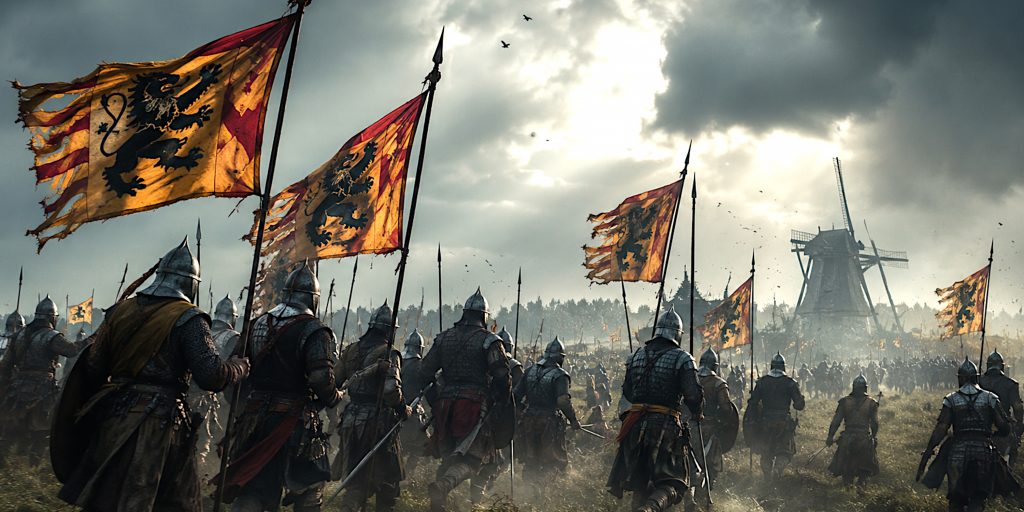
William himself was absent, but his brother Louis commanded the rebel army.
The victory demonstrated Spanish forces could be defeated.
Unfortunately, celebration proved premature.
Battle of Jemmingen (1568)
Spanish commander Fernando Álvarez de Toledo crushed the rebel army.
Thousands died.
It remains one of the worst defeats suffered during the revolt.
The Sea Beggars
William recognised conventional warfare alone would fail.
He increasingly relied upon privateers known as the Sea Beggars.
Their unexpected seizure of Brielle in 1572 transformed the rebellion.
One captured port inspired numerous towns to join the revolt.
Sometimes history pivots upon remarkably small events.
Relief of Leiden (1574)
Perhaps William’s finest strategic achievement.
With Leiden under siege, Dutch forces deliberately flooded large areas by breaking dykes.
Spanish troops eventually withdrew.
The city survived.
In gratitude, Leiden University was founded, becoming one of Europe’s leading centres of scholarship.
Military Acumen
William was not a battlefield commander in the mould of Marlborough or Caesar.
His strengths lay elsewhere.
Strategic Patience
He accepted temporary defeats while preserving the wider cause.
Few commanders willingly abandoned territory if doing so strengthened long-term survival.
William repeatedly made precisely those difficult decisions.
Political Warfare
He understood military victories meant little without public support.
He invested heavily in:
- Propaganda
- Religious compromise
- Provincial cooperation
- International diplomacy
Coalition Building
Maintaining unity among Dutch provinces proved almost harder than fighting Spain.
Catholics and Protestants often distrusted one another more than they disliked Philip II.
William constantly negotiated fragile alliances.
Financial Management
Funding rebellion became a perpetual struggle.
Spanish armies suffered frequent mutinies due to unpaid wages.
William’s own finances nearly collapsed several times.
Yet he somehow kept resistance alive.
This ability deserves far more recognition than it usually receives.
Arms and Armour
William dressed according to the fashions of Europe’s highest nobility.
Unlike medieval kings, sixteenth century rulers increasingly balanced ceremonial splendour with practical military equipment.
Armour
William likely owned several complete armour harnesses.
These included:
- Blackened field armour
- Decorated parade armour
- Etched breastplates
- Close helmets and burgonets
- Steel gauntlets
- Reinforced cavalry armour
German and Italian armourers probably produced much of his equipment.
Fine armour had become both protection and political theatre.
Weapons
William probably carried:
- Wheel lock pistols
- Military rapiers
- Broad cut and thrust swords
- Daggers
- Command batons
Unlike earlier medieval rulers, he rarely fought personally in hand to hand combat.
His role increasingly resembled that of commander rather than frontline knight.
Military Organisation
William gradually helped modernise Dutch military methods.
His armies included:
| Unit | Role |
|---|---|
| Pike infantry | Defensive formations |
| Arquebusiers | Firearms support |
| Musketeers | Increasing battlefield firepower |
| Cavalry | Reconnaissance and pursuit |
| Artillery | Siege operations |
| Engineers | Dyke construction and flooding operations |
Engineering became one of the defining characteristics of Dutch warfare.
Water itself became a weapon.
Spain possessed superior soldiers.
William learned to reshape the battlefield instead.
The Assassination
On 10 July 1584 William was assassinated in Delft.
His killer was:
Balthasar Gérard
Philip II had declared William an outlaw and offered a substantial reward for anyone willing to eliminate him.
Gérard gained access to William’s residence before shooting him with a wheel lock pistol.
William became one of the first major European heads of state to be assassinated using a handgun.
His reported final words remain famous:
My God, have mercy upon my soul… and upon this poor people.
Although versions differ slightly across surviving accounts, they capture his lifelong concern for the Dutch cause.
Family
William married four times.
His most significant marriage was to:
Louise de Coligny
His son Maurice of Nassau became one of Europe’s greatest military reformers.
Maurice would continue the struggle against Spain while introducing tactical innovations that influenced warfare across the continent.
Religion
William’s religious journey reflected Europe’s turbulent Reformation.
He was successively:
- Raised Lutheran
- Educated Catholic
- Eventually associated with Calvinism
More importantly, he consistently advocated coexistence.
His famous statement still resonates:
I cannot approve that princes should attempt to rule the consciences of their subjects.
For the sixteenth century, such thinking bordered on revolutionary.
Surviving Artefacts
Several remarkable objects connected with William survive.
Notable artefacts include:
- Portraits by Adriaen Thomasz Key
- Personal correspondence
- Official state papers
- Coins bearing his image
- Seals and documents
- Household possessions preserved in Dutch collections
- Contemporary firearms similar to the pistol used in his assassination
Many of these items remain central to exhibitions on the Dutch Revolt.
Where to See Artefacts Today
Visitors interested in William should begin with the Netherlands.
Prinsenhof Museum, Delft
The building where William was assassinated.
Visitors can still see the bullet holes traditionally associated with the murder.
Collections include:
- Weapons
- Portraits
- Documents
- Personal possessions
- Exhibitions on the Dutch Revolt
Rijksmuseum, Amsterdam
Contains paintings, documents, prints and decorative arts connected with William and the Eighty Years’ War.
Royal Armouries, Leeds
Holds sixteenth century European arms and armour comparable to equipment used during William’s lifetime.
Dutch National Archives, The Hague
Preserve extensive collections of correspondence and official documentation from his administration.
Archaeology and Recent Discoveries
Interest in the Dutch Revolt continues to generate archaeological discoveries.
Excavations across former siege sites have uncovered:
- Musket balls
- Cannon shot
- Fortification remains
- Defensive earthworks
- Military camps
- Domestic objects abandoned during sieges
Recent investigations around Leiden have improved understanding of how flood defences were intentionally breached during the famous relief of 1574.
Archaeologists have also examined surviving sections of sixteenth century bastioned fortifications across the Netherlands. Modern survey techniques, including LiDAR and ground penetrating radar, continue to reveal buried elements of defensive systems that shaped the war.
Research into Delft has provided further insight into William’s final residence, allowing historians to better reconstruct the circumstances surrounding his assassination.
The Dutch Revolt increasingly benefits from interdisciplinary research combining archaeology, archival studies and landscape analysis. Together they reveal that this was not simply a series of battles, but a conflict fought across fields, waterways, towns and carefully engineered landscapes.
Legacy
William never saw the independent Netherlands.
He died decades before victory was secured.
Yet his influence proved decisive.
His achievements include:
- Leading the Dutch Revolt
- Defending provincial liberties
- Promoting religious tolerance
- Creating the political foundations of the Dutch Republic
- Inspiring later constitutional movements
He became known as the “Father of the Fatherland,” a title that has endured for centuries.
His descendants continue to occupy the Dutch throne through the House of Orange-Nassau.
Unlike many military leaders remembered solely for conquest, William’s reputation rests upon perseverance, negotiation and principle.
There is something quietly admirable about that. He did not seek glory through spectacular battlefield victories. Instead, he accepted setbacks that would have broken many rulers, trusting that persistence could outlast power. Looking back across four centuries, it is difficult to argue that he was wrong.
Timeline
| Year | Event |
|---|---|
| 1533 | Born at Dillenburg |
| 1544 | Inherits the Principality of Orange |
| 1555 | Serves under Philip II |
| 1568 | Dutch Revolt begins |
| 1572 | Capture of Brielle transforms the rebellion |
| 1574 | Relief of Leiden |
| 1576 | Pacification of Ghent |
| 1581 | Act of Abjuration declares Philip II deposed |
| 1584 | Assassinated in Delft |
| 1648 | Dutch independence formally recognised |
Takeaway
William the Silent was not history’s most brilliant battlefield commander, nor its most charismatic monarch. His greatness lay in something less glamorous but arguably more difficult. He convinced exhausted people that defeat was not inevitable.
Against one of Europe’s richest empires, he transformed scattered resistance into a movement that eventually created a new nation. His victories were often political rather than military, his greatest weapon was patience, and his legacy still shapes the Netherlands today.
History frequently remembers those who won spectacular battles. William deserves equal recognition for refusing to lose the war.