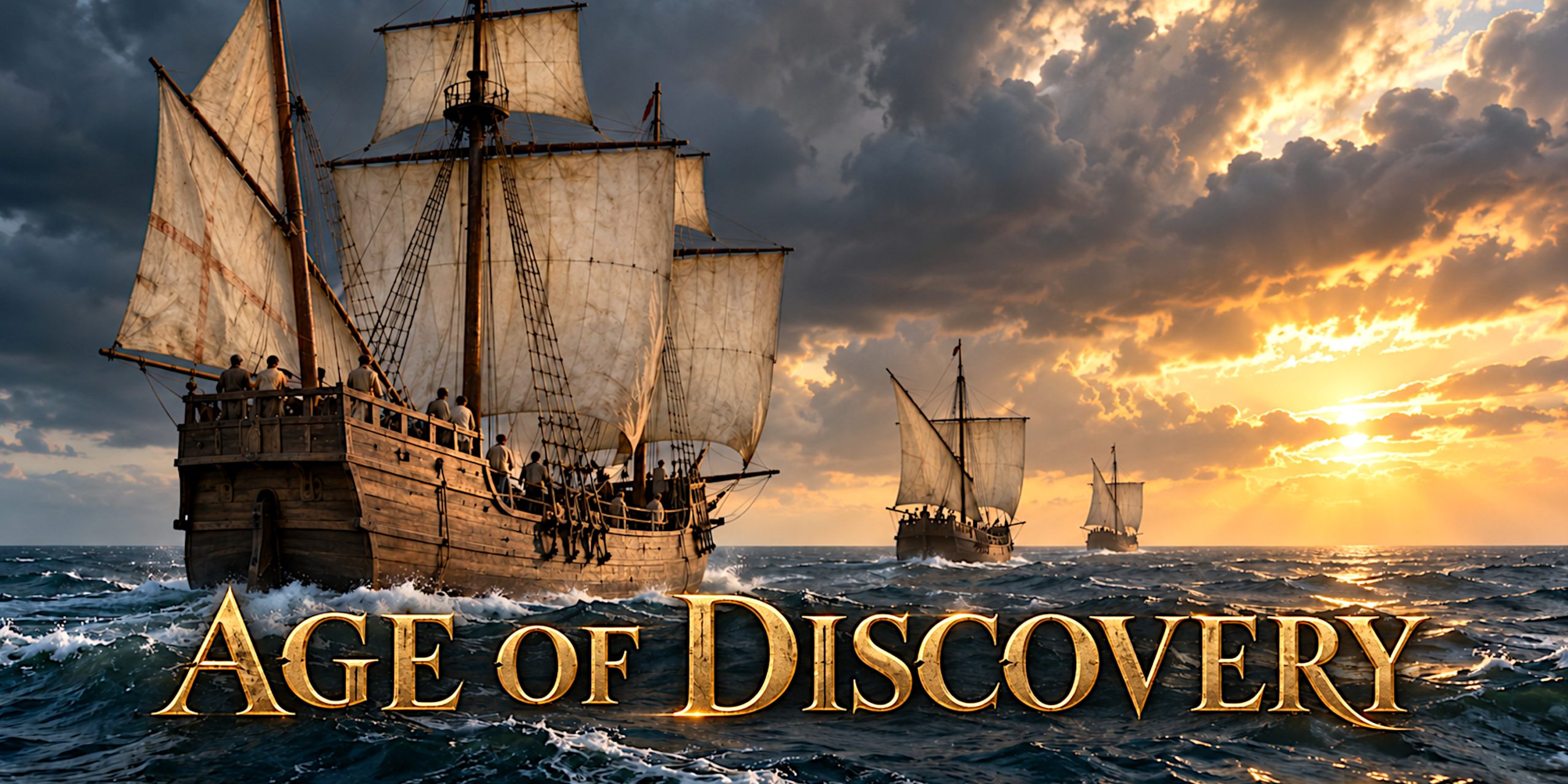
The Age of Exploration was a period of expanding European sea voyages, usually dated from the early fifteenth century to the seventeenth. Portuguese ships pushed into the Atlantic and around Africa, Spanish expeditions crossed to the Americas, and other European powers followed with ambitions of their own.
These voyages helped establish lasting connections between the Atlantic, Indian and Pacific oceans. They also carried conquest, forced labour and epidemic disease into societies whose histories had begun long before a European sail appeared offshore.
I find the period most revealing when the magnificent maps are put beside the less magnificent paperwork: commercial contracts, royal instructions and arguments about who owned what. There was genuine curiosity aboard these ships. There were also investors expecting a return.
What Was the Age of Exploration?
The term describes the growth of European overseas navigation and expansion, rather than the beginning of human exploration.
Polynesian navigators had already crossed enormous stretches of the Pacific. Arab, Persian, Indian and East African merchants operated established Indian Ocean networks. Chinese fleets under Zheng He sailed as far as East Africa in the early fifteenth century. Norse voyagers had reached North America centuries before Columbus.
“Age of Discovery” remains a familiar alternative name, but it needs care. Lands new to European mapmakers were frequently home to substantial populations, powerful states and sophisticated systems of trade.
The important change was the increasing frequency and permanence of connections between previously separated regions. Ships began to carry people, commodities, organisms and imperial claims across oceans on a sustained basis.
Why Did European Exploration Begin?
Several ambitions converged. No single event sent Europe collectively rushing for the nearest harbour.
Trade and profit: Pepper, cloves, nutmeg, textiles and other Asian goods commanded high prices. A direct maritime route offered the possibility of taking a larger share of the profits.
Royal competition: Overseas trade could enrich a crown, support warfare and weaken a rival. Monarchs were interested in geographical knowledge when it promised practical advantages.
Religion: Christian expansion and hostility towards Muslim powers influenced Portuguese and Spanish policy. Religious conviction could be sincere while also providing a convenient justification for conquest.
Atlantic experience: Voyages to islands such as Madeira and the Azores, together with expeditions along West Africa, developed practical knowledge of winds, currents and provisioning.
The Ottoman capture of Constantinople in 1453 belongs in this background, but the familiar claim that it simply closed Asian trade is misleading. Commerce continued through Muslim and Mediterranean intermediaries. Europeans wanted greater access and control, rather than a rescue from a world suddenly without spices.
Portuguese exploration was already under way before Constantinople fell. History rarely arranges its causes as neatly as a school revision sheet would like.
Portugal and the Sea Route to India
Portugal’s capture of Ceuta in 1415 is often treated as a starting point for its overseas expansion. During the following decades, Portuguese voyages extended along the African Atlantic coast.
Prince Henry, commonly called “the Navigator”, supported this activity, although his nickname can leave the unfortunate impression that he personally spent his days steering caravels.
In 1488, Bartolomeu Dias rounded southern Africa. Ten years later, Vasco da Gama reached Calicut, now Kozhikode, on India’s Malabar Coast.
Da Gama had connected Portugal by sea with an existing commercial world. Indian Ocean merchants did not need Europeans to explain either shipping or profit to them.
Portuguese expansion subsequently combined trading posts, fortified bases, diplomacy and violence. Goa was taken in 1510 and Malacca in 1511. The objective increasingly became control over strategically important ports and shipping routes, although Portuguese power never amounted to command of the entire Indian Ocean.
Columbus and the Atlantic Crossing
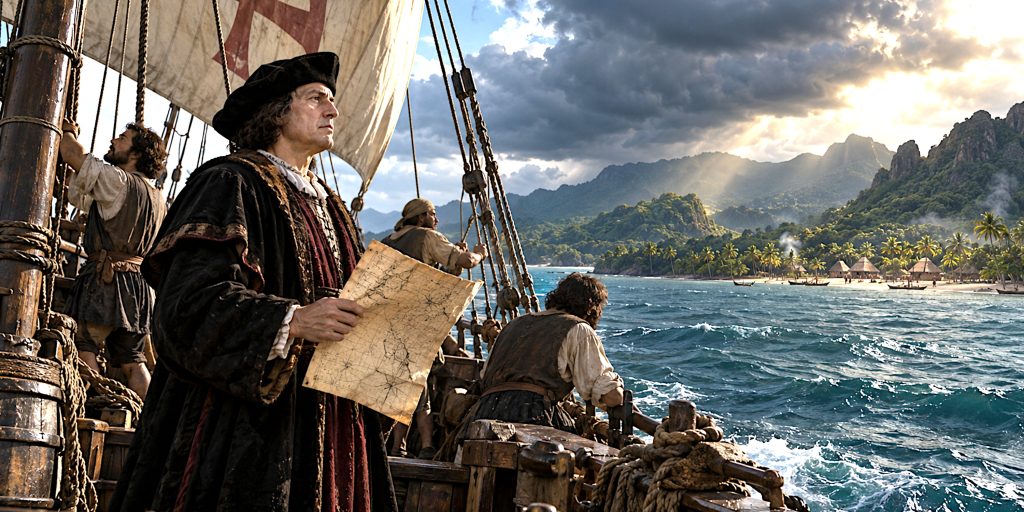
Christopher Columbus sailed west in 1492 with the backing of Isabella of Castile and Ferdinand of Aragon. His intention was to reach Asia.
He reached Caribbean islands instead, encountering communities including the Taíno. His voyages initiated sustained European colonisation in the region, rather than the first human discovery of the Americas.
Columbus underestimated the distance to Asia. The central disagreement was about geography and the feasibility of his route, not whether a ship might tumble off a flat Earth.
His surviving words also show how quickly observation became a claim to ownership. In his 1493 letter to Luis de Santángel, he wrote:
“I have taken possession of all for their highnesses”
Later in the same letter, he offered:
“slaves, as many as they shall order to be shipped”
Both excerpts are from an English translation reproduced by the University of Maryland’s Early Americas Digital Archive.
This was a report intended to demonstrate the voyage’s value. Its language tells us about Columbus’s priorities; it should not be mistaken for an impartial account of Caribbean societies.
Magellan, Elcano and the First Circumnavigation
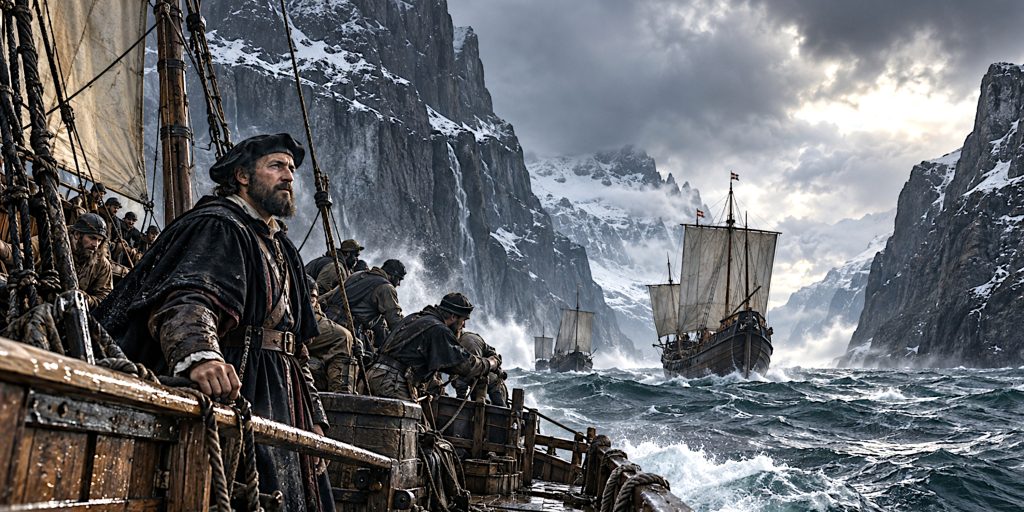
Ferdinand Magellan left Spain in 1519 seeking a western route to the Spice Islands. His expedition passed through the strait now bearing his name and crossed the Pacific.
Magellan was killed at Mactan in the Philippines in April 1521, during an intervention in local political conflict. Juan Sebastián Elcano subsequently commanded the Victoria on its return to Spain in 1522, completing the first recorded circumnavigation.
The voyage demonstrated the possibility of sailing around the globe and exposed the immense scale of the Pacific. It did not introduce educated Europeans to the idea of a spherical Earth.
Antonio Pigafetta, a participant and chronicler, recorded what the crossing actually felt like:
“We ate biscuit, which was no longer biscuit but powder swarming with worms”
This translated excerpt appears in the National Museum of Australia’s account of early world maps.
It is a useful corrective to the graceful ships painted on those maps. From a distance, an expedition could look heroic. At the dinner table, considerably less so.
Major Voyages and Turning Points
| Date | Event | Historical significance |
|---|---|---|
| 1415 | Portugal captures Ceuta | An important early stage in Portuguese overseas expansion |
| 1488 | Dias rounds southern Africa | Establishes that the Atlantic connects with the Indian Ocean around Africa |
| 1492 | Columbus reaches the Caribbean | Begins sustained European contact and colonisation in the region |
| 1494 | Treaty of Tordesillas | Spain and Portugal agree a dividing line for their overseas claims |
| 1498 | Da Gama reaches India | Establishes a direct sea route between Portugal and India |
| 1500 | Cabral reaches Brazil | Leads to a Portuguese claim over territory in South America |
| 1519–1522 | Magellan–Elcano expedition | Completes the first recorded circumnavigation |
| 1521 | Tenochtitlan falls | A decisive moment in the Spanish conquest of the Mexica Empire |
| 1532 | Atahualpa is captured at Cajamarca | A crucial opening in the Spanish conquest of the Inca Empire |
| 1565 | Spanish settlement at Cebu and an eastward Pacific return route | Helps establish regular links between the Philippines and the Americas |
| 1577–1580 | Drake’s circumnavigation | Combines English maritime exploration with attacks on Iberian interests |
| 1602 | Dutch East India Company founded | Signals the growing role of chartered companies in overseas expansion |
The Treaty of Tordesillas deserves particular attention. It organised competing Iberian claims, not the consent of the peoples whose territories appeared beneath the line. A diplomatic agreement in Europe was not universal permission.
Ships, Maps and Navigation
Long-distance voyages depended on accumulated experience as much as individual inventions.
Caravels were useful for exploration because of their handling and adaptable sail arrangements. Larger carracks carried the cargo, provisions and crews required for lengthy commercial voyages. Ship design varied with purpose; there was no single vessel that did everything well.
Navigators used compasses, charts, astronomical observations and dead reckoning. The mariner’s astrolabe helped estimate latitude from the altitude of the Sun or suitable stars. Taking an accurate observation on a moving deck was another matter.
Royal Museums Greenwich explains how the mariner’s astrolabe worked, including its use by Portuguese seafarers. Sextants belong to the eighteenth century and should not be placed in the hands of Columbus or da Gama.
Reliable longitude remained difficult. Knowledge of winds and currents, including the need to sail away from land to find a favourable return route, was therefore essential.
Local pilots, interpreters and guides also mattered. European accounts often place a captain at the centre of the story while leaving the people who helped him navigate it somewhere in the margins.
Weapons, Conquest and Resistance
Exploration and conquest were connected, but they were not identical activities. Surveying a coastline, negotiating access to a port and overthrowing a state required different decisions.
European forces carried swords, crossbows, firearms and artillery. Cannon were especially useful in naval warfare and attacks on coastal positions. Yet weapons alone cannot explain the expansion of European power.
In Mexico, Cortés depended on large numbers of Indigenous allies, including Tlaxcalans, who had their own reasons for opposing Mexica rule. In the Andes, Spanish intervention followed civil conflict within the Inca Empire. Interpreters, political divisions, coercion and disease all influenced the outcome.
The Library of Congress exhibition on exploration and encounters brings together records relating to Columbus, Cortés, Pizarro and the peoples they encountered.
Resistance belongs in this history too. Magellan’s death at Mactan makes it difficult to sustain any idea of automatic European military superiority. Local rulers and communities could defeat, exclude, bargain with or exploit newcomers.
Later English ventures likewise mixed navigation with armed opportunism. Sir Francis Drake circumnavigated the globe while raiding Iberian possessions and shipping. His career also included participation in slaving voyages. National celebration has often been more selective than the evidence.
The Columbian Exchange and Its Human Cost
The Columbian Exchange describes the movement of plants, animals, diseases and people between the Americas and the wider world after 1492.
American crops such as maize, potatoes and cassava eventually transformed diets far beyond their places of origin. Horses and cattle spread through the Americas, changing transport, land use and, in some regions, warfare.
These changes unfolded unevenly over centuries. The potato did not become a European staple the moment a ship unloaded it.
Disease had devastating consequences for Indigenous populations. Smallpox and other infections interacted with warfare, displacement, hunger and forced labour. Their effects varied between regions, and precise population estimates remain debated.
Plantation economies also expanded demand for enslaved labour. The Atlantic slave trade forcibly transported millions of Africans over subsequent centuries, binding commercial growth to systematic violence.
“Exchange” is therefore a useful description of movement, but an inadequate description of power. Many of those moved had no choice in the matter.
When Did the Age of Exploration End?
There is no universally agreed finishing date.
The seventeenth century is often used because overseas expansion was becoming increasingly organised through permanent colonies, regular trading networks and chartered companies. Dutch, English and French activity challenged earlier Iberian ambitions.
Exploration continued, including major Pacific voyages in the eighteenth century. What changed was the relationship between voyages and the institutions behind them.
A period label helps organise the evidence. It should not suggest that sailors collectively put away their charts on a particular afternoon.
Why the Age of Exploration Still Matters
The Age of Exploration helped create the foundations of a more closely connected world. Its consequences remain visible in languages, food, migration, commercial routes and unequal distributions of wealth and power.
I think its history is strongest when we allow achievement and responsibility to occupy the same page. Crossing an ocean in a wooden ship required formidable skill and endurance. That does not make every action taken on arrival admirable.
Nor were the people encountered merely witnesses to European ambition. They supplied knowledge, negotiated alliances, defended territory and adapted to upheaval, often under extraordinary pressure.
The maps grew more accurate. The claims written across them remained open to argument.