A medieval battlefield can look disappointingly ordinary. A ploughed field, a hedge, perhaps a road carrying people who have somewhere more urgent to be. Then you learn what happened there, and the same landscape becomes difficult to look at casually.
That change interests me more than any conveniently timed cold spot. Haunted medieval battlefields sit at the meeting point of documented violence, local folklore and our willingness to imagine the dead still occupying familiar ground. Some have recognisable traditions attached to them. Others acquire ghost stories through repetition, with remarkably little indication of who first told them.
Towton, Tewkesbury, Bannockburn, Agincourt and Crécy all deserve attention, but their reputations need handling carefully. The battles are historical events. Their supernatural afterlives are a different kind of evidence.
Haunted Medieval Battlefields at a Glance
| Battlefield | Battle date | Historical significance | Folklore and evidence |
|---|---|---|---|
| Towton, North Yorkshire | 29 March 1461 | A major Yorkist victory in the Wars of the Roses | Recorded traditions about groans near Cock Beck and roses coloured by the dead |
| Tewkesbury, Gloucestershire | 4 May 1471 | Lancastrian defeat and the death of Prince Edward | Abbey ghost stories overlap with memories of flight, sanctuary and executions |
| Bannockburn, near Stirling | 23–24 June 1314 | Robert Bruce defeated Edward II | Commemoration is extensive, but specific phantom-army claims need firmer sourcing |
| Agincourt, northern France | 25 October 1415 | Henry V defeated a French army | Contemporary testimony records terrible violence; detailed haunting claims are less secure |
| Crécy, northern France | 26 August 1346 | Edward III defeated Philip VI | Even the precise battlefield location remains debated, complicating site-specific ghost stories |
These are places to explore through history and folklore, rather than a ranking of proven paranormal activity. There is no reliable evidence establishing a supernatural haunting at any of them.
Towton: Groans at the Bridge of Bodies
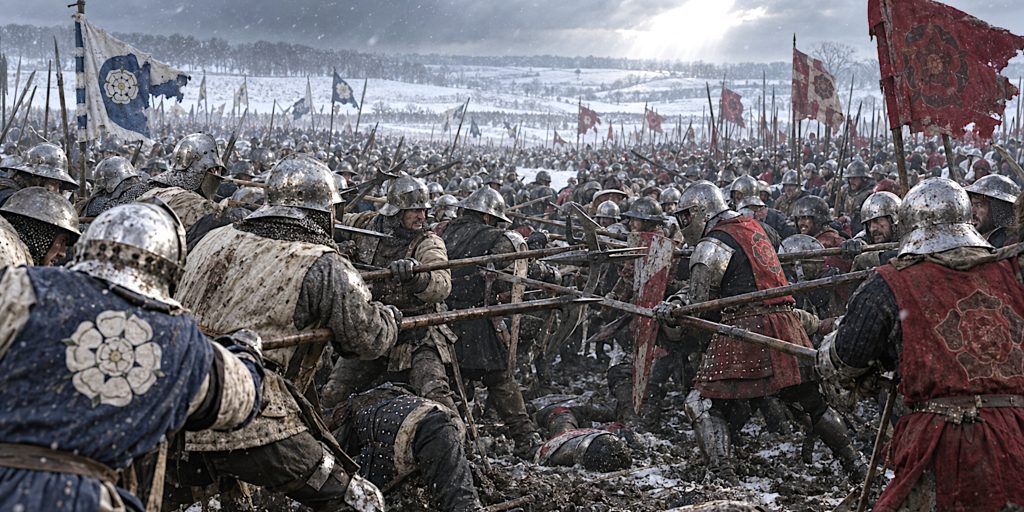
Towton has an unusually powerful combination of battlefield archaeology and local legend. On Palm Sunday 1461, Edward IV’s army defeated the Lancastrians on an exposed Yorkshire plateau. Accounts describe snow and a prolonged struggle, followed by a destructive pursuit.
The familiar figure of 28,000 dead comes from contemporary reporting, but it should not be treated as an audited total. The scale of the armies and losses remains disputed. Calling Towton one of England’s most devastating medieval battles is safer than pretending we can count every casualty.
The archaeology is harder to dismiss. A mass grave discovered near Towton Hall in 1996 contained men with severe injuries, including repeated blows to the head. These remains reveal individual acts of violence behind the broad language of victory and defeat. They do not establish every detail of the battle, but they make its human cost painfully tangible.
The Towton Battlefield Society’s account of local legends records a tradition that groans can be heard late at night near the supposed Bridge of Bodies over Cock Beck. It also describes the Towton Rose: wild roses whose red markings were said to have been nourished by blood from the graves, and which supposedly would not survive transplantation.
Both stories tie remembrance to something visible in the landscape. A crossing becomes a place of suffering; a flower becomes a memorial. Neither needs to be literally true to tell us something about how people have understood Towton.
For me, the rose is the more affecting story. It gives the dead a place in an otherwise ordinary growing season. That is a considerable burden to put on a shrub, but folklore rarely asks permission.
Tewkesbury: Bloody Meadow and the Abbey’s Unquiet Reputation
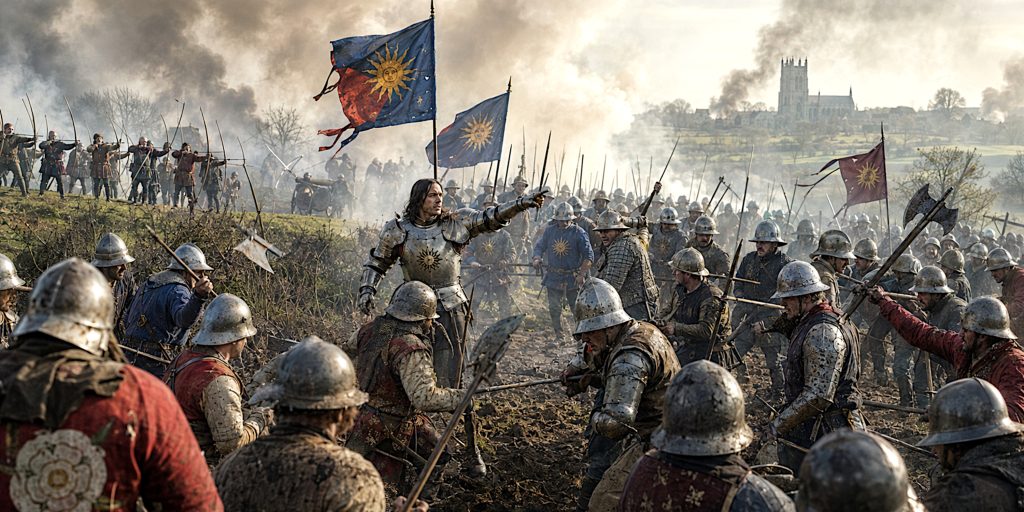
At Tewkesbury, the battlefield and the town belong to the same story. Edward IV defeated the Lancastrians on 4 May 1471. Prince Edward, the son of Henry VI and Margaret of Anjou, died in the aftermath of the fighting, and defeated men fled towards the town and abbey.
Bloody Meadow preserves the memory of the pursuit in its name. The contemporary Yorkist account known as the Arrivall of Edward IV, reproduced by the Tewkesbury Battlefield Society, describes the rout:
“many ran towards the town; many to the church; to the abbey”
The wording is reproduced from the historical account. Its author favoured Edward IV, so it needs reading with that allegiance in mind. Even so, those few words communicate the desperate search for somewhere safe.
What happened inside the abbey is less straightforward than a simple tale of massacre. Accounts differ over Edward’s conduct and the treatment of those sheltering there. Some emphasise pardon and thanksgiving; another tradition records bloodshed requiring the church to be reconsecrated. Lancastrian leaders, including the Duke of Somerset, were subsequently executed.
The building is Tewkesbury Abbey, not a cathedral, and it existed long before the battle. Ghost stories involving monks belong to its broader reputation, rather than providing evidence that particular casualties returned. Later accounts describe spectral religious figures within the church and grounds, but identifying them as witnesses to 1471 goes beyond what those stories establish.
I find the uncertainty around sanctuary more unsettling than a headless soldier with an implausibly regular timetable. Men ran into a church expecting protection. Whether that protection held is a historical question with real consequences.
Bannockburn: A Powerful Memory on a Changing Landscape

Bannockburn was fought over two days in June 1314. Robert Bruce’s victory over Edward II strengthened his control of Scotland and became central to Scottish historical memory. It did not, however, end the war or produce immediate English recognition of Scottish independence. That came in 1328.
The landscape also needs care. The commemorative site near the visitor centre is associated with the first day’s action, while the precise location of the main fighting on the second day remains debated. Drainage, roads and development have changed the ground substantially.
The Historic Environment Scotland battlefield record explains these competing interpretations. It is a useful corrective to descriptions of a single, perfectly preserved field where every encounter can be placed with confidence.
Stories of phantom riders or cries rising from the mist may suit Bannockburn’s reputation, but specific claims require a traceable source before they can be presented as established local traditions. A modern retelling is evidence that somebody told a story, not that somebody heard a medieval army.
There is still plenty here to occupy the imagination: crowded formations, constricted routes and a retreat in which cohesion collapsed. Understanding the terrain makes the battle more disturbing, even when the terrain refuses to provide neat answers.
Agincourt: The Eyewitness Account Is Disturbing Enough
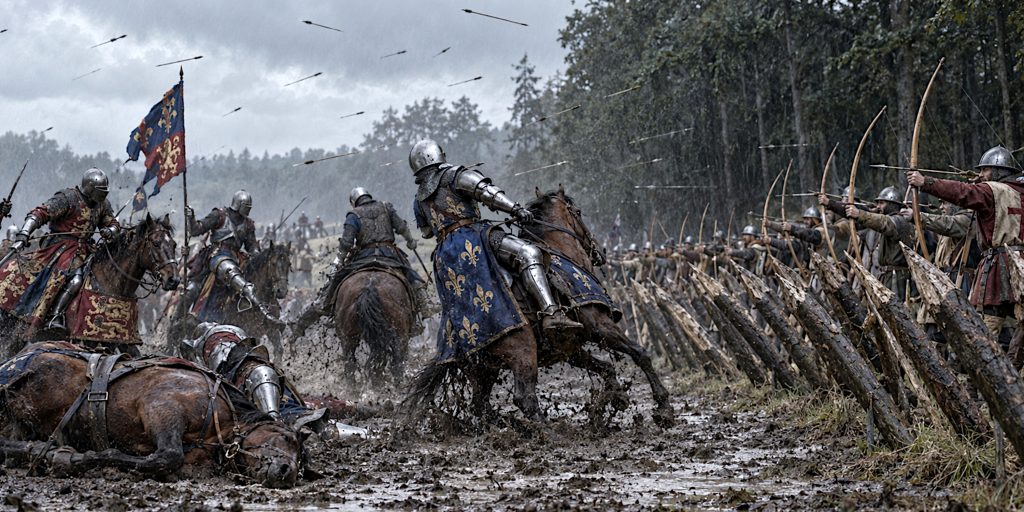
Agincourt’s reputation has been shaped by Henry V, English longbows and, rather insistently, Shakespeare. The fighting on 25 October 1415 was a much less tidy affair than its theatrical afterlife suggests. French men-at-arms advanced on foot, cavalry attacks failed, and close combat followed.
The anonymous clerical author of the Gesta Henrici Quinti accompanied the English army. In a modern translation of his contemporary account, he describes the pressure of the fighting:
“the living fell upon the dead”
He also records the killing of prisoners and reflects on the distress of seeing the bodies afterwards. His account is partisan and interprets victory through divine favour. It nevertheless preserves fear and suffering that triumphal summaries tend to smooth away.
Claims about phantom drums, torchlit figures or recurring smells of wet leather should be treated cautiously when no dated witness account or identifiable folklore source accompanies them. They may be atmospheric, but atmosphere cannot do the work of documentation.
Nor should Shakespeare’s famous exhortations be presented as recorded words spoken on this battlefield. They belong to a play written almost two centuries later. The playwright has contributed quite enough to Henry’s reputation without being appointed an eyewitness.
What stays with me at Agincourt is the compression of people into a killing ground. A landscape can be haunting because we understand what happened there, without requiring the battle to replay at dawn.
Crécy: Before Locating the Ghosts, Locate the Battle
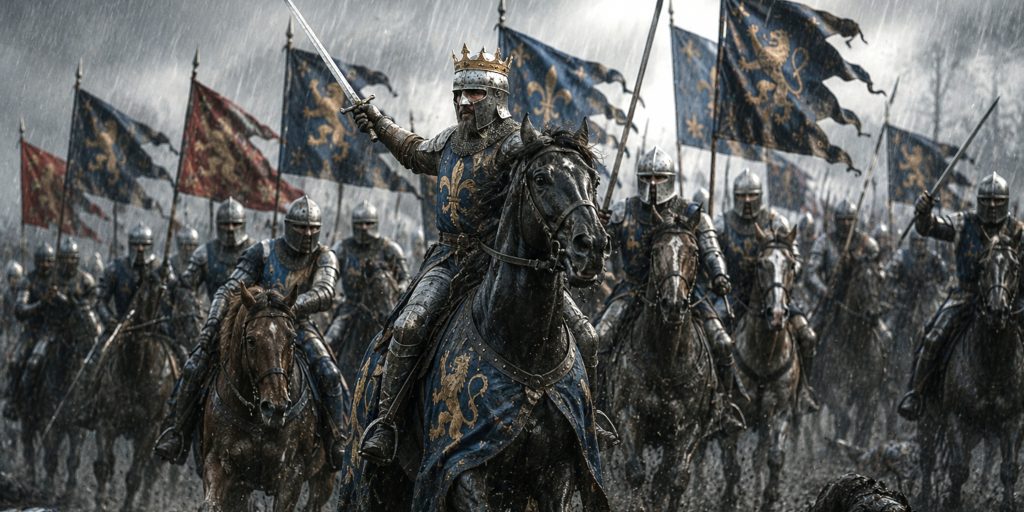
Edward III’s victory at Crécy in August 1346 has often been made to represent the death of chivalry and the birth of modern warfare. That is too convenient. Mounted warriors, aristocratic command and chivalric culture continued long after the French defeat.
The battle does demonstrate the destructive potential of archery within an effective defensive arrangement. It also left a powerful memory of failed attacks and heavy losses among the French and their allies.
Yet the traditional battlefield near Crécy-en-Ponthieu is not beyond debate. Historians have questioned how well it fits the surviving accounts and proposed alternative locations. That uncertainty matters whenever a story places phantom horses beside a particular hedge or armour-clad figures on a particular slope.
Such stories should come with an identifiable provenance. Without it, a precise setting can lend an undeserved appearance of authority to an otherwise untraceable claim.
Crécy deserves a place in this discussion because it shows how easily historical significance becomes a supernatural reputation. I would rather admit that the evidence is incomplete than furnish a French field with imaginary witnesses. Medieval chroniclers already supplied enough difficulties for one profession.
Why Medieval Battlefields Attract Ghost Stories

Battlefield folklore often centres on interrupted lives and incomplete farewells. Men died far from home. Some were buried collectively. Families might never recover a body, or learn exactly what had happened.
Medieval commemorative practices also remind us that the dead were not simply forgotten once the fighting stopped. Prayers, religious foundations and burial in consecrated ground mattered. Modern stories about restless soldiers sometimes echo that concern, although we should not assume an unbroken tradition without evidence.
Repeated motifs appear in battlefield tales: cries after dark, marching figures, blood-coloured water and flowers associated with graves. Their recurrence makes them interesting folklore, but it can also make supposedly unique sightings look suspiciously familiar.
As a historian, I want to know when a story was first recorded, who told it and how its details changed. A late account can still be culturally valuable. It simply answers different questions from a medieval document or an excavated grave.
Visiting a Medieval Battlefield with History in Mind
The most rewarding approach is to understand the landscape before looking for anything unusual.
- Read a battlefield interpretation or historical account before visiting.
- Distinguish a traditional battle location from ground confirmed by research.
- Use public paths and respect private land, crops and places of worship.
- Leave possible finds undisturbed and report them through appropriate heritage channels.
- Treat burial places as places of remembrance.
Notice slopes, watercourses and routes of retreat. They often explain more about a battle than a monument can. A gentle-looking descent may have become dangerous when exhausted men reached it together, pursued by an enemy.
These places hold enough difficult history to reward a quiet walk. The unanswered questions are part of their fascination. The dead do not need us to invent another ordeal for them.