The Siege of Jerusalem in 1187 was one of the decisive episodes of the Crusades. After defeating the army of the Kingdom of Jerusalem at Hattin in July, Saladin dismantled Crusader power across the Levant with remarkable speed. By September, Jerusalem stood almost alone.
Its defenders had limited manpower, few experienced knights and a city crowded with refugees. Saladin had the larger army, stronger logistical position and control of the surrounding countryside. Yet Jerusalem did not fall through a simple storming of the walls. Balian of Ibelin organised a determined defence, while Saladin eventually accepted a negotiated surrender rather than reduce the holy city to ruins.
The city changed hands, but the story was more complicated than a straightforward triumph. It involved military pressure, religious symbolism, desperate bargaining and a considerable amount of medieval administrative unpleasantness.
At a glance
| Detail | Information |
|---|---|
| Date | 20 September to 2 October 1187 |
| Location | Jerusalem, Kingdom of Jerusalem |
| Result | Ayyubid victory and negotiated surrender |
| Ayyubid commander | Saladin |
| Main Crusader commander | Balian of Ibelin |
| Defending authority | Patriarch Heraclius and the leading citizens of Jerusalem |
| Wider context | Saladin’s campaign after the Battle of Hattin |
| Immediate consequence | Jerusalem returned to Muslim rule |
| Long-term consequence | The Third Crusade |
Background to the siege
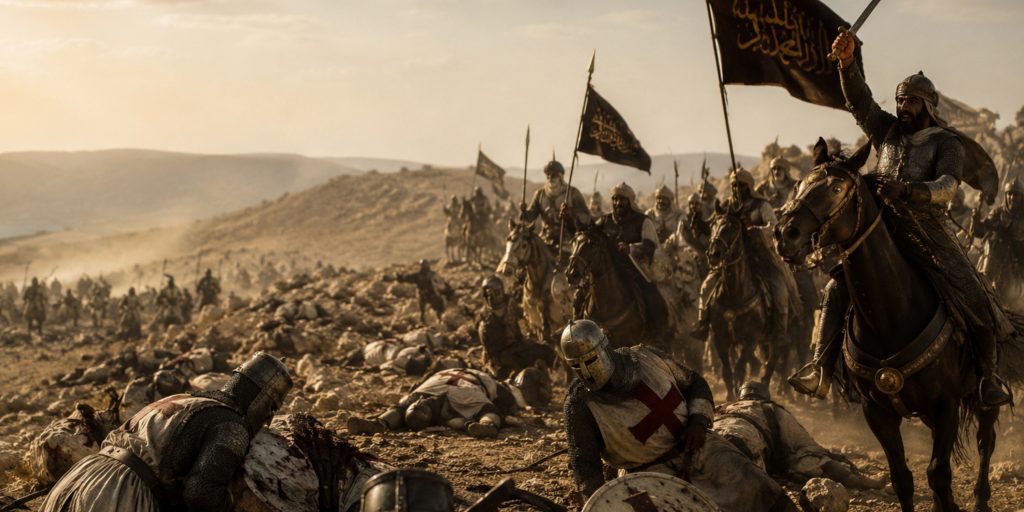
The Kingdom of Jerusalem had been weakened by factional politics, rival claims to the throne and repeated disputes among its leading nobles. The situation became catastrophic in 1187 when King Guy of Lusignan gathered the kingdom’s field army and marched against Saladin.
The two armies met near Tiberias at Hattin on 4 July 1187. The Crusader army was exhausted by heat, thirst and a difficult march across dry country. Saladin’s forces surrounded it, cut off access to water and destroyed much of the army.
The defeat was more than a battlefield loss. It removed the kingdom’s ability to defend its towns and castles in the field.
After Hattin, Saladin captured or received the surrender of several major settlements, including:
- Acre
- Nablus
- Jaffa
- Sidon
- Beirut
- Ascalon
- Ramla
- Tiberias
- Caesarea
Tyre resisted under Conrad of Montferrat, but most of the interior of the kingdom collapsed. Refugees moved towards Jerusalem, turning the city into both a sanctuary and a serious logistical problem.
By the time Saladin marched towards the capital, Jerusalem had become crowded with people who had escaped the earlier conquests. The city possessed formidable walls, but walls still require men to defend them. Stone, as ever, was not especially good at taking shifts.
The forces
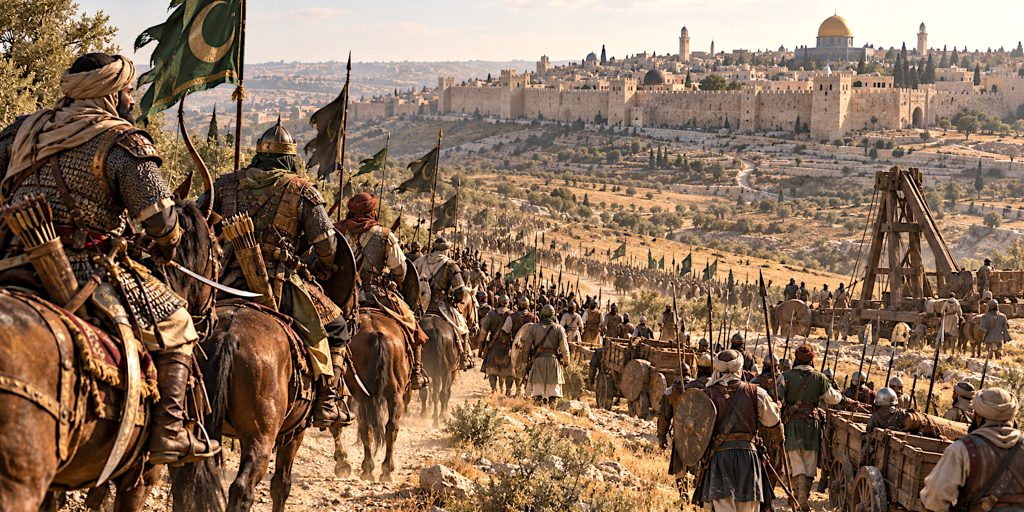
The exact size of Saladin’s army is uncertain. Medieval chroniclers frequently used large numbers to communicate importance rather than provide a reliable census. Modern estimates should therefore be treated as broad approximations.
Ayyubid forces
Saladin’s army included contingents from Egypt, Syria, Mesopotamia and the wider territories under his authority. Its strength lay in its combination of mounted troops, missile power, siege engineers and battlefield experience.
Crusader garrison
The garrison was much smaller and had been weakened by the losses at Hattin. Some knights and military order brothers were present, but the defence depended heavily on citizens, refugees and men who had little formal military experience.
| Side | Commander | Approximate strength | Main advantages |
|---|---|---|---|
| Ayyubid army | Saladin | Probably several tens of thousands, though the exact figure is unknown | Cavalry, archers, engineers, siege equipment and control of the countryside |
| Jerusalem garrison | Balian of Ibelin | Probably a few thousand combatants at most | Strong walls, local knowledge and the ability to concentrate defenders |
| Civilian population | Patriarch Heraclius and city authorities | Tens of thousands, including refugees | Labour, money, religious authority and manpower for the walls |
The number of fighting men inside the city was especially limited. Balian reportedly found fewer than fourteen knights available when he assumed command. The chroniclers may have simplified the figure, but there is no doubt that Jerusalem lacked a conventional field army.
To increase the number of mounted defenders, Balian is said to have knighted dozens of squires and burgesses. This was not a ceremonial flourish. The city needed men who could lead counter-attacks, organise wall sectors and maintain morale.
Leaders
Saladin

Saladin, or Salah al-Din Yusuf ibn Ayyub, was Sultan of Egypt and Syria and the most important Muslim ruler of the eastern Mediterranean.
He had spent years bringing rival Muslim territories under his authority. His campaign against the Kingdom of Jerusalem was therefore both religiously significant and strategically calculated. Jerusalem mattered deeply, but Saladin also understood that the city’s capture would make the survival of the Crusader kingdom far more difficult.
His strengths included:
- A broad political coalition
- Experienced cavalry forces
- Strong intelligence and reconnaissance
- Effective use of siege engineers
- The ability to sustain a campaign across Syria and Palestine
- A clear understanding of the symbolic value of Jerusalem
Saladin’s reputation for clemency was later polished by both Muslim and European writers, sometimes into a near-perfect chivalric portrait. The reality was more practical. He could be ruthless when it served his purposes, but at Jerusalem he preferred a controlled surrender to a costly assault and a devastated city.
Balian of Ibelin
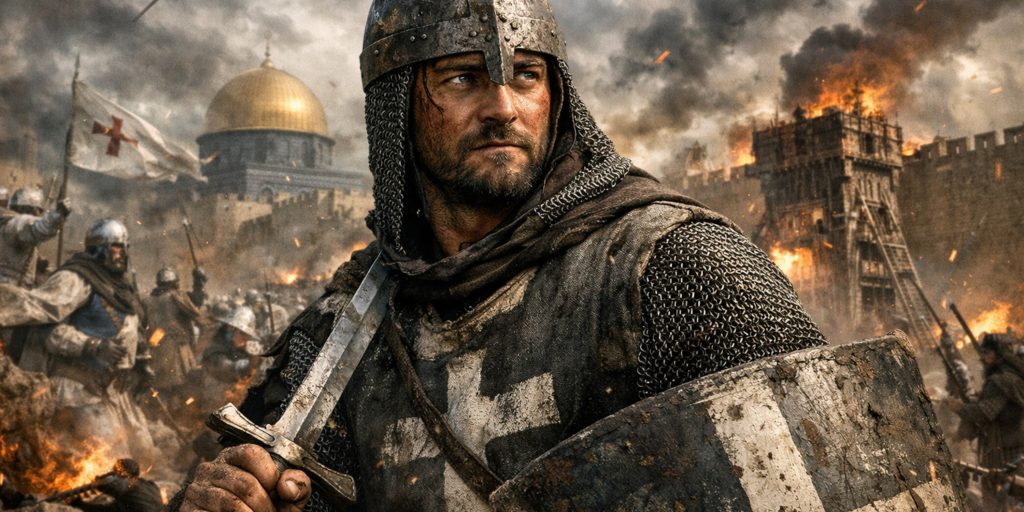
Balian was one of the senior nobles of the Kingdom of Jerusalem and lord of Ibelin. He had not intended to command Jerusalem.
He had travelled to the city with Saladin’s permission to collect his wife, Maria Komnene, and their children. He had promised not to remain or take up arms against the sultan. Once inside Jerusalem, however, the city’s leaders appealed to him to organise its defence.
Patriarch Heraclius released Balian from his oath. Balian then accepted responsibility for the garrison and began preparing the city for siege.
His role involved:
- Inspecting the walls
- Organising citizens into defensive groups
- Raising additional knights
- Distributing weapons
- Securing food and money
- Directing sorties and counter-attacks
- Negotiating the final surrender
Balian’s most important decision came at the end. He understood that the city could not survive a prolonged assault and that a negotiated surrender offered the best chance of saving its population.
Patriarch Heraclius
Heraclius was the Latin Patriarch of Jerusalem and one of the most senior religious authorities in the city. He helped persuade Balian to stay and command the defence.
The patriarch also became involved in the negotiations. Like Balian, he offered himself as a hostage for the people who could not pay their ransom. Saladin declined the offer, preferring a surrender that kept the city’s administration under control.
The citizens of Jerusalem
The city’s population was not a passive background to the siege. Citizens repaired walls, carried ammunition, worked on defences and served in the garrison. Chroniclers also describe religious processions and public penance as the crisis deepened.
These accounts were shaped by religious interpretation, but they reveal the emotional atmosphere inside Jerusalem. The siege was experienced not only by knights on the battlements, but by families who had already fled one war and now found themselves trapped behind another set of walls.
Troop composition
Ayyubid army
The Ayyubid army was not a single uniform force. It was a coalition built around Saladin’s political authority.
Its main elements included:
- Kurdish cavalry connected to Saladin’s own military establishment
- Turkish and Turcoman horse archers
- Syrian cavalry
- Egyptian troops
- Infantry with spears, bows and axes
- Engineers and miners
- Siege crews
- Religious volunteers and camp followers
The mounted troops were especially important. They could patrol the approaches, cut communications and prevent the defenders from receiving outside help. Horse archers could harass the walls and cover engineering work, while heavier cavalry provided protection for assault forces.
Crusader defenders
The garrison was a mixture of professional soldiers and civilians.
It included:
- Knights and mounted retainers
- Templar and Hospitaller personnel
- Burgesses and local militia
- Newly knighted squires and citizens
- Refugees capable of bearing arms
- Crossbowmen
- Labourers assigned to repair and reinforce the walls
The garrison’s greatest strength was defensive concentration. Unlike an army in the open field, the defenders did not have to protect a long marching column or maintain a vulnerable supply train. Their task was to hold the walls and make every assault expensive.
Arms and armour
The siege brought together military traditions from across the eastern Mediterranean. It is important to avoid treating terms such as “scimitar” or “longsword” as precise categories for 1187. Later popular descriptions often use familiar labels for weapons that were more varied in form.
Ayyubid weapons and protection
| Weapon or equipment | Likely use |
|---|---|
| Straight double-edged swords | General sidearms for cavalry and infantry |
| Curved sabres | Increasingly common among mounted troops, though forms varied |
| Composite bows | Mounted and ground archery |
| Javelins and spears | Cavalry skirmishing and close combat |
| Maces and axes | Attacking armour and fighting in confined spaces |
| Round shields | Protection for infantry and cavalry |
| Mail shirts | Protection for elite troops |
| Lamellar and scale armour | Used by some mounted soldiers |
| Conical helmets | Common protection for the head |
| Siege ladders and towers | Assaulting the walls |
| Mangonels and other stone-throwers | Damaging walls and suppressing defenders |
The composite bow was one of the most important weapons in the Ayyubid arsenal. Its compact form suited mounted warfare, while its construction allowed considerable power despite its relatively short limbs.
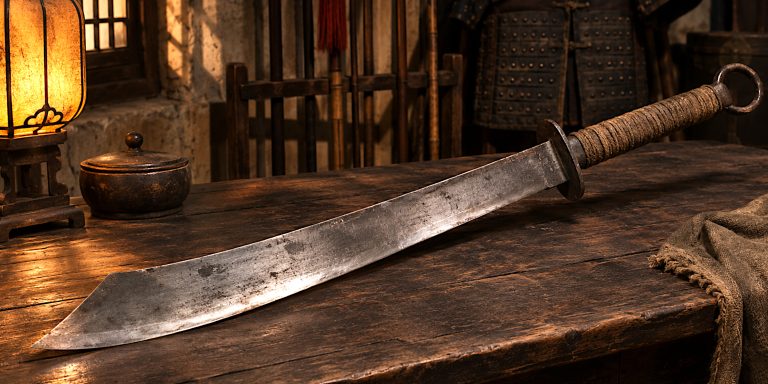
The term “kilij” is often applied loosely to any medieval Islamic curved sword. Some curved sabres were certainly in use, but the later Ottoman kilij should not be projected backwards as though the weapon had already reached its familiar mature form.
Crusader weapons and protection
| Weapon or equipment | Likely use |
|---|---|
| Arming swords | General sidearms for knights and infantry |
| Early single-edged falchion-like blades | Cutting weapons for close combat |
| Spears and lances | Wall defence and mounted action |
| Crossbows | Long-range shooting from towers and battlements |
| Maces and axes | Close fighting and anti-armour work |
| Kite shields | Protection for mounted warriors |
| Round or smaller shields | Used by infantry and some defenders |
| Mail hauberks | Main body armour for knights and wealthier soldiers |
| Padded garments | Worn beneath mail or used independently |
| Nasal and conical helmets | Head protection |
| Stones, beams and boiling materials | Emergency defensive measures |
The principal Crusader sword was the straight, double-edged arming sword. A few larger cutting swords may have existed, but the later medieval “longsword” with a long grip and extended blade belongs mainly to a later period and should not be presented as standard equipment at Jerusalem in 1187.
The most effective weapon on the walls was often the crossbow. It could be fired from behind cover and was particularly useful against men approaching with ladders, shields or siege equipment.
The fortifications of Jerusalem
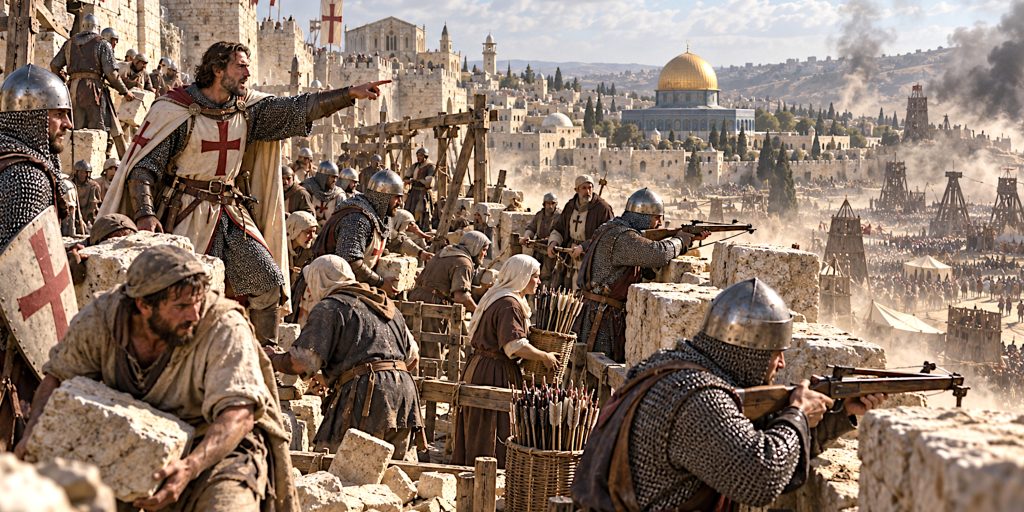
Jerusalem’s medieval defences had developed over centuries. The walls used in 1187 were not simply the same structures built by one ruler. They incorporated earlier work, repairs and alterations made under Muslim and Crusader governments.
The city’s topography made certain sectors more vulnerable than others. The northern side lacked the same natural protection provided by the valleys to the south and east. This made the northern and north-western approaches attractive to Saladin’s engineers.
Key defensive features included:
- Massive stone walls
- Towers projecting from the curtain
- Gates that allowed sorties
- The Tower of David and citadel complex
- Elevated ground
- Interior streets that could be barricaded
- Religious and civic buildings that could serve as supply points
The walls were formidable, but a siege turned them into a workplace. They needed constant repair, and the defenders had to remain exposed while fighting fires, replacing damaged masonry and watching for mining operations.
The siege begins
Saladin reached Jerusalem on 20 September 1187. His army surrounded the city and began testing its defences.
The initial attacks focused on the western side around the Tower of David and the Damascus Gate. This sector was heavily defended, and the attackers struggled to make progress.
The early phase involved:
- Archery exchanges
- Probing attacks
- Attempts to bring siege towers towards the walls
- Defensive sorties by the garrison
- Construction of siege works
- Efforts to identify a weaker section of the fortifications
The defenders were able to repel several assaults. Jerusalem’s walls gave the smaller force a temporary advantage, and the first attacks did not produce the rapid breakthrough Saladin wanted.
The sultan then shifted his main effort towards the northern side, near the area between the Damascus Gate and the northern approaches. This was a significant operational decision. Rather than continue spending men against the strongest section, he moved towards ground where mining and bombardment offered better prospects.
The breach
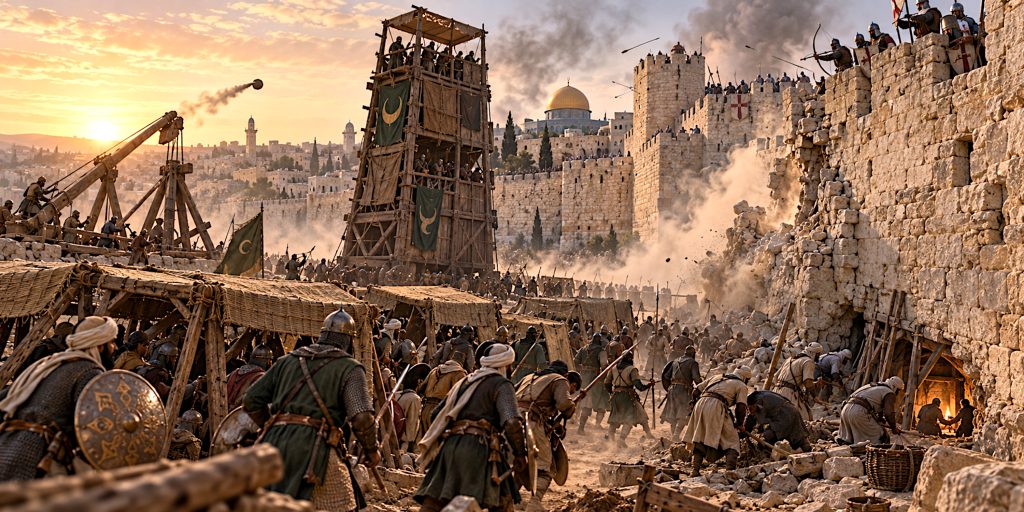
Saladin’s engineers began undermining the wall. Mining was among the most dangerous methods of medieval siege warfare because it attacked the foundations rather than the visible face of the fortification.
The attackers also used stone-throwing engines and sustained missile fire to keep defenders away from the threatened section. Siege towers and protective structures allowed troops to approach the walls while reducing exposure to arrows and crossbow bolts.
On or around 29 September, a section of the northern wall collapsed. The breach was serious, but it did not immediately give Saladin control of Jerusalem.
The defenders rushed to the damaged sector and fought to prevent the attackers from widening the gap. Their position was increasingly desperate. Every man sent to the breach weakened another part of the wall, while the city had very little reserve manpower.
The breach demonstrated the central truth of the siege. Jerusalem’s walls were strong enough to delay Saladin, but the garrison was not large enough to defend every threatened point indefinitely.
Negotiations and the surrender
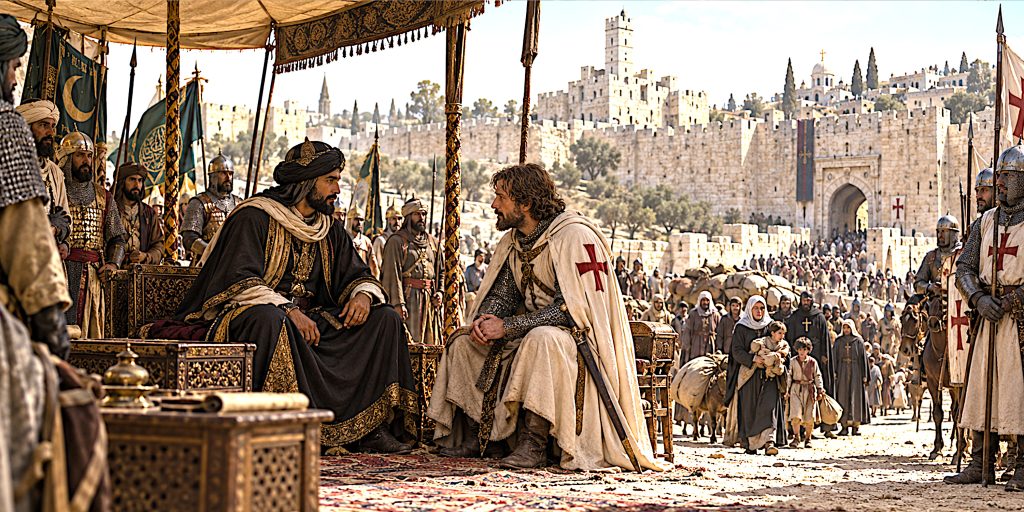
As the breach widened and the defenders’ situation deteriorated, Balian opened negotiations with Saladin.
The first discussions did not produce an immediate agreement. Saladin wanted the unconditional surrender of the city, while Balian argued that the inhabitants could not simply be abandoned.
Balian reportedly warned that if the city were taken by force, the defenders would kill their own families, destroy the Christian holy places and burn the wealth within Jerusalem. Medieval chroniclers may have sharpened the language, but the underlying point was clear. A violent assault could produce a catastrophe that Saladin had little interest in creating.
The final terms allowed inhabitants to leave by paying a ransom:
- Ten bezants for a man
- Five for a woman
- Two for a child
The sums were beyond the means of many residents. Saladin agreed that a large group of poorer inhabitants could be released through a collective payment. He also personally freed many people who could not pay.
The terms were not generous to everyone. Thousands were enslaved or remained vulnerable, and the surrender still involved the removal of a Christian population from the city. Later accounts that describe the event as an entirely bloodless act of mercy smooth over this harsh reality.
Nevertheless, compared with the massacre that followed the Crusader capture of Jerusalem in 1099, the surrender of 1187 was controlled and comparatively restrained.
Battle timeline
| Date | Event |
|---|---|
| 4 July 1187 | Saladin defeats the Crusader field army at Hattin |
| July to September | Ayyubid forces capture or receive the surrender of much of the Kingdom of Jerusalem |
| Early September | Refugees and survivors reach Jerusalem |
| 20 September | Saladin arrives before Jerusalem and begins the siege |
| 20 to 25 September | Initial attacks focus on the western walls near the Tower of David and Damascus Gate |
| Around 26 September | Saladin shifts the main attack towards the northern side of the city |
| Late September | Siege engines, archers and miners intensify the pressure |
| Around 29 September | A section of the northern wall is breached |
| 30 September to 1 October | Balian negotiates with Saladin over the surrender and ransom terms |
| 2 October | Jerusalem formally surrenders to Saladin |
| October to November | Groups of inhabitants leave the city under the agreed arrangements |
The precise sequence varies between sources. Medieval chroniclers were often more interested in divine judgement, heroic conduct or the moral meaning of events than in producing a neat operational diary.
Contemporary accounts and quotes
The surviving accounts were written from different religious and political perspectives. They should be read as evidence of how people understood the siege, not as perfectly neutral transcripts.
Balian’s warning to Saladin
A version of Balian’s speech survives in later accounts of the negotiations:
“O sultan, know that this city contains a multitude whose number God alone knows.”
He is then reported to have warned that the defenders would destroy the city rather than surrender without terms. The passage reflects the logic of medieval siege negotiations: the defender had to convince the besieger that mercy would be cheaper than assault.
Ibn al-Athir
The Muslim historian Ibn al-Athir treated the recovery of Jerusalem as a major victory after decades of Crusader rule. His account places the siege within the larger political and religious struggle over the city.
A cautious modern rendering of the sentiment is:
“The Muslims entered Jerusalem and restored it to Islam after a long period of occupation.”
The precise wording differs between translations, and passages attributed to later compilations should not be treated as direct battlefield transcripts.
Imad al-Din al-Isfahani
Imad al-Din was Saladin’s secretary and one of the most important Muslim writers associated with the campaign. His writing is highly rhetorical, as court histories usually are.
He celebrated the recovery of Jerusalem as a reversal of the Crusader conquest of 1099, presenting the event as both military victory and religious restoration.
Ernoul and the continuation of William of Tyre
The Old French continuations associated with Ernoul preserve material from the Crusader perspective. They describe the fear inside the city, the religious processions and the arguments over how Jerusalem should be defended.
The account portrays Balian as a practical commander forced to choose between a hopeless last stand and a negotiated surrender. It is not impartial, but it gives valuable insight into the emotional pressure placed upon the defenders.
Archaeology and the walls of Jerusalem
Archaeology can illuminate the physical setting of the siege, but it rarely identifies a single arrowhead or stone as belonging exclusively to Saladin’s attack. Jerusalem has been besieged, rebuilt and remodelled repeatedly. A projectile found in the soil may belong to several different periods.
What archaeology can establish more confidently is the layered character of the fortifications.
Evidence from the Old City and surrounding excavations shows:
- Repeated rebuilding of walls and towers
- Foundations belonging to earlier periods
- Repairs and alterations made under different rulers
- Complex changes around the northern gates
- A mixture of reused stone and later construction
- Defensive structures that cannot be attributed to one campaign alone
The fortifications attacked in 1187 had inherited elements from earlier Byzantine, Islamic and Crusader building programmes. Saladin’s engineers were therefore working against a layered defensive system rather than a single, uniform wall.
The Tower of David area is particularly important for understanding Jerusalem’s long military history. Its surviving appearance is dominated by later rebuilding, but the site preserves the strategic importance of the citadel and the western approaches.
Archaeological evidence supports the broad historical picture of a heavily fortified city. It does not, however, provide a complete map of every assault or prove that every damaged section fell during the siege of 1187. The stones are eloquent, but they are not inclined to provide dates on request.
Why Jerusalem fell
The city did not fall because its walls were weak. It fell because the wider military situation made long-term resistance impossible.
The decisive factors were:
- The destruction of the Crusader field army at Hattin
- The loss of most of the kingdom’s major ports and inland strongholds
- The lack of an external relief army
- The small number of trained defenders
- The arrival of large numbers of refugees
- Saladin’s control of the surrounding countryside
- The success of mining and siege bombardment
- The defenders’ inability to man every threatened section
- The danger that a full assault would lead to mass killing
Balian’s defence bought time, but it could not reverse the strategic collapse of the kingdom. The city’s survival as a Christian capital depended on an army that no longer existed.
The surrender and its aftermath
Saladin entered Jerusalem on 2 October 1187. The city was restored to Muslim rule, and Christian religious buildings were treated differently from the way many Muslim holy places had been treated after the Crusader conquest in 1099.
The Church of the Holy Sepulchre remained in Christian hands, although its status and administration changed. The Dome of the Rock and al-Aqsa Mosque were restored to Islamic use.
The Christian population was divided by wealth and status:
- Wealthy residents could often pay their ransoms
- Some religious institutions negotiated for their members
- Poor inhabitants were more vulnerable
- Some people were freed by Saladin or his officials
- Others were enslaved or displaced
- Groups of refugees travelled towards Tyre, Antioch and other remaining Christian territories
The fall of Jerusalem did not end Christian rule in the region immediately. Tyre remained in Crusader hands, and the Kingdom of Jerusalem continued in a reduced form around its coastal strongholds.
Legacy of the siege
The capture of Jerusalem shocked western Europe. Pope Gregory VIII issued Audita tremendi, calling for a new crusade. The response eventually brought Richard I of England, Philip II of France and Frederick Barbarossa towards the eastern Mediterranean.
The Third Crusade recovered several coastal positions, including Acre, but it did not retake Jerusalem. Richard reached agreements with Saladin that secured Christian access to the city for pilgrims, while leaving Jerusalem under Muslim control.
For Saladin, the siege confirmed his position as the leading Muslim ruler of the region. For the Crusader states, it marked the end of Jerusalem as their political centre.
The siege also became a lasting symbol. Muslim writers remembered the recovery of a sacred city. Christian writers remembered defeat, loss and the need for another crusade. Modern popular culture often turns Balian into a modern liberal hero and Saladin into a perfectly courteous philosopher king. Both portraits contain fragments of truth, but neither should be mistaken for a complete historical account.
Final assessment
The Siege of Jerusalem in 1187 was decided before Saladin’s army reached the walls. Hattin had destroyed the Kingdom of Jerusalem’s ability to fight in the open, leaving the capital isolated.
Inside the city, Balian of Ibelin organised a defence that was more effective than the numbers suggested. The garrison resisted repeated attacks, repaired breaches and forced Saladin to negotiate. Yet the breach in the northern wall exposed the limits of that resistance.
The final surrender was neither a simple act of chivalry nor an indiscriminate massacre. It was a negotiated settlement shaped by military necessity, religious politics and the practical difficulty of governing a devastated city.
Jerusalem changed hands because Saladin had won the campaign around it. Balian’s achievement was to ensure that the city did not pay for that defeat with the total destruction of its people.
Recommended external sources
- The Internet Medieval Sourcebook, Fordham University
- Encyclopaedia Britannica, Saladin
- The Siege of Jerusalem, World History Encyclopedia
- Cardiff University research on Ernoul’s account