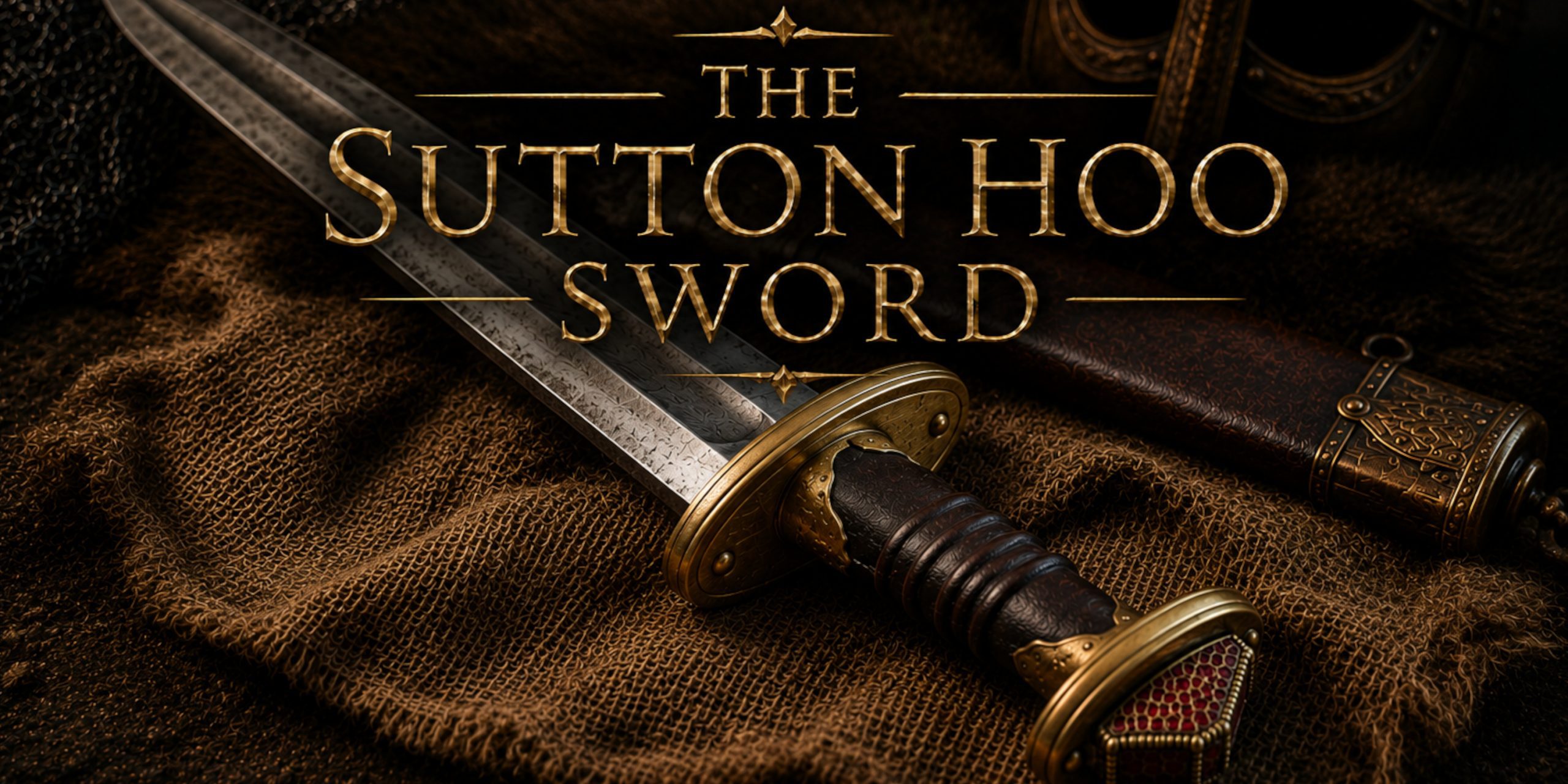
The Sutton Hoo sword is one of the most important weapons ever discovered in Britain. Unearthed in 1939 from the famous ship burial at Sutton Hoo in Suffolk, it transformed our understanding of Anglo-Saxon society. Before this discovery, the period was too often dismissed as a cultural decline after Roman Britain. A single burial mound helped prove otherwise.
This was not simply a weapon placed beside a warrior. It was a statement of identity, authority and wealth. The sword represented a world of kings, alliances, skilled craftsmen and warriors who valued reputation as much as survival.
The owner of the burial remains debated, although many historians consider King Rædwald of East Anglia the strongest candidate. Whoever rested there had extraordinary status. Ordinary warriors did not go into the next world accompanied by treasures from across Europe and a sword that required elite craftsmanship.
Early medieval rulers apparently understood something modern collectors still appreciate, a good sword makes quite the impression.
The Discovery Of The Sutton Hoo Sword

The sword was discovered during excavations led by archaeologist Basil Brown on land owned by Edith Pretty.
The burial contained a 27 metre long ship impression, although the acidic soil had destroyed the timber itself. What remained was the ghostly outline of the vessel and a collection of remarkable objects, including:
- Sutton Hoo helmet
- Gold and garnet shoulder clasps
- Shield fittings
- Ceremonial whetstone
- Byzantine silverware
- Drinking horns
- Coins
- The decorated sword and scabbard fittings
The sword had badly corroded after more than 1,300 years underground, but analysis revealed the quality hidden beneath the rust.
Sutton Hoo Sword Specifications

| Feature | Details |
|---|---|
| Culture | Anglo-Saxon |
| Date | Early 7th century CE |
| Discovery | Sutton Hoo, Suffolk, England |
| Weapon type | Double-edged sword |
| Blade construction | Pattern-welded iron and steel |
| Estimated blade length | Around 70 to 75 cm |
| Overall length | Approximately 85 to 90 cm |
| Edge | Double edged |
| Grip | Short one-handed grip |
| Pommel | Gold and garnet decorated fittings |
| Associated period | Early Medieval, Migration Period |
The Sutton Hoo sword followed the typical elite Germanic sword style of its era. It was a cutting weapon designed for close combat, usually paired with a shield rather than used alone.
How The Sword Was Made
The Sutton Hoo sword was created using pattern welding, a sophisticated technique where rods of iron and steel were twisted, heated and forged together.
This produced:
- Greater blade strength
- Improved flexibility
- Distinctive flowing patterns in the metal
- A visually impressive finish
Pattern welding was not decorative laziness. It required enormous skill and careful temperature control. A poorly made blade could fail at the worst possible moment, which in a shield wall was generally considered a poor career move.
The blade would have been polished so the patterns shimmered across the surface. To an Anglo-Saxon warrior, such craftsmanship could appear almost supernatural.
Decoration And Symbolism

Image Credit: CastleKeep
https://www.castlekeep.co.uk/pre-medieval-swords/sutton-hoo-sword.html
The Sutton Hoo sword’s decoration was as important as its battlefield function.
Notable features included:
- Gold fittings demonstrating elite status
- Garnet cloisonné decoration
- Fine metalworking associated with royal workshops
- High quality scabbard mounts
Anglo-Saxon swords were often inherited, gifted and named. They carried stories connecting generations of warriors.
A sword was not just military equipment. It represented loyalty, honour and a person’s place within a warrior society.
Was It Actually Used In Battle?
The Sutton Hoo sword was not simply ceremonial. Although its decoration marked it as a prestige object, the blade followed practical fighting designs.
An elite Anglo-Saxon warrior would typically fight with:
- Sword as a close combat sidearm
- Spear as a primary battlefield weapon
- Round wooden shield with iron boss
- Seax knife for utility and combat
- Mail armour if wealthy enough
The sword was the weapon people noticed, but the spear probably did more of the everyday work. Medieval glamour and battlefield practicality were not always the same thing.
The Possible Owner: Was It King Rædwald?

The strongest traditional identification links the Sutton Hoo burial with Rædwald, ruler of East Anglia.
Arguments supporting this include:
- The burial date matches his lifetime
- The wealth suggests royal status
- East Anglia was powerful during this period
- The mixture of pagan and Christian influences reflects accounts of Rædwald
The monk Bede wrote that Rædwald maintained both Christian and traditional religious practices:
“In the same temple he had an altar for the sacrifice of Christ and another small altar for victims to devils.”
Bede was not exactly neutral, but his writing gives us valuable insight into a kingdom experiencing huge cultural change.
The identification remains uncertain. Archaeology gives evidence, but rarely hands historians a convenient name tag.
Comparison With Similar Anglo-Saxon And Viking Age Swords
| Sword | Period | Comparison |
| Sutton Hoo sword | 7th century | Earlier elite Anglo-Saxon pattern-welded weapon |
| Vendel swords | 6th to 8th century | Similar Scandinavian aristocratic tradition |
| Viking Ulfberht swords | 9th to 11th century | Later blades with advanced steel quality |
| Norman knightly swords | 11th century onwards | Longer guards and evolving medieval design |
| Seax | Anglo-Saxon period | Single-edged knife or short sword used more widely |
The Sutton Hoo sword sits between the late Roman world and the medieval knightly sword. It represents a fascinating transitional period in European arms.
Archaeology And Modern Research
Modern investigation has revealed far more than early excavators could see.
Research techniques include:
- X-ray analysis of blade construction
- Metallurgical examination
- Study of corrosion patterns
- Reconstruction of missing elements
- Comparison with Scandinavian finds
The Sutton Hoo discoveries also showed strong connections across the North Sea world. Anglo-Saxon England was not isolated. Trade, diplomacy and cultural exchange linked Britain with Scandinavia, Francia and the wider European world.
Where To See The Sutton Hoo Sword Today
The Sutton Hoo sword is held by the British Museum in London as part of the Sutton Hoo collection.
Visitors can see:
- Original sword remains
- Gold and garnet fittings
- Sutton Hoo helmet
- Shield decorations
- Other burial treasures
The Sutton Hoo site itself, managed by the National Trust, allows visitors to explore the landscape where the burial was discovered.
Collector’s Guide: Can You Own A Sutton Hoo Sword?
The original Sutton Hoo sword is a priceless national treasure and will never appear for private sale.
Collectors instead look for:
- Museum quality replicas
- Pattern-welded Anglo-Saxon reproductions
- Historically accurate Migration Period swords
Typical prices:
| Type | Approximate Price |
| Decorative replica | £100 to £300 |
| Functional reproduction | £500 to £2,000 |
| Custom pattern-welded sword | £2,000 to £10,000+ |
Accuracy varies enormously. A proper reproduction requires specialist forging and detailed research rather than simply adding some gold-coloured fittings and hoping nobody asks difficult questions.
Legacy Of The Sutton Hoo Sword
The Sutton Hoo sword changed perceptions of Anglo-Saxon England. It revealed a society capable of exceptional craftsmanship, international connections and complex symbolism.
It remains powerful because it feels personal. We can study kingdoms, migrations and political changes, but a sword brings us closer to an individual. Someone held it, valued it and considered it important enough to accompany them beyond death.
More than thirteen centuries later, it is still doing exactly what it was designed to do, announcing power.