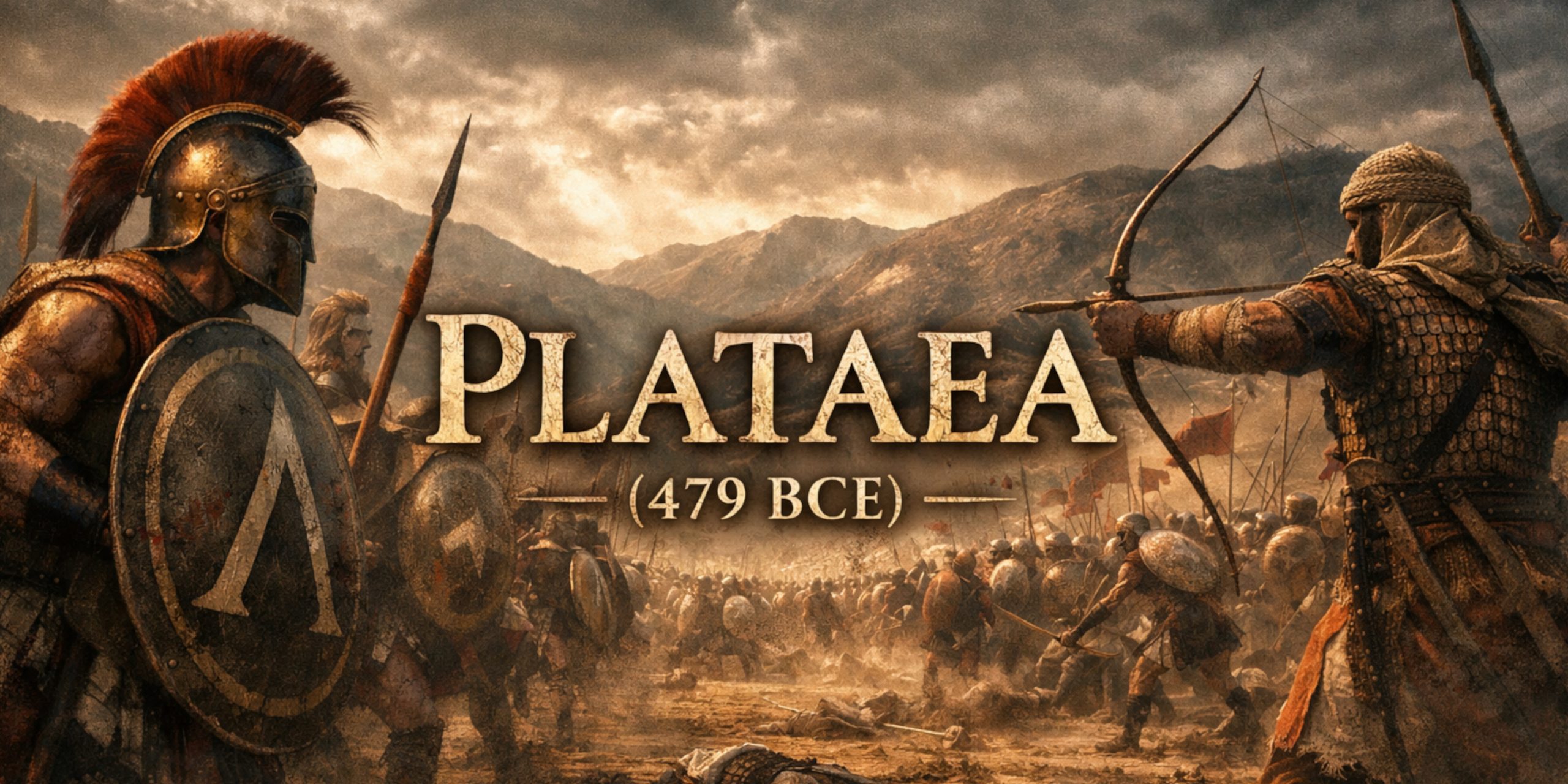
The Battle of Plataea was the final, brutal reckoning of the Persian Wars. Marathon had been daring. Thermopylae had been heroic. Salamis had been clever. Plataea was different. Plataea was where the Greeks stood in a field in Boeotia and finally settled the matter with spear, shield and an astonishing amount of shouting.
In August 479 BC, a coalition of Greek city-states led by Sparta and Athens faced the army of the Persian general Mardonius near the town of Plataea. By the end of the battle, the Persian invasion of mainland Greece had collapsed. Mardonius was dead, his camp was overrun, and the surviving Persians were fleeing north in confusion.
Herodotus, never a man inclined toward understatement, presents the battle as a struggle for the future of Greece itself. He may occasionally treat numbers with the same caution that a fisherman uses when describing the one that got away, but his central point is hard to dispute. Plataea mattered.
Why the Battle Happened
After the Persian defeat at Salamis in 480 BC, King Xerxes returned to Asia with much of his army. He left behind his finest general, Mardonius, with orders to finish the conquest of Greece.
Mardonius spent the winter in Thessaly and then moved south into Attica. Athens was evacuated for a second time and the city was burned again. It is difficult not to feel some sympathy for the Athenians here. Rebuilding your city once is irritating enough. Doing it twice in a year must have felt deeply unfair.
The Greek alliance, led largely by Sparta, finally marched north into Boeotia. The Persians withdrew to the plains near Plataea, where their cavalry could operate effectively and where they built a fortified camp beside the Asopus River.
The Greeks followed and took up position on higher ground near the foothills of Mount Cithaeron.
Foces
Greek Coalition
| State | Estimated Troops | Notes |
|---|---|---|
| Sparta | 10,000 hoplites and c. 35,000 helots | Included 5,000 Spartan citizens and 5,000 perioikoi |
| Athens | c. 8,000 hoplites | Commanded by Aristides |
| Corinth | c. 5,000 hoplites | One of the largest contingents |
| Megara | c. 3,000 hoplites | Occupied a vulnerable section of the line |
| Tegea | c. 1,500 hoplites | Fought beside the Spartans |
| Plataea and other allies | c. 20,000 | Included troops from several smaller states |
| Total Greek Force | Approximately 80,000 to 110,000 | Modern estimates vary |
Persian Army
| Contingent | Estimated Troops | Notes |
| Persian infantry | c. 40,000 | Core troops under Mardonius |
| Bactrians, Indians and Saka | c. 20,000 | Positioned in the centre |
| Greek allies of Persia | c. 20,000 | Mainly Thebans, Thessalians and Boeotians |
| Persian cavalry | c. 5,000 to 7,000 | Commanded by Masistius before his death |
| Other subject peoples | Several thousand | Included Egyptians, Phrygians and Thracians |
| Total Persian Force | Approximately 70,000 to 120,000 | Ancient figures are much higher |
Most modern historians reject Herodotus’ claim that the Persians had hundreds of thousands of men. Ancient historians loved very large numbers in much the same way medieval chroniclers loved dragons.
Leaders and Commanders
| Side | Commander | Role |
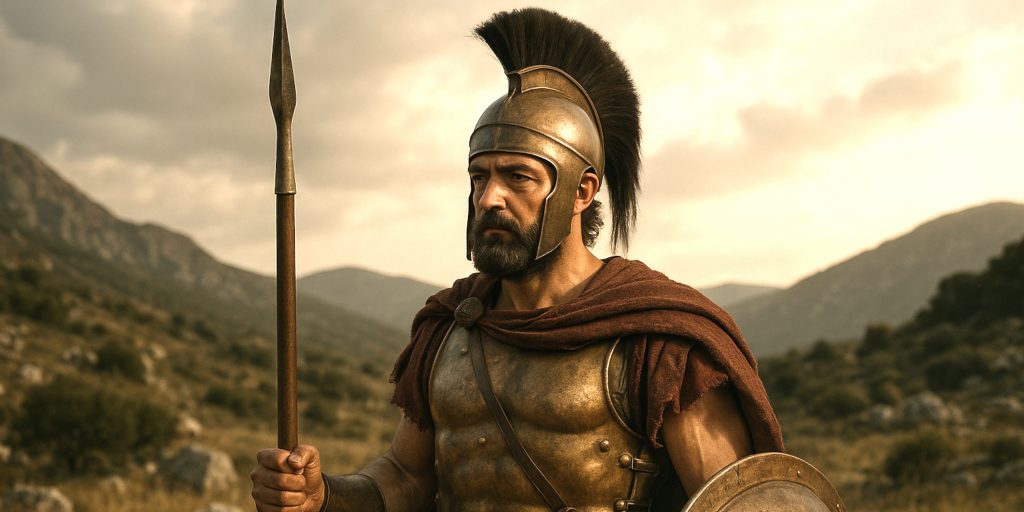
| Greeks | Pausanias | Spartan regent and overall commander |
| Greeks | Aristides | Athenian commander |
| Greeks | Amompharetus | Spartan officer who resisted retreat |
| Greeks | Arimnestos of Plataea | Plataean commander |
| Persians | Mardonius | Persian supreme commander |
| Persians | Artabazus | Senior Persian commander who escaped the battle |
| Persians | Masistius | Cavalry commander killed before the battle |
| Persians | Theban leaders | Commanded Greek allies fighting for Persia |
Pausanias has often been overshadowed by Leonidas, which is rather unfair. Leonidas died gloriously. Pausanias won.
The Battlefield

The battlefield lay south of the Asopus River near Plataea in Boeotia. The Persians held the open ground and river plain, ideal terrain for cavalry. The Greeks occupied the lower slopes and rougher ground nearer Mount Cithaeron.
This was not accidental. Greek hoplites were at their best on firm ground where they could hold formation. Persian cavalry was dangerous in the open. Pausanias therefore spent days refusing battle while Mardonius became increasingly impatient.
That impatience would eventually ruin him.
Arms and Armour
Greek Arms and Armour
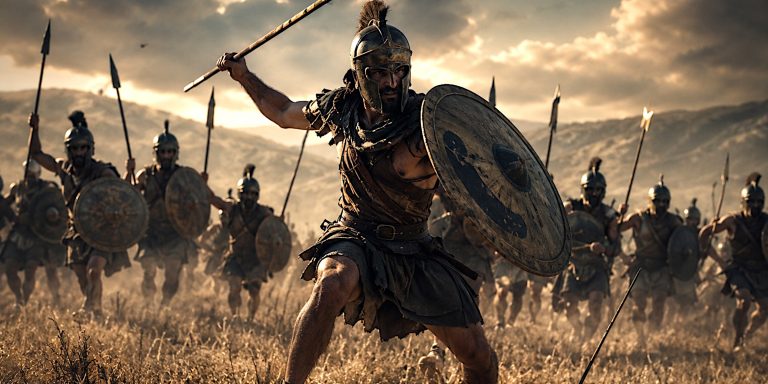
The Greek army was built around the hoplite phalanx. These men fought in close order with large round shields and long spears.
- Bronze Corinthian and Chalcidian helmets
- Bronze cuirasses or layered linen armour
- Large round hoplon shields
- Doru spear, usually 7 to 9 feet long
- Xiphos short sword for close fighting
- Kopis curved chopping sword, used by some Spartans and cavalry
- Greaves protecting the lower legs
| Weapon | Used By | Description |
| Doru spear | All hoplites | Primary weapon of the phalanx |
| Xiphos | Spartans, Athenians | Straight, double-edged sword for close combat |
| Kopis | Some Greek troops | Curved sword designed for powerful cuts |
| Hoplon shield | Greek infantry | Large circular shield of wood and bronze |
The xiphos was not an elegant weapon. It was short, brutal and designed for the unpleasant moment when two shield walls crashed together and there was no room left for anything more sophisticated.
Persian Arms and Armour
The Persian army was more varied and drew troops from across the empire.
- Wicker sparabara shields
- Scale armour or quilted tunics
- Spears and short swords
- Powerful composite bows
- Cavalry armed with javelins and bows
- Acinaces short sword worn by Persian nobles and guards
| Weapon | Used By | Description |
| Composite bow | Persian infantry and cavalry | Main Persian missile weapon |
| Spear | Persian infantry | Shorter than Greek spears |
| Acinaces | Persian nobles and guards | Short stabbing sword |
| Sagaris axe | Some eastern troops | Axe used in close combat |
The Persian acinaces was an elegant sidearm, more refined than the Greek xiphos. At Plataea, refinement proved less useful than a very large Spartan with a spear.
The Road to Battle
For more than a week the two armies watched one another.
Mardonius used his cavalry to harass the Greeks. Persian horsemen cut off supply routes and eventually captured and destroyed the Gargaphia spring, the Greeks’ main water source.
The Greek position became increasingly difficult. Pausanias decided to pull back by night to a stronger position nearer Plataea.
The retreat went badly.
Different contingents moved at different times. Some became separated. The Spartan officer Amompharetus flatly refused to retreat because he believed it dishonourable. Spartan stubbornness is famous, but even by Spartan standards this was a determined effort.
By dawn the Greek line was scattered and Mardonius believed the enemy was in full retreat.
He ordered an immediate attack.
Battle Timeline
| Time | Event |
| Early summer 479 BC | Greek army marches north into Boeotia |
| Days before battle | Persian cavalry attacks Greek positions and destroys water supply |
| Night before battle | Greeks attempt a withdrawal to a new position |
| Dawn | Greek line becomes disordered and partly separated |
| Morning | Mardonius launches attack, believing Greeks are retreating |
| Midday | Spartans and Tegeans hold against Persian assault |
| Shortly after | Mardonius is killed during the fighting |
| Afternoon | Persian line collapses and camp is stormed |
| Later that day | Athenians defeat the Thebans on the Persian right |
| Evening | Persian survivors flee north with Artabazus |
The Battle Itself
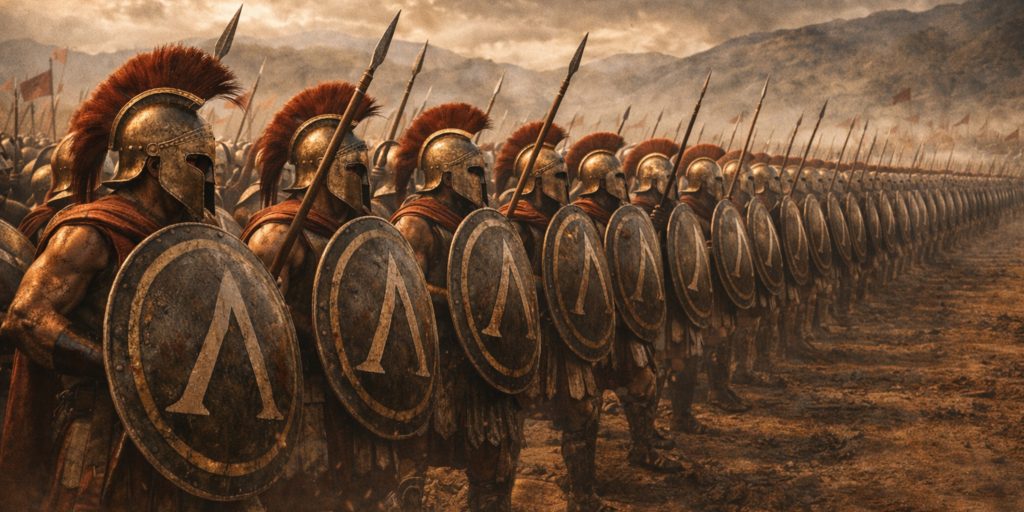
The Spartans and Tegeans faced the main Persian force under Mardonius. Persian archers opened the battle, showering the Greeks with arrows. The Spartans endured the barrage behind their shields and waited.
When Pausanias finally gave the order to advance, the Greek phalanx struck with tremendous force.
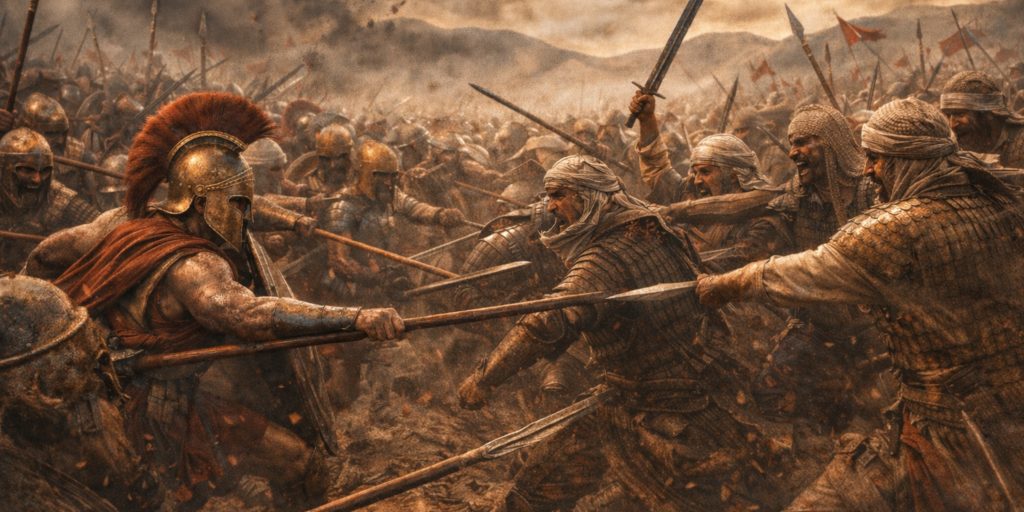
The Persians fought fiercely. Their front ranks used large wicker shields and tried to break the Greek line with missile fire and close combat. Yet they were at a disadvantage. Their spears were shorter, their shields weaker, and many lacked the heavy armour of the hoplites.
The turning point came when Mardonius was killed, probably struck down by a stone or spear while riding near the front. Herodotus claims he fell beneath a white horse surrounded by his bodyguard.
Once the Persian commander was dead, the centre of the Persian line began to crumble.
The Spartans and Tegeans pushed forward and drove the Persians back into their fortified camp. The Greeks then stormed the camp and slaughtered many of the defenders.
Meanwhile the Athenians fought the Thebans and other Greek allies of Persia on the opposite flank. This fighting was hard and prolonged, but the Athenians eventually prevailed.
By the end of the day the Persian invasion force had ceased to exist as a serious army.
Casualties
| Side | Estimated Losses |
| Greeks | Perhaps 1,000 to 10,000 |
| Persians | Perhaps 50,000 to 90,000 |
Herodotus famously claims that only 159 Greeks died. One admires his optimism.
Modern historians believe Greek losses were certainly higher, though still much lower than those suffered by the Persians.
Contemporary Quotes
“The fate of Greece was hanging in the balance.”
Herodotus on the importance of the campaign.
“The Persians fought with courage, but without heavy armour.”
Herodotus, describing the disadvantage of the Persian infantry.
“These men were fighting not for a king, but for their freedom.”
Plutarch, reflecting on the Greek alliance.
“Pausanias would not allow the body of Mardonius to be dishonoured.”
Herodotus, after the battle.
The last quote is particularly revealing. Even after years of invasion and devastation, the Greeks still believed there were limits to victory. One suspects this was easier to say after winning.
Archaeology
The precise location of the battlefield remains debated, although most scholars place it near the lower slopes beneath Mount Cithaeron and north-west of modern Plataies.
Archaeological work has uncovered:
- Fragments of arrowheads and spearheads
- Remains of ancient defensive earthworks
- Burial mounds traditionally linked with the Greek dead
- Evidence of the Persian camp and later commemorative monuments
- The foundations of the sanctuary of Zeus Eleutherios, built after the victory
Excavations have also identified tombs associated with the Spartans, Athenians and other allied contingents. Ancient sources claimed that several cities erected separate memorials for their dead.
The victory monument known as the Serpent Column originally commemorated Plataea before it was moved to Delphi. Part of it later found its way to Constantinople, which has a long history of borrowing things from elsewhere and keeping them.
Recent archaeological analysis has also focused on the line of the Persian camp and the route of the Greek withdrawal on the night before the battle. Modern terrain studies increasingly support the idea that the Greek retreat was not a panicked flight, but a confused attempt to regroup closer to water and more favourable ground.
Why the Greeks Won
Several factors explain the Greek victory:
- Superior hoplite armour and weapons
- Strong defensive use of terrain
- Better discipline in close combat
- The death of Mardonius at a critical moment
- Persian overconfidence after the Greek withdrawal
Pausanias also deserves more credit than he often receives. He kept together a deeply quarrelsome alliance of city-states that rarely agreed on anything except that Persia ought to leave.
That, in Greece, was practically a miracle.
Aftermath and Legacy
Plataea ended the Persian attempt to conquer mainland Greece. On the same day, according to Greek tradition, another Greek force won a victory over the Persians at Mycale in Asia Minor.
The consequences were immense:
- Persia lost control of Greece
- Athens soon emerged as the leading naval power
- Sparta gained enormous prestige
- The Greek world entered the period that would later become known as the Classical Age
Without Plataea, there may have been no Athenian empire, no Parthenon, no golden age of drama and philosophy. Historians should always be wary of claiming that one battle changed everything. Most battles do not.
Plataea, however, has a rather strong case.
Where to See Artefacts from the Battle
Visitors interested in Plataea can still see objects and memorials connected with the campaign.
- Archaeological Museum of Thebes, which holds finds from Boeotia
- National Archaeological Museum in Athens, with Greek and Persian military artefacts from the period
- The site of ancient Plataea in Boeotia
- The surviving base of the Serpent Column in Istanbul
- Delphi, where the original Greek victory monument once stood
The battlefield itself remains one of the most evocative places in Greece. It is quiet, broad and surprisingly peaceful. Looking across the plain, it is difficult to imagine that the future of Greece was decided there in a single violent afternoon.
Then again, battlefields often have that strange habit of appearing entirely innocent afterwards.