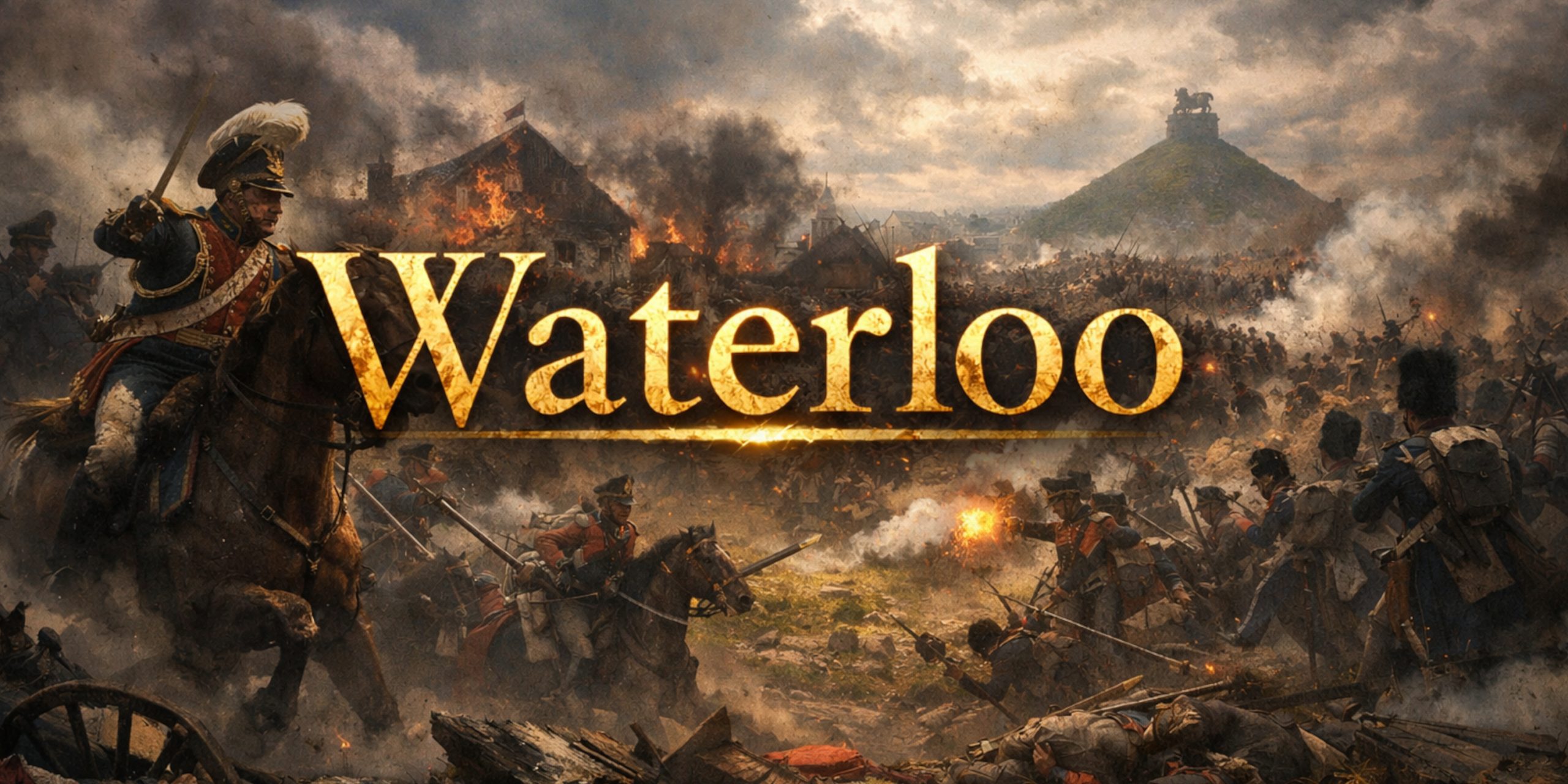
Few battles have such a clean sense of finality. On the evening of 18 June 1815, the long drama of the Napoleonic Wars reached its closing act in a muddy Belgian field. Napoleon Bonaparte, who had dominated European warfare for two decades, finally met a coalition that refused to break.
Waterloo was not simply a large battle. It ended an era. Within hours the French army collapsed, the emperor fled Paris, and Europe’s rulers began reshaping the continent without him.
Historians often debate whether Waterloo was won by Wellington’s stubborn defence or Blücher’s timely arrival. In truth, it was both. Wellington held the line with remarkable discipline while the Prussians marched through mud and gunfire to smash Napoleon’s flank.
The result was decisive, dramatic, and slightly chaotic in that very human way battles tend to be.
Background
Napoleon escaped exile on Elba in March 1815 and quickly reclaimed the French throne. The episode became known as the Hundred Days.
European powers moved with unusual speed. Britain, Prussia, Austria and Russia mobilised armies determined to end Napoleon’s rule permanently. Two allied forces stood closest to France.
- The Anglo-Allied army under the Duke of Wellington
- The Prussian army under Field Marshal Gebhard Leberecht von Blücher
Napoleon recognised the danger immediately. If these armies united, France would be overwhelmed.
His plan was simple and bold. Strike quickly in Belgium, defeat each army separately, and force negotiations before the wider coalition could assemble.
The campaign began well. French forces defeated the Prussians at Ligny and fought Wellington to a hard draw at Quatre Bras. Yet the Prussian army withdrew in good order rather than collapsing.
That detail mattered enormously.
Forces
Coalition Army (Anglo-Allied)
| Category | Details |
|---|---|
| Commander | Arthur Wellesley, Duke of Wellington |
| Strength | ~68,000 troops |
| Artillery | ~156 guns |
| Composition | British, Dutch, Belgian and German contingents |
Key formations
- British infantry brigades
- Dutch and Belgian line units
- King’s German Legion infantry and cavalry
- Brunswick troops
- Heavy cavalry brigades
The army was multinational and uneven in experience. Some British units were hardened Peninsular War veterans. Others had little battlefield experience.
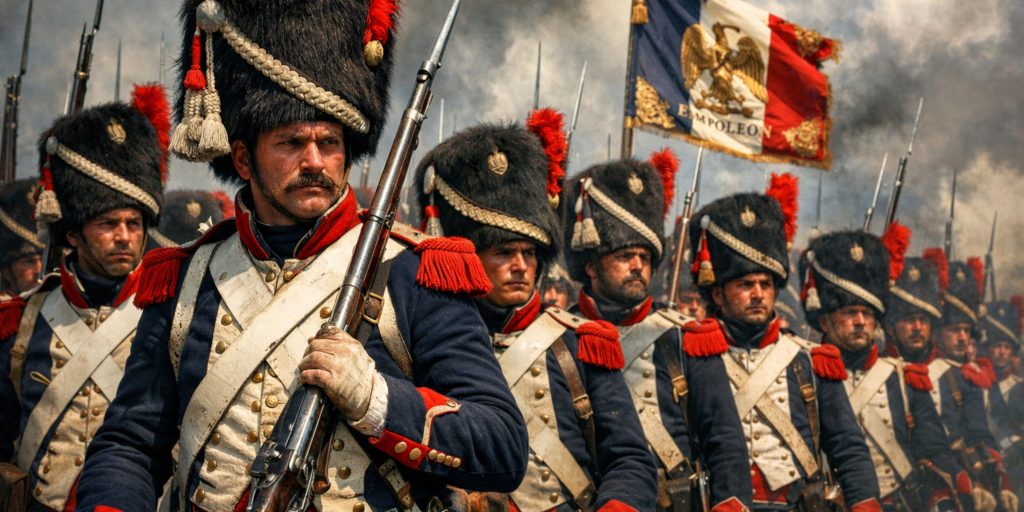
French Army
| Category | Details |
|---|---|
| Commander | Napoleon Bonaparte |
| Strength | ~72,000 troops |
| Artillery | ~246 guns |
| Composition | Veteran Imperial troops and conscripts |
Key formations
- Imperial Guard infantry
- Heavy cuirassier cavalry
- French line infantry divisions
- Light cavalry and dragoons
- Elite artillery batteries
Napoleon’s army contained many seasoned soldiers. Yet it also suffered from rushed mobilisation and command friction.
Prussian Army
| Category | Details |
|---|---|
| Commander | Field Marshal Gebhard Leberecht von Blücher |
| Strength engaged | ~50,000 by late afternoon |
| Artillery | ~134 guns |
Prussian forces approached the battlefield from the east during the afternoon and evening, ultimately striking the French right flank.
Their arrival turned a hard fight into a strategic collapse for Napoleon.
Leaders and Troop Composition
| Army | Commander | Notable Subordinates |
|---|---|---|
| Anglo-Allied | Duke of Wellington | Lord Uxbridge, Sir Thomas Picton, Prince of Orange |
| French | Napoleon Bonaparte | Marshal Ney, Marshal Soult, General Drouet d’Erlon |
| Prussian | Gebhard von Blücher | August von Gneisenau, Friedrich Bülow |
Wellington preferred defensive warfare. His style relied on terrain, disciplined infantry and carefully timed cavalry.
Napoleon relied on rapid manoeuvre and concentrated attacks, although at Waterloo the ground and weather slowed his usual tempo.
Blücher’s determination deserves special mention. After defeat at Ligny he insisted on marching to Wellington’s aid despite injuries and exhaustion.
One suspects Wellington appreciated the gesture.
Arms and Armour
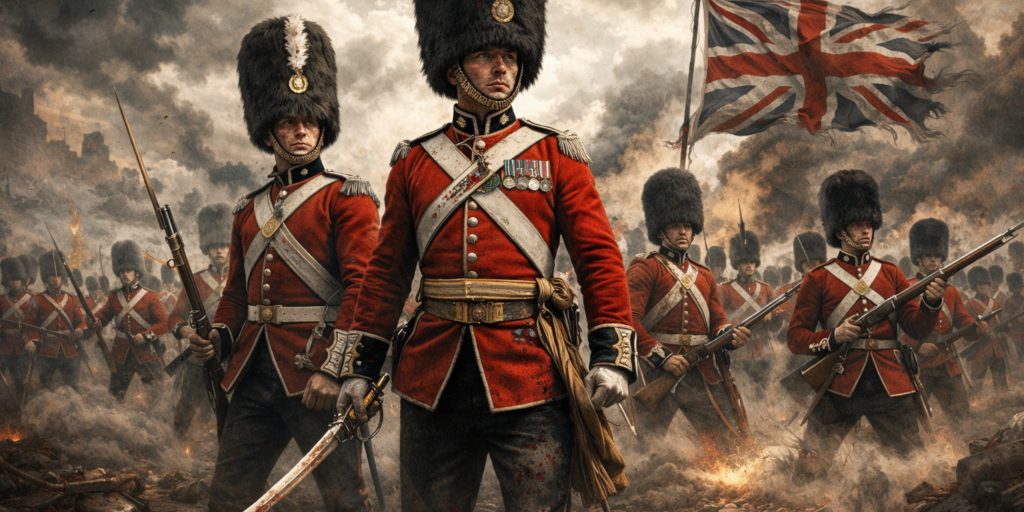
Napoleonic warfare still relied heavily on cold steel alongside muskets and artillery. Officers and cavalry carried a wide variety of swords.
Infantry Weapons
- Brown Bess musket, standard British firearm
- Charleville musket, used by French infantry
- Socket bayonets fixed to muskets
- Infantry hangers and short sabres for some troops
Cavalry Swords
| Unit | Sword Type | Description |
|---|---|---|
| British heavy cavalry | 1796 Heavy Cavalry Sword | Long straight blade suited for thrusting |
| British light cavalry | 1796 Light Cavalry Sabre | Deep curved blade designed for powerful cuts |
| French cuirassiers | AN XI heavy cavalry sword | Heavy straight blade with strong thrust |
| French dragoons | Dragoon sabre | Versatile curved blade |
| Prussian cavalry | Blücher sabre | Slightly curved sabre used for cutting attacks |
The 1796 Light Cavalry Sabre became infamous for its savage cutting ability. Contemporary reports describe it inflicting terrible wounds during cavalry charges.
Napoleonic cavalry combat was not subtle.
Other Equipment
- Steel cuirasses worn by French heavy cavalry
- Infantry shakos and bearskin caps
- Artillery sabres carried by gunners
- Pistols used by cavalry officers
Battlefield Archaeology
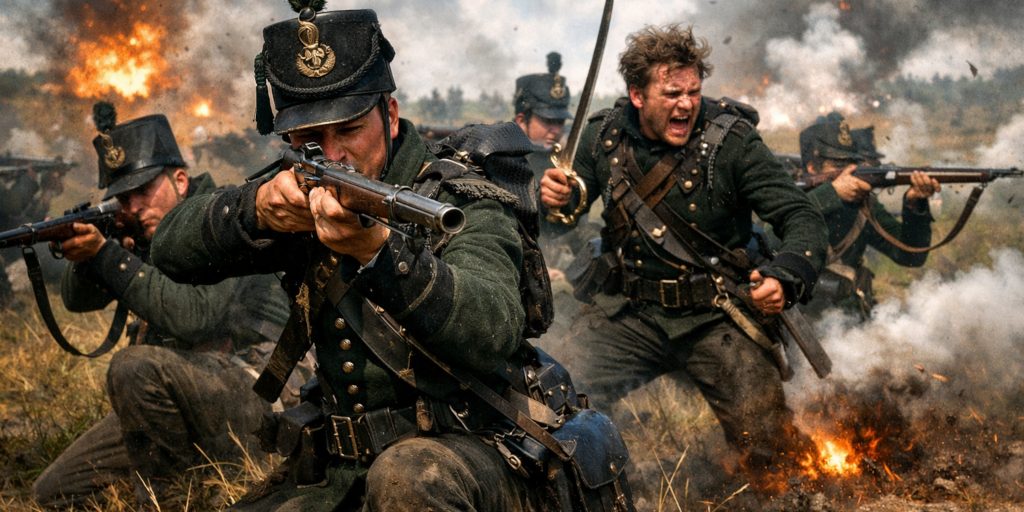
Waterloo has produced a surprisingly rich archaeological record.
Modern surveys have uncovered:
- Musket balls and canister shot scattered across the battlefield
- Broken sword fragments and bayonets
- Uniform buttons from several nations
- Horse equipment and saddle fittings
In 2022 archaeologists uncovered a severed human leg near the Mont-Saint-Jean farm complex. Amputation was common in battlefield surgery during the Napoleonic era.
It serves as a rather grim reminder that behind every famous painting lies a great deal of mud and suffering.
Ground-penetrating surveys also confirm the intense fighting around Hougoumont, La Haye Sainte, and Plancenoit, key strongpoints that shaped the battle.
Battle Timeline
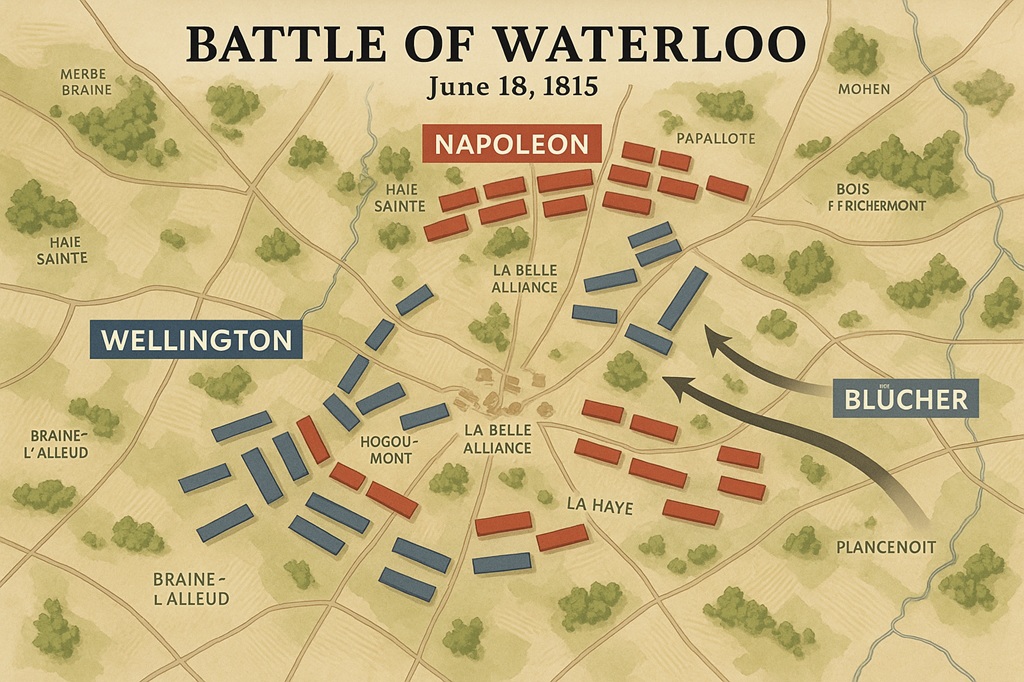
Morning, 18 June
Heavy rain from the previous night delayed the battle. Napoleon waited for the ground to dry before deploying artillery.
Around 11:30 AM French forces launched an attack on the fortified farm of Hougoumont on Wellington’s right flank.
The fighting there continued almost the entire day.
Early Afternoon
Around 1:30 PM French infantry under d’Erlon advanced against the allied centre.
British and allied infantry held their ground. The attack collapsed after a devastating countercharge by British heavy cavalry.
The charge succeeded brilliantly but continued too far, leaving cavalry exposed to French counterattacks.
Mid Afternoon
Marshal Ney launched repeated cavalry assaults against Wellington’s centre.
Thousands of French horsemen charged uphill toward squares of allied infantry.
The infantry formations held. Cavalry without infantry support rarely broke disciplined squares.
One might imagine the frustration building among French commanders at this stage.
Late Afternoon
Prussian forces under General Bülow began arriving near Plancenoit, striking the French right flank.
Napoleon diverted troops including elements of the Imperial Guard to hold them back.
The battlefield widened dramatically as fighting spread eastward.
Evening
Around 7:30 PM Napoleon committed the Imperial Guard in a final attack against Wellington’s centre.
The Guard advanced uphill but met intense musket fire from British infantry.
When the Guard began to retreat, panic spread through the French army.
The cry of “La Garde recule!” echoed across the field.
Once the Guard withdrew, the army followed.
Contemporary Quotes
The battle left many vivid accounts.
Wellington famously remarked:
“The nearest run thing you ever saw in your life.”
Prussian commander Blücher reportedly declared:
“We will beat them. I have promised it.”
A French officer later reflected on the collapse:
“All was lost. The army dissolved in a moment.”
These remarks capture the strange balance of Waterloo. For hours the outcome seemed uncertain.
Then suddenly it was not.
Legacy
Waterloo reshaped Europe.
Napoleon abdicated for the second time and was exiled to Saint Helena. The Napoleonic Wars ended, bringing two decades of almost continuous conflict to a close.
The battle also elevated Wellington and Blücher to legendary status.
For Britain, Waterloo became a national myth, a story of discipline and resolve. For France, it marked the end of imperial ambition under Napoleon.
Strategically the battle ensured that the Congress of Vienna settlement would dominate European politics for decades.
Historians continue to debate small details of the battle, yet its larger significance remains obvious.
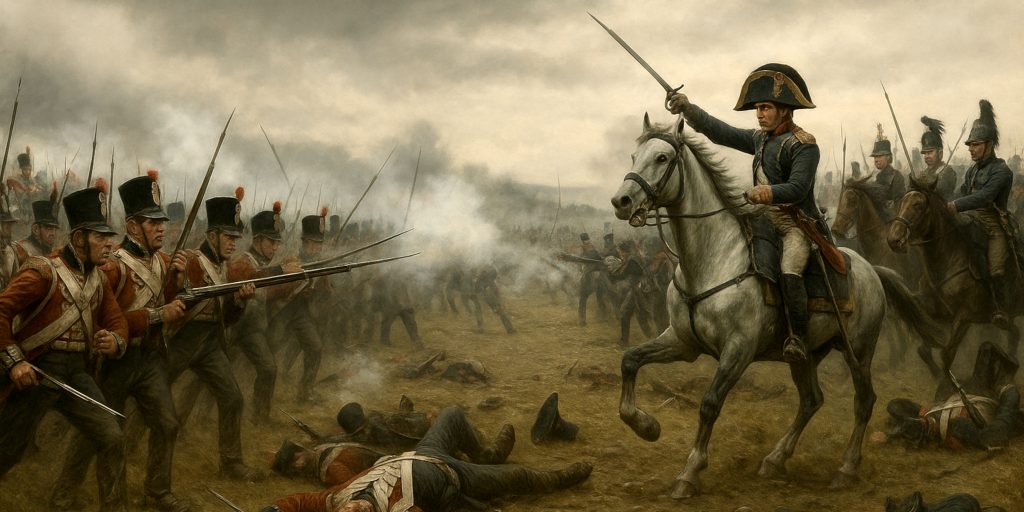
When Napoleon’s Imperial Guard retreated, an entire chapter of European history ended with them.
Where to See Waterloo Today
Visitors can explore the battlefield in modern Belgium.
Key locations include:
- Waterloo Battlefield and Visitor Centre
- Lion’s Mound, the artificial hill marking Wellington’s position
- Hougoumont Farm, preserved and restored
- La Haye Sainte, central strongpoint of the battle
- Plancenoit, where Prussians fought French troops
Walking the ground reveals the compact nature of the battlefield. What looks vast on maps feels surprisingly close in person.
Seven Swords Takeaway
Waterloo was not Napoleon’s most brilliant battle, nor Wellington’s most elegant victory.
It was muddy, brutal, and uncertain. Orders went astray. Cavalry charged too far. Infantry endured appalling artillery fire.
Yet the result changed the fate of Europe.
History rarely provides tidy endings, but Waterloo comes close.
Even Wellington admitted it was a near thing. And coming from him, that counts as quite a statement.
Watch the documentary: