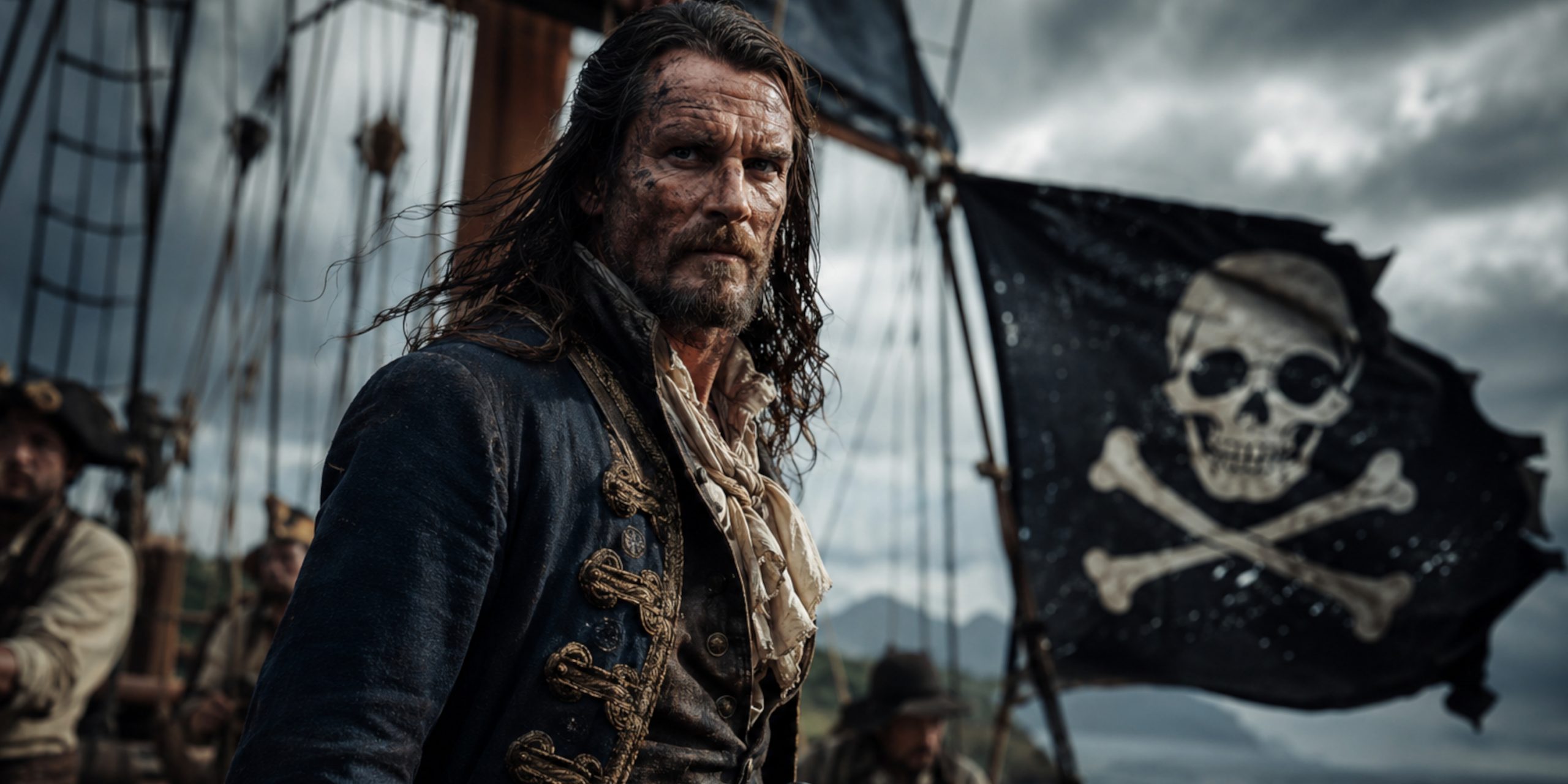
There are few names in pirate history that cling to the imagination quite like William Kidd. Mention Captain Kidd and most people picture buried treasure, mutinous rogues, tropical islands, and enough gold to bankrupt a small kingdom. The reality was both stranger and rather more miserable.
Kidd was not born a pirate king. He was, for much of his career, a respectable privateer and merchant captain trusted by powerful men in London and New York. He hunted pirates before he was accused of becoming one himself. He dined with governors, owned property, and moved through polite society with surprising ease for a man whose profession involved cannon fire and occasional stabbing.
Then politics entered the story, which is often where history becomes truly dangerous.
By the time Kidd swung from the gallows at Execution Dock in 1701, he had become one of the most notorious figures in the Atlantic world. Whether he deserved the reputation remains fiercely debated.
As a historian, I cannot help admiring the sheer catastrophic efficiency with which William Kidd ruined his own life. Few men have ever turned a legal commission into a death sentence with such flair.
Who Was William Kidd?
William Kidd was probably born around 1654 in Dundee, Scotland, though some later claims attempted to place his birth elsewhere. Scotland was producing hard sailors in abundance during the seventeenth century, and Kidd fitted the mould perfectly. He emerged from a world shaped by trade, naval warfare, colonial rivalry, and opportunism.
He first gained prominence as a privateer. A privateer was not technically a pirate. That distinction mattered enormously at the time, particularly if one wished to avoid hanging.
Privateers operated under government authority. They attacked enemy shipping legally during wartime and shared profits with investors and the Crown. It was piracy with paperwork.
Kidd eventually settled in New York, where he became a respected member of colonial society. He married a wealthy widow, Sarah Bradley Cox Oort, and developed useful political connections. This was not the usual career path for a drunken cutthroat with parrots and questionable dental hygiene.
The Commission That Changed Everything
In 1695, Kidd received a commission backed by influential English nobles and government figures. Among them was Richard Coote, Earl of Bellomont, who later became governor of New York.
Kidd’s mission had two objectives:
| Objective | Details |
|---|---|
| Hunt Pirates | Suppress piracy in the Indian Ocean |
| Capture Enemy Ships | Seize French vessels during wartime |
The expedition was financed privately. Investors expected profit. Kidd expected glory. The Crown expected results.
History, meanwhile, sharpened its axe.
The Adventure Galley
Kidd’s most famous ship was the Adventure Galley, launched in 1695.
Specifications of the Adventure Galley
| Feature | Detail |
|---|---|
| Type | Hybrid sailing ship and galley |
| Tonnage | Approximately 287 tons |
| Guns | Around 34 cannon |
| Crew | Roughly 150 men |
| Special Feature | Oars for movement in calm conditions |
The vessel was advanced for its time. The addition of oars allowed movement when winds failed, which was particularly useful in pirate hunting.
Unfortunately, the ship quickly suffered from leaks, rot, disease aboard, and constant crew unrest. Maritime history is full of splendid ideas ruined by damp timber and angry sailors.
Weapons Used by Kidd and His Crew
Pirate warfare in the late seventeenth century was brutal, close, and alarmingly personal.
Common Weapons Aboard Kidd’s Ships
| Weapon | Purpose |
|---|---|
| Cutlasses | Close combat boarding weapon |
| Flintlock pistols | Short-range fighting |
| Muskets | Ship-to-ship volleys |
| Boarding axes | Combat and utility |
| Daggers | Last-resort fighting |
| Cannon | Main naval armament |
Kidd himself reportedly favoured pistols and swords in combat. Officers often carried fine basket-hilted swords or naval hangers, symbols of status as much as practical weapons.
The average sailor, meanwhile, carried whatever could keep him alive for another afternoon.
The Murder of William Moore
One of the defining moments of Kidd’s downfall came during an argument with his gunner, William Moore, in 1697.
Moore urged Kidd to attack a Dutch vessel. Kidd refused, likely because attacking neutral shipping risked turning legal privateering into outright piracy.
The argument escalated violently.
Kidd struck Moore with an iron-bound bucket. Moore later died from the injury.
This incident haunted Kidd permanently. At his trial, it became one of the strongest charges against him.
It is a grim reminder that many pirate legends were built not upon cinematic duels, but sudden explosions of temper aboard overcrowded wooden ships filled with exhausted men.
Treasure, Riches, and the Great Pirate Myth
Captain Kidd’s treasure legend became one of the most enduring stories in maritime folklore.
Some treasure certainly existed. Kidd captured valuable cargoes, including silk, gold, silver, sugar, spices, and textiles. The most controversial capture was the Quedagh Merchant, an Armenian vessel sailing under French passes.
Kidd believed the seizure legal.
His enemies disagreed enthusiastically.
Kidd’s Known Treasure Cache
Before his arrest, Kidd buried a portion of treasure on Gardiners Island near New York.
The cache reportedly included:
- Gold dust
- Silver bars
- Coins
- Jewels
- Fine fabrics
Authorities recovered much of it quickly. Sadly for treasure hunters, reality tends to be deeply inconsiderate.
Still, rumours persisted that larger hidden hoards remained undiscovered across the Caribbean and the American coastline.
Kidd’s legend became one of the foundations of later pirate fiction, influencing stories such as Robert Louis Stevenson’s Treasure Island.
Battles and Captures
Kidd was not a conqueror on the scale of Blackbeard or Bartholomew Roberts, but he engaged in several significant actions.
Notable Captures
| Ship | Outcome |
|---|---|
| Quedagh Merchant | Kidd’s richest prize |
| Rouparelle | Captured during Indian Ocean operations |
| Smaller regional vessels | Seized for supplies or cargo |
Many of Kidd’s encounters involved intimidation rather than prolonged naval battle. Merchant crews often surrendered quickly once cannon were aimed at them.
The alternative involved splintered wood, amputations, and becoming fish food in warm tropical waters.
Most men chose surrender.
Contemporary Quotes About Kidd
Several contemporary accounts shaped Kidd’s reputation.
From a report associated with his examination:
“Captain Kidd had brought in great riches.”
A popular broadside published after his execution declared:
“My name was Robert Kidd, as I sailed.”
Cotton Mather, the influential New England minister, described Kidd as:
“A prisoner under a strong guard.”
Not especially poetic, admittedly, but Mather was generally more interested in moral warnings than dramatic flair.
The Bounty on Captain Kidd
As accusations mounted, Kidd transformed from state-sponsored privateer into wanted criminal.
A substantial bounty was offered for his capture. Former allies rapidly distanced themselves from him once political pressure intensified in London.
This was the true disaster for Kidd. Pirates could survive storms, cannon fire, and mutiny. Surviving embarrassment among powerful investors was considerably harder.
Arrest and Trial
Kidd returned to New York in 1699 hoping to clear his name.
This was an astonishingly poor miscalculation.
Governor Bellomont arrested him and sent him to England in chains. Kidd expected legal protection from his former backers. Instead, many quietly abandoned him to protect themselves from scandal.
His trial took place in 1701.
Charges Against Kidd
- Piracy
- Murder of William Moore
- Illegal seizure of ships
- Conduct unbecoming a licensed privateer
Kidd defended himself fiercely, insisting many of his captures were legal under wartime commissions.
Critical documents that may have supported his case mysteriously failed to appear during the proceedings.
Convenient accidents are one of history’s oldest political traditions.
Execution at Execution Dock
William Kidd was hanged on 23 May 1701 at Execution Dock in London.
The execution became infamous.
According to reports, the rope snapped during the first attempt. Kidd had to be hanged a second time.
Even the gallows seemed reluctant to finish the job properly.
After execution, his body was coated in tar and displayed in chains beside the River Thames as a warning to other pirates.
His corpse reportedly remained hanging for years.
The English state believed strongly in making examples of people.
Was Captain Kidd Really a Pirate?
This question still divides historians.
There is little doubt Kidd committed violent acts and seized ships aggressively. Yet the legal distinctions between privateering and piracy in the seventeenth century were often murky.
Many privateers behaved almost identically to pirates when far from Europe.
Kidd’s greatest mistake may not have been piracy itself, but political failure. He lost the protection of influential patrons at precisely the wrong moment.
Once that happened, conviction became almost inevitable.
Captain Kidd’s Legacy
Captain Kidd became larger in death than he ever was in life.
His story inspired:
- Pirate novels
- Treasure hunting myths
- Folk songs
- Films and television
- Endless conspiracy theories
Unlike Blackbeard, Kidd left behind ambiguity rather than pure terror. That uncertainty keeps historians returning to him.
Was he a criminal? A scapegoat? A reckless opportunist? Probably a little of all three.
History rarely grants us clean villains.
Where to See Artefacts Linked to Captain Kidd
Several museums hold artefacts connected to Kidd and the wider pirate age.
Notable Collections
| Museum | Location | Highlights |
|---|---|---|
| Museum of London Docklands | London | Pirate-era artefacts and maritime history |
| National Maritime Museum | Greenwich | Seventeenth-century naval collections |
| New-York Historical Society | New York | Colonial maritime records |
| Dundee collections | Scotland | Regional material connected to Kidd’s origins |
Some alleged Kidd artefacts have surfaced over the centuries, though authenticity is often disputed. Pirate relics attract exaggeration like seagulls to abandoned chips.
Takeaway
William Kidd remains fascinating because he stood at the crossroads between legality and piracy, empire and criminality, ambition and ruin.
He entered history as a trusted servant of the English Crown and left it dangling over the Thames in chains.
There is something deeply human in Kidd’s story. He was neither invincible pirate king nor innocent victim. He was an ambitious man navigating a violent age where fortunes shifted quickly and loyalty vanished faster still.
One almost feels sorry for him.
Almost.