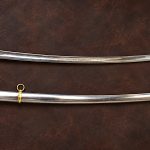
The cinquedea looks as though a dagger began growing into a sword and stopped at a particularly interesting point. Its blade is exceptionally broad near the hilt, then narrows towards a sharp tip. Smaller examples are usually called daggers; larger ones sit comfortably in short sword territory.
The name is commonly linked to cinque dita, or “five fingers”, describing the width of the blade at its base. It is a memorable name rather than a strict measurement. What matters is the distinctive shape: broad shoulders, a strong taper and a compact, one-handed hilt.
Popular in Renaissance Italy around the late fifteenth and early sixteenth centuries, the cinquedea could be both a useful sidearm and an expensive display of taste. Some surviving blades carry intricate etched figures and ornament. Others are comparatively plain. Both tell us more about the weapon than the tempting idea that every finely decorated example was made solely to be admired.
Specifications

There was no standard cinquedea. Surviving examples vary enough that measurements should be treated as a guide, not a definition.
| Feature | Typical form |
|---|---|
| Origin | Italy, especially its northern regions |
| Principal period | Late fifteenth to early sixteenth century |
| Classification | Large dagger or short sword |
| Blade | Double edged, very broad at the base and strongly tapered |
| Blade length | Often approximately 25–50 cm, though examples vary |
| Fullers | Frequently several grooves extending from the blade’s broad base |
| Hilt | Short guard and one-handed grip |
| Decoration | May include etched figures, foliage, inscriptions or gilding |
| Use | Civilian sidearm, personal defence and display |
The blade is the quickest way to identify one. Its width gives the cinquedea a profile quite unlike the narrow thrusting daggers that later became fashionable. The point is still functional, however. A broad base does not mean the weapon could only cut.
History and Evolution
The cinquedea developed in the world of Renaissance Italian cities, where carrying a weapon could be a practical precaution and a visible part of personal dress. Its period of greatest popularity fell around the turn of the sixteenth century.
The broad blade offered a generous surface for decoration. On elaborate examples, makers filled that space with classical imagery, figures or ornamental designs. Such work reflected the tastes of wealthy patrons, but decoration and usefulness were not mutually exclusive. A sharpened, well-made blade remained a weapon regardless of how much artistry appeared on it.
It is difficult to trace a simple evolution from “practical early type” to “decorative late type”. Plain and lavish examples overlapped. Nor can every surviving piece be assigned a precise purpose from its appearance alone. A museum object may reveal its construction and ornament while telling us very little about the occasions on which its original owner carried it.
By the later sixteenth century, the cinquedea’s distinctive form had fallen from fashion. Other civilian swords and daggers offered different combinations of reach, portability and handling. The cinquedea did not vanish because its blade suddenly ceased to work; tastes and the wider culture of carrying weapons changed.
Advantages and Disadvantages
Advantages
- Manageable length: A cinquedea was easier to carry and manoeuvre at close quarters than a full-sized sword.
- Versatile blade: Its edges could cut, while its taper produced a usable point.
- Civilian practicality: Smaller examples offered a substantial sidearm without the length of a sword worn for formal fighting.
- Room for decoration: The broad blade made an effective surface for imagery and inscriptions, particularly on costly commissions.
Disadvantages
- Short reach: Against someone armed with a longer sword, closing the distance would be a serious problem.
- Less suited to precise armoured thrusts: A narrow, stiff dagger was better adapted to exploiting small gaps in armour.
- Variable handling: A large cinquedea and a dagger-sized example cannot sensibly be judged as though they were identical weapons.
- Limited battlefield role: Its compact length made it a sidearm, not a replacement for weapons chosen as a fighter’s principal arm.
The original article describes the broad blade as clumsy for thrusting. That is too absolute. Blade geometry differs between examples, and the pointed taper was there for a reason.
Comparison With Similar Weapons
| Weapon | Defining feature | Main difference from the cinquedea |
|---|---|---|
| Baselard | Distinctive H-shaped hilt | Usually has a narrower blade and a different hilt construction |
| Rondel dagger | Circular fittings at the hilt and often a stiff blade | More closely associated with forceful, controlled thrusting |
| Stiletto | Very narrow, sharply pointed blade | Favours precise thrusts over substantial cutting edges |
| Arming sword | Longer blade and greater reach | Better suited to sword fighting at distance, but less compact |
| Cinquedea | Exceptionally broad blade base tapering to a point | Combines a short sidearm’s portability with a conspicuous cutting blade |
These are comparisons of design and likely strengths, not a ranking of which weapon would always win. The wielder, setting and individual example matter rather more than a tidy table can express.
Legacy
The cinquedea is now admired for the quality and variety of its surviving examples. Its dramatic proportions make it easy to recognise, but close inspection reveals more: the arrangement of fullers, the relationship between blade and hilt, and, on decorated examples, the images chosen for the steel.
It is also a useful reminder that Renaissance arms were not divided neatly into “real weapons” and “art objects”. Owners could care about both. The cinquedea’s place in history lies in that combination of practical design and personal display, rather than in any claim that it transformed later sword-making.
Where to See Original Examples
Major arms collections are the best place to study the differences between surviving cinquedeas:
- The Wallace Collection, London: An important collection of European arms and armour.
- The Metropolitan Museum of Art, New York: Its arms and armour collection includes Italian Renaissance weapons.
- Museo Stibbert, Florence: Particularly valuable for anyone exploring historic European arms in Italy.
Search a museum’s collection catalogue for cinquedea before visiting. An object listed in a collection may be in storage or temporarily off display.
Collector’s Guide
Original cinquedeas are uncommon enough that a promising listing deserves careful scrutiny. A convincing outline is only the start: later reproductions, restored fittings and old blades assembled with unrelated parts can all complicate an attribution.
Before bidding, ask:
- Is the attribution specific? “Italian, circa 1500” is a stronger claim than “Renaissance style”. Ask what evidence supports it.
- Do the parts belong together? Look closely at the junction between blade, guard, grip and pommel.
- What has been restored? Replacement grips and renewed decoration affect both historical value and price.
- What is the provenance? Earlier collection records, photographs and catalogue entries can help establish an object’s history.
- What condition is the blade in? Heavy polishing may remove original surface detail; corrosion can obscure construction and decoration.
- What will the final bill be? Buyer’s premium, taxes, shipping and any applicable import costs come on top of the hammer price.
Auction prices
These are indicative figures, not verified auction results:
| Description | Previously published estimate |
|---|---|
| Plain example | £4,000–£8,000 |
| Etched or inscribed blade | £10,000–£20,000 |
| High-quality example | £25,000–£70,000+ |
| Strongly provenanced example | £75,000–£150,000+ |
These bands should not be used to value a particular weapon. An original blade with later fittings, a disputed attribution and a documented example in exceptional condition belong in very different price conversations. For a meaningful comparison, look for dated sales of comparable objects and check whether each reported figure is the hammer price or the total including premium.
Seven Swords Assessment
The cinquedea earns attention through its shape, then holds it through its details. Its broad blade was capable of carrying both cutting edges and ambitious decoration, making it a revealing object from Renaissance Italy.
For collectors, the sensible approach is just as straightforward: examine the individual weapon, establish what is original and treat unsupported price ranges with care. A blade this distinctive deserves more than a quick glance at the silhouette.