Cannae is the battle that every military historian eventually circles back to.
Fought in 216 BC during the Second Punic War, it represents both the height of Hannibal Barca’s operational brilliance and one of the most catastrophic defeats in Roman history. Entire consular armies were enveloped and destroyed on a dusty plain in Apulia. The Roman Republic staggered but did not fall. That, in itself, is remarkable.
When people speak of annihilation in battle, they usually mean Cannae.
Strategic Background
After victories at Trebia and Lake Trasimene, Hannibal had proven that Roman armies could be beaten in the field. Rome responded with characteristic confidence. It assembled one of the largest forces it had ever deployed.
The consuls Lucius Aemilius Paullus and Gaius Terentius Varro were entrusted with crushing the Carthaginian threat in a decisive engagement.
The problem was not courage. It was method.
The Battlefield
Cannae lay near the River Aufidus, today the Ofanto, in southern Italy. The terrain was flat, open, and dry. It favoured cavalry manoeuvre and offered little natural obstruction.
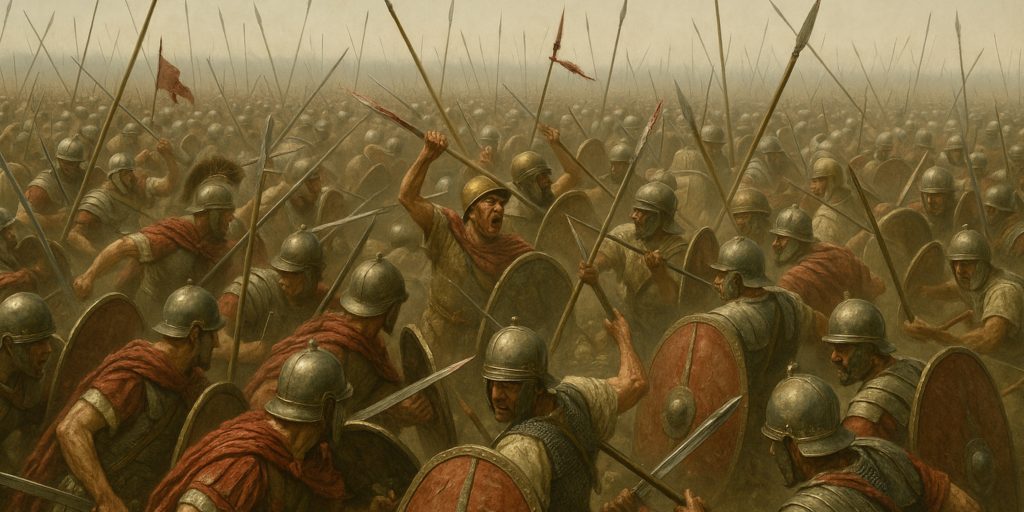
The Romans formed in an unusually deep, dense infantry block, seeking breakthrough through mass. Hannibal deployed a curved line, weaker troops in the centre, veterans on the flanks, cavalry on the wings.
It looked fragile. It was a trap.
Forces
Overall Strength Estimates
| Army | Estimated Strength | Infantry | Cavalry |
|---|---|---|---|
| Rome and Allies | 70,000 to 80,000 | Majority heavy infantry | Approx. 6,000 |
| Carthage | 40,000 to 50,000 | Mixed infantry | Approx. 10,000 |
The Romans possessed numerical superiority in infantry. Hannibal possessed superiority in cavalry and tactical imagination.
Leaders
Roman Command
- Lucius Aemilius Paullus
- Experienced aristocrat
- Favoured caution
- Killed during the battle
- Gaius Terentius Varro
- Politically ambitious
- Advocated aggressive engagement
- Survived and returned to Rome
Divided command rarely produces harmony under pressure.
Carthaginian Command
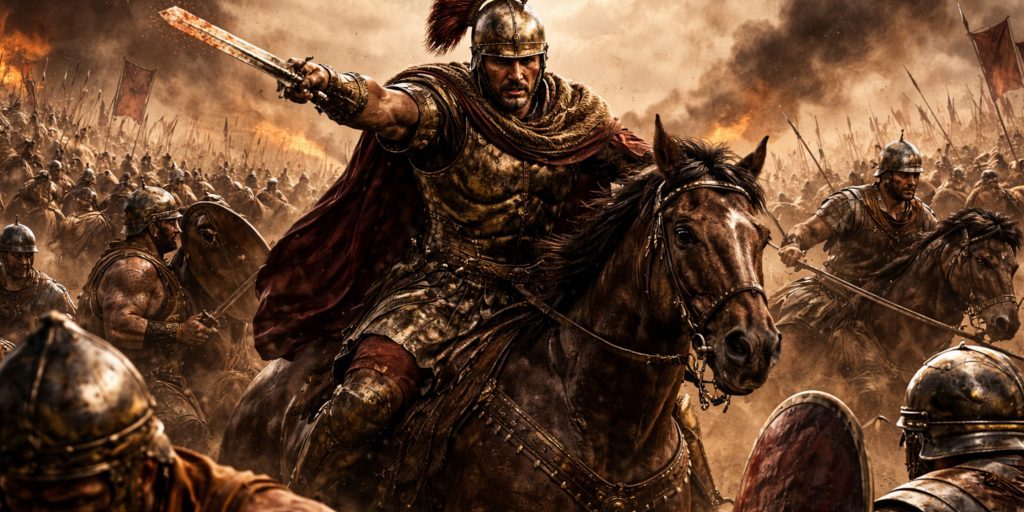
- Hannibal Barca
- Supreme commander
- Architect of the double envelopment
- Hasdrubal, commanding heavy cavalry
- Maharbal, leading Numidian cavalry
Hannibal delegated effectively and coordinated timing with precision.
Arms and Armour
Understanding Cannae requires attention to equipment. Weapons shaped behaviour.
Roman Arms and Armour
- Gladius Hispaniensis
- Short thrusting sword, ideal for close formation fighting
- Pilum heavy javelin
- Scutum large rectangular shield
- Montefortino helmet
- Mail armour for wealthier soldiers
The Roman infantry was designed for disciplined frontal combat. Packed tightly at Cannae, their gladii became less effective when movement was restricted.
Carthaginian Arms and Armour
- Iberian falcata curved sword
- Celtic long slashing swords
- African infantry equipped with captured Roman scuta and gladii
- Numidian light cavalry with javelins and small shields
The diversity of Hannibal’s army is often emphasised. What matters more is how he integrated that diversity. African veterans on the wings were disciplined heavy infantry capable of coordinated pivot manoeuvres. That pivot was decisive.
The Battle Timeline
Early Morning
- Roman infantry advances in deep formation
- Carthaginian centre absorbs pressure, gradually falling back
Midday
- Roman cavalry defeated on both flanks
- Numidian and heavy cavalry regroup behind Roman lines
Early Afternoon
- Carthaginian centre fully concave
- African infantry pivots inward
- Roman infantry encircled
Late Afternoon
- Systematic destruction of trapped Roman forces
- Consul Paullus killed
- Varro escapes with remnants
The killing likely continued for hours. Polybius suggests that congestion prevented effective resistance. A terrible efficiency took over.
Contemporary Accounts
Our main sources are Polybius and Livy.
Polybius writes:
“So great was the slaughter that neither battle nor rout but sheer massacre seemed to be taking place.”
Livy observes:
“There was no longer any hope, nor any strength left.”
These are not restrained sentences. They are written by men who understood that Rome had come close to disaster.
Casualties
| Army | Estimated Dead |
|---|---|
| Rome and Allies | 50,000 to 70,000 |
| Carthage | 6,000 to 8,000 |
Among the Roman dead were senators, officers, and experienced soldiers. The political and social impact was immense.
It is difficult to overstate the scale. For comparison, this represented a significant portion of Rome’s available manpower at the time.
Archaeology
Archaeological investigations near Cannae have uncovered:
- Weapon fragments
- Sling bullets
- Coinage
- Scattered human remains
Precise mass graves described in ancient sources remain debated. The flat landscape has changed through centuries of agriculture, complicating interpretation.
Material evidence supports large scale conflict but cannot provide exact casualty confirmation. As usual, archaeology humbles the grand claims of literary history.
Aftermath and Strategic Consequences
Despite annihilation, Rome refused negotiation. Prisoners were not ransomed. Emergency levies were raised. Even slaves were armed in desperation.
Under Quintus Fabius Maximus Verrucosus, Rome avoided major pitched battles and adopted a war of attrition. The so called Fabian strategy frustrated Hannibal’s preference for decisive engagement.
Hannibal achieved tactical perfection at Cannae. He did not achieve strategic victory. Rome’s institutional resilience proved formidable.
This is the irony that fascinates me. The most elegant battlefield victory in antiquity did not win the war.
Why Cannae is Etched in History
Cannae is studied in military academies across the world. The principle of double envelopment, crushing an enemy by surrounding both flanks, remains a textbook example of operational art.
It also serves as a warning.
- Numerical superiority can produce complacency
- Dense formations can become liabilities
- Unified command matters
Rome learned these lessons painfully. Later Roman commanders would adapt formations, improve cavalry coordination, and pursue more flexible tactics.
Cannae was not simply a defeat. It was a brutal education.
Takeaway
The Battle of Cannae was a masterclass in timing, discipline, and psychological insight. Hannibal understood how to turn Roman aggression into Roman vulnerability. The result was annihilation on a scale rarely matched in antiquity.
Yet Rome endured.
As a historian, I find that duality compelling. Cannae demonstrates how a single day can showcase human brilliance and human stubbornness in equal measure. One army achieved perfection in manoeuvre. The other achieved something quieter but no less impressive, the refusal to collapse.
In the long arc of history, both qualities shaped the Mediterranean world.
Watch the documentary: