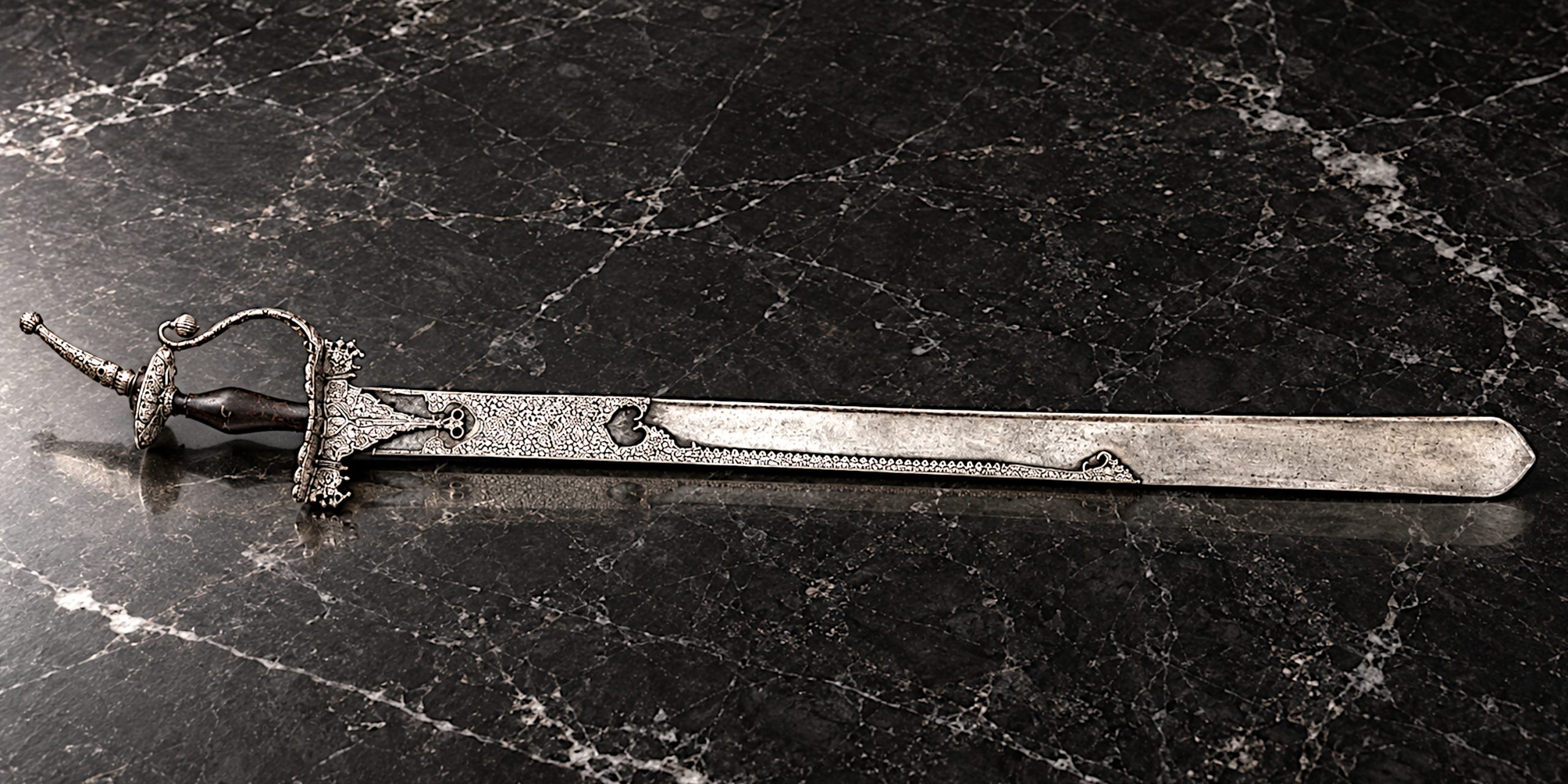
The khanda is one of the most recognisable swords of the Indian subcontinent. Its straight, broad blade, protective hilt and distinctive pommel spike give it a profile quite unlike the curved talwar more commonly associated with Indian warfare.
Although the word is sometimes applied loosely to several forms of straight Indian sword, the mature khanda was primarily a powerful cutting weapon. Its blade often widened towards the point, placing considerable authority behind the stroke. Surviving examples also show substantial variation. Some are comparatively restrained military weapons, while others are richly decorated objects made for rulers, nobles or ceremonial use.
The khanda became particularly associated with Rajput, Maratha and Sikh martial culture. Its importance cannot be understood through battlefield performance alone. It was also an emblem of authority, sacrifice and religious power.
Khanda Sword Specifications
There was no universal manufacturing standard, so measurements and construction vary considerably between periods and regions.
| Feature | Typical form |
|---|---|
| Place of origin | Indian subcontinent |
| Weapon type | Straight-bladed cutting sword |
| Main period of use | Medieval period to the 19th century |
| Overall length | Commonly around 85 to 105 cm |
| Blade length | Often approximately 70 to 90 cm |
| Blade form | Straight, broad and usually double-edged |
| Point | Rounded, spatulate or gently tapering |
| Hilt material | Usually iron or steel |
| Guard | Broad plate or shell-like guard |
| Hand protection | Frequently includes a knuckle guard |
| Pommel | Disc-shaped, often with a projecting spike |
| Blade reinforcement | Some examples have a strengthening strip along part of one edge |
| Decoration | Silver, gold koftgari, inscriptions, gilding or pierced steelwork |
| Primary action | Forceful cuts and chopping blows |
Published weights are often repeated as though every khanda followed a regulated pattern. They did not. Surviving swords vary in blade thickness, balance, decoration and intended use. A heavily ornamented court weapon should not be treated as a reliable model for an ordinary fighting sword.
What Does a Khanda Look Like?
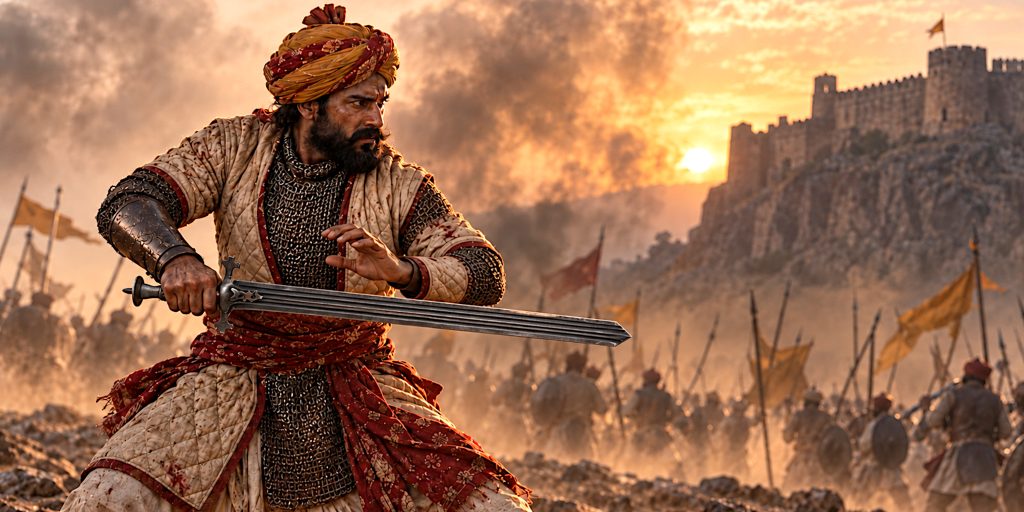
The khanda is normally identified by a combination of features rather than by one detail alone.
Its blade is straight and broad, sometimes becoming wider towards the upper portion. Many examples have a comparatively rounded or spatulate point. This geometry favours cutting, although pointed specimens could still deliver a thrust.
A typical developed hilt may include:
- A broad steel guard protecting the hand
- A knuckle bow running from the guard towards the pommel
- A disc-shaped pommel
- A long pommel spike or extension
- A short grip intended primarily for one-handed use
- Gold or silver decoration on higher-status examples
Some blades carry a reinforcing strip fixed along part of one edge. This is occasionally described as a back edge or spine, but its construction and purpose differ between individual weapons. It could strengthen the blade, alter its balance and provide a safer surface for supporting the weapon with the second hand.
The pommel spike could also be grasped during a powerful two-handed cut. It was not a conventional longsword grip, but it gave the wielder additional leverage when needed.
The Name Khanda
The name is connected with the Sanskrit word khaḍga, a broad term associated with swords and bladed weapons. Related forms appear in Sanskrit literature, religious texts and regional languages.
This creates a problem for historians. A reference to a khaḍga in an early text does not automatically describe the precise steel-hilted khanda familiar from later museum collections. Words survive for centuries while weapons change around them.
Ancient literary references therefore establish a long cultural history for the Indian straight sword, but they cannot by themselves prove that the mature khanda existed in an identical form during antiquity.
History and Evolution of the Khanda
Ancient Straight Swords in India
Straight swords appear early in South Asian archaeology, sculpture and literature. Iron Age warriors used several forms of straight blade, while Gupta-period art shows swords with broad profiles and expanded tips.
These weapons are important ancestors within the wider tradition, but calling every ancient straight Indian sword a khanda can be misleading. The fully developed weapon, particularly its elaborate all-metal hilt, belongs to a later technological and artistic setting.
Development During the Medieval Period
During the medieval period, Indian armourers produced an increasingly varied range of sword forms. Regional military traditions, court patronage and contact with Persianate weapon design all influenced their development.
The khanda became especially associated with Rajput martial culture. Paintings and surviving arms show straight swords carried by rulers, nobles and soldiers. It could function as a practical weapon, a courtly possession and a visible statement of rank.
The broad blade was suited to forceful cuts against lightly armoured or unarmoured opponents. Against mail or padded armour, its mass could still deliver considerable blunt trauma, although no sword should be imagined sailing through armour as if medieval warfare operated under theatrical rules.
The Khanda Under the Mughals and Marathas
The spread of Mughal power did not erase regional sword traditions. Indian armourers continued to combine local blades with different hilt forms, while imported European blades were also remounted for South Asian use.
This makes classification rather awkward. Some straight swords fitted with Indian basket hilts are identified as khandas, while others are classed as firangis, particularly when they use imported European blades. The distinction can depend upon blade form, provenance and catalogue convention.
Maratha warriors also used straight-bladed swords with developed Indian hilts. An especially important weapon connected with Raghuji Bhosale I was acquired by the Maharashtra government at auction in 2025. It was described as a Maratha firang-style sword rather than a conventional khanda, which neatly illustrates how closely these categories can overlap.
Sikh Use of the Khanda
The khanda became a prominent weapon within Sikh martial tradition, particularly among Akali and Nihang warriors. It appears in historical art, religious settings and later traditions surrounding figures such as Baba Deep Singh.
It also gave its name to the modern Sikh emblem. At the centre of that emblem is a double-edged khanda, surrounded by a circular chakkar and flanked by two curved kirpans. The design expresses religious authority, temporal responsibility and the defence of justice.
The sword and the emblem should not be confused. The weapon has a much longer history, while the familiar standardised form of the Sikh symbol developed considerably later.
Decline as a Battlefield Weapon
The khanda remained in use into the early modern period, but changing warfare reduced the importance of swords generally. Firearms, artillery and new military organisation gradually pushed them towards secondary, ceremonial and symbolic roles.
Even so, the weapon did not disappear. It continued to be preserved in armouries, religious collections, family holdings and martial traditions.
How Was the Khanda Used?
The khanda was built principally for committed cuts. Its broad blade could carry considerable momentum, while the double-edged form allowed the wielder to strike from either direction without turning the weapon.
Likely techniques included:
- Diagonal cuts towards the shoulder, neck or arms
- Horizontal blows against the torso
- Downward cuts delivered with one or two hands
- Short reverse-edge attacks
- Defensive actions using the broad blade and enclosed hilt
- Thrusts with examples possessing a more defined point
The basket-like hilt gave the hand better protection than the simple crossguards found on many earlier Indian swords. However, the confined grip could restrict wrist movement. This was less troublesome during strong chopping attacks than it would be in a fencing system built around delicate changes of point.
Claims that the wide blade served almost as a shield should be treated cautiously. It could certainly parry and oppose another weapon, but relying on a sword blade as a miniature shield would have been a spirited way to lose several fingers.
Advantages of the Khanda
- Powerful cutting performance: The broad blade and forward distribution of mass supported heavy cuts.
- Two usable edges: A second cutting edge allowed rapid follow-up attacks.
- Strong hand protection: Plate guards and knuckle bows protected the hand more thoroughly than many open hilts.
- Adaptable grip: The pommel extension could provide extra leverage during two-handed blows.
- Substantial construction: Reinforced examples were capable of enduring demanding cutting actions.
- Psychological presence: Its size, shape and cultural associations made it an imposing weapon.
- Symbolic importance: A khanda could serve as an emblem of authority as well as a functional sword.
Disadvantages of the Khanda
- Less agile than many sabres: A broad blade could be slower to redirect than a lighter talwar.
- Limited thrusting ability: Rounded or spatulate points were less effective than sharply tapered blades.
- Restricted wrist movement: The enclosed hilt could reduce flexibility in certain guards and cuts.
- Variable balance: Heavy decoration or blade reinforcement could make some examples demanding to handle.
- Less suited to prolonged fencing exchanges: The weapon rewarded decisive cuts more readily than subtle point control.
- Classification problems: Modern reproductions are frequently sold under the name khanda despite having inaccurate blades, hilts or proportions.
Khanda Compared with Similar Swords
| Weapon | Blade | Hilt | Principal strengths | Main difference from the khanda |
|---|---|---|---|---|
| Khanda | Straight, broad and usually double-edged | Indian basket hilt with pommel spike | Heavy cuts and protected hand | Broad cutting blade with strong symbolic importance |
| Talwar | Curved and single-edged | Disc-pommel Indo-Muslim hilt | Fast slicing cuts, including from horseback | Lighter and more curved |
| Firangi | Usually straight, often using a European blade | Indian basket hilt | Reach, cutting and thrusting | Generally narrower and more strongly pointed |
| Patissa | Straight and broad | Indian hilt, terminology varies | Powerful cutting | Often overlaps considerably with khanda classification |
| European longsword | Straight and double-edged | Crossguard with two-handed grip | Versatile cutting, thrusting and binding | Longer grip and usually a more acute point |
| Chinese jian | Straight and double-edged | Open guard | Agile cuts and precise thrusts | Usually lighter, narrower and more point-focused |
Khanda Versus Talwar
The talwar was generally better suited to mobile combat and slicing cuts, particularly from horseback. Its curved blade assisted draw-cutting, while its compact disc-pommel hilt helped lock the hand into a firm cutting position.
The khanda delivered a different sort of authority. It favoured broader, more committed blows and offered greater hand protection. Neither sword was universally superior. Their value depended upon the user, the situation and the individual weapon.
Khanda Versus Firangi
The firangi is the closest comparison because it often carries a very similar Indian basket hilt. Many firangis were fitted with long European blades imported through Portuguese and other trading networks.
A firangi blade is usually narrower and more pointed than a typical khanda blade. It may therefore offer greater reach and better thrusting performance. Borderline examples remain difficult to classify, and auction catalogues do not always agree.
Decoration and Craftsmanship
High-status khandas could be lavishly decorated. Gold koftgari was applied to steel hilts in scrolling floral, geometric or calligraphic designs. Other swords carried silver work, inscriptions, pierced guards or textile-lined hand protection.
Common decorative features include:
- Gold or silver koftgari
- Floral and foliate patterns
- Religious inscriptions
- Royal titles or ownership marks
- Armoury numbers
- Pierced steel guards
- Velvet or fabric linings
- Decorated scabbard fittings
Decoration does not mean that a sword was incapable of combat. Court weapons could be both functional and magnificent. Equally, elaborate ornament cannot prove battlefield use. A rather large portion of collecting consists of resisting attractive conclusions.
Religious and Cultural Legacy
In Hindu and Buddhist traditions, the sword may represent the destruction of ignorance, the defence of moral order or divine power. Sword forms associated with the broader khaḍga tradition appear in images of deities and protective figures.
Within Sikh tradition, the khanda holds particular significance as a weapon and symbol. It remains visible in the Khanda emblem, on religious standards and within martial displays.
Its continuing legacy can be found in:
- Sikh religious and martial symbolism
- Rajput ceremonies and commemorations
- Indian painting and sculpture
- Gatka and related martial traditions
- Museum collections
- Family armouries and hereditary collections
- Modern replicas and ceremonial swords
The khanda survived because it acquired meanings beyond practical combat. Firearms could remove a sword from the front rank of battle, but they could not so easily remove it from memory.
Where to See Historic Khandas
Collections and displays change, so check with each institution before arranging a visit specifically to see one weapon.
| Museum or collection | Location | What to look for |
|---|---|---|
| National Museum | New Delhi, India | Indian arms and armour, including straight swords and decorated steel hilts |
| Mehrangarh Museum | Jodhpur, India | Rajput weapons associated with the rulers of Marwar |
| City Palace Museum | Udaipur, India | Mewar arms, armour and courtly objects |
| Government Museum, Alwar | Rajasthan, India | A large regional armoury containing Indian swords and related weapons |
| Salar Jung Museum | Hyderabad, India | Indian and Indo-Persian arms from several regions |
| Victoria and Albert Museum | London, UK | South Asian arms and armour, including basket-hilted swords |
| Royal Armouries | Leeds, UK | Indian swords and comparative material within the national arms collection |
| The Metropolitan Museum of Art | New York, USA | Indian and Himalayan arms, including related straight and ritual swords |
Museum databases may describe similar swords as khanda, patissa, firangi, basket-hilted sword or simply Indian sword. Searching under several terms often produces better results.
Khanda Collector’s Guide
What Determines the Value of a Khanda?
The market value of an antique khanda depends upon far more than age.
Important factors include:
- Provenance supported by documents
- Originality of the blade and hilt
- Quality of the forging
- Presence of inscriptions or armoury marks
- Gold or silver decoration
- Survival of the original scabbard
- Association with a recognised ruler, family or historical event
- Condition of the blade beneath later cleaning
- Evidence of repairs or composite construction
- Quality and attribution of any imported blade
A plain but honest sword is generally preferable to a spectacular example assembled from unrelated antique components.
Indicative Auction Prices
The following ranges are broad market guides rather than formal valuations. Auction results can move sharply according to attribution, condition and provenance.
| Type | Approximate auction range |
|---|---|
| Modern decorative reproduction | £100 to £500 |
| Better-quality modern functional reproduction | £400 to £1,200 |
| Late or heavily restored antique example | £700 to £2,000 |
| Plain 18th or 19th-century khanda | £1,500 to £4,000 |
| Good antique example with original decoration | £4,000 to £10,000 |
| Fine gold-decorated or strongly provenanced sword | £10,000 to £30,000 |
| Royal, inscribed or historically associated example | £30,000 upwards |
Exceptional provenance can overwhelm the normal market range. The 18th-century sword associated with Raghuji Bhosale I, described as a Maratha firang-style weapon, was acquired in 2025 for a reported figure of roughly ₹47 lakh before additional costs. Some reports placed the total expenditure considerably higher. It is an instructive comparison, but not a sensible benchmark for an anonymous khanda.
Auction Costs
The hammer price is not the final cost. Buyers may also have to pay:
- Buyer’s premium
- VAT or local sales tax
- Shipping and specialist packing
- Insurance
- Import charges
- Export permit fees
- Professional condition assessment
- Conservation costs
A sword bought for £3,000 at the hammer can become noticeably more expensive before it reaches the wall, cabinet or carefully climate-controlled cupboard.
How to Identify an Antique Khanda
Examine the weapon as a complete construction.
Blade
Look for:
- Consistent forging and surface structure
- Genuine age rather than artificial pitting
- Signs of repeated sharpening
- Old nicks or edge damage
- Inscriptions that show appropriate wear
- Evidence that the blade fits the hilt naturally
- A reinforcing strip that is structurally convincing
Hilt
Check for:
- Period-appropriate construction
- Old patina in protected recesses
- Movement between blade and hilt
- Fresh solder or modern welding
- Recently applied decoration
- Missing grip lining
- Repairs concealed beneath paint or resin
Scabbard
Original scabbards add considerable value but survive less frequently than swords. Inspect the wooden core, fabric or leather covering, suspension fittings and metal mounts. A convincing old scabbard may still be a later replacement.
Provenance
Useful provenance can include:
- Historic collection labels
- Old auction catalogues
- Published collection records
- Family documentation
- Museum deaccession records
- Photographs showing the sword in an earlier collection
- Legible armoury or ownership marks
A romantic handwritten note stating that the sword belonged to a famous warrior is not proof. It is often merely a previous owner having an optimistic afternoon.
Common Problems and Warning Signs
Collectors should be cautious when a seller offers:
- A famous attribution without documentary evidence
- Freshly cut inscriptions
- Artificial rust designed to imitate age
- A modern blade placed in an antique hilt
- Heavy polishing that has removed the original surface
- Loose guards concealed with adhesive
- Newly applied gold-coloured decoration
- An implausibly complete royal story at a modest price
- A sword described as wootz without visible or tested evidence
- No photographs of the blade, tang area or inside of the guard
The claim that every Indian blade is made from wootz steel is particularly persistent. Many excellent weapons were forged from other steels. Wootz should be identified through proper examination, not enthusiasm.
Caring for an Antique Khanda
- Handle the blade with clean gloves.
- Keep it in a dry, stable environment.
- Apply a suitable conservation-grade oil sparingly.
- Do not use abrasive metal polish.
- Never attempt to sharpen an antique blade.
- Store the sword so its weight is properly supported.
- Keep organic scabbards away from damp and strong sunlight.
- Consult a specialist before removing rust or dismantling the hilt.
Active red rust requires attention, but aggressive cleaning can destroy tool marks, inscriptions, patina and value. The objective is preservation, not making a 250-year-old sword look recently delivered from the forge.
Is It Legal to Own a Khanda in the UK?
Antique swords can generally be owned in the UK, but rules concerning sale, importation, carrying and public display are separate matters. Age restrictions also apply to the sale of bladed articles.
Never carry a khanda in public without a lawful reason. Anyone buying, selling or importing one should check current government guidance and obtain specialist advice where necessary. Laws and enforcement guidance can change, while the description “ceremonial” does not grant a private exemption from common sense.
Final Assessment
The khanda was a formidable cutting sword, but its historical importance reaches well beyond blade geometry. It stood at the meeting point of warfare, rulership, religion and personal identity across several South Asian traditions.
Its design rewarded forceful, committed action. The broad blade delivered powerful cuts, the enclosed hilt protected the hand and the pommel extension offered additional leverage. Compared with a talwar, it was generally less nimble but more imposing. Compared with a firangi, it sacrificed some reach and thrusting ability for breadth and cutting authority.
Surviving examples must be judged individually. The label covers centuries of variation, and modern descriptions often force uncertain weapons into tidy categories. History rarely stays tidy for the convenience of collectors.