Alfred the Great inherited a kingdom on the brink of collapse and left behind something sturdier, more organised, and frankly harder to invade.
What makes him interesting is not just that he fought the Vikings and survived. It is how he adapted. Alfred reads less like a heroic last stand and more like a careful rebuild. He loses, retreats, studies the problem, then comes back with something sharper.
Early Life and Rise to Power
Alfred was born in 849, the youngest son of King Æthelwulf of Wessex. No one expected him to rule. That role was meant for his older brothers, and for a while it did.
By the time Alfred took the throne in 871, most of those brothers were gone, and the situation was dire. The so-called Great Heathen Army had carved through much of Anglo-Saxon England. Northumbria had fallen. East Anglia had collapsed. Mercia was barely holding together.
Wessex was next.
The Viking Threat and the Crisis of 878
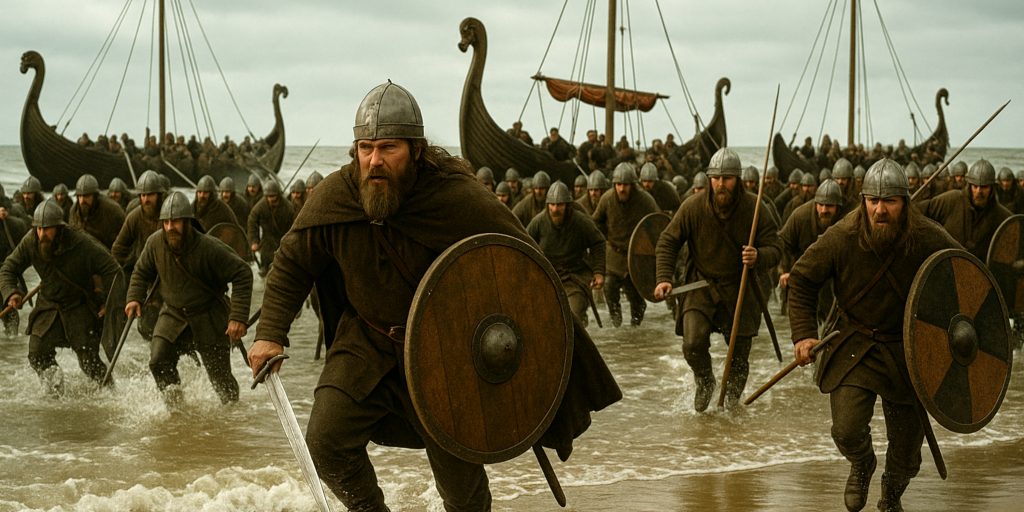
Alfred’s early reign was defined by survival. He fought a string of battles against Danish forces led by Guthrum. Some went well. Others did not.
The low point came in 878. The Vikings launched a surprise winter attack at Chippenham. Alfred was forced into hiding in the Somerset marshes at Athelney. It is one of those moments historians love because it feels uncomfortably human. The king reduced to a fugitive, trying to work out what went wrong.
He did not stay there long.
Battles and Military Acumen
Alfred’s reputation rests on one key victory and the system he built around it.
Key Battles
Battle of Ashdown (871)
A hard-fought early victory where Alfred showed initiative, attacking before the main force was fully assembled. Risky, but it worked.
Battle of Edington (878)
The decisive moment. Alfred regrouped, gathered forces, and met Guthrum in open battle. The Anglo-Saxon shield wall held. The Viking army broke.
Aftermath
Guthrum converted to Christianity and withdrew to East Anglia. It was not total peace, but it bought Alfred breathing room.
Military Reforms
Alfred understood that reacting to Viking raids was not enough. He changed how war was organised.
- Burh System
A network of fortified towns across Wessex. Not just defensive walls, but logistical hubs. If you map them, they form a grid that limits how far raiders can move unchecked. - Rotating Fyrd
Instead of calling all men to arms at once, Alfred split the levy. One half served while the other farmed. It sounds simple, but it solved a serious problem. Armies could now stay in the field longer. - Naval Development
Alfred experimented with larger, more stable ships. Early English naval thinking starts here, even if it was still rough around the edges.
There is a quiet intelligence to all of this. Alfred did not just win a battle. He made it harder to lose the next one.
Arms and Armour
The equipment used during Alfred’s reign reflects a mix of Anglo-Saxon tradition and Scandinavian influence.
Common Weapons
- Swords
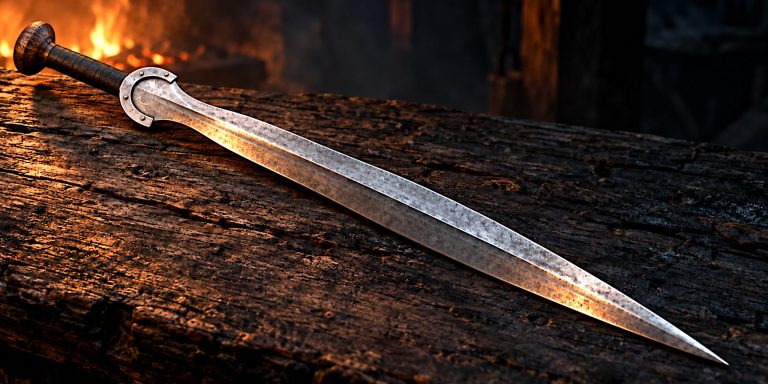
- Pattern welded blades were still in use, though high-status pieces were increasingly steel-edged
- Double-edged, broad blades suited for cutting and thrusting
- Often carried by elite warriors
- Seaxes
- Single-edged blades ranging from utility knives to long fighting weapons
- Widely used across all ranks
- Spears
- The most common battlefield weapon
- Versatile, cheap, and effective in shield wall combat
- Axes
- Both tools and weapons
- Viking styles influenced heavier combat axes
Armour and Protection
- Helmets
- Rare and expensive
- Likely similar in construction to earlier finds such as Sutton Hoo
- Mail Shirts
- Worn by wealthier warriors and nobles
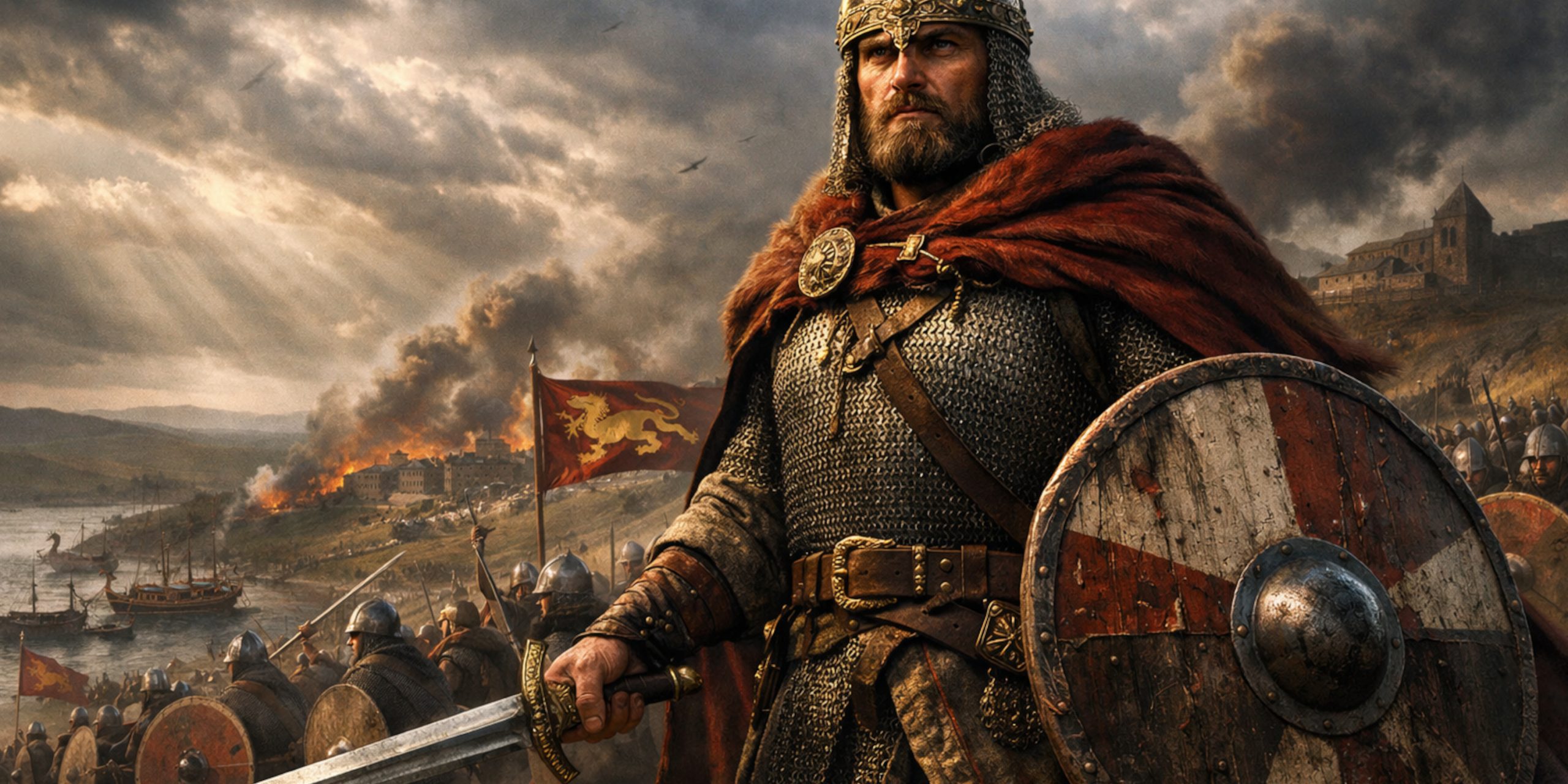
- Offered solid protection against cuts
- Shields
- Round, wooden, iron boss at the centre
- Essential for the shield wall
Alfred himself likely wore high-status gear, though no confirmed personal equipment survives. That absence is frustrating, but not unusual for the period.
Governance, Learning, and Reform
After Edington, Alfred turned inward. Not in retreat, but in reconstruction.
He promoted literacy among clergy and nobles, commissioned translations of key texts into Old English, and took an active role in governance. Law codes were revised. Administration became more consistent.
There is a sense that Alfred saw ignorance as a strategic weakness. If people cannot read, they cannot govern effectively. It is a surprisingly modern concern.
Artefacts and Where to See Them
No confirmed personal sword or armour of Alfred survives, but several artefacts are closely tied to his reign.
Key Artefacts
- The Alfred Jewel
A finely crafted object, likely used as a pointer for reading. Inscribed with “AELFRED MEC HEHT GEWYRCAN” meaning “Alfred ordered me to be made.” - Anglo-Saxon Coins of Wessex
Reflect economic reforms and royal authority - Burh Remains
Earthworks and town layouts still visible in places like Winchester
Where to See Them
- Ashmolean Museum
Houses the Alfred Jewel, one of the most iconic objects from his reign - British Museum
Extensive Anglo-Saxon collections including coins and weaponry - Winchester
Alfred’s capital, with layers of archaeological remains
Archaeology and Latest Findings
Recent work has focused less on singular treasures and more on systems.
- Excavations of burh sites show planned layouts, suggesting central coordination rather than ad hoc defence
- Landscape studies in Somerset continue to refine our understanding of Athelney and Alfred’s refuge
- Coin hoards from the period highlight economic stabilisation after decades of disruption
Archaeology here tells a story of recovery. Not dramatic, but steady. You can almost see the kingdom stitching itself back together.
Legacy
Alfred died in 899. Wessex did not fall after him, which might be the most telling measure of his success.
His descendants, including Edward the Elder and Aethelstan, expanded what he built. By the early 10th century, the idea of a unified England was no longer theoretical.
Alfred did not create England outright, but he made it possible. He stabilised the ground so others could build on it.
A Historian’s View
There is something appealing about Alfred that goes beyond the usual royal narrative. He is not a flawless warrior king. He loses battles. He makes mistakes. He hides in marshes and has to rethink everything.
Then he comes back with better answers.
That is the part that sticks. Not just survival, but adaptation. Alfred looks at a problem, changes the system, and leaves behind something that works.
History tends to reward that kind of thinking, even if it does not always look heroic in the moment.