The Mughal dynasty ruled parts of the Indian subcontinent for more than three centuries, although that simple sentence conceals several very different empires. Babur’s realm was a precarious conquest won by cavalry and gunpowder. Akbar built a durable imperial system. Shah Jahan presided over a court of almost theatrical magnificence. Aurangzeb extended Mughal authority farther than any predecessor, yet left behind a state strained by war. By the time Bahadur Shah Zafar was deposed in 1857, the emperor commanded poetry more effectively than provinces.
The Mughals were descendants of Timur through Babur’s father and claimed descent from Chinggis Khan through his mother. They came from the Persianate and Turkic world of Central Asia, but their empire became thoroughly rooted in South Asia. Its ruling class included Central Asian, Iranian, Afghan, Indian Muslim, Rajput and other Hindu elites. Its culture drew upon Persian, Indian, Islamic and regional traditions. To describe it simply as a foreign Muslim dynasty ruling Hindu India is convenient, politically useful to some, and historically inadequate.
At its height, the empire governed most of the subcontinent and stood among the wealthiest states in the world. It produced formidable armies, intricate revenue systems, exquisite manuscripts, planned cities and buildings that still make modern governments look rather timid. It also depended upon heavy agrarian taxation, coercive conquest and the personal authority of the emperor. Mughal splendour was real, but somebody always paid for the marble.
Mughal Dynasty at a Glance
| Detail | Information |
|---|---|
| Conventional beginning | 1526, after Babur’s victory at the First Battle of Panipat |
| Political end | 1857, with the deposition of Bahadur Shah II after the uprising |
| Dynastic founder | Zahir al-Din Muhammad Babur |
| Ancestry | Timurid on the paternal side, with Chinggisid ancestry claimed through Babur’s mother |
| Principal capitals | Agra, Fatehpur Sikri, Lahore, Shahjahanabad and, during Aurangzeb’s later reign, the mobile Deccan court |
| Court language | Persian, while many other languages flourished across the empire |
| State religion | Islam, although policy towards other faiths varied considerably by ruler, region and political circumstance |
| Economic foundation | Agricultural production and land revenue, supported by manufacturing and extensive domestic and overseas trade |
| Famous monuments | Humayun’s Tomb, Agra Fort, Fatehpur Sikri, Taj Mahal, Red Fort and Jama Masjid |
| Last emperor | Bahadur Shah II, also known as Bahadur Shah Zafar |
Where Did the Mughals Come From?
The English word Mughal derives from Mongol, but the dynasty did not think of itself in the crude ethnic terms the name can suggest. Babur identified strongly with his Timurid inheritance. He wrote in Chagatai Turkic, admired Persian literature and longed for the Central Asian homeland he had repeatedly tried and failed to hold.
Born in the Fergana Valley in 1483, Babur inherited a small principality at the age of eleven. He captured and lost Samarkand more than once before establishing himself in Kabul in 1504. India was not initially the inevitable object of his ambitions. It became the direction in which opportunity remained open.
The dynasty brought Timurid ideas of kingship, garden design, literary culture and military organisation into a region with its own mature political traditions. It then absorbed practices from the Delhi Sultanate, the Sur regime, Rajput courts and local systems of revenue collection. Mughal rule was therefore neither an untouched Central Asian import nor a seamless continuation of earlier Indian government. It was an unusually successful act of political adaptation.
Babur and the Conquest of North India
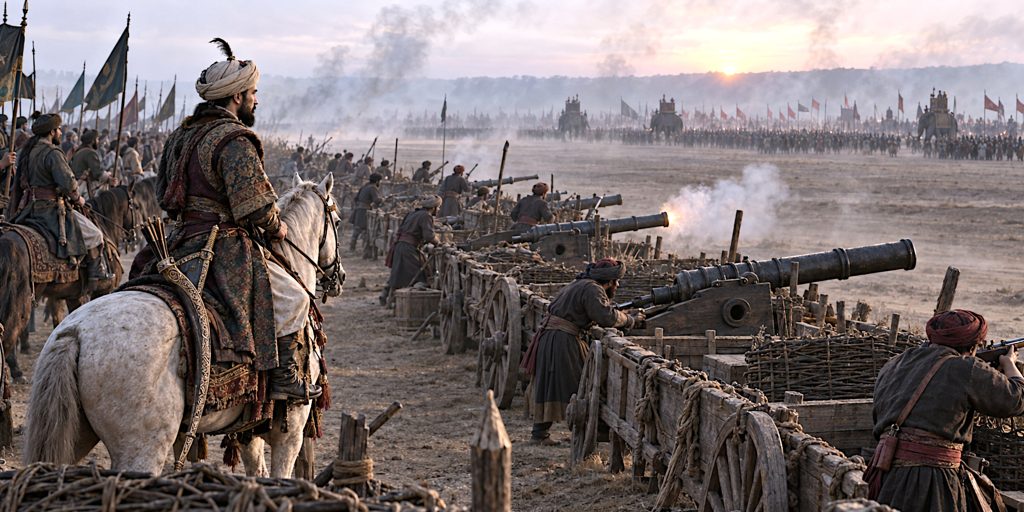
Babur invaded northern India at a moment when the Lodi Sultanate was divided. At the First Battle of Panipat on 21 April 1526, his smaller army defeated Sultan Ibrahim Lodi. Field fortifications, carts linked by rawhide ropes, matchlock men and artillery helped Babur resist and disrupt the much larger Lodi force. Firearms alone did not win the battle, but Babur used them within a coherent tactical system.
Victory at Panipat gave him Delhi and Agra, not unquestioned mastery. In 1527 he defeated the Rajput confederacy led by Rana Sanga of Mewar at Khanwa. He overcame Afghan opposition at Ghaghra in 1529. These campaigns established Mughal power in the Indo-Gangetic plain, although the regime remained young and vulnerable.
Babur’s memoirs, the Baburnama, reveal a ruler of startling candour. He recorded battles, gardens, plants, intoxicants, family quarrels and his own disappointments. His observations on India could be admiring, curious and sharply critical. Few conquerors have left us such an intimate account of their tastes. Most wisely employ someone to remove the embarrassing parts.
Babur died in 1530. His son Humayun inherited territory, enemies and relatives, which is very often the full royal package.
Humayun, Exile and Restoration
Humayun struggled against his brothers and against the Afghan leader Sher Khan, later Sher Shah Suri. Defeats at Chausa in 1539 and Kannauj in 1540 drove him from India. The Sur dynasty then ruled much of northern India.
Sher Shah’s reign was brief but important. His administration strengthened roads, communications, coinage and revenue practices later used or developed by the Mughals. This is an awkward point for any tale of uninterrupted Mughal genius, but history rarely arranges itself for dynastic publicity.
Humayun spent years in exile and received Safavid assistance in Persia. He recovered Kabul and eventually retook Delhi in 1555. His restoration lasted only months. In January 1556 he died after falling on the stairs of his library, reportedly while responding to the call to prayer. His thirteen-year-old son Akbar inherited the restored but insecure empire.
Akbar and the Creation of an Imperial System
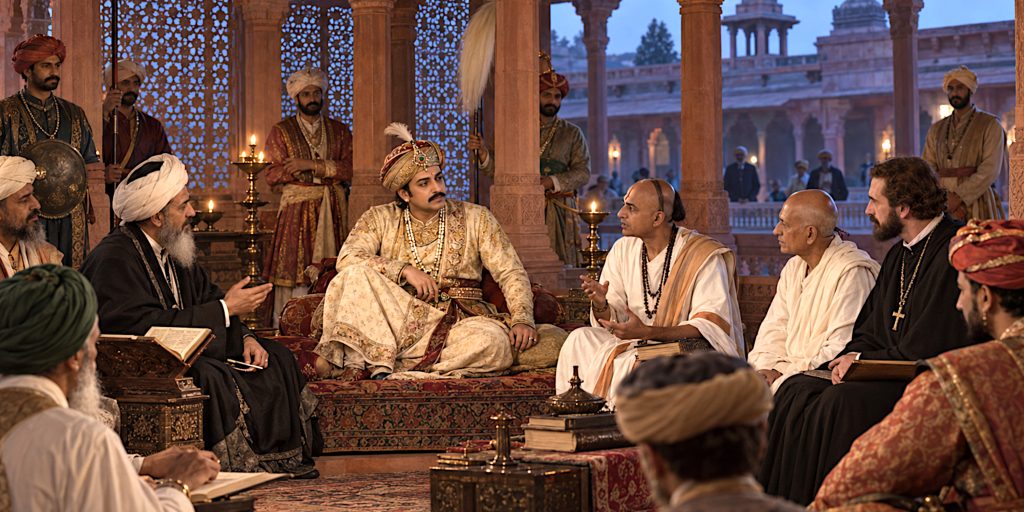
Akbar reigned from 1556 to 1605 and transformed a recovered kingdom into a powerful empire. His regent, Bairam Khan, helped secure the throne by defeating Hemu at the Second Battle of Panipat in 1556. Akbar subsequently took personal control and pursued expansion across northern and central India, Gujarat, Bengal, Kashmir, Sindh and parts of the Deccan.
His achievement was institutional as much as military. He incorporated Rajput rulers through diplomacy, marriage alliances and imperial service, although resistance continued, most famously from Mewar. Rajput officers became prominent within the Mughal elite. This was not modern tolerance or equality. It was a practical and often imaginative system for turning former rivals into stakeholders.
Akbar abolished the pilgrimage tax and, in 1564, the jizya levied on non-Muslims. He sponsored debates among Sunni and Shia Muslims, Hindus, Jains, Christians, Zoroastrians and others at Fatehpur Sikri. His principle of sulh-i kul, usually translated as universal peace, encouraged government above narrow sectarian affiliation. His court also produced Persian translations of Sanskrit works, including the Mahabharata.
The emperor’s religious thought became highly personal. The so-called Din-i Ilahi was not a mass religion and attracted only a small circle of disciples. It is better understood as an ethical fellowship bound to Akbar than as an attempted replacement for Islam or Hinduism.
Akbar’s reign provided the administrative skeleton upon which later emperors relied. It also strengthened the emperor’s personal centrality. A system built around an exceptional ruler can work splendidly, right until it encounters a rather ordinary one.
Jahangir and the Politics of the Court
Akbar was succeeded in 1605 by his son Salim, who took the regnal name Jahangir, meaning world-seizer. He inherited a functioning empire and a court rich in talent, rivalry and family tension.
Jahangir cultivated painting, natural history and imperial justice. His memoirs, the Tuzuk-i Jahangiri, record political affairs alongside close observations of animals, plants and unusual events. Mughal artists under Jahangir developed a remarkably precise style of portraiture and naturalistic study, combining Persianate techniques with Indian and European influences.
Nur Jahan, whom Jahangir married in 1611, became one of the most powerful women in Mughal history. Coins were struck in her name, imperial orders bore her authority and her family occupied important positions. Describing her simply as the scheming woman behind a weakened emperor tells us more about an old discomfort with female power than it does about the Mughal court.
The reign saw conflict with the kingdom of Mewar, campaigns in the Deccan and the loss of Kandahar to Safavid Persia in 1622. It also brought increasing contact with European trading companies. Sir Thomas Roe served as ambassador for James I at Jahangir’s court from 1615 to 1619, seeking commercial privileges for the English East India Company.
Shah Jahan and the Architecture of Authority
Prince Khurram seized the throne in 1628 as Shah Jahan after a violent succession struggle. There was no fixed law of primogeniture among the Mughals. Princes were expected to prove themselves, and their brothers were generally expected not to survive the proof.
Shah Jahan’s reign is associated with architectural refinement and courtly magnificence. He commissioned the Taj Mahal at Agra as the mausoleum of his wife Mumtaz Mahal, who died in 1631 following childbirth. The complex united a domed marble tomb, mosque, guest building, monumental gateway and carefully ordered garden. Its beauty should not obscure its political meaning. Mughal architecture expressed sovereignty, cosmic order and dynastic memory in stone.
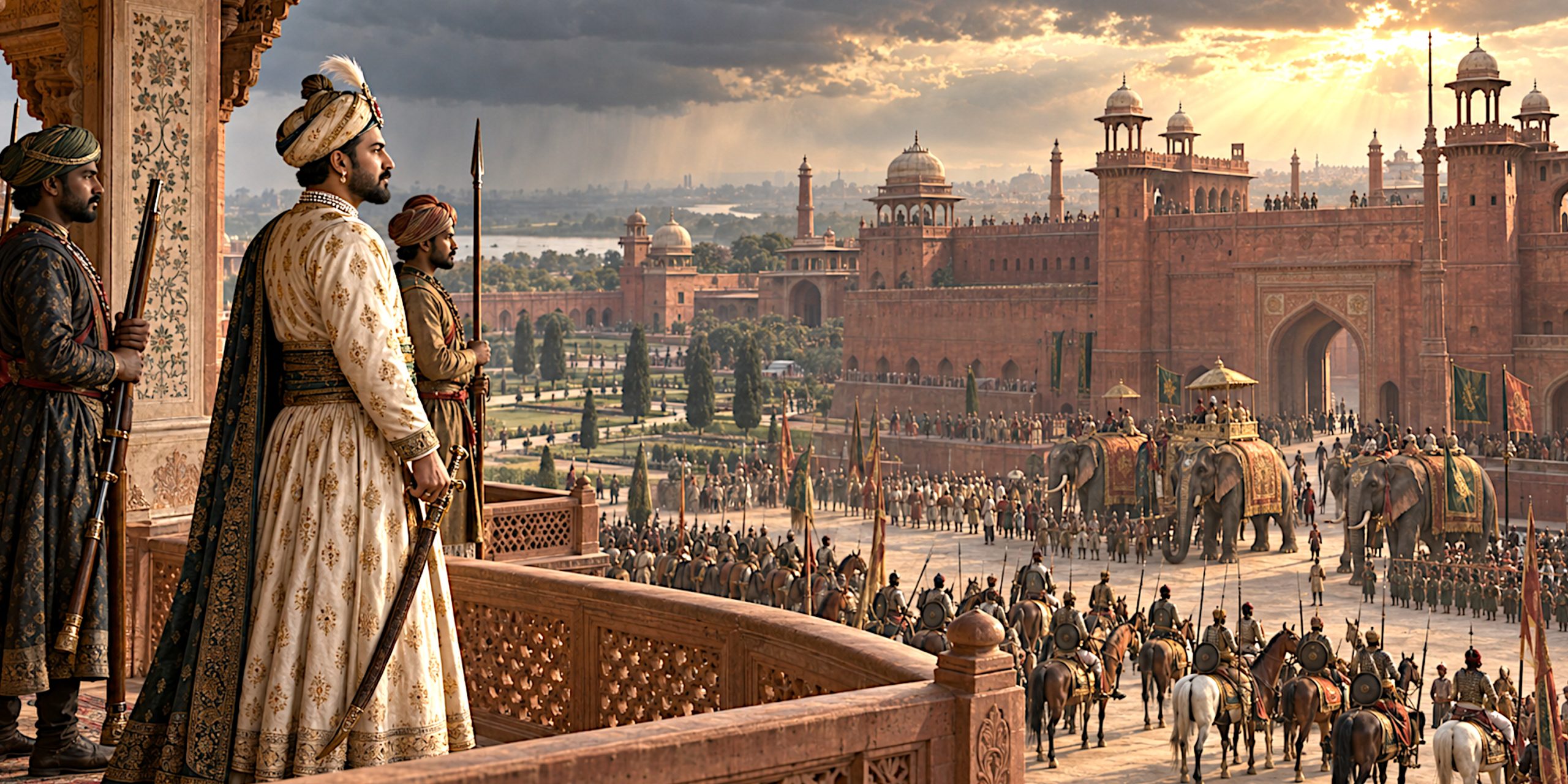
He also rebuilt Delhi as Shahjahanabad, constructing the Red Fort and Jama Masjid. The Peacock Throne became a concentrated statement of wealth and kingship. Court ritual grew more formal, placing the emperor at the centre of an ordered hierarchy.
Military campaigns recovered Kandahar in 1638 but failed to retain it after the Safavids reconquered the city in 1649. Deccan warfare continued, and imperial resources remained substantial. Shah Jahan’s reign was prosperous at court, but prosperity was unevenly distributed. Monumental splendour and severe agrarian pressure could occupy the same landscape without contradiction.
In 1657 the emperor fell ill, prompting war among his sons Dara Shukoh, Shah Shuja, Murad Bakhsh and Aurangzeb. Aurangzeb emerged victorious, imprisoned his father at Agra and took the throne in 1658.
Aurangzeb and the Empire at Its Greatest Extent
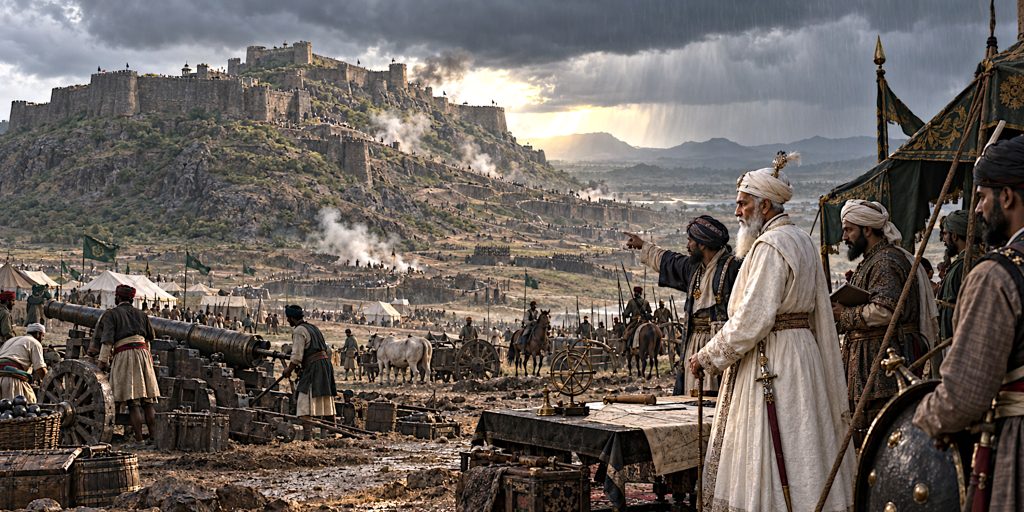
Aurangzeb Alamgir ruled for nearly fifty years, from 1658 to 1707. Under him the empire reached its greatest territorial extent, absorbing the Deccan sultanates of Bijapur and Golconda and campaigning deep into southern India. Yet expansion brought diminishing returns. Aurangzeb spent the final decades of his reign directing exhausting wars against the Marathas and other opponents.
His religious policies remain fiercely contested. Aurangzeb was personally more orthodox than Akbar and reimposed the jizya in 1679. Some temples were destroyed or converted under imperial orders, particularly when associated with rebellion or contested authority. Other Hindu religious institutions received grants or protection, and Hindu officials continued to serve in large numbers. Neither the image of an entirely tolerant pragmatist nor that of a ruler driven only by religious hatred can contain the evidence.
He commissioned the Fatawa-i Alamgiri, a large compilation of Hanafi law, restricted some courtly practices and presented himself as a disciplined Islamic sovereign. Political calculation, fiscal need, personal faith and the habits of conquest all shaped his government. Historians should resist reducing a half-century reign to a single motive, tempting though that is for anyone with a slogan to sell.
Aurangzeb faced Rajput tensions, Sikh resistance, Jat and Satnami uprisings, and the mobile warfare of the Marathas under Shivaji and his successors. The execution of the ninth Sikh Guru, Tegh Bahadur, in 1675 and the later conflict with Guru Gobind Singh had enduring consequences. In the Deccan, forts could be captured, lost and besieged again while imperial armies consumed money, animals and men at an alarming rate.
When Aurangzeb died in 1707, the empire was enormous but overextended. Its institutions had not simply collapsed, yet the balance between revenue, military obligation and political loyalty had become increasingly difficult to maintain.
How the Mughal Empire Was Governed
The emperor stood at the centre of government, but rule depended on negotiation with nobles, landholders, merchants, clerks, military commanders and regional powers. Orders sent from court did not automatically become reality in a distant village. The Mughal state was strong, but not magically omnipresent.
The empire was divided into provinces called subahs, each governed by officials whose responsibilities were deliberately separated. The subahdar exercised provincial executive and military authority, while the provincial diwan oversaw revenue. Below the province stood units including the sarkar, pargana and village.
At the imperial centre, important officers included:
- The diwan or wazir, responsible for finance and revenue administration
- The mir bakhshi, who supervised military appointments, intelligence and the mansab system
- The sadr-us-sudur, associated with religious grants and judicial appointments
- The mir saman or khan-i saman, who managed the imperial household and workshops
- The qazi, who administered aspects of Islamic law, alongside numerous local and customary legal practices
Imperial orders, revenue records, news reports and petitions generated a substantial paper administration. The Mughal Empire was a courtly monarchy, but it was also a bureaucracy with an appetite for figures.
The Mansabdari and Jagirdari Systems
The mansabdari system ranked imperial officers and tied status to service. A mansabdar received a numerical rank. Under the mature system, zat indicated personal status and salary, while sawar indicated the cavalry obligation attached to the rank.
Many officers were paid through a jagir, an assignment of revenue from designated lands. A jagirdar did not normally own the territory outright. He held the right to collect assessed revenue for a period, while imperial officials attempted to monitor the assignment. Transfers were intended to prevent officers from developing independent territorial bases.
In theory this joined administration, military service and revenue into one elegant structure. In practice, assessed income did not always match actual collection, officials sought profit before transfer, peasants bore much of the pressure and competition for productive jagirs could become fierce.
By the late seventeenth and early eighteenth centuries, the number and expectations of mansabdars strained the available assignments. Historians debate the scale and meaning of this jagirdari crisis, but the mismatch between imperial obligations and collectible resources was plainly serious.
Land Revenue, Agriculture and the Rural Population
Agriculture supported the empire. Peasants cultivated wheat, rice, millet, pulses, sugar cane, cotton, indigo and other crops across highly varied ecological regions. New World crops such as maize, tobacco and chillies entered Indian agriculture and consumption during the Mughal period.
Under Akbar, Raja Todar Mal was associated with reforms that measured cultivated land, classified soils and calculated assessments using average yields and prices. The zabt system was best suited to areas where measurement and cash assessment were practical. It was not applied uniformly across the whole empire. Revenue could also be collected through crop-sharing and other local arrangements.
The state’s demand was substantial, often approaching a large share of estimated produce. Zamindars acted as local chiefs, landholders or intermediaries, depending upon region and circumstance. They could collect revenue, command armed followers and resist imperial pressure.
Rural society was not static. Cultivation expanded, forests were cleared and market production increased. Yet famine, warfare, excessive collection and local oppression could be devastating. Court chronicles celebrated abundance because courts have always preferred abundance, especially when someone else grows it.
Trade, Manufacturing and Global Wealth
Mughal India was a major centre of textile production. Cotton cloth from Gujarat, Bengal and the Coromandel Coast reached markets across Asia, Africa and Europe. Bengal also produced silk and other valuable commodities. Indigo, saltpetre, sugar, spices and crafted goods moved through extensive commercial networks.
European companies arrived as relatively minor participants in an older and larger Indian Ocean trading world. Portuguese power was established before Babur’s conquest. Dutch, English and French companies later competed for access. They brought large quantities of American silver to pay for Indian goods, since European manufactures were often less attractive to Asian buyers.
Cities such as Agra, Delhi, Lahore, Ahmedabad, Surat, Dhaka and Burhanpur became important centres of production, administration and trade. Merchants, bankers and brokers financed commerce and sometimes the state itself. Instruments of credit allowed money to move without an unfortunate caravan of coin attracting every bandit between Surat and Agra.
The empire’s wealth was considerable, but modern estimates of its share of world output must be treated carefully. Large population and manufacturing capacity do not mean that the average cultivator lived in luxury. Imperial jewels are poor evidence for peasant comfort.
The Mughal Army
The Mughal army was not a single permanent national force in the modern sense. It combined the emperor’s household troops, contingents supplied by mansabdars, artillery, musketeers, cavalry, infantry, war elephants and forces raised by allied or subordinate rulers.
Cavalry remained central to Mughal warfare. The dynasty inherited the Central Asian tradition of mobile mounted archery, but adapted to Indian conditions and incorporated heavily armed lancers, swordsmen and regional cavalry. Horses were imported from Central Asia, Iran and Arabia because high-quality warhorses were strategically valuable.
Babur’s field artillery and matchlocks were decisive innovations in northern Indian warfare, although gunpowder weapons had appeared in the region before 1526. Later Mughal armies employed large siege guns, lighter field pieces, rockets and matchlock infantry. Artillery was impressive but could be painfully slow. A cannon that required scores of oxen made a fine statement of imperial seriousness, provided the enemy politely remained where expected.
Elephants carried commanders, hauled equipment and contributed shock and spectacle. They could also panic, reverse direction and ruin everyone’s carefully prepared afternoon. Their military value was genuine but conditional.
Mughal power worked best when cavalry mobility, artillery, intelligence, logistics and political alliance supported one another. Its difficulties against the Marathas were not caused by ignorance of warfare. They arose partly because a huge imperial force struggled to dominate mobile opponents across difficult terrain while maintaining long supply lines and endless sieges.
Arms and Armour
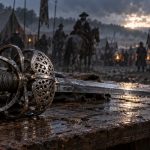
Mughal arms reflected Central Asian, Persian, Indian and European influences. Surviving pieces range from practical campaign weapons to lavish court objects whose decoration proclaimed rank as clearly as any title.
Swords and Bladed Weapons
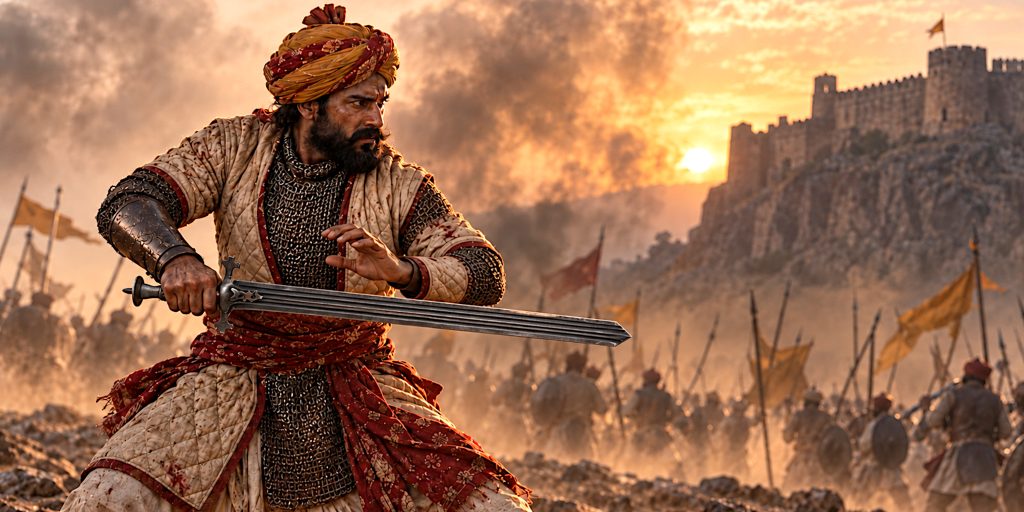
- Talwar: The characteristic curved Indian sword, usually fitted with a disc pommel and compact hilt. It was effective for cutting from horseback or on foot.
- Shamshir: A deeply curved Persianate sabre designed principally for the draw cut. Imported blades and Indian-made examples circulated at elite courts.
- Firangi: An Indian sword mounted with a straight European blade, often Portuguese, Spanish, Italian or German in origin. Its name derived from a term for Europeans or foreigners. Firangis could use extended Indian hilts and were prestigious weapons among nobles and warriors.
- Khanda: A straight, broad-bladed Indian sword with a reinforced profile and an established association with elite martial traditions.
- Pata: A gauntlet sword in which the blade extended from a metal hand and forearm guard. It was especially associated with western and central India.
- Katar: The Indian push dagger, held by transverse grips. Katar blades could be plain, reinforced, pierced or elaborately decorated.
- Jamdhar and bichwa: Forms of dagger used for personal defence, ceremony and close combat.
Missile Weapons and Firearms
The composite bow remained important, particularly for cavalry. Mughal paintings frequently show nobles with bows, quivers and matchlocks. The toradar, an Indian matchlock, appeared in varied forms with wooden stocks and long barrels. Some were finely decorated, but they remained functional firearms rather than ornaments with an identity crisis.
Polearms and Other Weapons
Spears and lances served cavalry and infantry. Maces, axes and various forms of battle pick were also used. Ceremonial arms could retain genuine combat forms while serving as badges of office or rank.
Armour and Shields
Armour included mail shirts, plate-and-mail defences, helmets, arm guards and quilted coats. The zirah bagtar combined mail with rows of plates. The chahar aina, or four mirrors, consisted of four large plates protecting the torso, often worn over mail. Shields called dhal were made from hide or steel and commonly fitted with four bosses.
Firearms did not immediately remove armour from the battlefield. Protection evolved unevenly according to wealth, role and changing weapons. Elite armour was sometimes inscribed or decorated in gold, which did nothing to stop a bullet but greatly improved one’s appearance while being shot at.
Forts, Sieges and Military Landscapes
Control of forts was essential to Mughal strategy. Agra Fort, Lahore Fort and the Red Fort were imperial residences as well as military structures. Elsewhere, hill forts and walled strongholds guarded routes, territories and local power.
Siege warfare required artillery, miners, engineers, supply trains and negotiation. Commanders frequently combined assault with bribery, blockade or promises of rank. A gate opened by political agreement was generally cheaper than one battered down by cannon.
The Deccan wars exposed the limits of siege-based conquest. Capturing a fort did not necessarily pacify the surrounding countryside, while garrisons consumed resources and could be isolated. Maratha commanders exploited speed, local intelligence and a network of strongholds to exhaust imperial armies.
Religion and Imperial Policy
The Mughal emperors were Muslims ruling a population that was predominantly non-Muslim and religiously diverse. Their policies changed over time and were never experienced identically across every province.
Akbar’s inclusion of Rajput elites and advocacy of sulh-i kul created a broad imperial culture. Jahangir and Shah Jahan retained much of this political framework while expressing Islamic kingship more conventionally. Aurangzeb’s reign brought a more explicitly orthodox style, the restoration of jizya and prominent acts against certain temples. It also retained Hindu nobles, negotiated with non-Muslim powers and issued grants to some religious establishments.
Temple destruction under Mughal rule must be neither denied nor stripped of context. Temples could be targeted as centres of rival sovereignty, punished for association with rebellion or attacked from sectarian conviction. Political and religious motives were often intertwined. Pre-modern rulers were quite capable of acting from more than one disagreeable reason at once.
The period also saw the growth of Sikh institutions. Relations with the Mughal state varied from accommodation to violent confrontation. The executions of Guru Arjan under Jahangir and Guru Tegh Bahadur under Aurangzeb became central memories in Sikh history, while Guru Gobind Singh’s founding of the Khalsa in 1699 reshaped Sikh community and resistance.
Sufi orders, Islamic scholars, Hindu devotional traditions, Jain communities and Christian missions all participated in the religious landscape. Court policy mattered, but belief was never confined to court.
Women of the Mughal Dynasty
Mughal women exercised influence through property, patronage, marriage alliances, commercial activity and access to the emperor. The imperial household was secluded according to elite custom, but seclusion did not mean political absence.
Gulbadan Begum, Babur’s daughter, wrote the Humayun-nama, an invaluable account of the dynasty’s early decades. Hamida Banu Begum accompanied Humayun through exile. Akbar’s foster mothers and female relatives formed powerful networks around the young ruler.
Nur Jahan exercised exceptional authority during Jahangir’s reign. Mumtaz Mahal was a trusted companion to Shah Jahan as well as the woman memorialised by the Taj Mahal. Jahanara Begum, their daughter, became a major patron, landholder and respected Sufi author. Roshanara Begum supported Aurangzeb during the succession war and gained considerable standing afterward. Zeb-un-Nissa, Aurangzeb’s daughter, was a learned princess and poet.
These women did not possess modern political equality, and their opportunities were shaped by rank and family. Even so, an account that leaves them behind a decorative screen has misunderstood how dynastic government worked.
Art, Painting and Literature
Mughal painting emerged from Persian manuscript traditions but developed through the work of Indian artists and exposure to European images. Akbar’s large ateliers produced illustrated histories, romances and epics. The Hamzanama, with its vast painted folios, reflects the ambition of his court.
Under Jahangir, artists such as Ustad Mansur produced acute studies of animals and plants, while portraiture became more individualised. Shah Jahan’s manuscripts and albums favoured polish, elegance and formal splendour. As central patronage contracted under Aurangzeb and later rulers, artists moved to regional courts, helping spread and transform Mughal styles.
Persian remained the main language of high administration and court literature. Chagatai Turkic retained dynastic significance, while Sanskrit, Bengali, Punjabi, Braj, Dakhni and other languages flourished. The development of Urdu emerged from long interaction among regional vernaculars and Persianate court culture, rather than from a single imperial decree.
Mughal texts include memoirs, official chronicles, poetry, biographies, legal compilations and administrative surveys. Abu’l-Fazl’s Akbarnama and Ain-i Akbari are indispensable, though they present Akbar through the admiring lens of a favoured courtier. Court histories are rich sources. They are not impartial minutes.
Architecture and Gardens
Mughal architecture joined Persianate forms with Indian materials, craftsmanship and structural traditions. Red sandstone dominated many early imperial projects, while white marble became increasingly prominent under Shah Jahan.
Humayun’s Tomb in Delhi, commissioned by his widow Haji Begum, established a monumental garden-tomb form that influenced later architecture. Akbar’s Agra Fort and Fatehpur Sikri combined palatial, administrative, religious and ceremonial spaces. Jahangir’s period saw refined tomb and garden design, including the tomb of Itimad-ud-Daulah commissioned by Nur Jahan.
The Taj Mahal is the best-known Mughal monument, but it belongs to a much wider architectural programme. Shah Jahan’s Red Fort, Jama Masjid and additions at Lahore and Agra reshaped imperial space. Gardens used water channels, terraces and geometric division to evoke order and paradise.
These structures were created by architects, calligraphers, stonecutters, engineers and labourers whose individual names are often less visible than the emperor’s. Dynastic history has a habit of handing one man the credit for several thousand people’s work.
Food, Dress and Courtly Life
Elite Mughal cuisine combined Central Asian, Persian, Indian and regional practices. Rice dishes, breads, grilled meats, stews, fruits, nuts, sweetmeats and scented preparations appeared at court, although recipes changed across time and place. It is unwise to label every rich north Indian dish “Mughal” merely because cream has entered the room.
Court dress included robes, sashes, turbans, jewellery and weapons suited to rank and occasion. Textiles were a major form of wealth. Jewelled daggers, sword hilts, boxes and vessels displayed extraordinary lapidary skill.
The imperial court operated through carefully staged audiences, gift exchange and visual hierarchy. The emperor appeared at the jharokha, received officials in formal halls and distributed robes of honour. Ceremony was government made visible. Who stood where, wore what and received which gift could have direct political meaning.
Contemporary Voices
The Mughal period is unusually rich in first-person and courtly testimony, though every writer had a position to defend.
Babur wrote in the Baburnama of Hindustan’s unfamiliar landscape and customs with a mixture of fascination and homesickness. His famous complaints about the absence of good grapes, melons and cold water are revealing. Conquest, apparently, did not compensate for disappointing fruit.
Abu’l-Fazl presented Akbar as a divinely illuminated sovereign whose reason rose above sectarian division. His praise is politically charged, but the Ain-i Akbari preserves exceptional detail about offices, ranks, revenue, prices, crops and court organisation.
Jahangir’s memoir records his fascination with precise observation. He ordered unusual animals and natural phenomena to be examined and painted, allowing court art to serve curiosity as well as display.
The French traveller François Bernier, who spent years in Mughal India during the seventeenth century, admired its wealth but criticised landholding and government. His comparisons with Europe were shaped by his own intellectual and political assumptions. European travellers are valuable witnesses, not visiting inspectors from the future.
Bahadur Shah Zafar’s Urdu poetry gives the dynasty’s final years a painfully personal voice. The verses associated with exile, loss and displacement helped turn the last emperor into a symbol far larger than his remaining political authority.
Archaeology and Surviving Evidence
Mughal history survives through architecture, excavated settlements, inscriptions, coins, weapons, ceramics, manuscripts and administrative documents. Archaeology is particularly valuable when court chronicles overlook ordinary activity or when later rebuilding has obscured earlier phases.
At Fatehpur Sikri, archaeology and architectural study reveal a planned imperial centre containing palaces, audience spaces, workshops, water systems and religious buildings. Its abandonment as the principal capital was not necessarily caused by one simple water crisis. Strategic movement, the north-western frontier and the logistical demands of court all contributed.
Excavations and conservation at forts in Agra, Delhi and Lahore have identified successive construction phases. Buildings were altered by later Mughal rulers, regional powers and the British. What visitors see today is often a layered site, not a palace frozen at the moment of completion.
Coins help trace sovereignty, mints and economic circulation. Akbar’s experimental religious language, Jahangir’s portrait and zodiac issues, and coins bearing Nur Jahan’s name expose political ideas that texts sometimes soften. Weapons and armour in collections preserve workshop techniques, inscriptions and patterns of cultural exchange, although ceremonial objects survive more readily than the ordinary equipment of common soldiers.
Documentary archives contain revenue papers, imperial orders, court news reports and correspondence. The evidence is abundant but uneven. The lives of peasants, servants and foot soldiers appear most often when the state wished to tax, command or punish them, which is hardly the introduction they might have chosen.
Why the Mughal Empire Declined
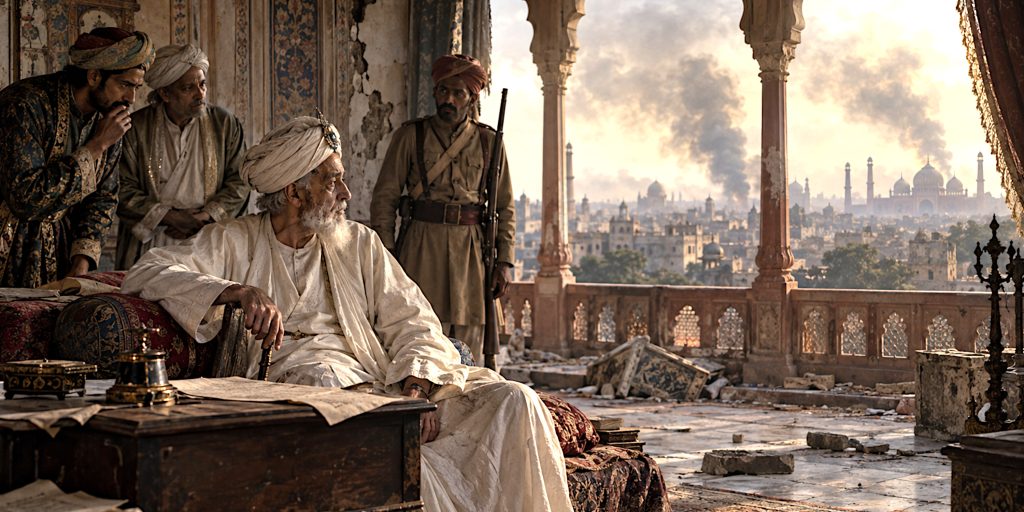
There was no single collapse. Mughal power fragmented through interacting military, fiscal, political and regional changes.
Prolonged Warfare
Aurangzeb’s Deccan campaigns drained money and manpower. Garrisons and sieges imposed long-term costs, while conquest did not guarantee stable collection of revenue.
Succession Struggles
The absence of primogeniture repeatedly produced civil war. Such contests could bring capable rulers to power, but they killed experienced princes, divided nobles and consumed resources.
Fiscal Pressure
Competition for jagirs, inflated revenue assessments and difficulty matching imperial obligations to real income weakened the service structure. Local officials and zamindars had incentives to retain revenue.
Regional Powers
Marathas, Sikhs, Jats and other groups built military and political power. Provincial governors in Bengal, Awadh and Hyderabad became increasingly autonomous while maintaining a formal connection to Mughal legitimacy.
Invasion
The Persian ruler Nader Shah defeated Mughal forces at Karnal in 1739 and sacked Delhi, carrying away immense wealth, including the Peacock Throne. Ahmad Shah Durrani later invaded repeatedly. These attacks exposed weakness and accelerated political fragmentation.
European Companies
The East India Company gradually moved from commerce to territorial power. Its victory at Plassey in 1757 and acquisition of revenue rights in Bengal, Bihar and Orissa in 1765 transformed its finances. The Company exploited Indian alliances, banking networks and soldiers. Britain did not defeat a united India from outside in one campaign. Company rule grew inside a fractured political world using Indian resources on a formidable scale.
The empire’s decline was therefore also a period of regional state formation and cultural creativity. Hyderabad, Awadh, Bengal, Mysore, Maratha polities and Sikh power were not merely debris. They were active successors competing over resources and legitimacy.
The Later Emperors
After Aurangzeb, rulers followed in rapid and often violent succession. Bahadur Shah I attempted compromise but reigned only from 1707 to 1712. Farrukhsiyar was elevated and later deposed by the influential Sayyid brothers. Muhammad Shah ruled from 1719 to 1748 and patronised culture, but his reign included Nader Shah’s catastrophic invasion.
Shah Alam II spent years away from Delhi and became entangled with competing Indian powers and the East India Company. After the Company secured the diwani of Bengal, Bihar and Orissa in 1765, imperial authority was increasingly used to legitimise power exercised by others.
In 1803 the East India Company captured Delhi. The emperor remained in the Red Fort as a pensioner and symbolic sovereign. Mughal titles, coins and ceremonies still mattered because legitimacy can survive political strength by an inconveniently long margin.
Bahadur Shah Zafar and the End in 1857
Bahadur Shah II ascended the throne in 1837. Known by his poetic name Zafar, he presided over a refined literary court in Delhi but wielded little authority beyond the palace.
When Company soldiers rebelled in 1857 and reached Delhi, they proclaimed the elderly emperor as their sovereign. Zafar’s position was deeply constrained. He became the symbolic centre of a diverse uprising he did not command. Rebels, princes, soldiers and civilians pursued different aims, while violence struck Europeans, Indians, Christians and others.
British forces retook Delhi in September after a brutal siege. The city was subjected to killing, expulsion and destruction. Several of Zafar’s sons were shot by Major William Hodson. The emperor was tried by a British military commission, deposed and exiled to Rangoon, where he died in 1862.
The British Crown formally replaced East India Company rule in 1858. The Mughal dynasty’s political life had ended, but its cultural and symbolic presence did not.
Timeline of the Mughal Dynasty
| Year | Event |
|---|---|
| 1483 | Babur is born in the Fergana Valley |
| 1504 | Babur captures Kabul |
| 1526 | Babur defeats Ibrahim Lodi at the First Battle of Panipat |
| 1527 | Mughal victory over Rana Sanga’s confederacy at Khanwa |
| 1530 | Babur dies and Humayun succeeds him |
| 1540 | Humayun loses northern India to Sher Shah Suri |
| 1555 | Humayun recovers Delhi |
| 1556 | Humayun dies; Akbar succeeds and Mughal forces win the Second Battle of Panipat |
| 1564 | Akbar abolishes the jizya |
| 1571 | Imperial court moves to Fatehpur Sikri |
| 1605 | Akbar dies and Jahangir succeeds |
| 1611 | Jahangir marries Nur Jahan |
| 1628 | Shah Jahan takes the throne |
| 1631 | Mumtaz Mahal dies; work on the Taj Mahal follows |
| 1648 | Shahjahanabad becomes the imperial capital |
| 1658 | Aurangzeb defeats his rivals and seizes power |
| 1675 | Guru Tegh Bahadur is executed in Delhi |
| 1679 | Aurangzeb reimposes the jizya |
| 1686 to 1687 | Bijapur and Golconda fall to the Mughals |
| 1707 | Aurangzeb dies |
| 1739 | Nader Shah defeats the Mughals and sacks Delhi |
| 1757 | East India Company victory at Plassey |
| 1765 | Company receives the diwani of Bengal, Bihar and Orissa |
| 1803 | East India Company captures Delhi |
| 1837 | Bahadur Shah Zafar becomes emperor |
| 1857 | Uprising, siege of Delhi and deposition of Bahadur Shah Zafar |
| 1858 | British Crown rule formally replaces Company government |
| 1862 | Bahadur Shah Zafar dies in exile in Rangoon |
The Main Mughal Emperors
| Emperor | Reign | Historical significance |
|---|---|---|
| Babur | 1526 to 1530 | Founded the empire through victories at Panipat, Khanwa and Ghaghra |
| Humayun | 1530 to 1540, 1555 to 1556 | Lost and recovered the empire; strengthened Persian cultural connections during exile |
| Akbar | 1556 to 1605 | Expanded and institutionalised Mughal rule; developed an inclusive imperial elite |
| Jahangir | 1605 to 1627 | Presided over major artistic development and the political ascendancy of Nur Jahan |
| Shah Jahan | 1628 to 1658 | Commissioned celebrated architecture and formalised imperial court culture |
| Aurangzeb | 1658 to 1707 | Brought the empire to its greatest extent while intensifying military and fiscal strain |
| Bahadur Shah I | 1707 to 1712 | Tried to manage the contested inheritance after Aurangzeb |
| Muhammad Shah | 1719 to 1748 | Important cultural patron whose reign included Nader Shah’s invasion |
| Shah Alam II | 1759 to 1806 | Reigned amid Company expansion and the erosion of imperial independence |
| Bahadur Shah II | 1837 to 1857 | Poet-emperor and symbolic leader during the 1857 uprising; last Mughal ruler |
The Mughal Legacy
The Mughal legacy survives in political vocabulary, garden design, architecture, painting, literature, cuisine, clothing, music and the urban histories of cities across South Asia. Persian administrative culture shaped later regional states and early Company government. Mughal artistic traditions dispersed into Rajput, Pahari, Deccani and other schools.
The dynasty also remains politically contested. Akbar and Aurangzeb are repeatedly recruited into modern arguments about religious identity, nationalism and the meaning of India. Their reigns deserve criticism, but they deserve evidence too. Neither emperor lived as a cardboard representative of present-day politics.
For me, the most revealing feature of Mughal history is its capacity for combination. The empire was built through conquest, certainly, but sustained through translation, alliance, negotiation and adaptation. It could be cosmopolitan and violent, administratively brilliant and locally extractive, artistically generous and politically ruthless. Those qualities are not contradictions to be tidied away. Together, they are the history.
The Mughal dynasty did not end because beauty proved weak, because one ruler held the wrong beliefs or because Europeans possessed some effortless superiority. It ended after imperial resources, provincial ambition, regional warfare, invasion and Company expansion altered the political order over generations. That explanation is less dramatic than a single fatal mistake. It is also much closer to the truth.
Frequently Asked Questions
Who founded the Mughal dynasty?
Babur founded Mughal rule in northern India after defeating Ibrahim Lodi at the First Battle of Panipat in 1526.
Were the Mughals Mongols?
The dynasty had both Timurid and Chinggisid ancestry, but Babur’s court culture was Turkic and Persianate. The rulers usually understood themselves primarily through their Timurid lineage rather than as simply Mongol.
Which Mughal emperor was the most powerful?
Akbar created the strongest enduring institutions, while Aurangzeb ruled the empire at its greatest territorial extent. The answer depends upon whether power is measured by consolidation, territory, wealth or long-term stability.
Why was Akbar called the Great?
Akbar greatly expanded the empire, reorganised its administration and incorporated a diverse group of elites. His religious and cultural policies also distinguished his reign.
Did Aurangzeb destroy Hindu temples?
Aurangzeb ordered the destruction or conversion of some temples, especially in politically contested settings. He also granted protection or support to certain Hindu institutions and employed many Hindu officials. The historical record does not support either blanket denial or the claim that he pursued the destruction of every Hindu institution.
When did the Mughal Empire really end?
Mughal political power declined sharply during the eighteenth century, and the emperor came under East India Company control after 1803. The dynasty formally ended when Bahadur Shah Zafar was deposed in 1857.
What was the main weapon of Mughal cavalry?
Mughal cavalry used composite bows, lances and swords. Common sword types included the talwar, shamshir and firangi, with equipment varying by period, rank and regional tradition.