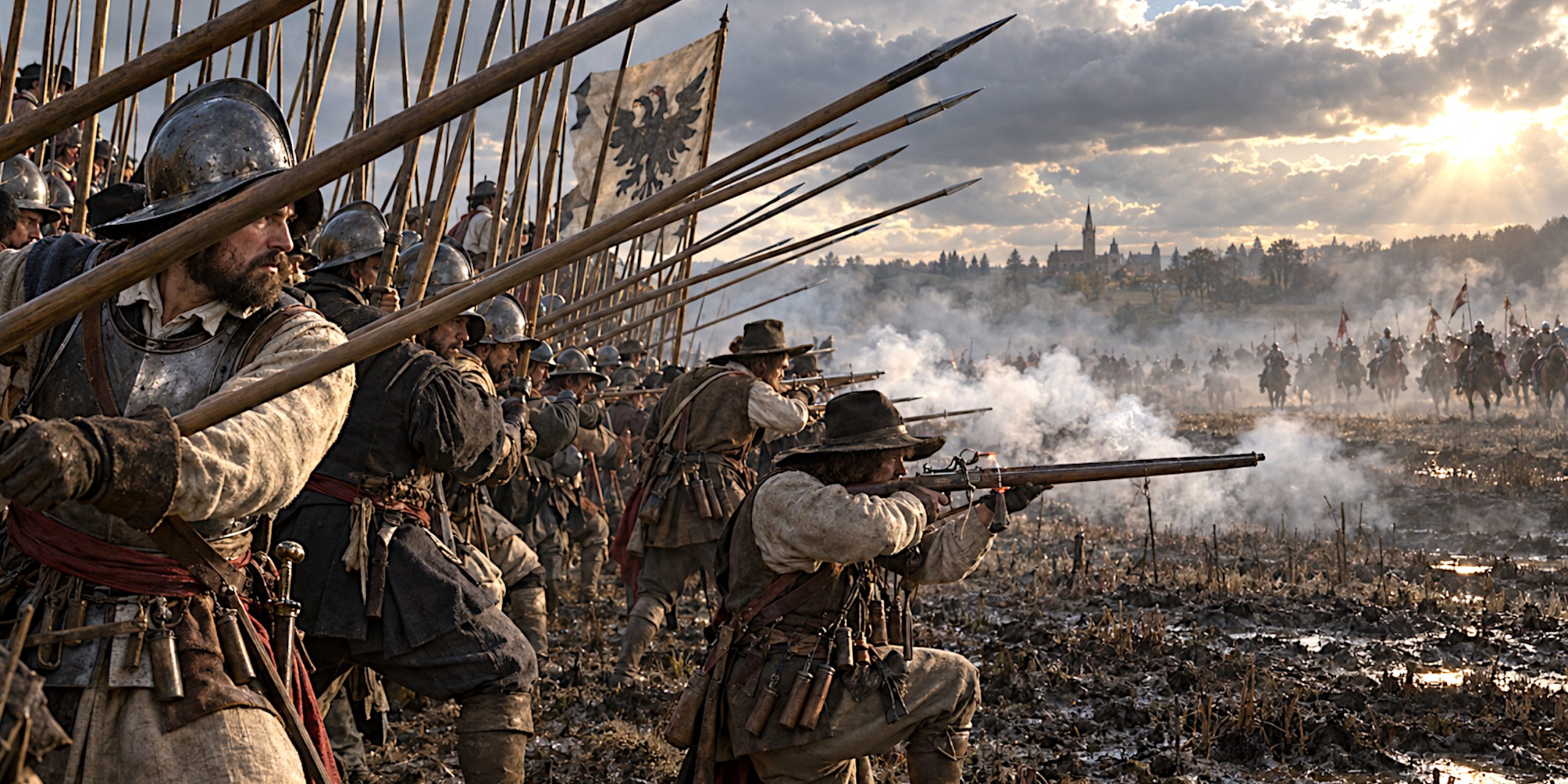
Pikes and firearms shared European battlefields for nearly two centuries. At first sight, it seems an awkward partnership. A pikeman needed both hands and considerable space to manage a long shaft. A musketeer needed powder, a slow match and enough time to reload. Put them together, however, and each could protect the other at the moment he was most vulnerable.
Pike and shot was a method of combining troops, not the name of a single regiment or an unchanging formation. Its proportions and tactics varied between Spanish, Dutch, Swedish, Imperial and British forces. To understand it, we need to look beyond the tidy diagrams. Battles were decided amid smoke, uneven ground, frightened horses and orders that did not always travel as intended.
Pike and Shot at a Glance
| Feature | Typical practice |
|---|---|
| Period | From the late 15th and 16th centuries into the later 17th century, with regional variation |
| Main troops | Pikemen supported by arquebusiers or musketeers |
| Pikeman’s role | Hold ground, threaten cavalry and support the formation in close combat |
| Shot’s role | Deliver missile fire, skirmish and exploit cover |
| Common supporting arms | Cavalry, artillery and sometimes halberdiers or other close combat troops |
| Main weakness | Disruption by terrain, flank attacks, sustained fire or a collapse in cohesion |
Origins and Evolution
Late medieval armies already combined polearms, bows, crossbows and early firearms. Swiss pike formations demonstrated the force of disciplined infantry; German Landsknechts adapted long-pike warfare on a large scale. As handheld firearms became more useful, commanders had to solve a practical problem: gunners could damage an approaching enemy but were exposed while reloading and poorly equipped to face cavalry at close quarters.
The Spanish tercio, which developed in the 16th century, became the most famous answer. Its soldiers could combine a substantial pike body with firearms deployed around it. Yet tercio described an administrative unit as well as troops arranged for battle, and its battlefield shape changed over time. The popular picture of one enormous, permanent square is too neat.
Dutch reforms around the turn of the 17th century placed greater emphasis on drill, smaller tactical units and coordinated movements. Swedish armies under Gustavus Adolphus used formations with more flexible cooperation between shot, pike, cavalry and light artillery. None of this happened overnight. Older and newer arrangements served alongside each other, and commanders borrowed whatever seemed useful.
By the later 17th century the share of firearms had grown, while socket bayonets eventually allowed musketeers to offer a better defence against cavalry without a separate pike body. The transition depended on supply, training and local practice. There was no morning when every pikeman put down his weapon at once, presumably to the relief of everyone who had to carry one.
How Did Pike and Shot Fight?
Pikemen formed a disciplined core or a protective element within a battalion. Their long weapons presented a difficult obstacle to horsemen and could contest an enemy formation at close quarters. Musketeers fired from wings, sleeves, forward positions or nearby cover, depending on the army and the ground. They might withdraw behind the pikes when threatened, then move out again when it was safe to fire.
Early matchlock weapons required many separate actions to load and fire. A soldier carried powder, shot and a burning match; rain, confusion and a shortage of supplies could make the textbook rate of fire irrelevant. Commanders trained ranks to fire in sequence and used countermarches and other drills to keep some weapons ready. Actual practice varied, and volley fire alone did not guarantee victory.
Pikes could not solve every problem. A tightly ordered body was difficult to move through hedges, ditches or broken terrain, and its flanks needed attention. Shot troops could use such ground more readily, but they remained vulnerable if cavalry caught them unsupported. The decisive skill was coordination: advancing, firing, opening gaps and closing them again while the enemy was attempting much the same thing.
Arms and Armour, Including the Swords
| Equipment | Who used it and why |
|---|---|
| Pike | Primarily pikemen; a long thrusting weapon, often roughly four to six metres, with length varying by army and period. |
| Arquebus | An earlier shoulder firearm, common in 16th-century shot formations. |
| Matchlock musket | The familiar firearm of many later pike-and-shot armies. Heavier early examples sometimes used a rest; lighter models could dispense with it. |
| Bandolier, powder flask and shot | Essential loading equipment. Wooden charge containers and their caps could be lost in action. |
| Helmet and breastplate | Commonly associated with pikemen, although issue, quality and coverage varied. Musketeers generally wore less armour. |
| Side sword | A practical one-handed cut-and-thrust sword used by some 16th-century infantry as a secondary weapon. |
| Katzbalger | A short, broad-bladed sword closely associated with 16th-century Landsknechts, especially in surviving examples and imagery. |
| Military rapier or long-hilted cut-and-thrust sword | Worn by some later 16th- and 17th-century soldiers and officers; ‘rapier’ did not always mean an exclusively civilian duelling weapon. |
| Hanger or short backsword | A compact sidearm seen among some 17th-century soldiers. Availability and local terminology varied. |
A sword mattered most after a formation broke, in a crowded struggle, or when a man had lost the use of his primary weapon. It was no substitute for a pike at reach or a musket at distance. Officers might carry better-finished swords and protective gear than ordinary soldiers, so surviving museum pieces can give a misleading impression of a whole regiment’s equipment.
Pikemen could wear breastplates, backplates, helmets and sometimes tassets protecting the upper thighs. Armour was never universal or equally effective. Shot troops needed mobility and the freedom to work a firearm; many fought in ordinary clothing with little more than a sword or helmet for close defence. A polished cuirass in a museum is striking. A long march in it would have offered a less romantic perspective.
Training, Pay and the Soldier’s Experience
Drill books present crisp ranks and exact movements because those were the results commanders wanted. Keeping a match alight, carrying powder safely and handling a pike in company demanded repeated practice. So did recognising an order through gunfire and smoke.
An infantryman’s experience was also shaped by food, wages, disease and the distance to the next supply point. Armies could be formidable in a set battle and still struggle to keep their men fed. Sieges, marches, foraging and garrison duty took up far more of many soldiers’ lives than dramatic clashes between perfectly aligned blocks.
We should also resist assuming that every pikeman was heavily armoured or every musketeer wore the same kit. Equipment could be issued, purchased, replaced, stolen or simply worn out. Surviving regulations tell us what authorities required; inventories, images and excavated objects help show what men actually had.
Contemporary Voices
Accounts from the Battle of Worcester in 1651 reveal how little a real battlefield resembled a drill manual. A contemporary letter described the fighting near Powick as “from hedge to hedge, and very hot”. The wording survives in the Worcestershire Archive and Archaeology Service’s account of the battlefield investigation.
A Parliamentary pamphlet reported that the enemy had “lined their hedges thick with men”. These are short extracts from partisan contemporary accounts, so neither should be mistaken for a complete, neutral description. Together with the excavated shot around a former boundary, they show why terrain mattered as much as a commander’s preferred diagram. Source: Worcestershire Archive and Archaeology Service.
Archaeology: What Survives?
Battlefield archaeology often finds the remains of firearms more readily than pikes. Wooden shafts decay, and serviceable iron could be collected after a battle. Lead shot, powder equipment, buckles and horseshoes may survive, but their location and context matter more than an isolated find.
At the Battle of Worcester site near Powick Bridge, archaeologists identified a buried 17th-century surface beneath later river deposits. They recovered 50 pieces of lead shot compatible with Civil War weaponry, including 30 musket balls, alongside powder charge caps and a priming flask nozzle. A concentration of musket shot lay near a former field boundary, lending physical weight to the accounts of fighting around hedges and ditches.
There are limits to what a ball can tell us. Shot sizes overlapped, weapons lacked perfect standardisation, and a projectile might have been dropped rather than fired. The Worcestershire team explicitly notes these difficulties. Archaeology can locate an encounter and test written claims; it cannot identify every individual who fought there or reconstruct every movement from a handful of finds.
Battles That Show the System Changing
| Battle | Date | Why it matters |
|---|---|---|
| Pavia | 1525 | Firearms, pikes and manoeuvre contributed to a major Habsburg victory; it is a useful warning against crediting one weapon alone. |
| Nieuwpoort | 1600 | Dutch troops showed the value of training and coherent infantry action against a formidable Spanish force. |
| Breitenfeld | 1631 | Swedish success demonstrated the effectiveness of coordinated infantry, cavalry and artillery against Imperial forces. |
| Rocroi | 1643 | The French victory damaged the reputation of Spain’s infantry, although it did not instantly end the use of tercios. |
| Naseby | 1645 | English Civil War infantry and cavalry fought a decisive battle in which cohesion and the wider battle plan mattered alongside pike and musket. |
Decline and Legacy
The pike survived because it performed a real job. Early muskets fired slowly and did not provide a reliable answer to a mounted attack once their shots were spent. As firearms improved, armies increased the number of shot troops. Effective bayonets then made a separate mass of pikemen progressively less necessary in many European armies.
What lasted was the underlying discipline: infantry trained to move, fire and protect one another as part of a larger force. Pike and shot belongs to a long period of experimentation rather than a brief pause between the knight and the modern soldier. Its commanders had to make imperfect weapons work together. That remains the most interesting part of the story.
Frequently Asked Questions
Were pike and shot soldiers Renaissance or early modern? Both descriptions are used. The system grew during the Renaissance and remained important well into the 17th century, usually described as early modern history.
Did musketeers carry swords? Many had sidearms, but the type and quality varied. Side swords, hangers, short backswords and longer military swords all appear in the broader period. A named sword type should not be assigned to every musketeer in every army.
Could pikes stop cavalry? A steady, supported formation posed a serious obstacle. Its protection could fail if ranks broke, the ground disrupted the formation or an enemy attacked an exposed flank.
Did the bayonet end pike warfare immediately? No. Bayonets developed over time, and armies adopted new equipment at different rates. Pikes persisted in some forces after others had abandoned them.
Sources and Further Reading
- Worcestershire Archive and Archaeology Service, “Archaeology: what was found?”. Excavated evidence and contemporary extracts from the Worcester campaign.
- Jacob de Gheyn II, The Exercise of Armes (1607). Period illustrations of pike, musket and caliver drill; read as a training ideal rather than an eyewitness account of combat.
- Geoffrey Parker, The Army of Flanders and the Spanish Road, 1567–1659. A major study of Habsburg military organisation and logistics.
- David Parrott, The Business of War: Military Enterprise and Military Revolution in Early Modern Europe. Useful on recruitment, finance and the institutions behind campaigning armies.