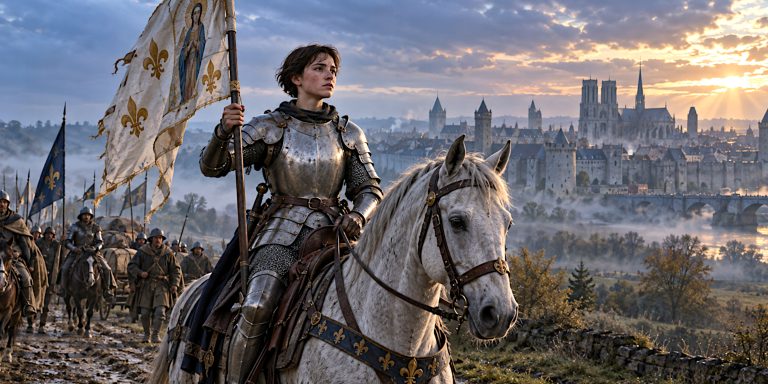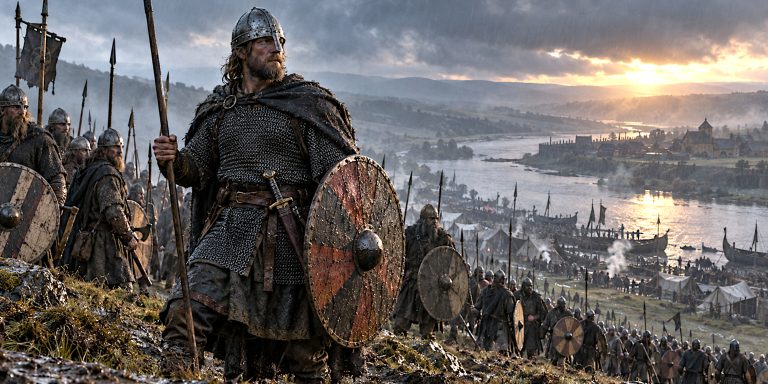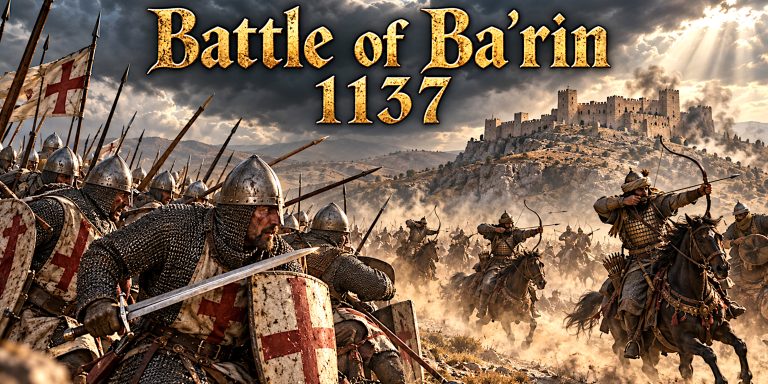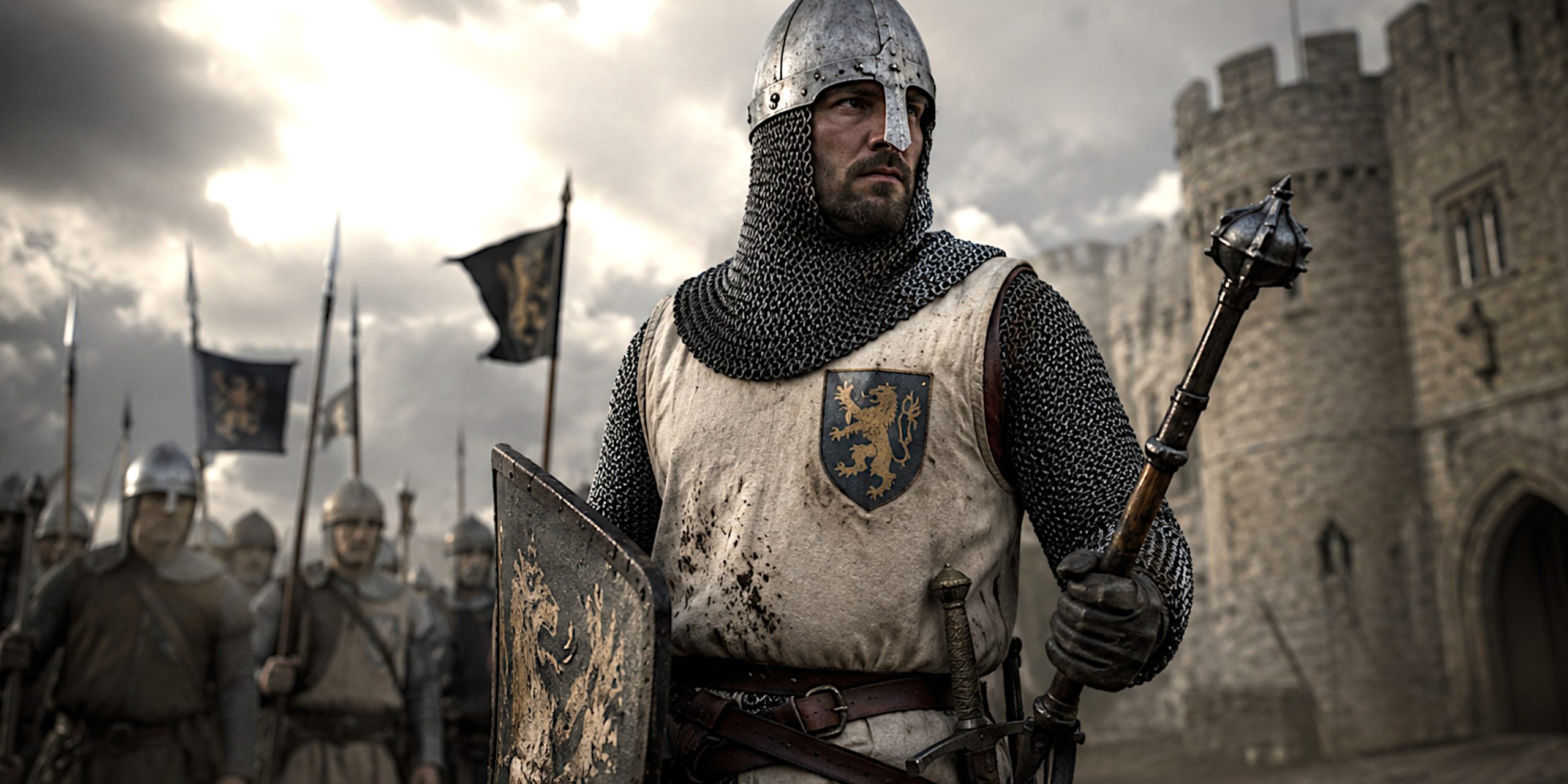
The medieval battlefield was not divided neatly between magnificent knights and frightened peasants clutching farm implements. Between those two extremes stood a substantial body of experienced fighting men whose importance is easy to underestimate: the sergeants, or servientes.
They appear throughout the military world of the twelfth and thirteenth centuries as mounted soldiers, infantrymen, garrison troops, household retainers and members of the military orders. Some fought in equipment approaching that of poorer knights. Others served as spearmen, crossbowmen or lighter cavalry. Their common characteristic was service rather than a precisely defined military rank.
The term sergeant-at-arms, however, requires more care. Medieval sources distinguish ordinary military sergeants from the more specialised sergeants d’armes attached to royal households. These royal officers developed into armed servants of the Crown, bodyguards, messengers and agents capable of making arrests. The modern parliamentary Serjeant at Arms ultimately descends from this rather more muscular medieval institution.
So when discussing High Medieval sergeants-at-arms, we are really looking at two overlapping worlds: the broad class of professional or semi-professional servientes who fought below knightly status, and the narrower royal office of the armed sergeant.
That distinction matters. Medieval terminology is quite capable of turning a seemingly simple job title into an afternoon’s argument.
What Did the Word Sergeant Actually Mean?
The word ultimately derives from the Latin serviens, meaning someone who serves. Through Old French forms such as sergent and serjant, it acquired an extraordinary range of meanings.
A medieval serviens might be:
- an armed retainer
- a mounted soldier below knightly rank
- an infantryman
- a garrison soldier
- a member of a military order
- a household official
- a man holding land in return for a particular service
- a royal officer entrusted with enforcement duties
It therefore makes little sense to imagine the medieval sergeant as the direct equivalent of the modern army NCO.
The underlying idea was service.
A military sergeant was normally a fighting man whose status stood below that of a knight, but this did not necessarily make him an inferior soldier. A veteran sergeant who had spent years campaigning could be considerably more useful in a fight than a newly dubbed young knight whose principal qualification was having the correct father.
Sergeants, Men-at-Arms and Knights
The distinction between these categories was partly military and partly social.
| Category | Typical social position | Battlefield role | Horse | Typical protection |
|---|---|---|---|---|
| Knight | Noble or knightly elite | Heavy cavalry, command | Usually | Mail and increasingly extensive armour |
| Mounted sergeant | Below knightly status | Cavalry, escort, reconnaissance, battle line | Usually | Mail or lighter protection |
| Foot sergeant | Professional or semi-professional soldier | Spearman, crossbowman, garrison soldier | Usually not | Gambeson, mail, helmet |
| Royal sergeant-at-arms | Crown servant | Bodyguard, messenger, arresting officer, military service | Often | Appropriate military equipment |
| Levy | Free tenant, townsman or rural recruit | Infantry | Rarely | Highly variable |
These divisions were never completely rigid.
A wealthy sergeant might possess equipment that differed little from that of a relatively poor knight. Conversely, the difference in horses, armour, retainers and social standing between a great aristocratic knight and an ordinary sergeant could be enormous.
This is one reason medieval armies should not be imagined as uniform formations. Wealth walked onto the battlefield wearing itself.
The Rise of the Military Sergeant
During the eleventh and twelfth centuries, warfare increasingly demanded troops who could do things that short-term feudal levies could not always do particularly well.
Castles needed permanent garrisons. Lords required household soldiers. Campaigns needed scouts, escorts and dependable infantry. Crossbows required trained operators. Cavalry warfare needed mounted men who did not necessarily possess knightly status.
Sergeants filled much of this space.
They were particularly valuable because they could provide military experience without the expense or social implications associated with maintaining another knight.
By the later twelfth century, servientes occur frequently enough in military contexts to represent an identifiable and significant part of European warfare.
The Royal Sergeants-at-Arms
The specialised sergeant-at-arms emerged from the royal household.
French kings employed sergents d’armes as trusted armed servants and bodyguards. Tradition particularly associates their development with the royal household of Philip II Augustus in the late twelfth century.
Their distinctive weapon was the mace.
This was not originally the enormous ceremonial object familiar from later parliamentary ritual. It was a genuine weapon. The mace simultaneously demonstrated royal authority and provided a reasonably persuasive means of dealing with anyone inclined to dispute it.
English royal sergeants-at-arms are securely documented by the reign of Edward I, when a body of twenty royal sergeants existed. Their responsibilities extended well beyond fighting. They could carry messages, collect money, execute royal orders and arrest individuals in the king’s name.
The mace gradually became their badge of authority.
A medieval royal officer displaying the king’s mace was therefore doing something rather more serious than participating in ceremony. He was effectively announcing that the authority of the Crown had arrived in person.
The modern British parliamentary office developed from these royal sergeants. The House of Commons still retains the spelling Serjeant at Arms, and the mace remains central to the office.
Sergeants in Feudal Armies
Outside the royal household, military sergeants were especially useful as mounted retainers.
A lord might maintain several sergeants alongside his knights. They could accompany the household on campaign, guard castles, escort important individuals and perform reconnaissance.
In some systems, military obligations were calculated according to approximate equivalents between knights and sergeants. Documents sometimes treat two sergeants as broadly equivalent to one knight for purposes of military service.
That should not be interpreted as a literal battlefield calculation in which one knight possessed precisely twice the combat power of a sergeant. Medieval administrators enjoyed converting human beings into accounting units almost as much as modern administrators do.
It does, however, demonstrate the recognised military value of the sergeant.
Sergeants in the Crusader States
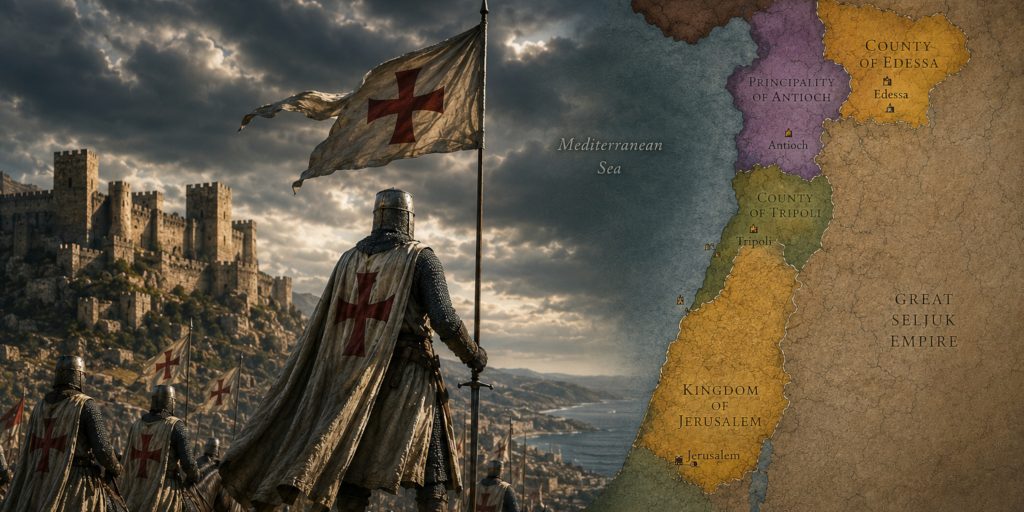
The importance of sergeants becomes particularly obvious in the Latin East.
The Crusader states suffered from a chronic shortage of Western manpower. Every trained soldier mattered.
Sergeants served as:
- mounted troops
- infantry
- castle garrisons
- escorts
- crossbowmen
- household soldiers
- members of military orders
The legal and military structures of the Kingdom of Jerusalem could require thousands of sergeants in emergencies. John of Ibelin’s description of the kingdom’s obligations records more than 5,000 sergeants potentially owed by towns and ecclesiastical establishments in circumstances of great need.
This gives some idea of their importance. Crusader armies were emphatically not composed simply of knights surrounded by anonymous infantry.
Templar Sergeants
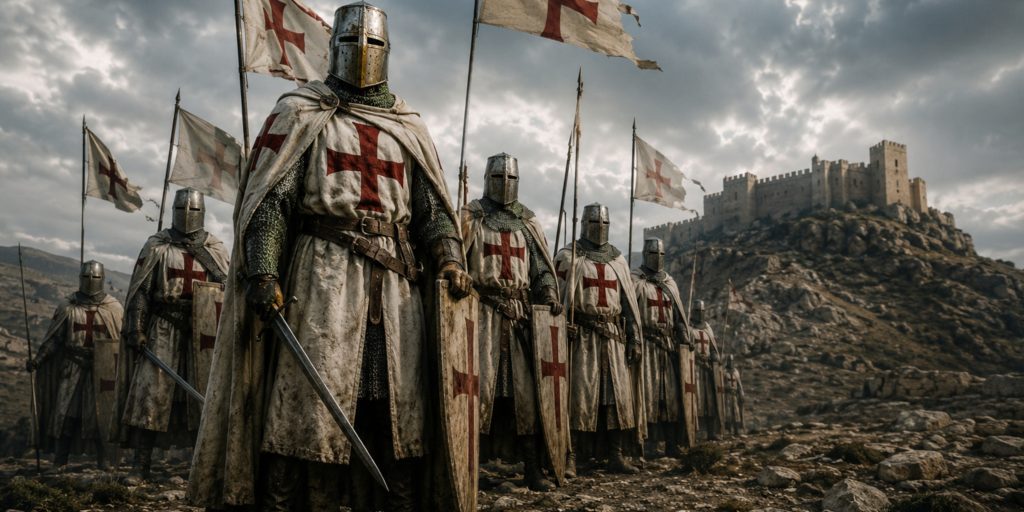
The Knights Templar provide some of the clearest evidence for the institutional role of sergeants.
The Order contained knight brothers, chaplains and serving brothers, commonly described as fratres servientes. Some of these men performed military service.
The distinction was partly social. Knight brothers generally came from knightly or noble backgrounds, whereas serving brothers did not require the same pedigree.
Their equipment and privileges also differed.
A Templar knight normally possessed several horses and the assistance of a squire. An ordinary sergeant typically received fewer horses. Nevertheless, sergeants could fight mounted and participate directly in military operations.
Some sergeants held important positions within the Order, including administrative and military responsibilities.
Their clothing also distinguished them from knight brothers. The famous white mantle belonged to the knightly class, while serving brethren normally wore darker clothing.
The military orders therefore institutionalised something already visible elsewhere in medieval society: a professional fighting class below knighthood that could nevertheless be well equipped, experienced and extremely useful.
What Did Sergeants-at-Arms Actually Do?
There was no universal job description, but military and royal sergeants could perform a remarkable range of duties.
Battlefield service
Mounted sergeants could fight alongside knightly cavalry, sometimes forming separate contingents. Foot sergeants served with spears, crossbows and other infantry weapons.
Garrison duty
Professional soldiers were particularly useful in castles because castles required troops throughout the year, not simply when a feudal host had been summoned.
Escort
Kings, bishops, nobles, officials and valuable convoys all required armed protection.
Reconnaissance
Mounted sergeants could serve as scouts and messengers, duties for which expensive heavy cavalry were not always ideal.
Policing and arrests
Royal sergeants-at-arms increasingly became instruments of royal government. They could deliver commands and apprehend individuals.
Guard duty
The royal household required trustworthy armed men close to the monarch. This was particularly important in an age when political disagreement occasionally expressed itself with knives.
Arms and Armour
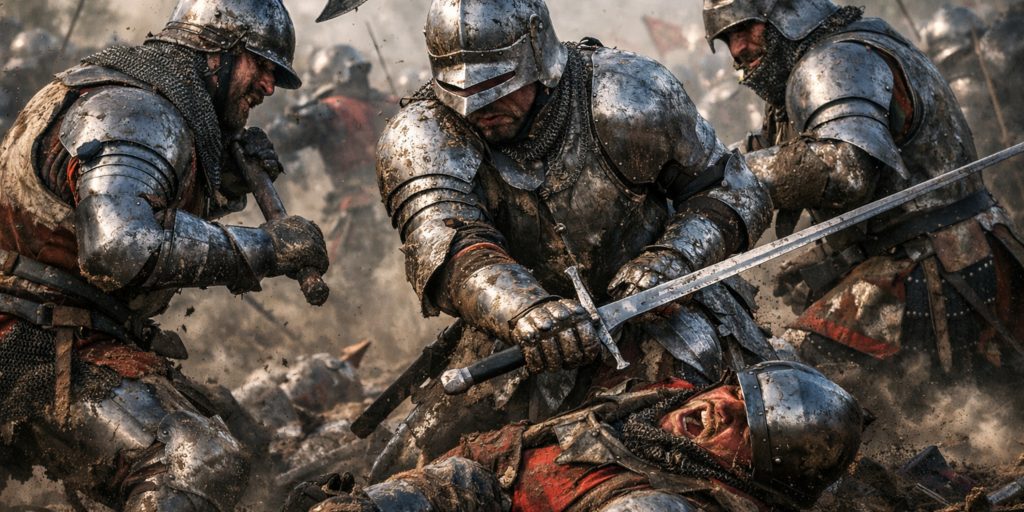
There was no single “sergeant’s armour”. Equipment depended upon wealth, employer, region, date and whether the man fought mounted or on foot.
Nevertheless, the better-equipped military sergeant of the twelfth and thirteenth centuries could be a formidable opponent.
Body armour
Common protection included:
- padded gambeson or aketon
- mail hauberk
- shorter mail haubergeon
- mail coif
- mail chausses among wealthier mounted soldiers
- additional textile protection beneath mail
During the thirteenth century, supplementary defences of hardened leather, metal plates and early forms of coat-of-plates increasingly appeared.
A prosperous mounted sergeant could therefore resemble a knight remarkably closely from a distance.
The difference became rather more apparent when someone inspected the horse, quality of armour, heraldic display and accompanying servants.
Helmets
Sergeants could use:
- nasal helmets
- conical helmets
- iron caps
- kettle hats
- early great helms
- transitional enclosed helmets
Infantry sergeants were particularly well suited to the kettle hat, whose broad brim offered excellent protection from blows and missiles while maintaining visibility.
Shields
During the twelfth century, the kite shield remained common, particularly among mounted troops.
During the thirteenth century it gradually gave way to smaller heater-shaped shields.
Sergeants did not necessarily possess personal heraldry, although household colours and identifying devices could be displayed.
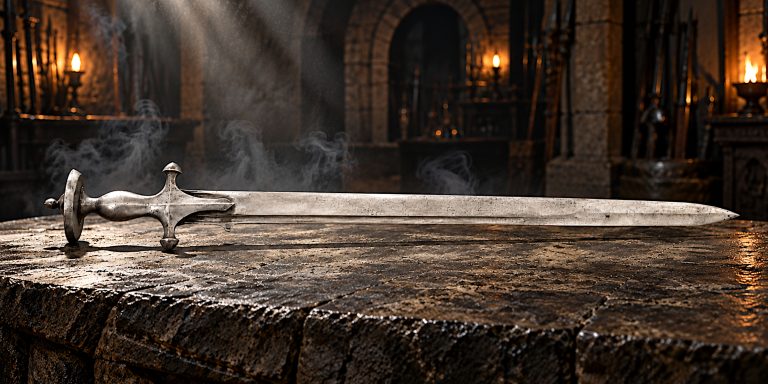
Swords Used by High Medieval Sergeants
The sword remained an important secondary weapon for well-equipped sergeants, particularly mounted men.
The most appropriate typology for surviving European swords of this period is Ewart Oakeshott’s classification.
Oakeshott Type X
A continuation of the broad-bladed cutting swords familiar from the Viking Age and early medieval period.
Typical characteristics:
- broad blade
- relatively parallel edges
- rounded or slightly pointed tip
- broad fuller
- optimised primarily for cutting
These remained relevant during the eleventh and early twelfth centuries.
Oakeshott Type Xa
Similar to Type X but generally somewhat longer and narrower.
These swords were well suited to mounted fighting and remained common during the twelfth century.
Oakeshott Type XI
Characterised by a relatively long and slender blade with a pronounced fuller.
The Type XI appears particularly suited to cavalry use, combining reach with effective cutting ability.
Oakeshott Type XII
Perhaps the archetypal High Medieval sword.
Typical features included:
- tapering double-edged blade
- fuller extending along much of the blade
- improved thrusting point
- straight crossguard
- single-handed grip
Type XII swords became particularly widespread during the thirteenth century.
Oakeshott Type XIII
These were broad, powerful cutting swords, sometimes possessing longer grips.
Type XIII and XIIIa weapons became increasingly significant during the later thirteenth century.
For most sergeants the sword was not necessarily the primary battlefield weapon. A mounted soldier would normally begin combat with a lance, while infantry might depend upon a spear, polearm or crossbow.
The sword came into its own once formations broke down or the primary weapon had been lost or discarded.
Other Weapons
Lance
Mounted sergeants frequently carried lances and could fight in much the same basic manner as knightly cavalry.
Spear
The spear remained cheap, practical and lethally effective. Foot sergeants could use it individually or within organised formations.
Mace
The mace became particularly associated with royal sergeants-at-arms.
Its usefulness against armoured opponents was considerable, but its symbolic value became increasingly important. Over time, the mace transformed from weapon into badge of royal authority.
Crossbow
Professional sergeants frequently appear in contexts involving crossbows, especially in garrisons and Mediterranean warfare.
A trained crossbowman represented a considerable military investment. Unlike temporary levies, professional soldiers could maintain the practice required to use sophisticated missile weapons effectively.
Dagger and knife
Utility knives and fighting daggers provided essential secondary weapons.
Horses and Mounted Service
The horse provides one of the clearest distinctions between sergeant and knight.
A knight might maintain several horses, including a valuable warhorse, riding horses and pack animals.
A mounted sergeant generally operated with fewer.
Within the Templar system, for example, ordinary sergeants were normally allocated fewer horses than knight brothers.
This mattered enormously.
Maintaining horses was one of the great expenses of medieval warfare. The economic difference between supporting one serviceable riding horse and maintaining several specialised animals could determine whether a man was capable of functioning socially as a knight.
The medieval military hierarchy was therefore partly a hierarchy of horse ownership.
Chivalry sounds rather less romantic when reduced to stable bills, but horses had to eat.
Sergeantry and Landholding
The word sergeant also became associated with serjeanty, a form of land tenure in which land was held in return for performing a specified service.
Not all serjeanties were military.
Services might involve:
- carrying royal equipment
- providing horses
- supplying arrows or weapons
- serving food
- performing administrative duties
- providing military service
This complicates attempts to define sergeants as a distinct social class.
Some military sergeants possessed land. Others were salaried household retainers. Others belonged to religious military orders.
What united them was not a single legal status but the concept of service.
Archaeological Evidence
Archaeology rarely identifies an object as having belonged specifically to a sergeant.
A sword excavated from a river does not come with a helpful label reading “property of Robert, mounted sergeant, please return to castle”.
Instead, archaeology allows us to reconstruct the material world in which sergeants operated.
Swords
Large numbers of twelfth and thirteenth-century swords survive in museums and archaeological collections. Their variation in quality demonstrates that swords were available across a broader social spectrum than the knightly aristocracy alone.
Fragments of riveted mail recovered from medieval sites support written and artistic evidence for widespread mail armour.
Mail required enormous labour to manufacture, but by the High Middle Ages it was not restricted exclusively to knights.
Helmets
Archaeological finds and surviving examples demonstrate the development from relatively simple iron helmets towards increasingly enclosed protection during the twelfth and thirteenth centuries.
Simpler iron caps and kettle hats were particularly practical for professional infantry.
Crossbow equipment
Bolt heads, spanning equipment and crossbow components found at castles and fortified settlements demonstrate the enormous importance of the weapon in garrison warfare.
Professional sergeants are among the troops most plausibly associated with such material.
Horse equipment
Bits, stirrups, horseshoes and harness fittings provide equally important evidence.
The sheer quantity of equestrian material recovered from castles reminds us that medieval warfare depended upon a vast infrastructure of horses, grooms, smiths and fodder.
The knight gets the illuminated manuscript. The farrier quietly keeps the campaign moving.
Sergeants in Medieval Art
Visual evidence provides some of our best indications of how non-knightly professional soldiers looked.
Manuscript illustrations frequently show armed retainers wearing:
- mail shirts
- iron helmets
- shields
- spears
- swords
- padded armour
The difficulty lies in identifying status.
A figure wearing mail and carrying a sword is not automatically a knight. Medieval artists frequently distinguished status through heraldry, clothing, horses or narrative context rather than armour alone.
This is an important corrective to modern reconstructions in which every man wearing mail immediately receives a knighthood.
Contemporary Voices
The Assize of Arms of 1181, issued under Henry II, gives a particularly valuable picture of how extensively military equipment was expected to penetrate free society.
Men possessing sufficient wealth were required to maintain equipment including:
“a shirt of mail, a helmet, a shield, and a lance.”
Those with less wealth were still expected to possess appropriate arms and protection.
The significance is considerable. Mail, helmets and lances were not conceived solely as knightly possessions. A substantial layer of free society could be expected to own military equipment capable of producing soldiers broadly comparable with some categories of sergeant.
The terminology of the military orders is equally revealing. Their records repeatedly distinguish the knight brothers, milites, from the serving brothers, fratres servientes.
That apparently modest word, “serving”, concealed men who could ride into battle alongside some of the most heavily armed warriors in Christendom.
Were Sergeants Professional Soldiers?
Many were, although the term must be used cautiously.
Medieval Europe did not possess professional standing armies in the modern sense, but kings, nobles, towns and military orders increasingly employed men whose principal occupation involved warfare.
Sergeants could accumulate years of experience through:
- household service
- castle garrisons
- campaigning
- mercenary employment
- crusading
- service within military orders
Some were consequently among the most experienced soldiers available.
This is one of the larger misconceptions surrounding medieval warfare. Social rank and military competence were related, but they were certainly not identical.
How Effective Were Sergeants in Battle?
Good sergeants offered commanders several advantages.
Experience: Long-serving retainers understood formations, horses, weapons and battlefield discipline.
Availability: Household soldiers and paid troops could remain in service longer than temporary levies.
Versatility: Sergeants could fight mounted or on foot, perform guard duty, scout or occupy castles.
Cost: They were generally less expensive to maintain than fully equipped knights.
There were disadvantages.
Their equipment could vary considerably, and mounted sergeants generally lacked the expensive horses and extensive resources available to elite knights.
They also lacked the social authority of the knightly class, which mattered in an army where command remained closely linked to aristocratic status.
Sergeants-at-Arms and the Growth of Royal Power
The development of royal sergeants-at-arms tells us something larger about medieval government.
Twelfth and thirteenth-century monarchies were becoming increasingly sophisticated administrative machines. Kings needed reliable men who could travel through the kingdom and make royal decisions physically effective.
A written order was useful.
A written order accompanied by an armed royal sergeant carrying a mace was rather more convincing.
Sergeants-at-arms therefore occupied the boundary between soldier, bodyguard, policeman, messenger and royal official.
By the reign of Edward I, English royal sergeants were performing administrative and judicial duties alongside their protective functions. They collected money, delivered commands and made arrests.
Their mace became increasingly symbolic because the authority behind the weapon mattered more than the weapon itself.
From Battlefield Weapon to Ceremonial Mace
The transformation of the mace is one of the more satisfying survivals of medieval military culture.
The original mace was brutally practical. Concentrating force through a compact head made it useful against armoured opponents.
Royal sergeants carried maces both as weapons and as signs of office.
As royal institutions became more formalised, the symbolic function gradually overwhelmed the military one. Maces became larger, richer and increasingly ceremonial.
Eventually they ceased to resemble sensible battlefield weapons at all.
Yet their meaning remained essentially medieval: the bearer acts with delegated authority.
That tradition survives in Parliament today.
Decline of the Medieval Military Sergeant
During the later Middle Ages, military organisation changed.
Paid companies, indentured retinues, professional archers and increasingly sophisticated systems of recruitment altered the terminology used for fighting men.
The man-at-arms became a more useful description for heavily armoured cavalry regardless of whether the individual had actually been knighted.
Meanwhile, “sergeant” increasingly developed specialised administrative and military meanings.
The broad High Medieval category therefore fragmented.
The royal sergeant-at-arms survived because the office had acquired an institutional purpose beyond battlefield service.
Legacy
The High Medieval sergeant occupies an awkward place in popular history because he does not fit comfortably into the familiar hierarchy of knight, archer and peasant.
Yet these men were fundamental to medieval warfare.
They guarded castles, accompanied knights, fought from horseback, operated crossbows, escorted rulers and provided monarchs with dependable armed servants. Some possessed mail, horses and swords approaching knightly standards. Others served as specialised infantry.
The royal sergeant-at-arms developed still further, becoming an officer whose mace represented the physical authority of the Crown.
That evolution produced an extraordinary historical continuity.
A weapon once carried by armed royal servants eventually became the ceremonial mace carried before Parliament.
Strip away the robes, silver and ceremony and the ancestry remains visible. The medieval message was wonderfully uncomplicated: the king has sent this man, and he is carrying a mace. Cooperation would be sensible.
Frequently Asked Questions
Was a medieval sergeant the same as a modern army sergeant?
No. The medieval term derived from serviens, meaning someone who served. It described several categories of retainers, soldiers and officials rather than a standardised NCO rank.
Were sergeants knights?
Generally not. Military sergeants normally occupied a social position below knights, although some could be similarly equipped.
Did sergeants fight on horseback?
Yes. Mounted sergeants were an important element of many High Medieval armies.
Did medieval sergeants use swords?
Yes. Well-equipped sergeants could carry the same broad families of single-handed sword used by knights, including swords corresponding to Oakeshott Types X, Xa, XI, XII and XIII.
What was their main weapon?
For mounted sergeants it was often the lance. Infantry sergeants might use spears, crossbows or other weapons. The sword normally served as a versatile secondary weapon.
Why did sergeants-at-arms carry maces?
The mace began as a practical weapon but became a symbol of delegated royal authority. Royal sergeants could display it when carrying out the king’s commands.
Did the Knights Templar have sergeants?
Yes. The Templars included serving brothers, fratres servientes, alongside their knight brothers and chaplains. Some serving brothers performed military duties and fought mounted.
Do sergeants-at-arms still exist?
Yes. The office survives in several parliamentary institutions. Britain’s House of Commons retains a Serjeant at Arms whose ceremonial responsibilities include the parliamentary mace.