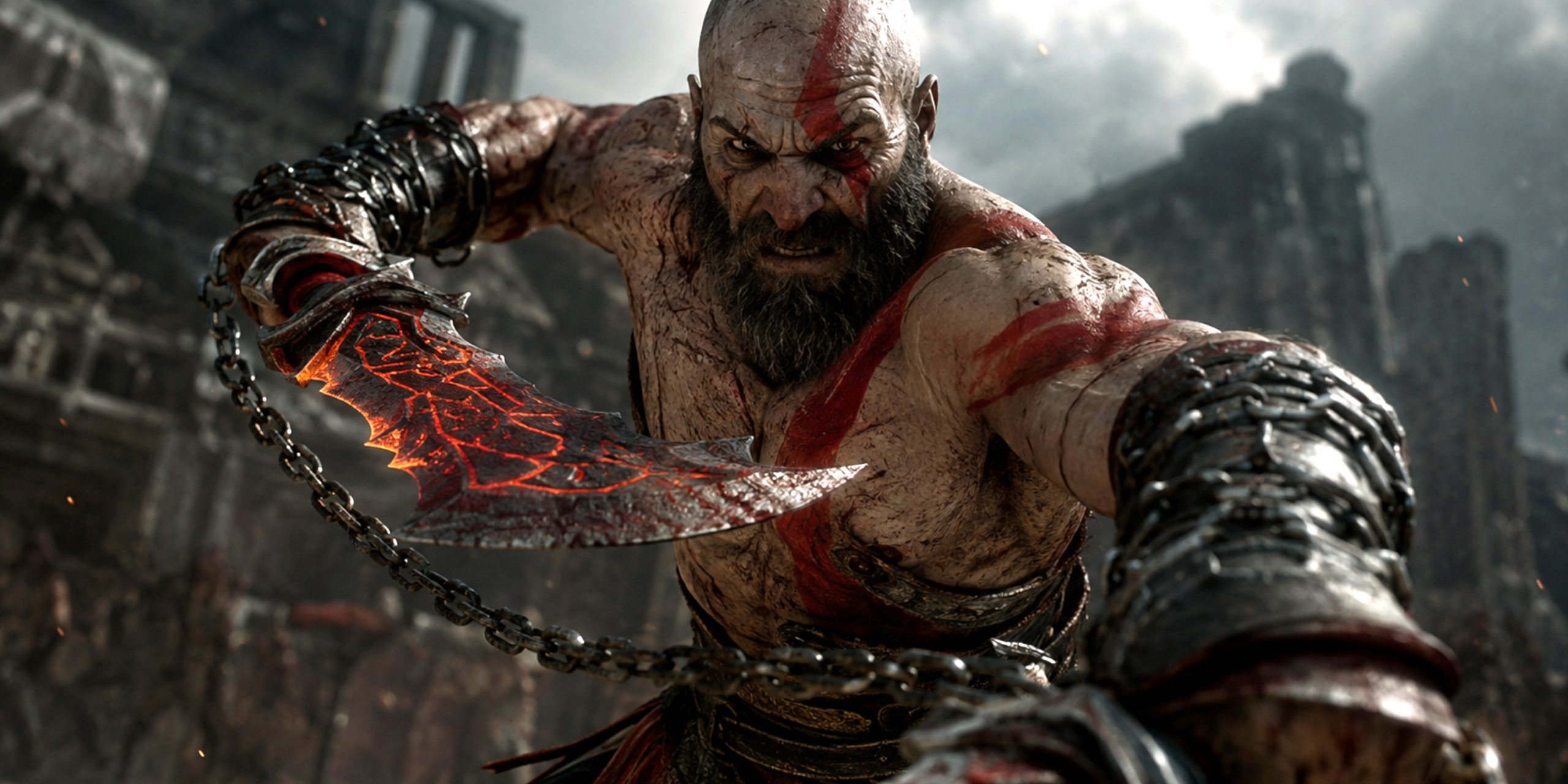
Few video game weapons are as instantly recognisable as the Blades of Chaos. The moment those chained blades ignite and begin carving through enemies, you know exactly whose hands they belong to. Kratos has wielded many weapons throughout the God of War series, from the Leviathan Axe to the Blade of Olympus, yet nothing defines the Ghost of Sparta quite like the Blades of Chaos.
Their brutal design, tragic origins and satisfying combat have made them one of gaming’s greatest weapon designs. They are not simply tools for defeating monsters. They are physical reminders of Kratos’ past, his mistakes, and the gods who manipulated him.
Let’s be honest. If someone handed most of us two flaming swords attached to chains, we’d probably lose a lamp before reaching the first enemy. Kratos somehow makes them look effortless.
What Are the Blades of Chaos?
The Blades of Chaos are a pair of curved short swords permanently attached to long magical chains. Forged by Ares, the Greek God of War, they were gifted to Kratos after he pledged himself to the god in exchange for victory and survival.
Unlike conventional swords, the blades are designed for relentless movement. The enchanted chains allow Kratos to slash enemies from surprising distances, pull opponents closer, launch devastating spinning attacks and keep entire groups under pressure.
They are as much ranged weapons as they are melee weapons, making them one of the most versatile arsenals in the franchise.
At a Glance
| Feature | Details |
|---|---|
| Weapon Type | Paired chained blades |
| Creator | Ares |
| Primary User | Kratos |
| First Appearance | God of War (2005) |
| Damage Type | Fire |
| Combat Style | Fast, aggressive crowd control |
| Signature Ability | Long-range chained attacks |
The Origins of the Blades
Before Kratos became the feared Ghost of Sparta, he was a Spartan general facing certain defeat.
In desperation, he called upon Ares, promising eternal service if the god would save him and his army. Ares accepted.
The Blades of Chaos became the symbol of that bargain.
According to the original game, Ares had the blades magically fused to Kratos’ forearms. The chains burned into his flesh, making them impossible to remove by ordinary means.
That detail transformed the weapons into something far darker than magical equipment. They became a permanent reminder of Kratos’ loss of freedom.
The blades accompanied him through countless battles, including the campaign that ultimately led to the accidental murder of his own wife and daughter after Ares manipulated him into slaughtering a temple full of innocents.
From that point onwards, every swing carried emotional weight.
Physical Design
The Blades of Chaos blend Greek mythology with exaggerated fantasy.
Their design features:
- Curved bronze-like blades
- Jagged cutting edges
- Long enchanted chains
- Fiery magical energy
- Ornate Greek-inspired engravings
- Heavy hooked tips for devastating strikes
The chains behave almost like living extensions of Kratos himself. They coil, extend and retract instantly without tangling, something that makes absolutely no sense in physics but looks spectacular every single time.
As fantasy weapon design goes, they remain remarkably distinctive even twenty years after their debut.
Why the Chains Matter
The chains are arguably more iconic than the blades themselves.
Mechanically they allow:
- Long-range melee attacks
- Wide sweeping arcs
- Enemy juggling
- Crowd control
- Environmental interaction
- Grappling attacks
Narratively they symbolise slavery.
Kratos can never completely escape what Ares made him become. Even after destroying Olympus, abandoning Greece and attempting to build a new life in Midgard, the chains continue to represent the guilt that follows him everywhere.
When the Blades of Chaos return in God of War (2018), their reappearance becomes one of the series’ most emotional moments.
Kratos literally digs up the past he desperately wanted to bury.
Combat Style
Unlike the Leviathan Axe, which rewards precision and timing, the Blades encourage relentless aggression.
Their strengths include:
- Fast attack speed
- Excellent area damage
- Huge attack combinations
- Fire elemental effects
- Mobility during combat
- Effective against multiple enemies
Players can seamlessly chain together:
- Light attacks
- Heavy attacks
- Air combos
- Launchers
- Finishers
- Runic abilities
- Grapples
Few weapons in action games feel as fluid once fully upgraded.
The Blades Across the God of War Series
God of War (2005)
The original game introduced the Blades of Chaos as Kratos’ primary weapon.
Players gradually unlocked increasingly elaborate combos, aerial attacks and devastating magical abilities. The weapon quickly became the identity of the franchise.
God of War II
The sequel expanded the move set considerably.
New magical abilities, faster combo chains and cinematic executions made the blades even more satisfying.
The developers leaned into spectacle, creating increasingly extravagant animations without sacrificing responsiveness.
God of War III
The Blades of Exile replaced the original weapons during Kratos’ final war against Olympus.
Although technically different weapons, they retained much of the same combat philosophy while introducing stronger magical attacks.
God of War (2018)
One of the game’s biggest surprises was the return of the Blades of Chaos.
Initially, players rely entirely on the Leviathan Axe.
Later, Kratos retrieves the blades from beneath his home to confront enemies immune to frost damage.
The sequence remains one of the most memorable moments in modern gaming because the weapons carry genuine narrative significance rather than serving as simple fan service.
God of War Ragnarök
Ragnarök further develops the blades through:
- New Runic attacks
- Elemental interactions
- Improved traversal mechanics
- Enhanced mobility
- More advanced combo systems
The blades remain central to both combat and storytelling.
Signature Abilities
Throughout the series, the Blades of Chaos gain a huge variety of powers.
Some of the most memorable include:
| Ability | Description |
|---|---|
| Hyperion Grapple | Pulls Kratos towards enemies |
| Cyclone of Chaos | Massive spinning area attack |
| Rampage of the Furies | Rapid chained strikes |
| Flame Whiplash | Charges blades with explosive fire |
| Scorched Sweep | Wide flaming attack |
| Chaotic Rampage | Sustained combo assault |
These abilities allow players to constantly shift between crowd control and single-target damage.
Upgrading the Blades
Progression differs between games, but upgrades generally improve:
- Damage output
- Combo variety
- Fire effects
- Runic attacks
- Special abilities
- Cooldown reduction
In the Norse games, crafting resources such as Chaos Flames unlock higher weapon levels.
This upgrade system ties directly into exploration, encouraging players to complete optional quests and challenge tougher enemies.
Blades of Chaos vs Leviathan Axe
| Feature | Blades of Chaos | Leviathan Axe |
|---|---|---|
| Speed | Very fast | Moderate |
| Reach | Excellent | Medium |
| Crowd Control | Outstanding | Good |
| Single Target Damage | Strong | Excellent |
| Element | Fire | Frost |
| Combat Style | Aggressive | Tactical |
Neither weapon is objectively better.
The Leviathan Axe rewards patience and accuracy.
The Blades reward momentum and relentless pressure.
Switching between both is one of the defining features of the Norse games.
Symbolism
The Blades of Chaos represent far more than combat.
They symbolise:
- Slavery
- Guilt
- Rage
- Identity
- Redemption
- Personal growth
Kratos spends much of the newer games attempting to become a better father than warrior.
The blades constantly challenge that transformation.
Every time they appear, players are reminded that redemption does not erase history. It simply changes what you choose to do next.
That emotional depth is a huge reason the weapons continue to resonate with players.
Behind the Design
The developers at Santa Monica Studio intentionally designed the Blades of Chaos to create a unique combat identity.
Most action games already featured swords, axes and spears.
The chained blades offered something visually distinctive.
They enabled:
- Cinematic camera movement
- Long uninterrupted combos
- Fast traversal
- Large enemy encounters
- Highly expressive combat animation
The result was a combat system that still feels surprisingly modern.
Why Players Love the Blades
The Blades of Chaos remain fan favourites because they combine excellent gameplay with meaningful storytelling.
Players appreciate:
- Instantly recognisable design
- Extremely satisfying combat
- High skill ceiling
- Strong narrative significance
- Spectacular visual effects
- Memorable boss encounters
Very few weapons become inseparable from their protagonist.
The Blades of Chaos have reached that rare level where seeing their silhouette alone is enough to identify the franchise.
Legacy
Over two decades after their introduction, the Blades of Chaos remain among the most influential weapons in gaming.
They helped define character action combat, inspired countless imitators and continue to evolve with each new God of War entry.
Many iconic weapons become outdated as technology advances.
The Blades of Chaos have done the opposite. Better animation, improved physics and richer storytelling have only strengthened their impact.
That is probably the greatest compliment any fictional weapon can receive. Players still get excited the moment those chains begin rattling, because they know something spectacular is about to happen.
For Kratos, they are weapons of war.
For players, they have become one of gaming’s most enduring legends.