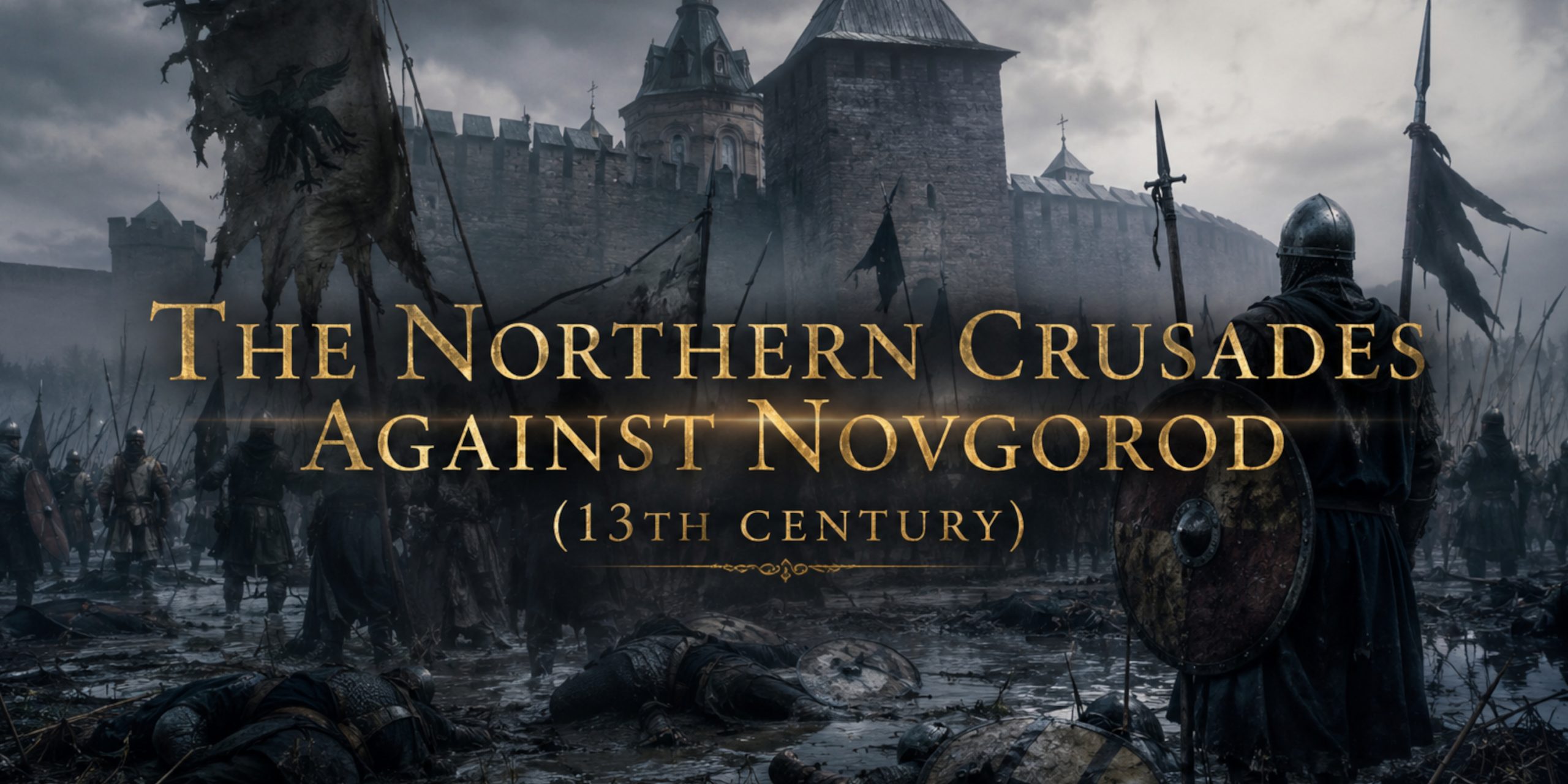
The Northern Crusades occupy a curious place in medieval history. Overshadowed by the better-known expeditions to the Holy Land, they unfolded across frozen forests, marshes, rivers and the Baltic coast, where religion, trade and politics collided with remarkable persistence. For the Republic of Novgorod, these campaigns represented a struggle for survival against expanding western powers who viewed eastern Christianity with increasing suspicion.
The conflicts were never a single uninterrupted war. Instead, they consisted of decades of raids, sieges, border campaigns and diplomatic manoeuvring involving Swedish, Danish and German crusaders, the Teutonic Order, the Livonian Brothers of the Sword and the Republic of Novgorod, often supported by Vladimir-Suzdal.
Looking back as a historian, it is difficult not to admire the resilience of Novgorod. It lacked the centralised authority of many western kingdoms, yet repeatedly adapted to threats from every direction. Medieval politics was rarely straightforward. One year’s ally could become next year’s enemy before the ink on the treaty had dried.
What Were the Northern Crusades?
The Northern Crusades were a series of military campaigns sanctioned by the Papacy between the 12th and 14th centuries. Their official aim was the conversion of pagan peoples around the Baltic Sea, particularly the Finnic, Baltic and Livonian tribes.
In practice, these campaigns soon became intertwined with territorial expansion and commercial interests.
For Novgorod, the danger came when crusading states expanded eastwards beyond pagan territories and into regions already following Eastern Orthodox Christianity.
The principal western powers included:
- The Swedish Kingdom
- The Danish Crown
- The Teutonic Order
- The Livonian Brothers of the Sword, later absorbed into the Livonian Order
- Various German bishops and merchant interests
Novgorod regarded itself as the defender of Orthodox Christianity in the north-western frontier of the Rus’.
Why Novgorod Became a Target
Novgorod was among the wealthiest cities in medieval Europe.
Its prosperity rested upon:
- Fur exports
- Wax
- Timber
- Honey
- Baltic trade
- River routes reaching deep into eastern Europe
The city also controlled strategic routes linking Scandinavia, the Baltic and the interior of Russia.
From the perspective of western crusaders, Novgorod represented both a religious rival and an economic competitor.
The establishment of crusader-controlled territories in modern Estonia and Latvia steadily increased pressure on Novgorod’s western borders.
Political and Religious Background
The division between Roman Catholicism and Eastern Orthodoxy following the Great Schism of 1054 hardened throughout the 13th century.
Although the crusades officially targeted pagans, relations between Latin and Orthodox Christians became increasingly hostile.
Following the capture of Constantinople during the Fourth Crusade in 1204, distrust deepened dramatically.
By the 1230s, western military orders increasingly viewed Orthodox territories as legitimate areas for expansion.
Novgorod, meanwhile, defended both its political independence and its religious identity.
Major Campaigns Against Novgorod
Swedish Expedition, 1240
The Swedish campaign sought to establish control over the mouth of the Neva River.
If successful, Sweden would have dominated trade flowing from the Gulf of Finland into Novgorodian territory.
Prince Alexander of Novgorod launched a rapid counterattack.
The resulting engagement became known as the Battle of the Neva.
Alexander’s victory earned him the title by which history remembers him: Alexander Nevsky.
Livonian Campaigns
The Livonian Brothers of the Sword, followed by the Livonian branch of the Teutonic Order, conducted repeated campaigns into territories controlled or influenced by Novgorod.
Their objectives included:
- Pskov
- Izborsk
- Border fortifications
- Trade routes
Several temporary occupations were achieved before Novgorodian counterattacks restored much of the frontier.
Expansion of the Teutonic Order
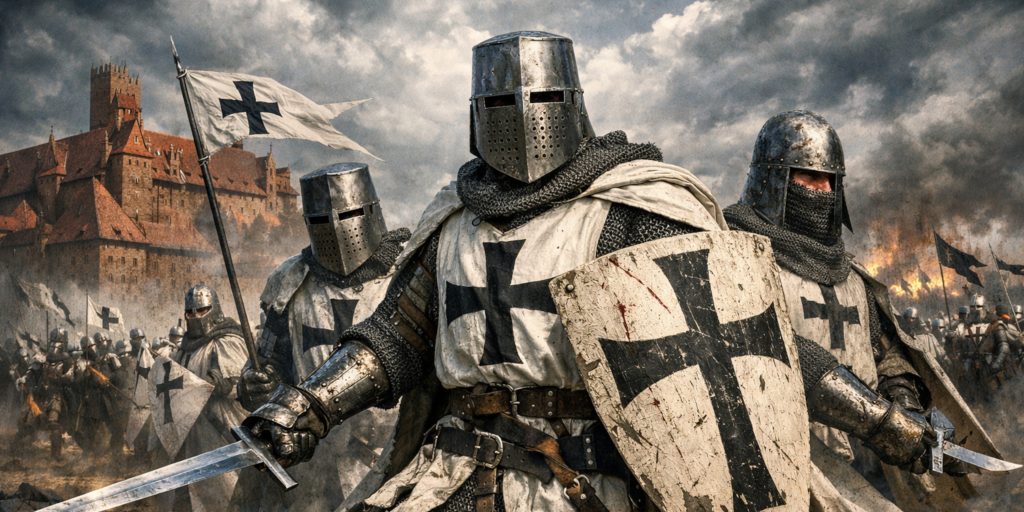
Following the defeat of the Livonian Brothers at Saule in 1236, their remaining forces merged with the Teutonic Order.
This created a far stronger military organisation capable of coordinating campaigns across the eastern Baltic.
Pressure upon Novgorod increased throughout the early 1240s.
Major Battles
Battle of the Neva (1240)
Location: Neva River
Opponents:
- Novgorod
- Swedish expedition
Alexander Nevsky surprised the Swedish force before it could fully establish itself.
Although medieval accounts exaggerate the scale, the battle proved strategically significant because Sweden abandoned immediate expansion along the Neva.
The victory enhanced Alexander’s reputation across the Rus’.
Capture and Recovery of Pskov (1240 to 1242)
Livonian forces captured Pskov with assistance from local collaborators.
Alexander returned from temporary political exile and launched a determined campaign to retake the city.
The recovery restored Novgorod’s western defensive line.
Battle of the Ice (1242)
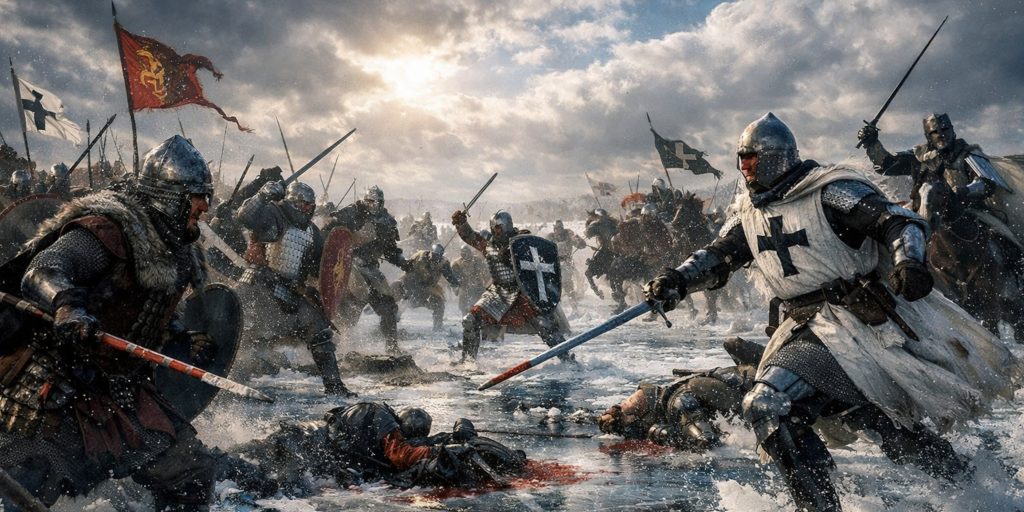
Perhaps the most famous battle of the Northern Crusades.
Location: Frozen Lake Peipus
Opponents:
- Novgorod under Alexander Nevsky
- Livonian branch of the Teutonic Order
According to Russian chronicles, Alexander deliberately allowed the crusaders to advance before counterattacking.
Popular legend depicts heavily armoured knights plunging through the ice.
Modern historians are more cautious.
The ice may well have supported both armies throughout much of the battle. Some casualties probably occurred during the retreat, but there is little evidence for the dramatic collapse portrayed in later artwork and film.
Nevertheless, the battle halted crusader expansion towards Novgorod.
Its symbolic importance eventually far exceeded its likely scale.
Continuing Border Warfare
Conflict continued for decades after 1242.
Raids, castle construction, diplomatic negotiations and limited campaigns characterised relations between Novgorod and the Livonian Order for much of the century.
Neither side achieved complete dominance.
Alexander Nevsky’s Leadership
Alexander Nevsky became one of medieval Russia’s defining rulers.
His military success was matched by careful diplomacy.
Rather than provoking conflict with the Mongol Golden Horde, he accepted their overlordship while concentrating military efforts against western crusading powers.
From a strategic perspective, it was a remarkably pragmatic decision.
It was hardly glamorous, but surviving to fight another day has often proved a wiser policy than chasing glorious defeat.
Weapons and Warfare
Armies fighting around Novgorod reflected a mixture of Scandinavian, Rus’ and western European traditions.
Novgorodian forces commonly employed:
- Spears
- Axes
- Straight double-edged swords
- Composite bows
- Round and kite shields
- Lamellar and mail armour
The crusading armies fielded:
- Mounted knights
- Crossbowmen
- Infantry spearmen
- German mercenaries
- Military order cavalry
The heavily forested terrain reduced opportunities for classic western cavalry charges.
Rivers, marshes and winter conditions often dictated tactical decisions far more than battlefield theory.
Archaeology
Archaeological discoveries have significantly expanded our understanding of these conflicts.
Excavations at Novgorod have revealed exceptionally preserved wooden streets, buildings and everyday objects thanks to waterlogged soil.
Finds include:
- Arrowheads
- Crossbow bolts
- Sword fragments
- Spearheads
- Armour fittings
- Horse equipment
- Religious objects
- Birch bark documents
The birch bark letters are especially valuable.
Written by merchants, officials and ordinary citizens, they reveal a remarkably literate society and provide insight into everyday life during periods of conflict.
Around Lake Peipus, archaeological evidence connected directly to the Battle of the Ice remains surprisingly limited.
This absence has encouraged historians to treat many later legendary accounts with caution.
Rather than disproving the battle, the evidence reminds us how difficult medieval battlefields can be to identify centuries later.
Contemporary Sources and Quotes
Most surviving accounts originate from medieval chronicles.
The principal sources include:
- The Novgorod First Chronicle
- The Livonian Rhymed Chronicle
- Later Russian chronicles
- Papal correspondence
The chroniclers naturally favoured their own side, requiring careful comparison.
The Novgorod First Chronicle praises Alexander’s victory at the Neva:
“God was not in power, but in truth.”
This phrase became closely associated with Alexander’s later reputation.
The Livonian Rhymed Chronicle, describing the campaigns in the east, records:
“Many brave men were lost.”
Although brief, it acknowledges the heavy fighting experienced by the crusading forces.
Another passage from the Novgorod tradition declares:
“The Lord helped Prince Alexander.”
Like many medieval chronicles, divine intervention appears almost as frequently as military planning.
Historical Debate
Modern historians continue debating several questions.
How large were the armies?
Probably much smaller than later nationalist traditions suggested.
Did thousands perish beneath breaking ice?
Almost certainly not.
Were the campaigns purely religious?
Religion mattered enormously, but political ambition, commercial competition and territorial control were equally important.
The Northern Crusades cannot be reduced to a simple struggle between faiths.
They were contests for influence across one of Europe’s most economically valuable frontier regions.
Legacy
The defence against the Northern Crusades became central to Russian historical memory.
Alexander Nevsky evolved into both a national hero and a canonised Orthodox saint.
His victories later inspired literature, paintings, monuments and one of the most influential historical films ever produced.
For the Teutonic and Livonian Orders, the campaigns secured much of the eastern Baltic but ultimately failed to extend their influence into the heart of the Rus’.
The frontier established during these conflicts shaped the political geography of north-eastern Europe for centuries.
Perhaps that is the greatest lesson these wars offer. Medieval borders often appeared temporary while people were fighting over them, yet some ended up lasting far longer than anyone on either side could have imagined.
Frequently Asked Questions
Why did the Northern Crusades target Novgorod?
Novgorod controlled valuable trade routes and represented a powerful Orthodox state bordering crusader territories in the Baltic.
Who defeated the crusaders?
Prince Alexander Nevsky achieved the most famous victories, particularly at the Battle of the Neva in 1240 and the Battle of the Ice in 1242.
Did knights really fall through the ice?
Modern historians consider the dramatic version unlikely. While some casualties may have occurred during the retreat across frozen Lake Peipus, there is little archaeological evidence supporting the popular legend.
Why was Alexander Nevsky so important?
He successfully defended Novgorod against western expansion while maintaining a pragmatic relationship with the Mongol Golden Horde, preserving the autonomy of his lands during a turbulent period.
What evidence survives today?
Evidence includes medieval chronicles, excavated weapons, armour fragments, fortifications, birch bark documents and archaeological remains from Novgorod itself, although direct battlefield evidence from Lake Peipus remains limited.