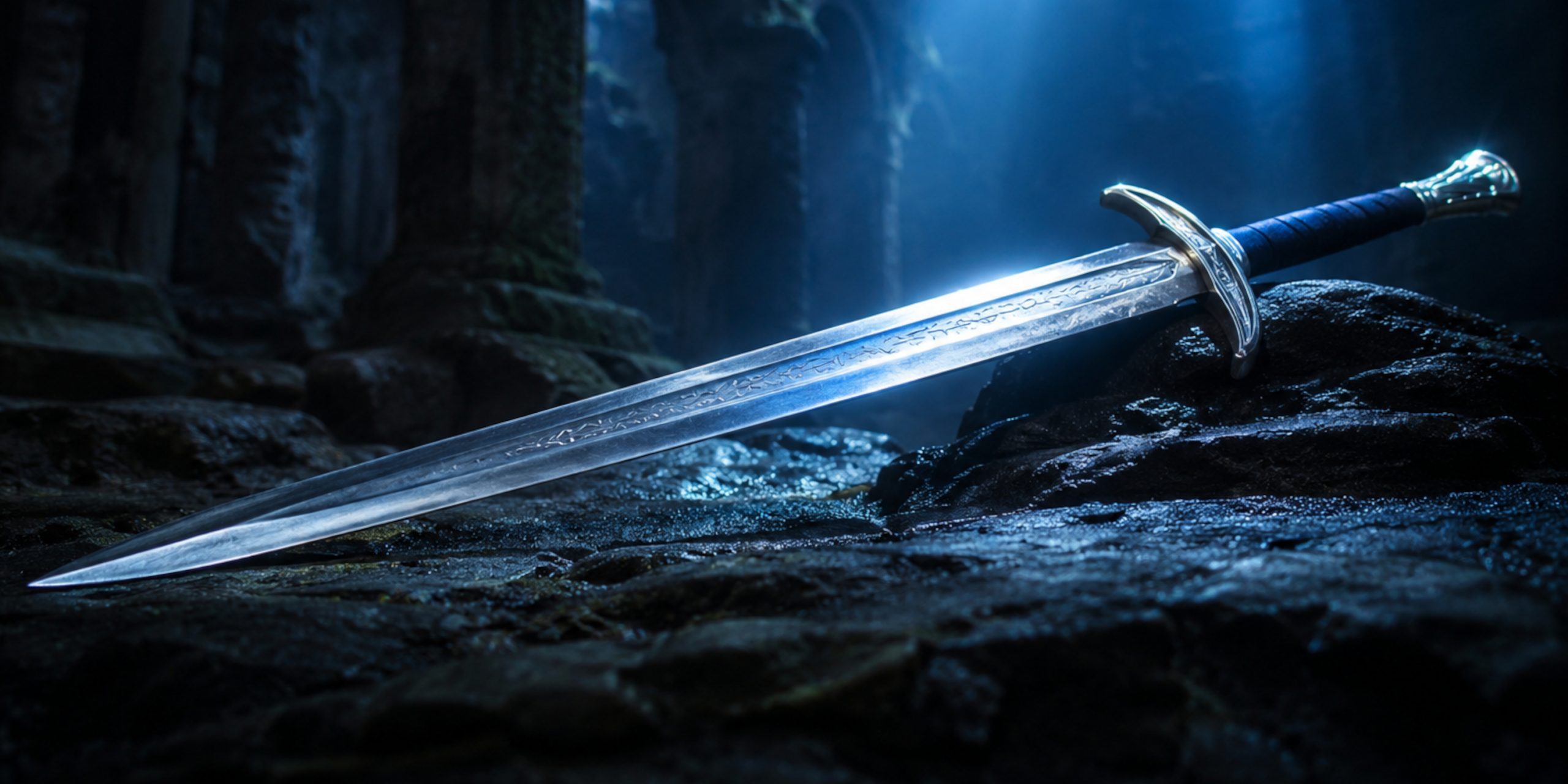
Few weapons in fantasy literature carry the same weight as Gandalf’s famous blade. It is ancient, elegant, practical and deeply tied to the lost kingdoms of Middle-earth. Long before Gandalf wielded it against goblins, trolls and Balrogs, Glamdring belonged to one of the greatest Elven kings to ever live.
What makes Glamdring so fascinating is that it never tries too hard to impress. It has no flaming explosions, no reality-shattering magic and no dramatic speeches. It simply appears whenever Gandalf needs it most, quietly reminding everyone that the old legends never truly disappear.
Let’s take a closer look at one of Tolkien’s greatest weapons.
What Is Glamdring?
Glamdring is an ancient Elven sword forged during the First Age for Turgon, King of Gondolin.
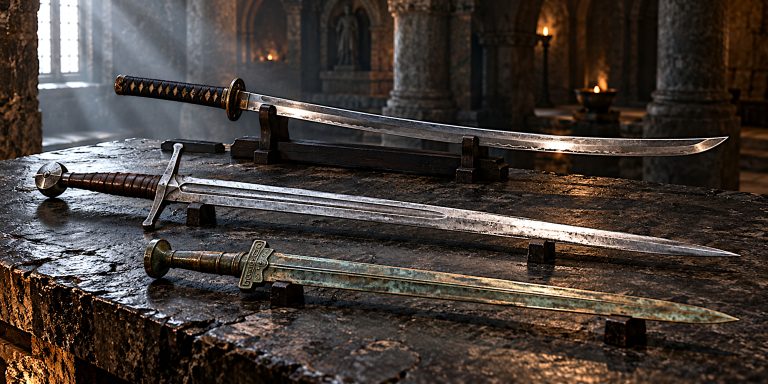
After Gondolin fell to Morgoth, the sword disappeared for thousands of years before unexpectedly resurfacing during the events of The Hobbit. Gandalf discovers it in a troll hoard alongside two other legendary blades, Orcrist and Sting.
Its name means “Foe-hammer” in Sindarin, an appropriate title considering its long history of killing Orcs and Goblins.
Unlike many fantasy weapons created simply to look impressive, Glamdring has a believable history that stretches across thousands of years.
Glamdring at a Glance
| Feature | Details |
|---|---|
| Weapon Type | Long sword |
| Owner | Originally Turgon, later Gandalf |
| Forged By | Elven smiths of Gondolin |
| Age | First Age |
| Material | Enchanted Elven steel |
| Meaning | “Foe-hammer” |
| Special Ability | Glows blue when Orcs are nearby |
| First Appearance | The Hobbit |
| Creator | J.R.R. Tolkien |
The Origins of Glamdring
Glamdring was forged in the hidden Elven city of Gondolin during the First Age.
At the time, Gondolin represented one of the greatest centres of craftsmanship anywhere in Middle-earth. Its smiths produced weapons that combined incredible skill with subtle enchantments. Their creations were renowned for holding sharp edges, resisting corrosion and surviving battles that would destroy ordinary swords.
King Turgon carried Glamdring during the wars against Morgoth, where it became feared by the Dark Lord’s armies.
When Gondolin eventually fell, countless treasures vanished beneath the ruined city. Glamdring was believed lost forever.
That assumption turned out to be spectacularly wrong.
How Gandalf Finds Glamdring
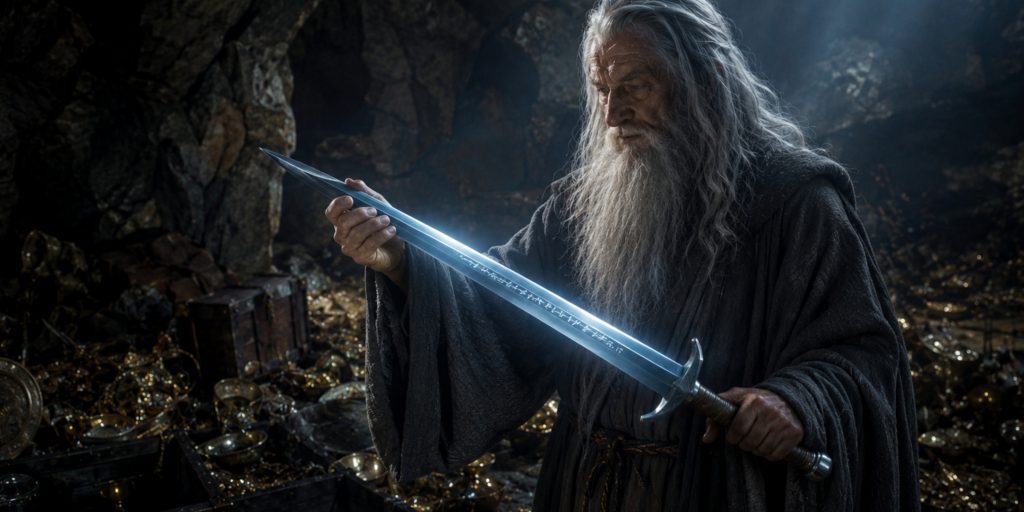
One of the most memorable moments in The Hobbit occurs when Bilbo, Gandalf and Thorin’s company discover a cave belonging to three trolls.
Inside the treasure hoard they uncover three remarkable swords:
- Glamdring
- Orcrist
- Sting
At first they appear to be beautifully made ancient weapons.
Only later do Elrond and the Elves of Rivendell identify them as genuine blades from Gondolin.
Imagine finding a dusty old sword in someone’s garage, only to discover it once belonged to King Arthur. That is essentially what happens.
The trolls had absolutely no idea what they were sitting on.
Why Does Glamdring Glow Blue?
Perhaps Glamdring’s best-known magical ability is its blue glow whenever Orcs or Goblins are nearby.
This enchantment serves two purposes.
First, it provides an early warning system for approaching enemies.
Second, it reflects the ancient hatred between the Elves of Gondolin and the servants of Morgoth.
Unlike magical effects in many modern fantasy stories, Tolkien treats this ability with restraint. The glow is practical rather than spectacular. It adds tension without becoming the focus of every battle.
That subtle approach is one reason Tolkien’s magic often feels more believable.
Glamdring Throughout The Hobbit
Although Bilbo becomes the unlikely hero, Gandalf and Glamdring repeatedly save the company.
Key moments include:
| Event | Glamdring’s Role |
| Troll Cave | Discovered alongside Sting and Orcrist |
| Rivendell | Identified by Elrond |
| Goblin Tunnels | Used to fight Goblins during the escape |
| Throughout the Quest | Serves as Gandalf’s primary weapon |
The Goblins immediately recognise Glamdring.
That reaction says everything.
Weapons with long histories develop reputations, and Glamdring’s reputation clearly survived thousands of years.
Apparently even Goblins remember bad experiences remarkably well.
Glamdring in The Lord of the Rings
Although discovered in The Hobbit, Glamdring continues to play a major role during The Lord of the Rings.
Gandalf carries it throughout the War of the Ring.
Some of its most famous appearances include:
- The Battle of the Chamber of Mazarbul
- The journey through Moria
- The confrontation with the Balrog
- The defence of Minas Tirith
- The final campaigns against Sauron
By this point, Glamdring has become inseparable from Gandalf himself.
It reflects his authority without overshadowing his wisdom. Gandalf wins battles through intelligence, courage and sacrifice, not because he possesses the biggest magical sword.
That distinction matters.
Glamdring’s Symbolism
Glamdring represents far more than military strength.
Throughout Tolkien’s work it symbolises:
- The endurance of ancient hope
- The survival of forgotten kingdoms
- The wisdom of previous generations
- Resistance against overwhelming darkness
- The lasting legacy of Gondolin
Many of Tolkien’s greatest objects carry emotional weight because they connect the present with an almost mythical past.
Glamdring is one of the clearest examples of that theme.
When Gandalf draws the sword, he is carrying thousands of years of history into every battle.
Why Glamdring Stands Out
Fantasy literature is full of famous swords.
Many are impossibly powerful.
Others are cursed beyond reason.
Glamdring feels different because Tolkien avoids exaggeration.
The sword is exceptional because of its craftsmanship, history and symbolism rather than endless magical abilities.
Its reputation comes from the people who carried it, not from flashy powers.
That approach has influenced countless fantasy authors ever since.
It proves that a legendary weapon does not need to bend reality to become unforgettable.