The Forgotten Powerhouse Of Medieval Africa
Long before the modern country of Ghana existed, a powerful kingdom rose hundreds of miles to the north in what is now parts of Mali and Mauritania. Known to Arab writers as Ghana, and probably called Wagadu by its own people, this empire became one of medieval Africa’s greatest political and economic powers.
From around the 7th century until the 13th century, the rulers of Ghana controlled trade routes carrying gold, salt, ivory, textiles and ideas across the Sahara. Their kings became famous far beyond their borders, not because they personally mined gold, but because they mastered something arguably more useful: controlling everyone else trying to move it.
A historian has to admire the simplicity of the strategy. Let merchants cross your territory, keep the roads safe, tax the goods, and suddenly everyone wants to know your name.
Who Were The Kings Of Ghana?
The rulers of the Ghana Empire came from the Soninke people, part of the wider Mande cultural world of West Africa. The title “Ghana” was originally not the name of the land itself but a royal title meaning something similar to “warrior king” or “ruler”.
Arab geographers recorded the splendour of these monarchs, describing courts filled with ceremony, gold ornaments and powerful officials. Much of what survives comes from outside observers, especially Muslim scholars writing from North Africa and the wider Islamic world.
This creates one of the great frustrations of studying medieval African history. We can see the shadow of a sophisticated state, but many of its own voices were preserved through oral tradition rather than written royal records. The story survives, but sometimes we have to listen carefully.
The Rise Of Ghana (c. 700 To 900)
The Ghana Empire grew from earlier Soninke settlements around the Sahel, the grassland region between the Sahara Desert and the forests further south.
Its rise depended on several advantages:
- Control of trans-Saharan caravan routes
- Access to gold from regions such as Bambuk
- Strong cavalry forces
- Skilled diplomacy with Berber traders
- A centralised monarchy supported by nobles and officials
The introduction of the camel to Saharan trade transformed the region. Suddenly, journeys that were once extremely dangerous became slightly less dangerous. The Sahara was still not exactly a pleasant afternoon walk, but organised caravans could now connect West Africa with North Africa and the Mediterranean world.
Gold flowed north. Salt, cloth, horses and luxury goods travelled south.
Ghana sat in the middle.
The Power Of The Ghana Kings
The kings of Ghana ruled through a combination of military strength, spiritual authority and economic control.
According to the 11th-century writer al-Bakri, the king held court surrounded by impressive displays of wealth. He described royal audiences where officials, warriors and visitors approached according to strict customs.
The king was seen not simply as a political leader but as a figure with sacred importance. Traditional Soninke beliefs remained central to royal identity, even as Islam spread among merchants and officials.
This created a fascinating balance:
- Muslim merchants had their own communities and judges
- Traditional religious practices remained connected to kingship
- Trade with Islamic North Africa continued to expand
It was a practical arrangement. Medieval rulers everywhere tended to discover that religious disputes were complicated, but gold taxes were wonderfully straightforward.
Famous Kings Of Ghana
The names of many Ghanaian kings have sadly been lost, but several rulers or figures are remembered through written accounts and tradition.
Kaya Maghan Cissé
Often remembered in Soninke oral traditions as a legendary founder of Ghana, Kaya Maghan Cissé is associated with the early formation of the kingdom.
Separating history from legend is difficult, but his importance lies in what he represents: the idea of a warrior founder who united communities and established royal authority.
Bassi
Mentioned by later Arabic sources, Bassi was said to be one of Ghana’s rulers before the famous king Tunka Manin. His reign is associated with the period when Ghana was already a significant regional power.
Tunka Manin (c. 11th Century)
Tunka Manin is the best documented ruler of Ghana and was described by al-Bakri around 1068.
During his reign:
- Ghana controlled major trade routes
- Royal authority remained strong
- The army was considered formidable
- Wealth from taxation supported the court
Al-Bakri claimed that the king could call upon a huge number of soldiers. Medieval figures should always be treated carefully, as chroniclers had a habit of adding enthusiasm where mathematics might have been more useful.
Still, the message is clear: Ghana was viewed as a serious military power.
The Royal Court
The Ghanaian court impressed foreign visitors with its organisation and ceremony.
Features included:
- Royal officials managing administration
- Interpreters dealing with foreign merchants
- Military commanders
- Religious specialists
- Regional governors
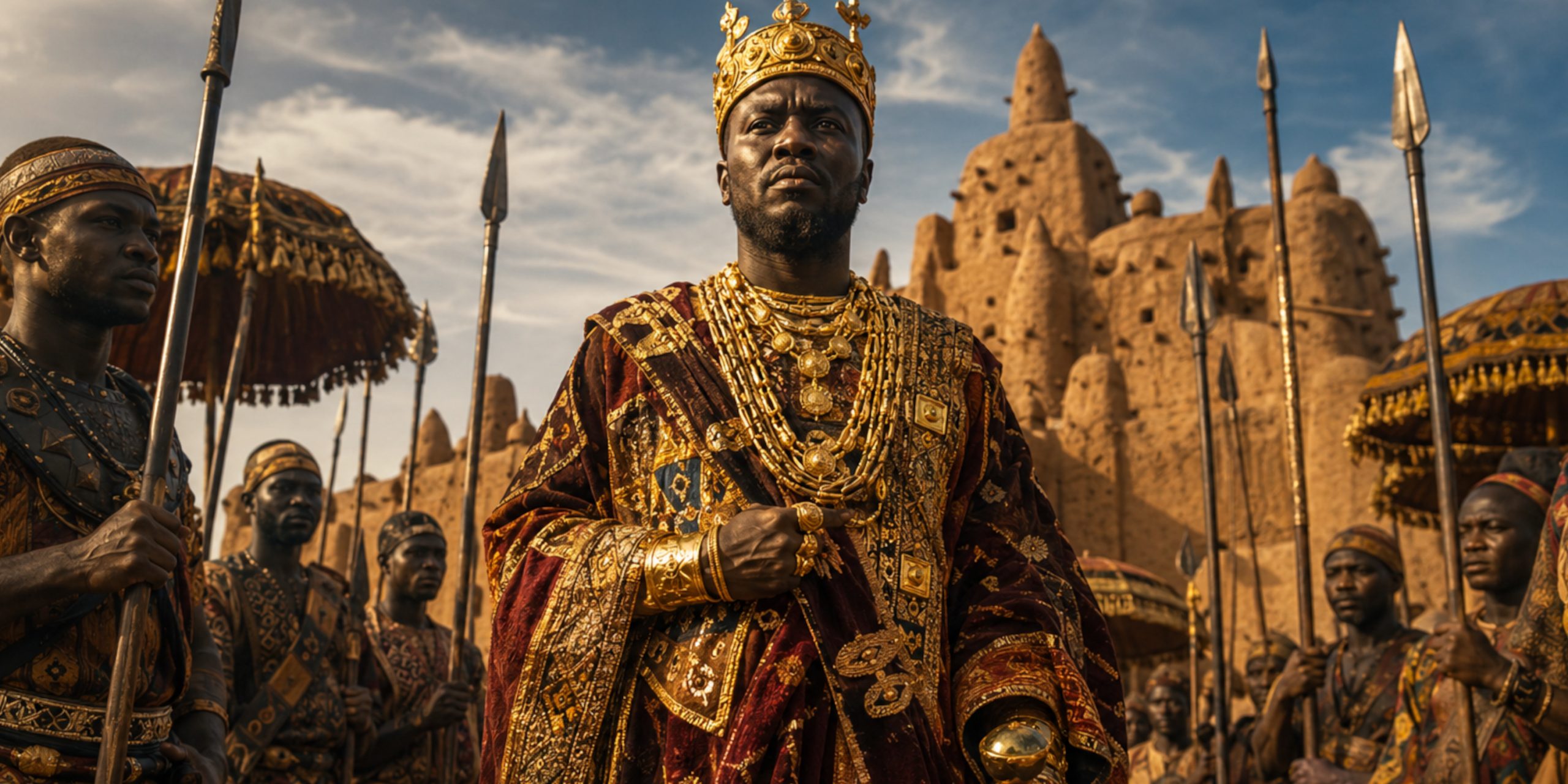
The king reportedly wore jewellery and fine clothing as symbols of status. Gold was central to royal display, although one clever tradition held that large gold nuggets belonged exclusively to the ruler, while smaller pieces circulated in trade.
A royal monopoly on the biggest gold pieces is certainly one way to avoid awkward competition.
Military Strength Of Ghana
The Ghana Empire maintained a powerful army to defend trade routes and expand influence.
Forces likely included:
| Unit | Role |
|---|---|
| Cavalry | Elite troops, scouting, rapid attacks |
| Infantry | Main battlefield force |
| Archers | Support and harassment |
| Spearmen | Defensive formations |
| Royal guards | Protection of the king and court |
The army’s greatest advantage was organisation. By maintaining security across trade routes, Ghana became attractive to merchants who needed protection.
In a world where losing your caravan meant losing your fortune, reliable roads were a very valuable product.
Arms And Armour
Evidence comes from archaeology, regional traditions and written sources.
Weapons likely included:
- Iron swords: Locally produced blades used by warriors and elites
- Spears and javelins: Common weapons among infantry and cavalry
- Bows: Important for mobile warfare
- Daggers and knives: Personal weapons
- Shields: Usually leather, often made from animal hide
Ironworking was a major technological strength in West Africa. Skilled smiths held important social positions because their work supported agriculture, trade and warfare.
Armour varied by status:
- Wealthy cavalry could possess quilted protection, helmets or imported equipment
- Ordinary soldiers relied more on mobility, shields and practical clothing
The image of medieval West Africa as technologically isolated is completely wrong. These kingdoms were connected, adaptive and deeply involved in international exchange.
Trade And The Gold Economy
Gold made Ghana famous, but the empire’s real genius was administration.
Major exports:
- Gold
- Ivory
- Animal products
- Enslaved people
- Crafted goods
Imports included:
- Salt
- Horses
- Textiles
- Metal goods
- Books and luxury items
Salt was especially important. In parts of West Africa, salt could become extraordinarily valuable because it was essential for health and preserving food.
Gold may look prettier in a crown, but try surviving without salt. History has a way of making everyday objects surprisingly powerful.
Religion And Culture
Before Islam became influential, Ghana’s rulers followed traditional Soninke religious beliefs involving ancestral connections and sacred kingship.
Islam spread mainly through:
- Merchants
- Scholars
- Diplomats
- Trade communities
Unlike some later periods, conversion was gradual. The Ghanaian kings maintained older traditions while allowing Muslim communities to flourish.
This was not a society waiting to be “introduced” to civilisation by outsiders. It already had government, law, trade, military organisation and complex beliefs.
Decline Of The Ghana Empire
By the 12th and 13th centuries, Ghana weakened due to several pressures:
- Changing trade routes
- Environmental difficulties
- Internal political challenges
- Rival kingdoms gaining strength
- Conflict involving the Almoravids
Older histories often claimed the Almoravid movement simply conquered and destroyed Ghana around 1076. Modern historians are more cautious. The relationship was likely more complicated, involving conflict, influence and gradual decline rather than a single dramatic collapse.
History rarely provides a neat ending, despite how much easier that would make writing books.
Rise Of Mali And The End Of Ghana’s Dominance
By the early 13th century, Ghana’s influence faded as new powers emerged.
The greatest successor was the Mali Empire, which inherited and expanded many of the trade networks Ghana had helped build.
The rise of Mali under rulers such as Sundiata Keita did not erase Ghana’s importance. It continued a tradition of powerful West African kingdoms controlling commerce, diplomacy and culture.
Archaeology And Evidence
Important discoveries linked to Ghana’s world include:
Koumbi Saleh
Often identified as a possible capital or major urban centre of Ghana, archaeological work has revealed:
- Stone structures
- Settlement organisation
- Trade evidence
- Islamic influences
- Imported goods
The site shows a wealthy, connected society rather than the simple settlements once imagined by outdated histories.
Other evidence comes from:
- Oral traditions
- Arabic manuscripts
- Settlement archaeology
- Trade goods found across the Sahara
The challenge is combining these sources carefully. A good historian has to work a little like a detective, except the witnesses are usually centuries old and annoyingly unavailable for follow-up questions.
Legacy Of The Ghana Kings
The kings of Ghana created one of Africa’s first great medieval empires. Their achievements influenced later West African powers including Mali and Songhai.
Their legacy includes:
- Development of major trade networks
- Growth of urban centres
- Strong traditions of kingship
- Expansion of West African diplomacy
- Cultural exchange across continents
The Ghana Empire deserves to be discussed alongside other medieval powers of the world. Its kings controlled wealth, managed international relationships and built a state that endured for centuries.
The gold attracted attention, but organisation built the empire.
Takeaway
Studying the kings of Ghana is a reminder that medieval history was far larger than castles, knights and European dynasties. Across the Sahara, West African rulers were building wealthy states, negotiating with foreign merchants and commanding armies.
The records leave gaps, and those gaps can be frustrating, but what remains is extraordinary. Ghana was not a footnote before Mali. It was the foundation stone of a golden age of West African power.
Watch the documentary: