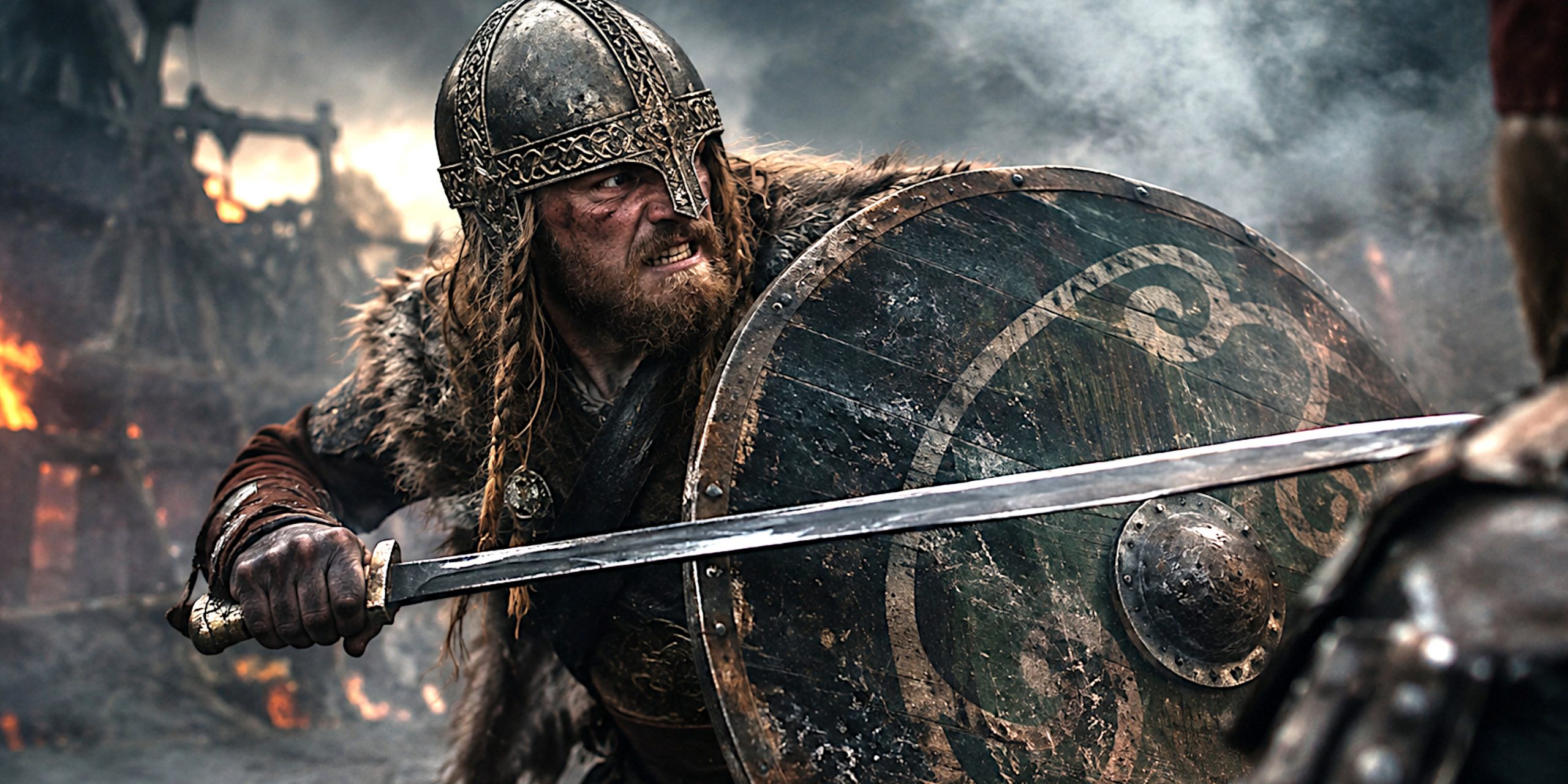
The Viking sword is among the most recognisable weapons of the early medieval world, although the name can be slightly misleading. These swords were not uniquely Scandinavian inventions. They belonged to a wider European family of blades used from roughly the 8th to the 11th centuries, appearing in Scandinavia, the British Isles, Francia, the Baltic and far beyond the traditional boundaries of the Viking world.
What the Norse did was adopt the sword enthusiastically, trade for blades and materials across considerable distances, and turn the weapon into a particularly potent symbol of wealth and martial standing.
A good Viking Age sword was expensive. Spears, axes and bows could be produced more economically, while a sword required a substantial quantity of quality iron or steel and considerable skill to manufacture. Decorated hilts, silver inlay and prestigious blade inscriptions pushed the finest examples into another category entirely.
Yet underneath the status was a practical weapon. The characteristic Viking sword combined a broad double-edged blade, shallow fuller, short guard and one-handed grip. It was principally suited to cutting, particularly when used alongside a round shield, but surviving blades show enough variation to make any single definition rather dangerous.
Viking Sword Specifications

There was no standard Viking sword pattern. Dimensions varied according to date, workshop, blade type and individual weapon. Surviving archaeological examples nevertheless provide a useful general range.
| Feature | Typical Characteristics |
|---|---|
| Period | c. 750 to 1050 AD |
| Overall length | Usually around 85 to 100 cm |
| Blade length | Commonly around 70 to 85 cm |
| Weight | Often approximately 1 to 1.5 kg |
| Blade | Straight, broad and double-edged |
| Fuller | Usually broad and relatively shallow |
| Point | Generally moderate rather than acutely pointed |
| Grip | One-handed |
| Guard | Short compared with later medieval swords |
| Pommel | Highly variable, including lobed and simpler forms |
| Construction | Pattern-welded, piled or increasingly homogeneous steel depending on period and manufacture |
| Scabbard | Normally wood covered with leather or textile |
| Primary role | Cutting with secondary thrusting capability |
| Typical companion weapon | Round shield |
Actual archaeological examples underline the variation. A 10th to 11th-century Petersen Type X sold by Bonhams had a 76.5 cm blade and measured 91 cm overall, while another 10th to 11th-century example sold by the same auction house had a 78.5 cm blade and overall length of 92.5 cm.
The fuller deserves particular attention. It is sometimes incorrectly described as a “blood groove”. Its principal purpose was structural. Removing material from the central portion of the blade could reduce weight while retaining useful stiffness and leaving more material towards the cutting edges.
Anatomy of a Viking Sword
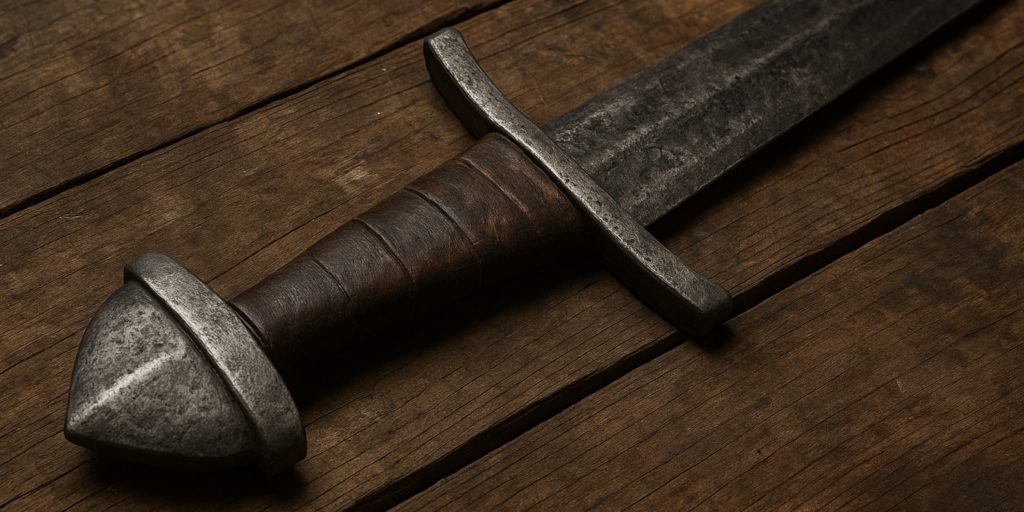
Although Viking Age swords varied enormously in decoration, several features recur.
The blade
Most blades were:
- Straight
- Double-edged
- Broad in proportion to their length
- Equipped with a wide central fuller
- Designed primarily for effective cuts
- Capable of thrusting, although generally less specialised for this than later medieval swords
A surviving 10th-century Petersen Type H recorded by Christie’s has a 76.8 cm blade which tapers only slightly before terminating in a very short point. Other examples are more noticeably tapered.
The crossguard
The guard was normally short, especially compared with the long crosses of later medieval arming swords.
This made sense in the context of shield-based fighting. Hand protection was supplied partly by the shield, while an excessively long crossguard was unnecessary for the sword’s predominant method of use.
The grip
The grip was short and intended for one-handed use. Surviving organic coverings are uncommon, but grips could incorporate wood and leather or textile coverings.
The relatively compact hilt can feel unusual to someone accustomed to later European swords. It encouraged a secure grip while leaving the other hand free for the shield.
The pommel
Pommel design is one of the most useful features for classifying Viking Age swords.
Forms included:
- Multi-lobed pommels
- Trilobate forms
- Cocked-hat forms
- Rounded or flattened forms
- The characteristic later Type X “tea-cosy” shape
Pommel and guard decoration could include silver, copper-alloy and occasionally gold inlay.
The Petersen Typology
One of the most important systems for studying Viking swords was developed by Norwegian archaeologist Jan Petersen in his 1919 work De Norske Vikingesverd.
Petersen classified swords primarily through the form of their hilts. His system contains numerous types and remains fundamental to archaeological discussion of Viking Age swords.
Some frequently encountered forms include:
| Petersen Type | Broad Characteristics | Approximate Association |
| Type H | Substantial multi-part pommel, often decorated | Particularly associated with the 9th and 10th centuries |
| Type K | Distinctive hilt form with Scandinavian distribution | Viking Age |
| Type L | Often associated with elaborate hilt forms and regional variants | 9th to 10th centuries |
| Type S | Frequently richly decorated | Later Viking Age |
| Type X | Simpler guard and characteristic rounded or “tea-cosy” pommel | 10th to 11th centuries |
The system should not be treated as a catalogue of models produced to fixed specifications. Archaeological swords are inconvenient things and regularly refuse to fit modern categories quite as neatly as we might like.
A sword offered by Christie’s and dated to the mid-9th to late 10th century, for example, was classified as Petersen Type L and retained a pattern-welded blade and elaborate cocked-hat pommel.
History and Evolution of the Viking Sword
Origins before the Viking Age
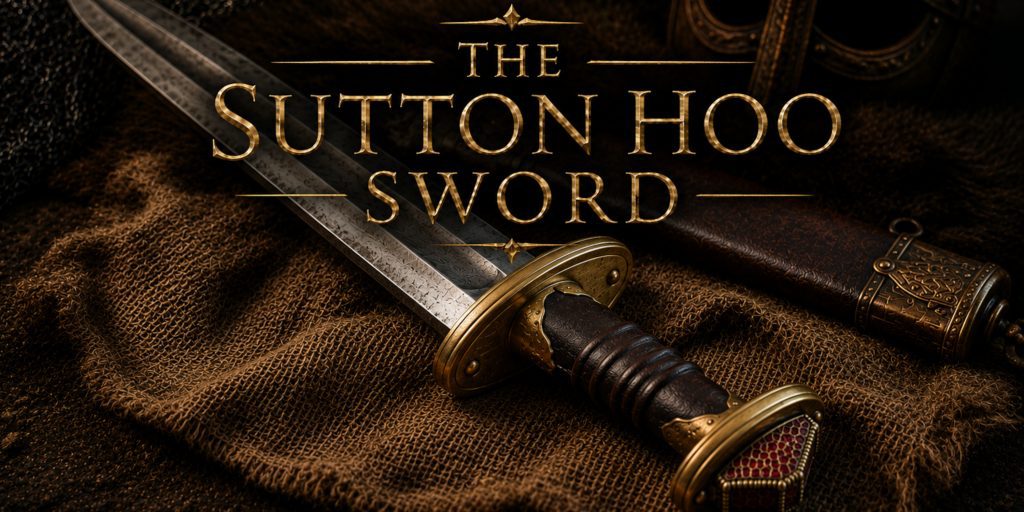
The Viking sword developed from Migration Period and Merovingian sword traditions.
Earlier Germanic swords already possessed several familiar characteristics:
- Double-edged blades
- Pattern-welded construction
- Short guards
- Elaborate pommels
- One-handed grips
The Viking sword therefore represents an evolutionary stage rather than a sudden Scandinavian invention.
The 8th and 9th centuries
Early Viking Age swords frequently retained complicated hilt forms and, in many cases, pattern-welded blades.
Pattern welding involved combining iron and steel elements through forge welding and manipulation. The technique could create blades with useful mechanical properties while producing striking surface patterns when polished and etched.
A 9th-century sword documented by Christie’s had a broad, straight, pattern-welded blade measuring 78.1 cm, together with silver decoration on the cross and pommel.
Such weapons demonstrate just how sophisticated early medieval sword production could be.
The 10th century
During the 10th century, blade construction and hilt styles continued to change.
Improved access to better-quality steel reduced the need for elaborate pattern welding in some workshops. Pattern welding did not simply disappear overnight, however. Different manufacturing traditions overlapped.
Hilts also became increasingly varied. Petersen Types H, L, S and X illustrate only part of a much larger range.
The 11th century
By the late Viking Age, sword design was moving towards forms recognisable as early medieval knightly swords.
Type X is particularly important in this transition. Its comparatively straightforward crossguard and pommel anticipate the visual language of the later arming sword.
The boundary between a “Viking sword” and an “early medieval sword” becomes increasingly artificial here. Weapon development did not stop because a historian reached the end of a convenient period.
Pattern-Welded Viking Swords
Pattern welding has become almost synonymous with Viking swords in popular culture, sometimes to the point of exaggeration.
The process could involve:
- Forging iron and steel rods together
- Twisting selected rods
- Welding them into a composite core
- Adding harder cutting edges
- Grinding and polishing the completed blade
The resulting patterns might resemble waves, chevrons or twisting lines.
Pattern welding could provide practical benefits when high-quality steel was difficult to obtain in large quantities. It also produced visually impressive blades.
Later Viking Age swords increasingly used different forms of more homogeneous blade construction as metallurgy and supply networks changed.
Not every Viking sword was pattern welded, and pattern welding itself should not automatically be interpreted as evidence of superior quality.
Ulfberht Swords

Few early medieval blade inscriptions have generated as much interest as the famous Ulfberht group.
These swords carry variations of an inscription usually rendered as:
+VLFBERH+T
or related spellings.
Ulfberht was probably originally a personal or workshop-associated name, although the inscription appears across enough swords and over a sufficiently long period that it almost certainly became something resembling a prestigious manufacturing tradition or mark.
Some Ulfberht blades contain unusually high-quality steel, while others differ considerably in composition and workmanship. This has led to theories concerning multiple workshops, imitation inscriptions and deliberate attempts to exploit the reputation of the name.
They should therefore not all be described as identical “super swords”.
Their distribution nevertheless demonstrates the extraordinary reach of early medieval trade and weapon production.
How Viking Swords Were Used in Combat
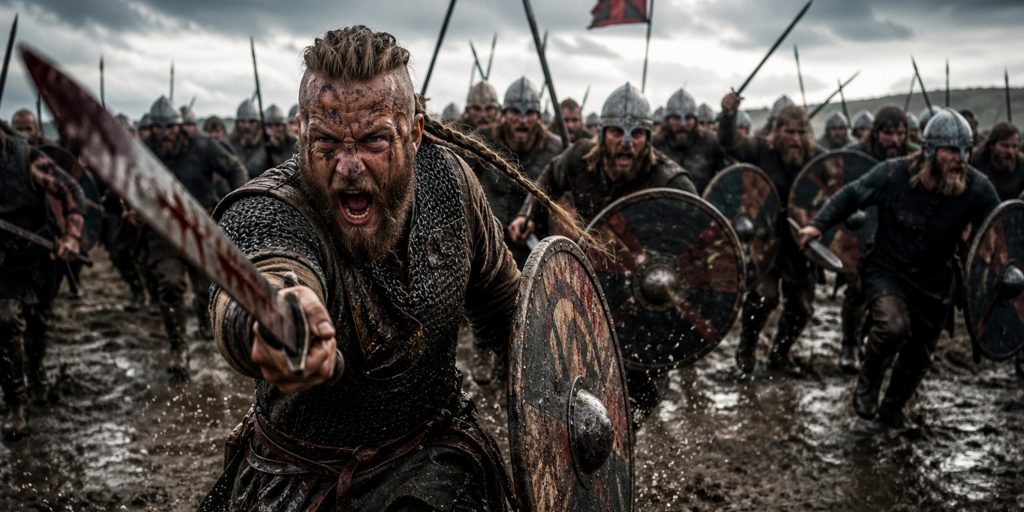
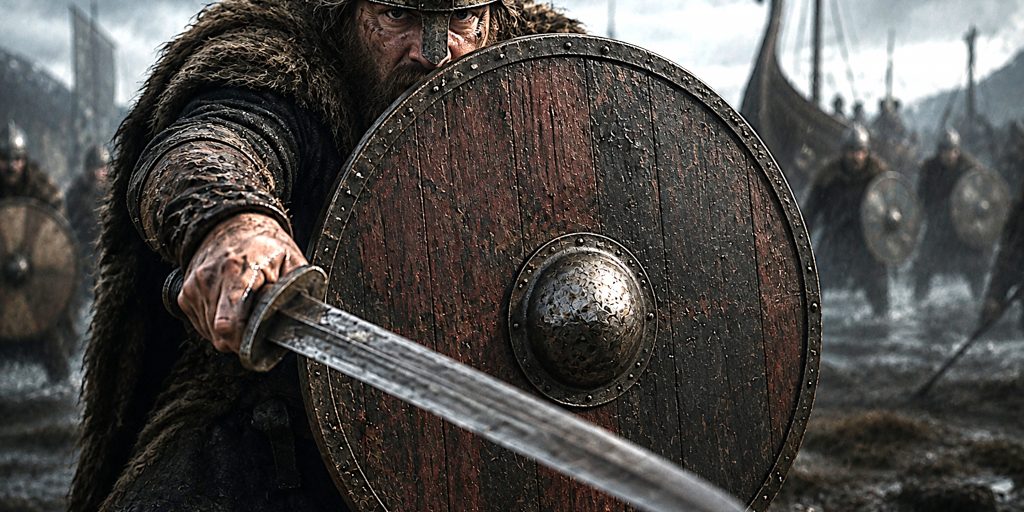
The Viking sword was fundamentally a one-handed weapon.
Its natural partner was the round shield.
A warrior could use the shield to:
- Protect the sword hand and body
- Deflect incoming blows
- Control an opponent’s weapon
- Strike or shove an opponent
- Create openings for the sword
The sword could then exploit those openings with fast cuts.
Likely targets included exposed limbs, the head, neck and areas inadequately protected by armour.
Thrusting was certainly possible. The idea that Viking swords could only slash is misleading. Their broad blades and often relatively rounded points, however, show that powerful cutting was central to their design.
Advantages of the Viking Sword
| Advantage | Why It Mattered |
| Excellent cutting ability | Broad blades delivered effective cuts |
| Double-edged blade | Allowed attacks from either side without rotating the weapon |
| Good balance | A well-made sword could remain lively despite its blade width |
| One-handed use | Left the other hand free for a shield |
| Durable construction | Quality examples were formidable working weapons |
| Versatility | Useful in individual fighting and formation combat |
| Status | Ownership advertised wealth and martial prestige for famous Vikings |
| Repair potential | Hilts and grips could sometimes be replaced during a blade’s working life |
One of its greatest strengths was the combination of reach and manoeuvrability.
Compared with an axe, the sword offered a long cutting edge and could recover quickly after a strike. Compared with a spear, it was much easier to manipulate at extremely close range.
Disadvantages of the Viking Sword
The weapon had equally real limitations.
- Cost: swords required more metal and specialist labour than many axes or spears.
- Limited hand protection: the short guard offered less coverage than later developed medieval hilts.
- Armour penetration: cutting attacks became less effective against increasingly sophisticated armour.
- Reach: a spear could threaten an opponent from substantially farther away.
- Maintenance: edges required sharpening and corrosion was a persistent problem.
- Point geometry: many examples were less optimised for powerful thrusts than later medieval swords.
- Accessibility: swords were not necessarily the normal weapon of every Viking warrior.
The last point matters. Popular culture has equipped almost every Norseman with a sword. Archaeology presents a more complicated picture.
Spears, axes, bows and knives were important parts of Scandinavian warfare. A sword represented a considerable investment.
Viking Sword vs Similar Weapons
| Weapon | Reach | Cutting | Thrusting | Defence | Cost | Typical Strength |
| Viking sword | Medium | Excellent | Good | Good with shield | High | Versatility |
| Viking axe | Short to medium | Excellent | Limited | Moderate | Lower | Powerful cuts |
| Spear | Long | Moderate | Excellent | Good in formation | Low | Reach |
| Seax | Short | Good | Good | Limited | Lower | Close combat and utility |
| Later arming sword | Medium | Excellent | Very good | Better hand protection | High | More developed cut-and-thrust performance |
Viking sword vs axe
The axe was cheaper and capable of ferocious cuts. Larger axes could also offer greater reach.
The sword generally recovered more smoothly between attacks and offered cutting edges on both sides.
Viking sword vs spear
The spear possessed the decisive advantage of reach and was considerably easier to manufacture.
In organised fighting, that mattered enormously. The sword became particularly useful once fighting closed or a spear was lost, damaged or impractical.
Viking sword vs seax
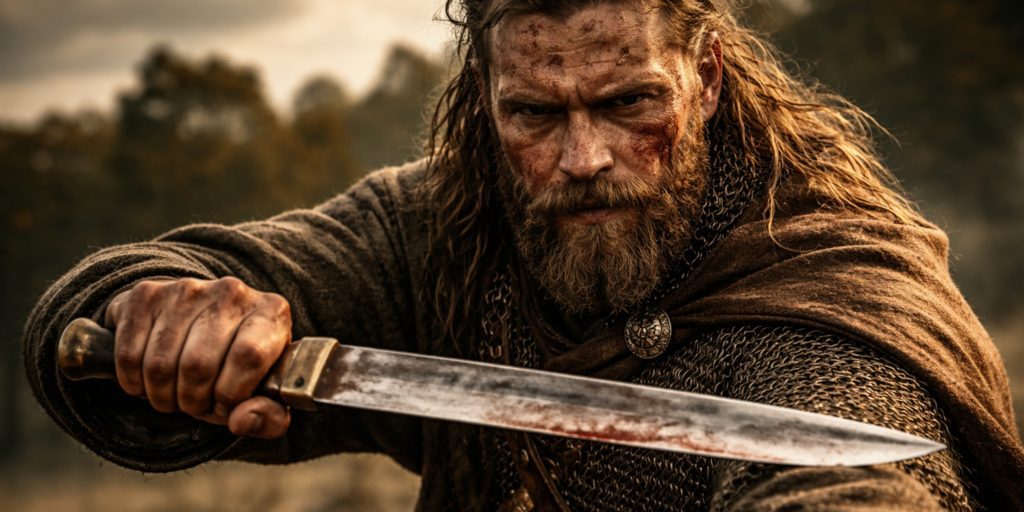
The seax was substantially shorter and could serve as both weapon and utility knife.
It lacked the reach and overall fighting versatility of a full sword but was considerably easier to carry.
Viking sword vs medieval arming sword
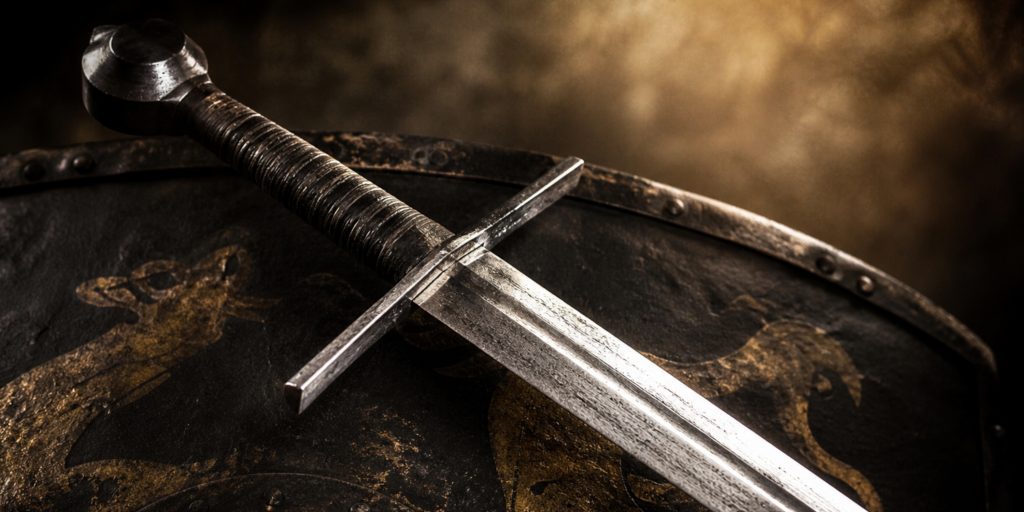
The later arming sword represents a continuation of the same broad European sword tradition.
Over time:
- Crossguards became longer
- Pommel designs changed
- Blades often became more tapered
- Points could become more effective for thrusting
- Hilt construction evolved alongside changes in armour
The transformation was gradual rather than revolutionary.
Viking Swords as Symbols of Status
Swords appear in burials, literature and poetry as objects carrying significance far beyond their practical function.
Some were:
- Given names
- Passed between generations
- Presented as gifts
- Buried with owners
- Decorated with precious metals
- Associated with elite identity
- Deliberately damaged before deposition
Saga literature should be treated cautiously as evidence for Viking Age behaviour because many surviving texts were written considerably later. Even so, the recurring literary fascination with named and inherited swords probably reflects genuine traditions surrounding prestigious weapons.
A sword could embody family history in a way that a cheap spearhead probably did not.
Archaeological Evidence
Viking swords survive in surprisingly large numbers, although many are heavily corroded.
They have been recovered from:
- Graves
- Rivers
- Lakes
- Wetlands
- Settlement contexts
- Accidental losses
- Ritual deposits
Water finds can be particularly intriguing because interpretation is difficult. A sword in a river might represent accidental loss, deliberate deposition, later disturbance or any number of circumstances that archaeology cannot always recover.
Corrosion can also disguise original construction. X-rays, metallographic examination and other analytical techniques have consequently become important for understanding blade structure.
One Christie’s Type X sword was subjected to X-ray analysis at the Royal Armouries and metallurgical examination associated with the Wallace Collection, demonstrating how modern investigation can reveal features invisible beneath corrosion.
Famous Viking Sword Finds
Ulfberht swords
Examples carrying Ulfberht inscriptions have been discovered across Europe and remain central to debates about early medieval metallurgy, trade and workshop organisation.
River Witham sword
The British Museum holds an important late 9th-century sword recovered from the River Witham in Lincolnshire. Its decorated hilt has been used for comparison with other Anglo-Saxon and Viking-period swords, including a richly decorated example sold through Christie’s.
Finnish Viking Age swords
Finland has produced important groups of Viking Age and immediately post-Viking swords. A richly decorated 10th to 11th-century sword sold by Bonhams was associated with a group of seventeen complete or fragmentary comparable finds from Finnish graves.
Where to See Viking Swords
Several European museums hold important Viking Age swords and related weapons.
| Museum | Location | What to Look For |
| British Museum | London, UK | Anglo-Saxon and Viking-period swords and decorated fittings |
| National Museum of Denmark | Copenhagen, Denmark | Extensive Viking Age weapon collections |
| National Museum of Norway | Oslo, Norway | Norwegian Viking Age archaeological material |
| National Museum of Finland | Helsinki, Finland | Important Finnish Viking Age swords |
| Royal Armouries | Leeds, UK | Comparative European arms and metallurgical research |
| Museum of Cultural History | Oslo, Norway | Major Norwegian Viking archaeological collections |
Displays change and objects can be removed for conservation or loans, so it is worth checking a museum’s current galleries before travelling specifically to see one object.
The Legacy of the Viking Sword
The Viking sword occupies an important position in the development of the European medieval sword.
Its ancestry extends backwards into Migration Period weapon traditions while its later forms merge into the knightly swords of the 11th and 12th centuries.
Features that continued into later swords included:
- Straight double-edged blades
- One-handed grips
- Counterbalancing pommels
- Crossguards
- Fullered blade construction
The proportions changed as armour, metallurgy and fighting methods evolved.
Culturally, the Viking sword has enjoyed an even longer afterlife. Victorian antiquarianism, Romantic nationalism, cinema, television and games have transformed it into an instant visual shorthand for the Viking Age.
The historical weapon was generally more restrained than its modern fantasy descendant. Huge blades, excessive ornament and improbable proportions belong more readily to prop departments than Scandinavian graves.
Collecting Original Viking Swords
Authentic Viking swords occasionally reach the international antiquities and arms market, but buying one requires considerably more caution than buying a later antique sword.
Condition varies dramatically.
Most genuine examples have spent centuries underground or underwater. Heavy oxidation, missing grips, damaged blades and incomplete hilts are normal.
A suspiciously immaculate “Viking sword” deserves very careful investigation.
What collectors should examine
- Documented provenance
- Previous auction appearances
- Export and import documentation
- Professional conservation history
- Metallurgical examination where available
- X-ray evidence
- Petersen classification
- Blade construction
- Pommel and guard morphology
- Signs of modern welding or reconstruction
- Replaced hilt components
- Artificially created patination
- Whether the blade and hilt genuinely belong together
Provenance is particularly important. Legal ownership of archaeological material can be complicated by the country of discovery, date of export and national heritage legislation.
Viking Sword Auction Prices
Original swords can reach substantial sums, although condition, rarity, decoration, provenance and completeness have an enormous effect on value.
Recorded sales provide better guidance than speculative asking prices.
| Sword | Date | Auction | Result |
| Petersen Type X Viking sword | 10th/11th century | Bonhams, London, 2015 | £7,500 including premium |
| Rare Viking sword, Oakeshott Type XII | 10th/11th century | Bonhams, London, 2016 | £11,250 including premium |
| Same Type X sword, earlier sale | 10th/11th century | Christie’s, London, 2002 | £14,340 including premium |
The 2015 Type X example is particularly useful for illustrating how prices can change. Bonhams offered it with an estimate of £6,000 to £9,000 and it sold for £7,500 including premium. The same sword had reportedly achieved £14,340 at Christie’s in 2002.
Another Petersen Type W/X sword offered by Bonhams in 2019 carried an estimate of £7,000 to £9,000, while a Type X example offered in 2018 was estimated at £5,000 to £7,000.
These figures are historical results and estimates rather than a current valuation guide.
Approximate collector market bands
| Category | Broad Market Position |
| Modern decorative reproduction | £100 to £400 |
| Better functional reproduction | £400 to £1,500+ |
| High-end historically researched reproduction | £1,000 to £4,000+ |
| Fragmentary archaeological original | Highly variable |
| Recognisable original Viking sword | Often several thousand pounds upwards |
| Exceptional decorated or strongly provenanced example | Potentially well into five figures or beyond |
The market for genuine early medieval weapons is thin enough that rigid price guides are not particularly useful. Two swords of superficially similar type can achieve very different results.
Buying a Viking Sword Replica
For most enthusiasts, a reproduction is a considerably more sensible proposition.
Before buying, decide what the sword is actually for.
For display
Look for:
- Historically plausible proportions
- Accurate pommel and guard
- Sensible blade geometry
- A convincing scabbard
- Appropriate decoration
For historical re-enactment
Look for:
- Compliance with the rules of your re-enactment group
- Safe edge thickness
- Rounded point
- Secure hilt construction
- Appropriate blade flexibility
- Reliable manufacturer
For cutting practice
Use a sword specifically manufactured for cutting and follow appropriate training and safety procedures.
A sharp reproduction and a re-enactment sword are not interchangeable simply because both happen to look Viking.
How to Identify a Good Viking Sword Reproduction
Some reproductions capture the historical weapon remarkably well. Others appear to have been designed after someone described a Viking sword over a poor telephone connection.
Look for:
- Overall weight around historical norms
- A broad but not excessively thick blade
- Proper distal taper
- A historically plausible fuller
- A compact one-handed grip
- Correct Petersen-inspired hilt geometry
- A securely constructed pommel
- Minimal unnecessary fantasy decoration
Avoid assuming that heavier means stronger or more authentic. Historical swords were fighting weapons. Their makers had little reason to burden warriors with unnecessary steel.
Frequently Asked Questions
How heavy was a Viking sword?
Many functional examples probably weighed somewhere around 1 to 1.5 kg, although individual archaeological swords vary.
Were Viking swords sharp?
Yes. Combat swords were edged weapons intended to cut. Surviving archaeological blades are normally heavily corroded and cannot be judged by their present edge condition.
Could Viking swords stab?
Yes. They could thrust as well as cut, although many Viking Age blades were less strongly optimised for thrusting than later medieval swords.
Did every Viking carry a sword?
No. Swords were comparatively expensive. Spears, axes, bows and knives were also widely used.
Were Viking swords made from Damascus steel?
The terminology is problematic. Viking swords could be pattern welded, but pattern welding is not the same thing as historical crucible steels sometimes described as Damascus or wootz.
Did Vikings make Ulfberht swords?
Some Ulfberht swords certainly circulated within Viking contexts, but describing the entire group simply as “Viking-made” goes beyond the evidence. Their manufacturing origins and the organisation behind the inscription remain debated.
Why did Viking swords have such small guards?
They were designed for a fighting system in which the other hand normally carried a shield. Later European swords developed larger crosses as weapon use and defensive equipment changed.
Why the Viking Sword Matters
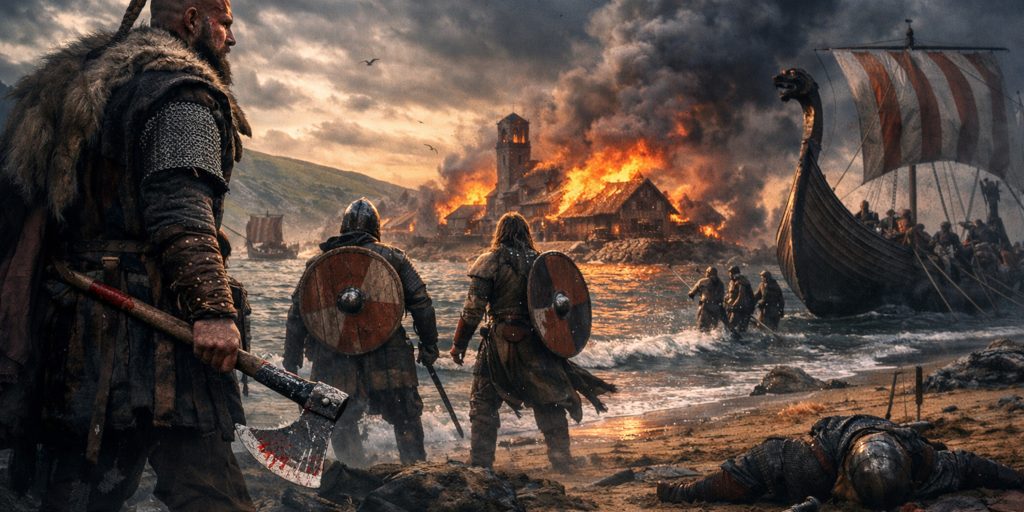
The Viking sword is interesting precisely because the archaeology is more complicated than the legend.
It was neither a crude iron chopping weapon nor a miraculous piece of lost technology. The best examples were sophisticated products of skilled smiths working within trading networks that connected Scandinavia with the rest of Europe and regions much farther east.
The weapon also sits at an important point in sword development. Follow its changing blade construction, guards and pommels through the 9th, 10th and 11th centuries and the later medieval arming sword begins to emerge.
For the Viking warrior wealthy enough to possess one, however, the academic typologies would have meant rather less. A sword was valuable, conspicuous and extremely personal. It could be inherited, named, decorated, buried or remembered in stories.
More than a thousand years later, we are still cataloguing them. That is a respectable legacy for a piece of sharpened steel.