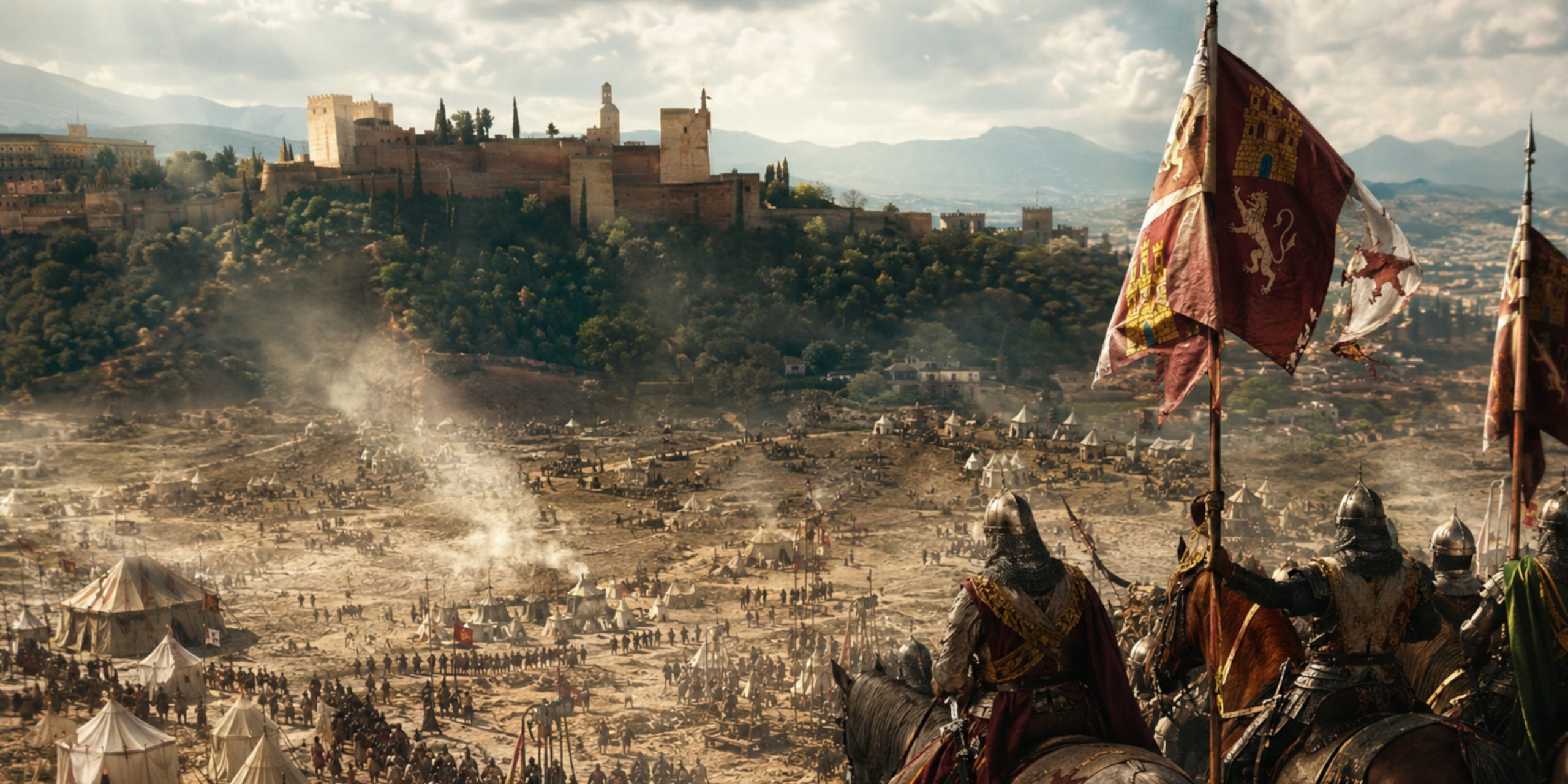
The Siege of Granada was not simply the capture of a city. It was the closing chapter of nearly eight centuries of conflict, coexistence, ambition, betrayal, faith, and exhaustion on the Iberian Peninsula. By the winter of 1492, the Emirate of Granada stood alone, isolated between mountains and memory, facing the combined might of Ferdinand of Aragon and Isabella of Castile.
Historians often speak of “the end of Muslim Spain” with dramatic flourish, and admittedly it is difficult not to. Granada had survived far longer than most expected. Its palaces glittered while other kingdoms fractured. Its poets wrote of paradise while Christian armies tightened the ring around it. Yet by the late fifteenth century, the Nasrid state resembled a beautiful sword with a crack hidden beneath the hilt.
The siege itself was methodical rather than wildly cinematic. There were no berserk final cavalry charges charging through flaming gates. Medieval warfare, inconveniently for filmmakers, often involved mud, hunger, paperwork, artillery positioning, and arguments over supply wagons.
Still, Granada’s fall changed Europe forever.
Background to the Siege
The Emirate of Granada had existed since 1238 under the Nasrid dynasty. It survived through diplomacy, tribute payments, internal Christian rivalries, and the defensive geography of southern Spain.
By the reign of Ferdinand and Isabella, however, the political climate had changed dramatically. Castile and Aragon had effectively united under the Catholic Monarchs, creating a far more centralised and financially capable state. The Reconquista was no longer a fragmented frontier struggle. It had become a royal mission backed by religious zeal, artillery, and increasing administrative sophistication.
Granada itself was weakened by internal division. Sultan Muhammad XII, better known in Spanish tradition as Boabdil, faced rivalry from his own family, including his uncle Muhammad XIII al-Zagal. Civil conflict during wartime is usually a catastrophic idea, though history shows rulers remain remarkably committed to trying it anyway.
The Christians exploited these divisions relentlessly.
By 1491, Granada city was effectively isolated.
Forces
Nasrid Granada
| Element | Details |
|---|---|
| Estimated strength | 7,000 to 15,000 defenders |
| Leadership | Muhammad XII (Boabdil) |
| Core troops | Andalusi infantry, archers, cavalry |
| Foreign support | Limited North African volunteers |
| Defensive assets | Walls, towers, mountain terrain |
| Artillery | Present but inferior in scale |
Castile and Aragon
| Element | Details |
|---|---|
| Estimated strength | 50,000 to 80,000 personnel |
| Leadership | Ferdinand II and Isabella I |
| Core troops | Castilian infantry, cavalry, artillery |
| Elite forces | Knights of Santiago, Calatrava, Alcántara |
| Naval support | Mediterranean blockade operations |
| Artillery | Large siege train with bombards |
The Christian army represented one of the most organised military forces Iberia had yet seen. Supply lines were carefully maintained, camps were fortified, and artillery was deployed systematically.
One of the most remarkable developments was the construction of Santa Fe, a permanent military town built during the siege after a fire destroyed part of the Christian encampment. Rather than retreat or complain, the monarchs simply built an entirely new settlement in stone. It was a very fifteenth-century way of saying, “We are not leaving.”
Leaders and Commanders
Nasrid Leadership
| Leader | Role |
|---|---|
| Muhammad XII (Boabdil) | Sultan of Granada |
| Muhammad XIII al-Zagal | Rival claimant and military commander |
| Nasrid nobles | Regional military leadership |
Muhammad XII (Boabdil)
Boabdil remains one of the most tragic figures in Spanish history. Romantic literature often portrays him as melancholic and doomed, though contemporary politics suggests he could also be pragmatic, cautious, and trapped by impossible circumstances.
According to later tradition, his mother Aixa supposedly rebuked him after Granada’s surrender:
“Weep like a woman for what you could not defend like a man.”
There is debate over whether she actually said it, though historians secretly hope she did because it is brutally memorable.
Christian Leadership
| Leader | Role |
|---|---|
| Ferdinand II of Aragon | Supreme commander |
| Isabella I of Castile | Political and logistical leadership |
| Gonzalo Fernández de Córdoba | Senior military commander |
| Cardinal Mendoza | Royal advisor and organiser |
Gonzalo Fernández de Córdoba
Later known as “The Great Captain,” Córdoba gained valuable experience during the Granada campaigns. His later reforms would help shape the emerging Spanish military system that dominated Europe in the sixteenth century.
Granada was not merely a victory. It was a rehearsal for empire.
Arms and Armour
Nasrid Weapons
Common Sword Types
- Jineta-style curved swords
- Straight double-edged arming swords
- North African sabres
- Daggers and jambiyas
Other Weapons
- Composite bows
- Spears and javelins
- Crossbows
- Early handguns
- Stone-throwing artillery
Nasrid cavalry traditions retained strong North African influence, especially the fast-moving jinete style of mounted warfare. These riders excelled at raids, skirmishes, and mobility rather than heavy shock combat.
Christian Weapons
Common Sword Types
Other Weapons
- Poleaxes
- Pikes
- Crossbows
- Arquebuses
- Bombards and cannons
The growing use of gunpowder artillery proved decisive. Granada’s walls, impressive though they were, increasingly belonged to an earlier military age.
Armour
| Side | Typical Protection |
|---|---|
| Nasrid forces | Mail, lamellar armour, padded garments |
| Christian forces | Plate armour, brigandines, mail |
Christian heavy cavalry remained formidable, though infantry and artillery were becoming more central to siege warfare. The age of the knight charging gloriously across every battlefield was slowly being replaced by engineers with gunpowder and accountants with ledgers.
History can be deeply unfair to romantics.
The Siege of Granada Timeline
April 1491
- Christian forces formally begin encirclement operations.
- Roads and supply routes are cut.
Summer 1491
- Bombardment intensifies.
- Christian camps become semi-permanent settlements.
July 1491
- Fire destroys sections of the Christian encampment.
- Construction of Santa Fe begins.
Autumn 1491
- Negotiations increase between Granada and Ferdinand.
- Food shortages worsen inside the city.
November 1491
- Preliminary surrender terms are agreed.
- Guarantees are offered regarding religion and property.
2 January 1492
- Granada formally surrenders.
- Christian banners are raised over the Alhambra.
- Ferdinand and Isabella enter the city ceremonially.
The surrender was surprisingly orderly considering the scale of the event. There was tension and fear, certainly, but not the immediate annihilation many had expected.
That relative moderation would not last forever.
Contemporary Quotes
Andrés Bernáldez
“This was the end of the kingdom of Granada after it had lasted 781 years.”
Bernáldez wrote with clear triumphalism, reflecting the Christian perception that a sacred historical mission had finally been completed.
Hernando del Pulgar
“The city surrendered more through necessity than force.”
This observation captures an important truth. Granada was not stormed dramatically in a final suicidal assault. It was gradually suffocated.
Anonymous Nasrid Verse
“There is no victor but God.”
The famous Nasrid motto, repeated across the Alhambra, became haunting after the surrender. By 1492, the words carried less confidence and more resignation.
Archaeology and Surviving Evidence
The Siege of Granada is unusually well documented compared to many medieval conflicts.
Key Archaeological Evidence
- Artillery remains around siege positions
- Excavated sections of Santa Fe
- Nasrid defensive structures
- Cannonballs and shot fragments
- Military encampment traces
The Alhambra itself remains the greatest surviving monument connected to the siege. Walking through its courtyards today, it is difficult not to sense the melancholy beneath the beauty. The Nasrids built one of medieval Europe’s most refined palace complexes while simultaneously trying not to collapse politically.
An impressive achievement, though perhaps not an ideal long-term strategy.
The Surrender Terms
Initially, the surrender agreement was comparatively generous.
The Treaty of Granada promised:
- Protection of Muslim property
- Religious freedom
- Legal autonomy
- Preservation of mosques
- Limited taxation
Many Granadans likely hoped coexistence would continue under Christian rule.
Within years, however, these guarantees eroded. Forced conversions, persecution, censorship, and rebellion followed. By the early sixteenth century, much of the original agreement had effectively collapsed.
The conquest of Granada became both an ending and a beginning.
Wider Historical Impact
The fall of Granada had consequences far beyond Spain.
Major Consequences
- Completion of the Reconquista
- Consolidation of Spanish royal authority
- Increased religious centralisation
- Expansion of the Spanish Inquisition
- Funding and confidence for overseas ventures
In the same year Granada fell, Christopher Columbus departed westward under Castilian sponsorship.
1492 therefore became one of the defining turning points in world history. Medieval Iberia closed one chapter precisely as the global Spanish Empire began opening another.
Legacy
The Siege of Granada occupies a strange space in historical memory.
For some, it symbolises Christian triumph and Spanish unity.
For others, it marks the destruction of one of Europe’s most sophisticated multicultural societies.
The truth sits awkwardly between celebration and tragedy. Granada was not a fantasy kingdom of perfect harmony, nor was it merely an enemy fortress awaiting liberation. It was a living state full of ambition, art, brutality, scholarship, rivalry, and ordinary people trying to survive political catastrophe.
That complexity is exactly what makes it fascinating.
And perhaps that is why historians keep returning to it, generation after generation, staring at the red walls of the Alhambra and wondering whether anyone inside truly believed the kingdom could survive to the next century.