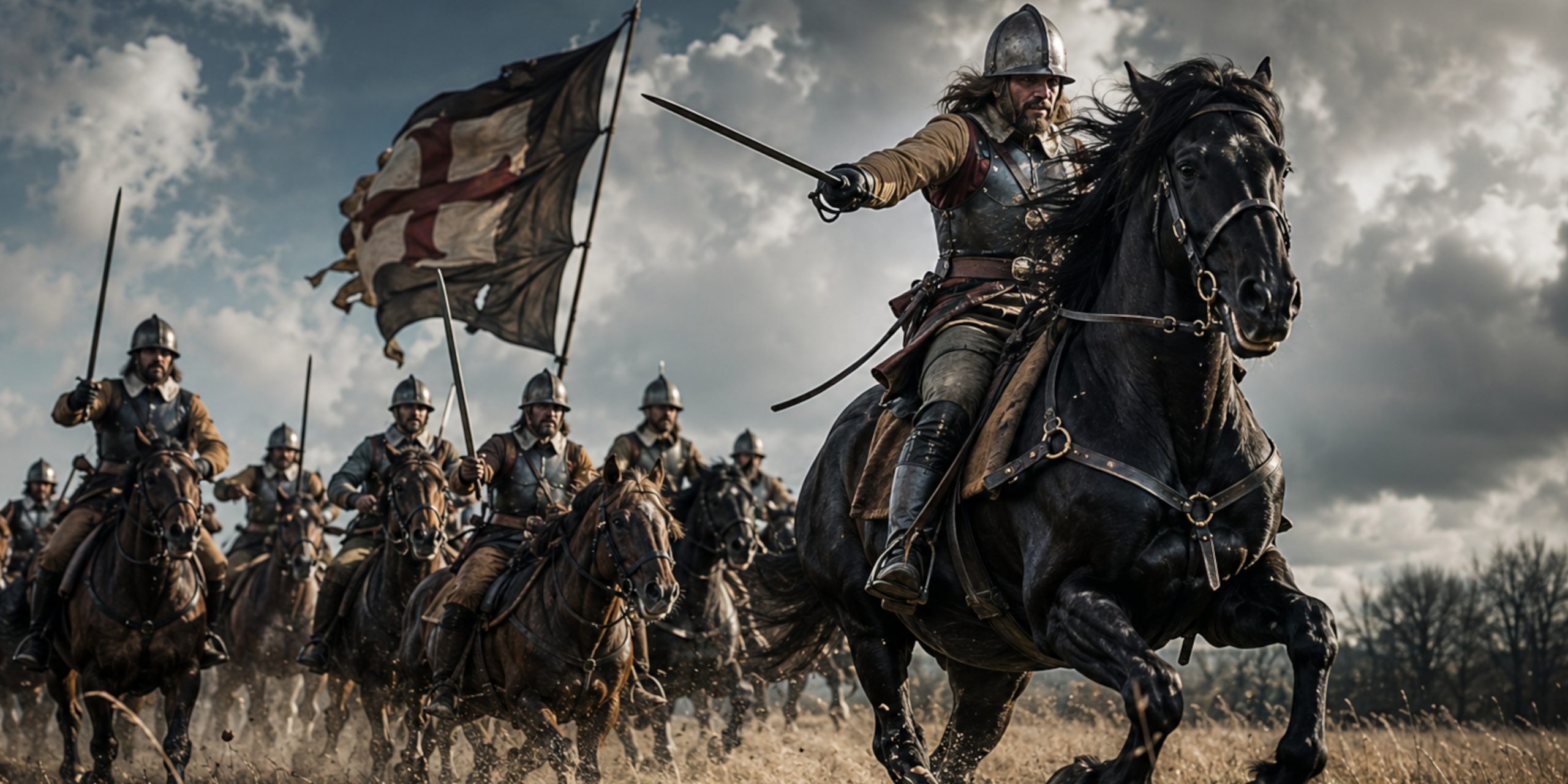
Few military formations from British history carry quite the same hard-edged reputation as the Ironsides. Even their name sounds like something forged in a furnace and sharpened on stone. They were not glamorous knights in polished tournament armour, nor swaggering mercenaries looking for plunder and wine. They were disciplined cavalrymen, shaped by religious conviction, brutal campaigning, and a commander who believed that character mattered just as much as courage.
The Ironsides emerged during the chaos of the English Civil War in the 1640s, serving under Oliver Cromwell and becoming one of the most effective cavalry forces in Europe at the time. Royalist opponents feared them for good reason. Unlike many cavalry units of the era, they rarely dissolved into chaos after the first charge. They regrouped, wheeled, and attacked again with unnerving discipline. That sounds simple on paper. In reality, it was battlefield gold dust.
To understand the Ironsides properly, you have to picture England tearing itself apart. Villages divided. Families split by politics and religion. Church sermons turning into recruitment speeches. Somewhere amid all that, Cromwell built a cavalry force that helped reshape Britain forever.
Who Were the Ironsides?
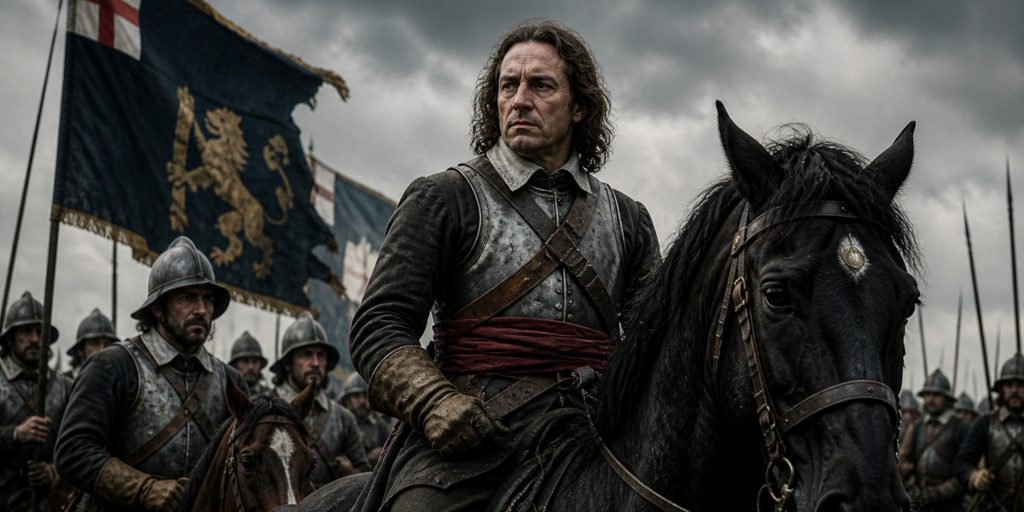
The Ironsides were a cavalry force raised primarily by Oliver Cromwell during the early years of the English Civil War. The name itself may originally have been applied directly to Cromwell by Royalists before becoming associated with his cavalry as a whole.
They first gained prominence in the Eastern Association army, particularly during campaigns in eastern and central England. Their ranks were composed largely of committed Parliamentarians, many drawn from the “middling sort” of society rather than the aristocratic elite.
Cromwell preferred men who were:
- Religiously motivated
- Disciplined under pressure
- Capable riders
- Obedient during combat
- Less interested in looting than fighting
That final point deserves emphasis. Civil War cavalry often had a bad habit of winning the first clash, then disappearing across the countryside chasing baggage trains and expensive coats. Cromwell despised that behaviour. He wanted cavalry that could hit hard, reform quickly, and strike again.
The Ironsides became the prototype for the later New Model Army cavalry.
Historical Background
The English Civil War erupted in 1642 between supporters of King Charles I and Parliament. The causes were tangled together in the usual wonderfully explosive British mixture of politics, money, religion, and stubbornness.
At the beginning of the war, Royalist cavalry often held the advantage. Prince Rupert of the Rhine, commander of much of the Royalist horse, was aggressive, daring, and highly experienced.
Parliament needed an answer.
Cromwell, then a relatively obscure Member of Parliament from Huntingdonshire, recognised that discipline and morale could offset aristocratic swagger. He raised cavalry units in East Anglia and gradually forged them into a professional force.
The Ironsides proved decisive in battles such as:
| Battle | Year | Importance |
|---|---|---|
| Battle of Gainsborough | 1643 | Early demonstration of Cromwell’s cavalry effectiveness |
| Battle of Winceby | 1643 | Helped secure Lincolnshire for Parliament |
| Battle of Marston Moor | 1644 | Massive Parliamentarian victory in the north |
| Battle of Naseby | 1645 | Decisive defeat of Royalist forces |
By the time of Naseby, the Parliamentarian cavalry had become terrifyingly efficient.
Arms and Armour
The Ironsides fought during a transitional period in military history. Medieval styles of warfare still lingered, but firearms were becoming increasingly dominant.
Their equipment reflected that shift.
Typical Weapons of the Ironsides
| Weapon | Purpose |
|---|---|
| Basket-hilted broadswords | Close combat cavalry weapon |
| Mortuary swords | Common among officers and cavalrymen |
| Backswords | Durable cutting weapons |
| Wheel-lock pistols | Fired before contact |
| Carbines | Short firearms for mounted troops |
| Daggers | Utility and backup weapon |
Sword Types Used
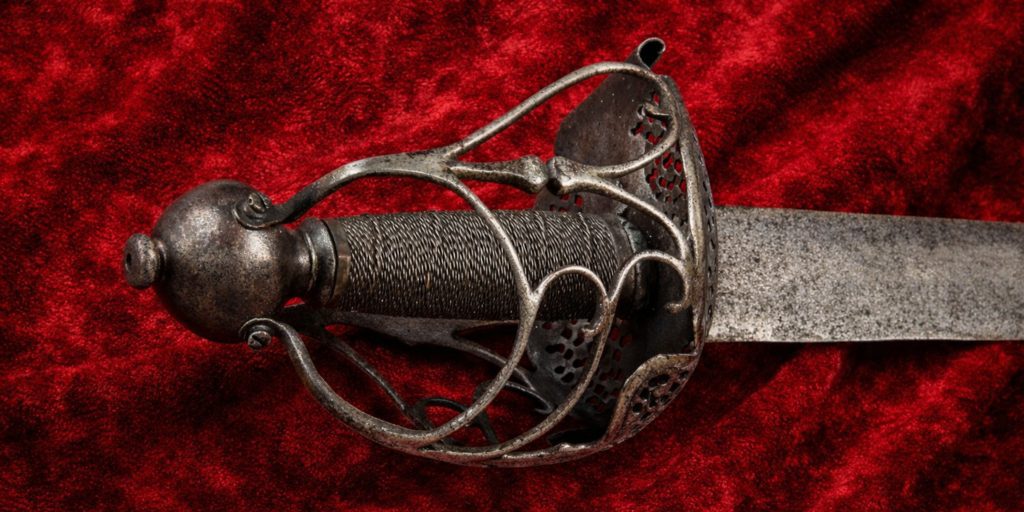
The cavalry sword was central to the Ironsides’ battlefield role.
Common examples included:
- Mortuary-hilt swords with decorated guards
- Early basket-hilted cavalry swords
- Straight backswords designed for slashing from horseback
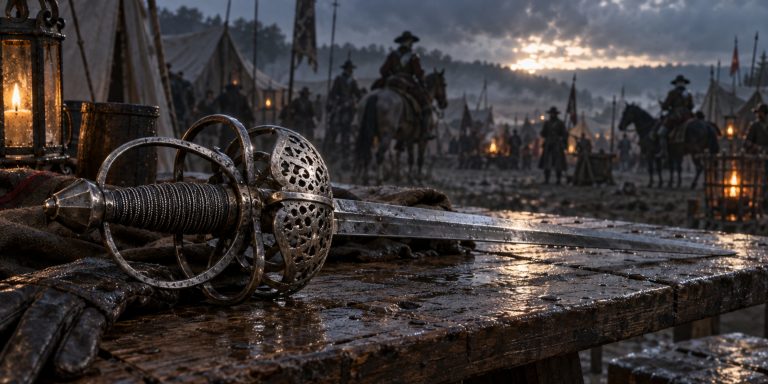
The mortuary sword has become especially associated with Parliamentarian cavalry. These swords often featured complex iron hilts and occasionally stylised human faces worked into the guard. Slightly unsettling objects, honestly. They look as though the sword itself disapproves of your life choices.
Royalist cavalry tended to favour similar weapons, though quality varied enormously.
Armour
The Ironsides typically wore:
- Buff coats made from hardened leather
- Breastplates and backplates
- Pot helmets or lobster-tailed helmets
- Heavy riding boots
- Gauntlets
Not every cavalryman wore full armour. By the mid-17th century, complete plate armour was already fading from regular battlefield use due to firearms.
Still, cavalry armour remained important against swords and pistol fire at distance.
Tactics and Battlefield Doctrine
What separated the Ironsides from many opponents was not simply equipment. It was discipline.
Cromwell drilled his cavalry to:
- Maintain formation after impact
- Rally quickly after charges
- Support infantry effectively
- Avoid reckless pursuit
- Coordinate attacks in depth
Royalist cavalry under Prince Rupert often delivered devastating initial charges, but they could lose cohesion afterward.
The Ironsides fought differently. Their attacks were methodical and sustained.
At Marston Moor in 1644, Cromwell’s cavalry smashed Royalist horse on the Parliamentarian left flank before regrouping and attacking the Royalist centre. That ability to reorganise under battlefield conditions was exceptional.
Modern historians sometimes compare the Ironsides to later professional cavalry formations because of their cohesion and command structure.
Religion and Morale
Religion was deeply embedded within the Ironsides.
Many troopers were Puritans who believed they were fighting a godly cause against corruption and tyranny. Sermons, prayer meetings, and biblical language formed part of military life.
Cromwell himself famously said:
“Trust in God and keep your powder dry.”
Whether he actually phrased it exactly that way remains debated, but the sentiment certainly matched his outlook.
The Ironsides developed a reputation for sobriety and discipline compared with some other armies of the period. This should not be romanticised too heavily. Civil War armies could still behave brutally toward civilians and prisoners. Yet contemporary observers often remarked upon the comparatively restrained behaviour of Cromwell’s horse.
A Royalist critic grudgingly described them as:
“Men of religion.”
One can almost hear the irritation in the wording.
Contemporary Quotes
Several contemporary accounts shed light on the reputation of the Ironsides.
Sir Philip Warwick wrote of Cromwell:
“He had a lovely company of poor men, and the meanest were as fit for their duty as gentlemen.”
Another Royalist account described Cromwell’s cavalry as:
“Never beaten at all.”
That was an exaggeration, but not wildly so.
At Naseby, Royalist observers noted the terrifying orderliness of Parliamentarian cavalry manoeuvres compared with the increasingly fractured Royalist resistance.
Archaeology and Surviving Artefacts
Archaeology from the English Civil War has expanded significantly in recent decades.
Battlefield excavations at sites linked to the Ironsides have uncovered:
- Pistol balls
- Musket shot
- Cavalry sword fragments
- Horse fittings
- Belt buckles
- Armour fragments
Marston Moor
Archaeological surveys around Marston Moor have revealed concentrations of shot and battlefield debris consistent with cavalry action.
The scale of the engagement remains astonishing. Tens of thousands of men collided across open ground with black powder smoke reducing visibility to near chaos.
Naseby
Finds from the Naseby battlefield include:
- Lead musket balls
- Cavalry equipment
- Personal items from soldiers
- Uniform fittings
Modern battlefield archaeology has helped historians reconstruct troop movements more accurately than older written sources alone.
Museums holding artefacts linked to the Civil War and the Ironsides include:
- Royal Armouries
- National Army Museum
- Museum of the Order of St John
Many surviving mortuary swords associated with Parliamentarian cavalry are now highly prized collector pieces.
The Ironsides and the New Model Army
The success of the Ironsides directly influenced the formation of the New Model Army in 1645.
This new national force standardised:
- Training
- Pay
- Equipment
- Discipline
- Promotion structures
The old feudal model of raising troops through aristocratic loyalty was fading.
Merit, professionalism, and ideological commitment increasingly defined Parliament’s military machine.
The New Model Army would eventually help bring about the trial and execution of Charles I in 1649. That moment still feels startling even now. England had killed its king after a civil war fought partly by men who began as provincial cavalry troopers from East Anglia.
History has a habit of escalating.
Legacy of the Ironsides
The Ironsides became symbolic of military professionalism in Britain.
Their influence can be seen in:
- The development of disciplined cavalry doctrine
- The rise of standing armies
- Merit-based military leadership
- Parliamentary military power
They also remain controversial.
To some, they were defenders of constitutional government and military reform.
To others, they represented religious extremism and the destruction of traditional monarchy.
Both views contain truth.
The Civil War left deep scars across Britain and Ireland, and Cromwell himself remains one of the most divisive figures in British history.
Still, the Ironsides changed warfare in Britain permanently. They demonstrated that disciplined, ideologically motivated troops could defeat aristocratic cavalry traditions that had dominated Europe for centuries.
That was no small thing.
Where to See Civil War Battlefields and Artefacts
Several important sites connected with the Ironsides can still be visited today.
| Site | Importance |
|---|---|
| Naseby Battlefield | Decisive Parliamentarian victory |
| Marston Moor Battlefield | Largest battle of the Civil War |
| Edgehill Battlefield | First major pitched battle |
| Royal Armouries | Extensive Civil War arms collection |
Walking these battlefields today can feel strangely quiet. Birds, hedgerows, muddy tracks, perhaps a distant tractor. Then you remember thousands of cavalrymen once charged across the same ground with pistols, swords, and prayers.
British history can turn pastoral landscapes into haunted places very quickly.
Takeaway
The Ironsides were not mythical super-soldiers, nor were they humourless zealots marching across England in perfect formation. They were complex men shaped by one of the most violent and transformative periods in British history.
What made them exceptional was consistency.
They fought with discipline when many armies collapsed into disorder. They combined religious conviction with tactical effectiveness. Most importantly, they helped drag English warfare into a more modern age.
Even now, nearly four centuries later, the word “Ironsides” still carries weight. It suggests endurance, discipline, and cold resolve under pressure.
Not a bad reputation for a cavalry force raised in the muddy fields of East Anglia.