The first recorded Viking raid in England
There is something almost understated about the first Viking raid on England. No grand armies, no vast fleets blotting out the horizon. Just a handful of ships, a coastal official who likely thought he was doing his job, and a misunderstanding that ended rather badly for him.
The Raid on Portland, dated to around 789, sits quietly in the historical record, but its consequences were anything but small. It marks the moment when Scandinavian raiders first made violent contact with Anglo-Saxon England. At the time, it was an isolated incident. In hindsight, it reads like the opening line of a much longer and bloodier chapter.
Background
Late eighth-century England was politically fragmented, though relatively stable compared to what was coming. The kingdom of Wessex, under King Beorhtric, controlled the south coast, including Dorset. Trade networks stretched across the North Sea, and foreign ships were not unusual sights.
What made this encounter different was intent.
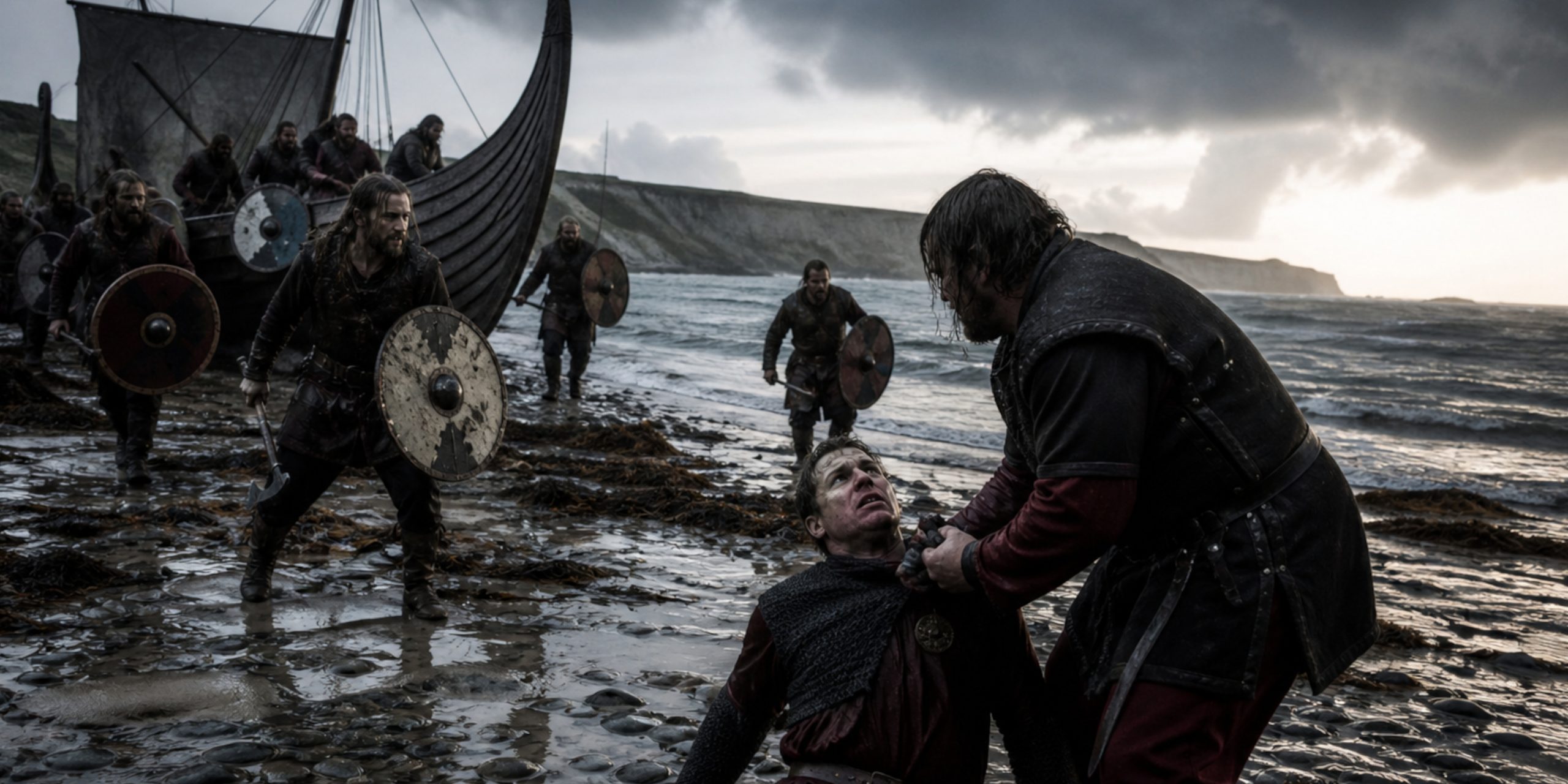
According to the Anglo-Saxon Chronicle, three ships arrived at Portland. The local reeve, Beaduheard, rode out to meet them, assuming they were merchants. That assumption proved fatal.
Foces
Precise numbers are not recorded, which is frustrating but typical. What we can infer gives us a rough picture.
| Side | Estimated Strength | Type |
|---|---|---|
| Viking raiders | 20 to 50 men | Ship-borne raiding party |
| Wessex officials | Small escort, possibly under 10 | Local administrative force |
Observations
- The Vikings were likely a scouting or opportunistic group, not a warband intended for conquest
- The Anglo-Saxon presence was administrative rather than military
- This was not a battle in the formal sense, more a violent encounter that escalated rapidly
Leaders and Troop Composition
Anglo-Saxon Side
- Beaduheard (Reeve of Portland)
- Royal official responsible for local governance
- Likely accompanied by a small mounted or armed escort
- Not a battlefield commander, which becomes painfully clear
Viking Raiders
- Unknown leaders
- Composition likely included:
- Experienced seafarers
- Lightly armed warriors
- Possibly younger men testing raiding prospects abroad
There is a strong sense that these were not nobles or famous war leaders. They were practical men with ships and ambition.
Arms and Armour
Even in this early phase, Scandinavian raiders were not poorly equipped. Nor were Anglo-Saxon officials entirely defenceless.
Viking Equipment
- Swords:
- Early forms of what would later develop into the Viking sword
- Pattern-welded blades, double-edged, designed for slashing
- Axes:
- Practical tools turned weapons
- Likely more common than swords among lower-status warriors
- Spears:
- The most versatile and widespread weapon
- Shields:
- Round wooden shields with central iron boss
- Armour:
- Limited
- Some may have worn mail shirts, though not universally
Anglo-Saxon Equipment
- Swords:
- Similar in construction to Scandinavian blades
- Pattern-welded, prestige items
- Spears:
- Standard issue for most armed men
- Seaxes:
- Single-edged blades, widely used
- Shields:
- Round shields, comparable to Viking designs
- Armour:
- Likely minimal for a local official party
Key Takeaway
This was not a mismatch of technology. The difference lay in intent. One side arrived expecting trade. The other was prepared for violence.
The Incident
The Chronicle offers only a brief account, but it is enough.
Beaduheard rode out to greet the newcomers and attempted to bring them to the king, as protocol demanded. The Vikings refused. Violence followed, and Beaduheard was killed along with his men.
That is all the record gives us. No dramatic speeches, no detailed clash. Just a sudden shift from routine to fatal.
There is a certain bluntness to it that feels entirely appropriate.
Battle Timeline
Arrival of Viking ships
- Three vessels reach the coast of Portland
- Likely drawn by opportunity or reconnaissance
Initial contact
- Beaduheard approaches, expecting traders
- Attempts to escort them to royal authority
Escalation
- Vikings resist or misunderstand the demand
- Tension turns into violence quickly
Clash and deaths
- Beaduheard and his party are killed
- Vikings depart, likely with minimal losses
Archaeology
Physical evidence tied directly to the raid is limited, which is not surprising given its scale.
What we do know
- No confirmed battlefield site has been identified
- Early Viking activity along the southern coast is supported by later finds
- Scandinavian artefacts in southern England increase in the decades following
Interpretation
The absence of evidence reflects the nature of the event. A small, sudden encounter leaves little trace. What matters is not what was left behind, but what followed.
Contemporary Quotes
From the Anglo-Saxon Chronicle:
“And in his days came first three ships of Northmen… and then the reeve rode thereto… and they slew him.”
It is brief, almost casual in tone. The chronicler did not yet realise what this moment represented.
Significance and Legacy
At the time, this incident may have seemed like a local tragedy. One official killed, a handful of foreigners behaving badly, the sort of thing a king might hear about and then move on from.
History had other plans.
Within a few years, the raid on Lindisfarne would shock the Christian world. By the mid ninth century, large Viking armies would carve out territories across England. What began at Portland would grow into something far more organised and far more dangerous.
There is a certain irony here. The first recorded encounter was not a grand invasion, but a misjudged greeting on a quiet stretch of coast.
It feels almost like England was caught off guard, not because it was weak, but because it had no reason yet to expect what was coming.
Final Thoughts
The Raid on Portland is easy to overlook. It lacks the drama of later Viking campaigns, and the sources give us very little to work with. Yet it marks a turning point.
It is the moment when two worlds met under the worst possible circumstances. One assumed familiarity. The other brought something new, something sharper.
And from that brief, fatal encounter, a whole era of conflict began.
You have not enough Humanizer words left. Upgrade your Surfer plan.