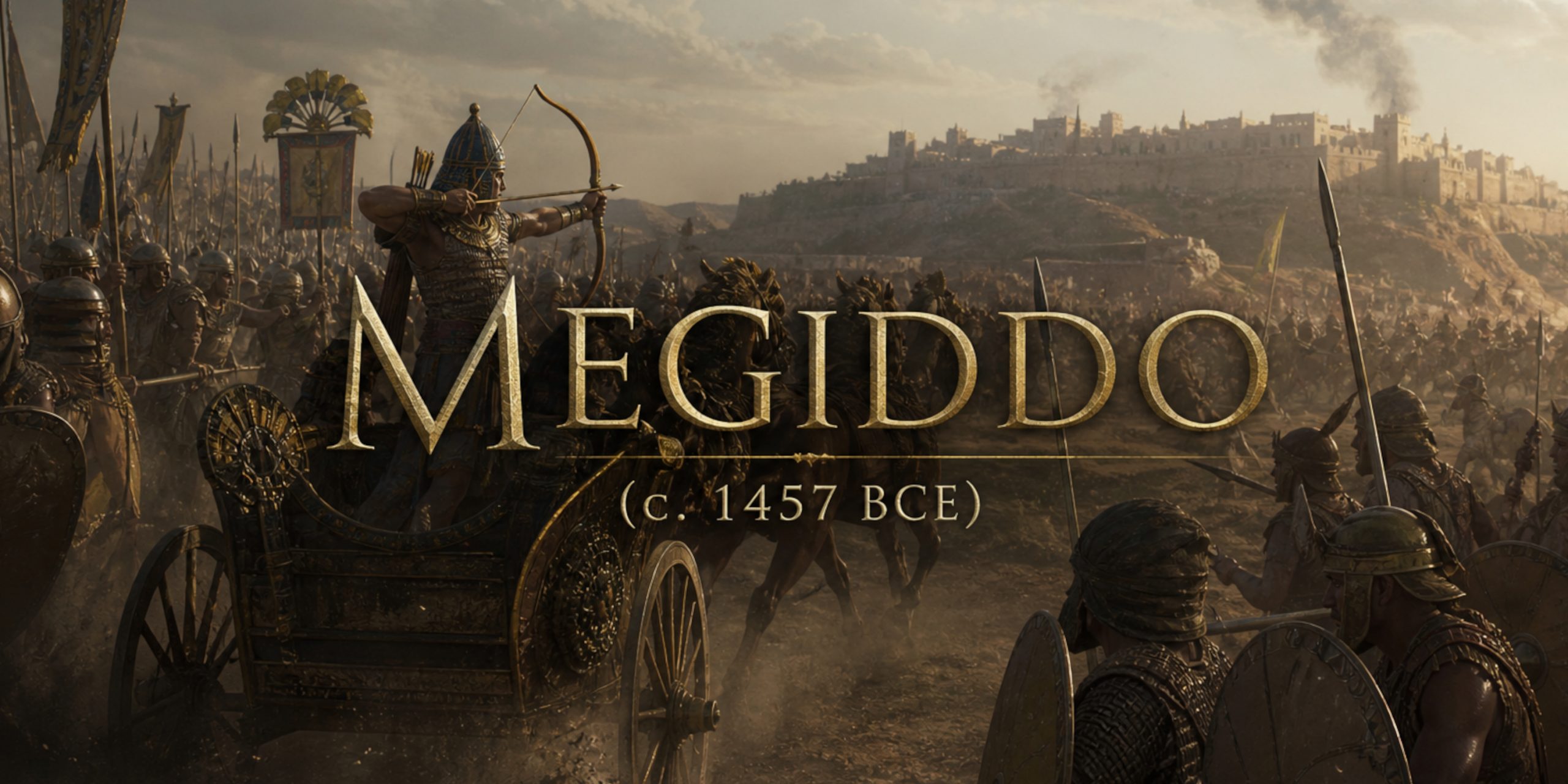
There are battles that feel half remembered, hazy at the edges, and then there is Megiddo. Here, for once, the ancient world speaks clearly. The campaign of Pharaoh Thutmose III against a rebellious coalition in Canaan is the earliest battle we can reconstruct in real detail, thanks to a set of temple inscriptions that are unusually precise and, rather refreshingly, not entirely subtle in their self-confidence.
If one is looking for the beginning of recorded military history as something more than myth and poetry, Megiddo is a strong candidate. It has strategy, risk, logistics, and just enough ego to feel familiar.
Historical Background
By the mid 15th century BCE, Egypt’s grip on its northern territories had loosened. A coalition of Canaanite city states, led by the ruler of Kadesh, gathered around the strategic stronghold of Megiddo. This was not a minor revolt. Megiddo sat astride vital trade routes linking Egypt to Syria and Mesopotamia. Losing it would have meant more than embarrassment. It would have signalled the slow unravelling of Egyptian authority in the region.
Thutmose III responded with speed. His campaign was not simply punitive. It was a demonstration of control, and he intended it to be seen as such.
Foces
Precise numbers remain uncertain, though the Egyptian records give us a reasonable framework.
Egyptian Army
| Component | Estimated Strength | Notes |
|---|---|---|
| Infantry | 10,000 to 15,000 | Core of the army, equipped with shields and spears |
| Chariots | 1,000 or more | Elite shock troops, highly mobile |
| Archers | Integrated | Composite bows provided range and impact |
| Command | Centralised under Thutmose III | Highly organised command structure |
Canaanite Coalition
| Component | Estimated Strength | Notes |
|---|---|---|
| Infantry | 10,000 plus | Mixed quality from various city states |
| Chariots | Several hundred | Less coordinated than Egyptian units |
| Leadership | King of Kadesh and allies | Coalition command, less unified |
The balance was not overwhelmingly in Egypt’s favour. What made the difference was how that force was used.
Commanders
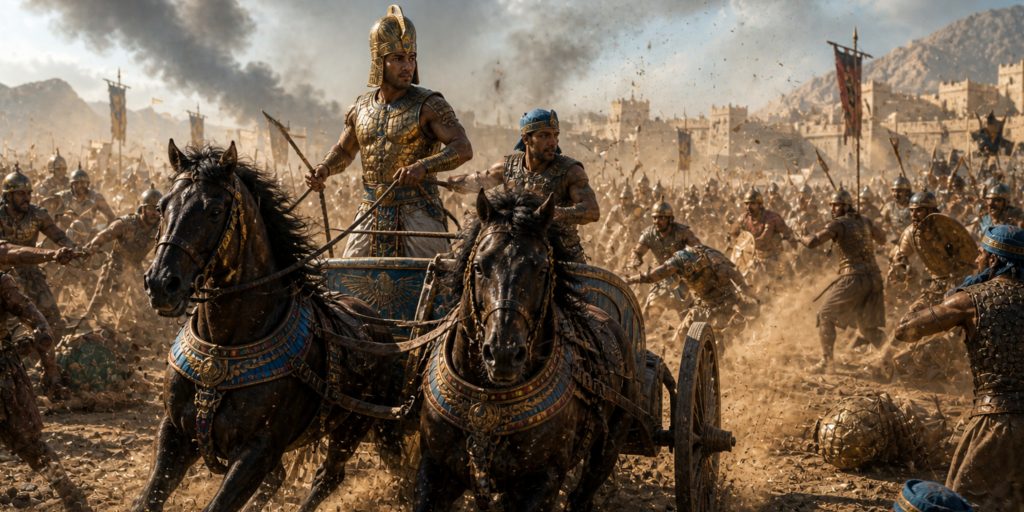
Egyptian Leadership
- Thutmose III
- Personally led the campaign
- Known for aggressive and decisive tactics
- Willing to take calculated risks
Canaanite Leadership
- King of Kadesh
- Coalition leader
- Defensive strategy centred on holding Megiddo
- Allied city rulers
- Likely varied in experience and loyalty
Coalitions tend to look impressive on paper and less so under pressure. Megiddo follows that pattern rather neatly.
Arms and Armour
Egyptian Equipment
| Category | Details |
|---|---|
| Primary Weapons | Spears, axes, daggers |
| Swords | Early sickle shaped blades such as the Khopesh |
| Ranged Weapons | Composite bows with high penetration |
| Armour | Light armour, leather or padded |
| Shields | Wooden frames with leather covering |
| Chariots | Two man crews, driver and archer |
Canaanite Equipment
| Category | Details |
|---|---|
| Primary Weapons | Spears, axes, daggers |
| Swords | Short bronze blades, similar regional designs |
| Ranged Weapons | Bows and javelins |
| Armour | Variable, often lighter |
| Shields | Round or oval designs |
| Chariots | Present but less effectively coordinated |
Observations
- The Khopesh was not the dominant battlefield weapon but carried symbolic weight and practical utility in close combat
- Egyptian chariot warfare was more refined, combining speed with disciplined archery
- Armour remained relatively light on both sides, favouring mobility over protection
The March and Strategic Gamble
The most striking decision of the campaign came before the battle even began. Thutmose III had three possible routes to Megiddo. Two were safe and predictable. The third, through the Aruna pass, was narrow and dangerous.
He chose the dangerous route.
It is the sort of decision historians admire in hindsight and generals tend to regret in real time. Had the enemy blocked the pass, the Egyptian army could have been destroyed in detail. Instead, the Canaanite forces expected a cautious approach and positioned themselves elsewhere.
Thutmose emerged from the pass unopposed, directly threatening Megiddo. It was a calculated risk that paid off handsomely.
The Battle
The Egyptian army deployed quickly after clearing the pass. Chariots took the flanks, infantry held the centre. The Canaanite coalition scrambled to respond, forming up outside the city.
The clash itself appears to have been decisive but not especially prolonged.
- Egyptian chariots disrupted enemy formations
- Archers provided sustained pressure
- Coalition forces broke and retreated toward the city
And then, in a detail that always makes me sigh a little, the Egyptian troops paused to loot the abandoned camp instead of pressing the pursuit. It is a very human moment. Also a very costly one.
The defeated forces managed to retreat into Megiddo and shut the gates.
Siege of Megiddo
What followed was not a dramatic storming of walls but a methodical siege.
- Egyptians encircled the city
- Supply lines were cut
- Siege lasted several months
Eventually, starvation and exhaustion forced the defenders to surrender. The city fell, and with it, the rebellion collapsed.
Battle Timeline
| Phase | Event |
|---|---|
| Early Campaign | Thutmose III marches north from Egypt |
| Approach | Decision to take the Aruna pass |
| Deployment | Egyptian forces emerge near Megiddo |
| Battle | Canaanite forces defeated in open field |
| Aftermath | Egyptian troops loot instead of pursuing |
| Siege | Megiddo surrounded and blockaded |
| Conclusion | City surrenders after prolonged siege |
Archaeology
Megiddo is one of the most extensively excavated sites in the Levant. Layers of occupation stretch across millennia.
Key findings include:
- Fortification walls and gate complexes
- Evidence of destruction layers consistent with conflict periods
- Administrative buildings indicating its importance as a regional centre
While direct physical evidence of the battle itself is limited, the broader archaeological record supports Megiddo’s strategic significance. It was exactly the kind of place worth fighting over, repeatedly, and with some determination.
Contemporary Accounts
Our primary source comes from inscriptions at Karnak, commissioned by Thutmose III. They are detailed, occasionally theatrical, and entirely unapologetic.
A notable passage records the king’s decision regarding the Aruna pass:
“His Majesty said that he would go upon this road.”
It is brief, almost understated, but the implication is clear. The decision was his alone, and it mattered.
Another passage reflects the outcome:
“The wretched enemy of Kadesh has come into it and closed himself in.”
There is a certain satisfaction in the phrasing. One can almost hear the scribes enjoying themselves.
Legacy and Significance
Megiddo established a model for Egyptian military campaigns in the Near East.
- Demonstrated the effectiveness of rapid, decisive manoeuvre
- Reinforced Egyptian authority over Canaan
- Provided one of the earliest detailed military records in history
It also offers a rare glimpse into the mechanics of Bronze Age warfare. Not myth, not legend, but something closer to lived experience, with all the planning, risk, and occasional misjudgement that implies.
If anything, Megiddo feels less distant than it ought to. The decisions made there would not look entirely out of place in much later campaigns. Only the equipment has truly changed.