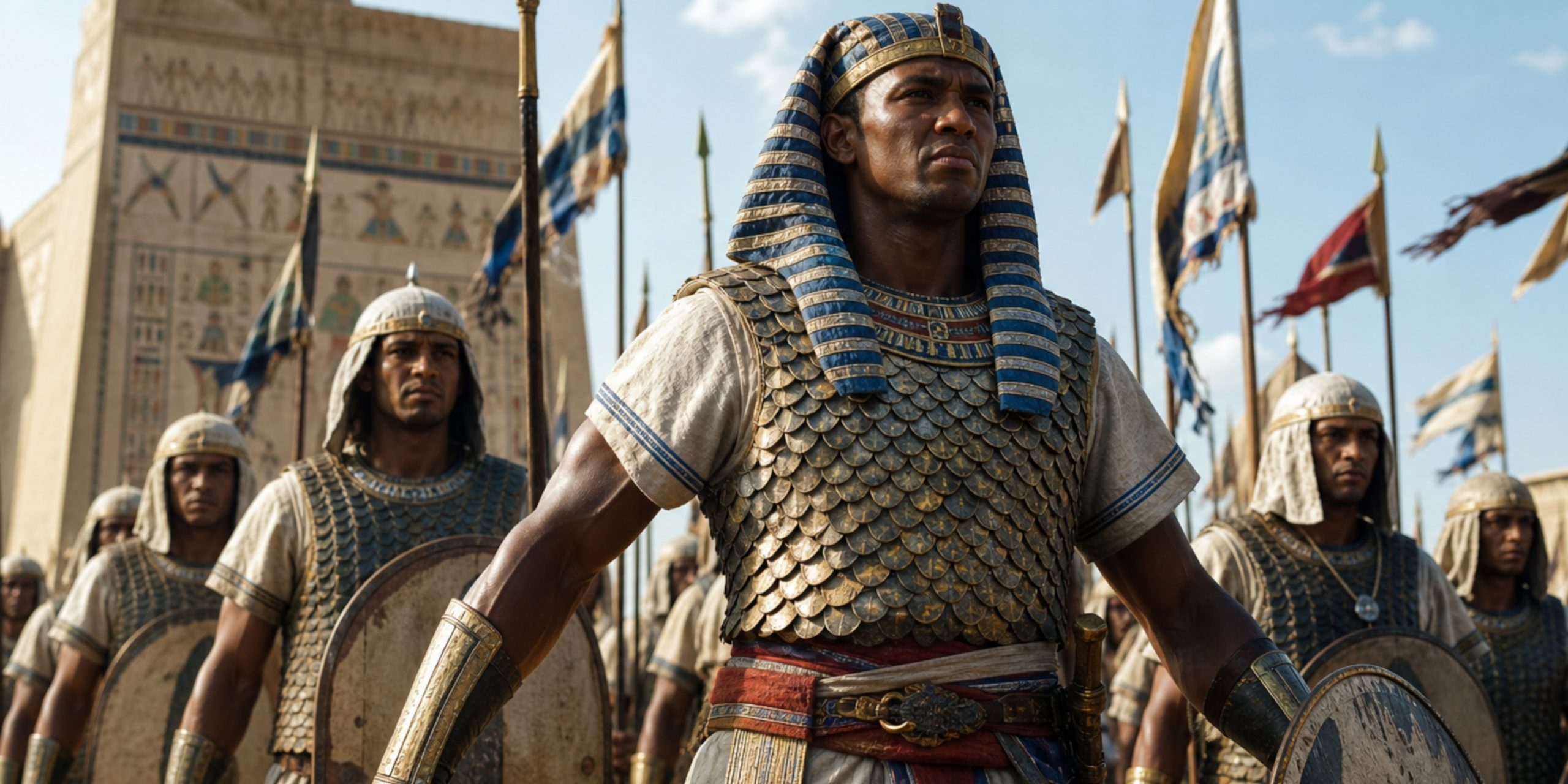
There is a tendency to picture ancient Egyptian warfare as something ornamental, all painted chariots and heroic pharaohs posing for eternity. The infantry tells a different story. They did the marching, the sweating, and quite often the dying. By the New Kingdom, Egypt had built something far more formidable than a ceremonial army. It was organised, disciplined, and increasingly professional.
What emerges from reliefs, papyri, and battered equipment is a force that could campaign far beyond the Nile, hold territory, and stand toe to toe with rivals like the Hittites. Not bad for an army still occasionally shown barefoot in official art.
Organisation and Structure
The New Kingdom army was no loose levy. It developed into a structured force with clear hierarchy and division.
- Infantry formed the backbone of the army
- Units were often organised into companies under officers
- Command ultimately rested with the pharaoh or trusted generals
- Foreign mercenaries, especially Nubians and Sherden, were integrated into ranks
There is a growing sense of permanence here. Soldiers were not simply called up for a season. Many served long enough to gain experience, promotions, and in some cases land grants as reward.
Recruitment and Training
Recruitment drew from across Egypt and its territories.
- Native Egyptian conscripts formed the core
- Nubian archers were highly valued for skill and range
- Levantine auxiliaries appeared in later campaigns
Training is harder to pin down, though evidence suggests:
- Drill and formation practice
- Weapon proficiency, especially with spear and bow
- Physical conditioning suited for long marches
One suspects the training was effective, even if it did not involve modern comforts. No written complaints survive, though that may say more about scribal priorities than soldier satisfaction.
Battlefield Role
Infantry operated alongside chariots but remained central to combat.
- Held the line in battle formations
- Supported chariot advances
- Engaged in close combat once lines met
- Conducted sieges and garrison duties
At battles such as Kadesh, infantry formed the bulk of the fighting force, even if the narrative prefers to focus on royal heroics.
Arms and Armour
Egyptian infantry carried a practical and evolving set of weapon
Primary Weapons
- Spears
The most common infantry weapon, used for thrusting in formation or individual combat - Axes
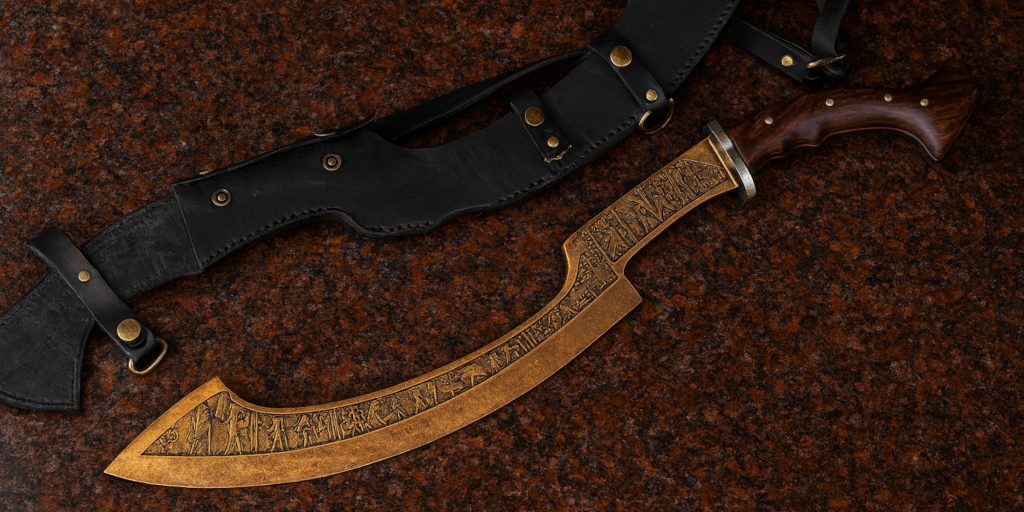
Often with crescent-shaped bronze blades, effective against lightly armoured opponents - Khopesh (sickle-sword)
A distinctive curved blade combining cutting and hooking capability
Particularly associated with elite troops and officers - Daggers
Secondary weapons for close encounters
Missile Weapons
- Bows
Though often associated with specialised units, many infantrymen were capable archers
Defensive Equipment
- Shields
Wooden frames covered with leather, sometimes reinforced
Usually rectangular or slightly rounded - Body Protection
Limited. Most infantry wore simple linen garments
Some elite troops used scale armour or layered textiles - Helmets
Rare among standard infantry
More common among foreign contingents like the Sherden
The overall impression is mobility over protection. Egyptian soldiers relied on speed and coordination rather than heavy armour. It worked, most of the time.
Tactics and Warfare Style
Egyptian infantry fought in coordinated formations, though not rigid phalanxes in the later Greek sense.
- Spearmen formed the main line
- Archers provided ranged support behind or within formations
- Chariots disrupted enemy lines before infantry engagement
There was flexibility here. Egyptian armies adapted to different enemies and terrains, from Syrian plains to Nubian river valleys.
Siege warfare also became more prominent:
- Use of ladders and battering tools
- Encirclement and starvation tactics
- Psychological warfare through display and intimidation
Reliefs tend to exaggerate success, but the repeated campaigns suggest real competence.
Archaeology and Evidence
Our understanding comes from a mix of sources, each with its own quirks.
- Temple Reliefs
Detailed battle scenes at sites like Medinet Habu
Often propagandistic, though still valuable for equipment and formations - Tombs
Scenes of soldiers and tribute bearers, showing weapons and attire - Weapons Finds
Khopesh blades, spearheads, and axes recovered from sites across Egypt - Written Records
Military dispatches and campaign accounts, though heavily stylised
One learns to read these sources with a raised eyebrow. Egyptian artists were excellent, but rarely impartial.
Contemporary Quotes
Egyptian texts favour grand declarations over modest reporting. Still, they give a sense of how infantry warfare was perceived.
From the Poem of Pentaur, describing the Battle of Kadesh under Ramesses II:
“His infantry and chariotry had fled before him, none stood to fight.”
A rather convenient account, given that the battle was closer to a stalemate.
From a military inscription praising soldiers:
“Valiant in the face of the foe, firm of heart when battle is joined.”
Formulaic, yes, but it reflects the qualities expected of infantrymen.
Strengths and Limitations
The New Kingdom infantry had clear advantages:
- Strong organisation and command structure
- Effective integration with chariot forces
- Flexibility across different theatres of war
Yet there were limitations:
- Light armour left soldiers vulnerable in close combat
- Heavy reliance on leadership, especially the pharaoh’s presence
- Occasional overconfidence in official narratives, if one reads between the lines
Legacy
The infantry of the New Kingdom helped sustain one of Egypt’s most expansive periods.
- Enabled campaigns into Syria and Nubia
- Maintained imperial control over distant territories
- Influenced later military traditions in the region
Their image, preserved in temple walls, has endured longer than most armies ever could hope for. Though, if those same soldiers could comment on how they were portrayed, one suspects a few would ask for less emphasis on the pharaoh and a bit more credit for themselves.
Takeaway
Egyptian New Kingdom infantry were not ornamental extras in a royal pageant. They were the substance of Egypt’s military power. Their equipment was practical, their organisation increasingly sophisticated, and their role decisive in both battle and occupation.
Strip away the artistic exaggeration and what remains is a capable, adaptable fighting force. Not invincible, certainly, but far more effective than the stylised scenes might suggest.