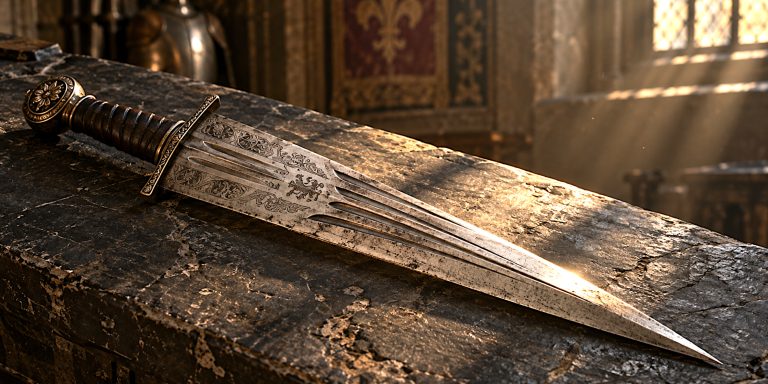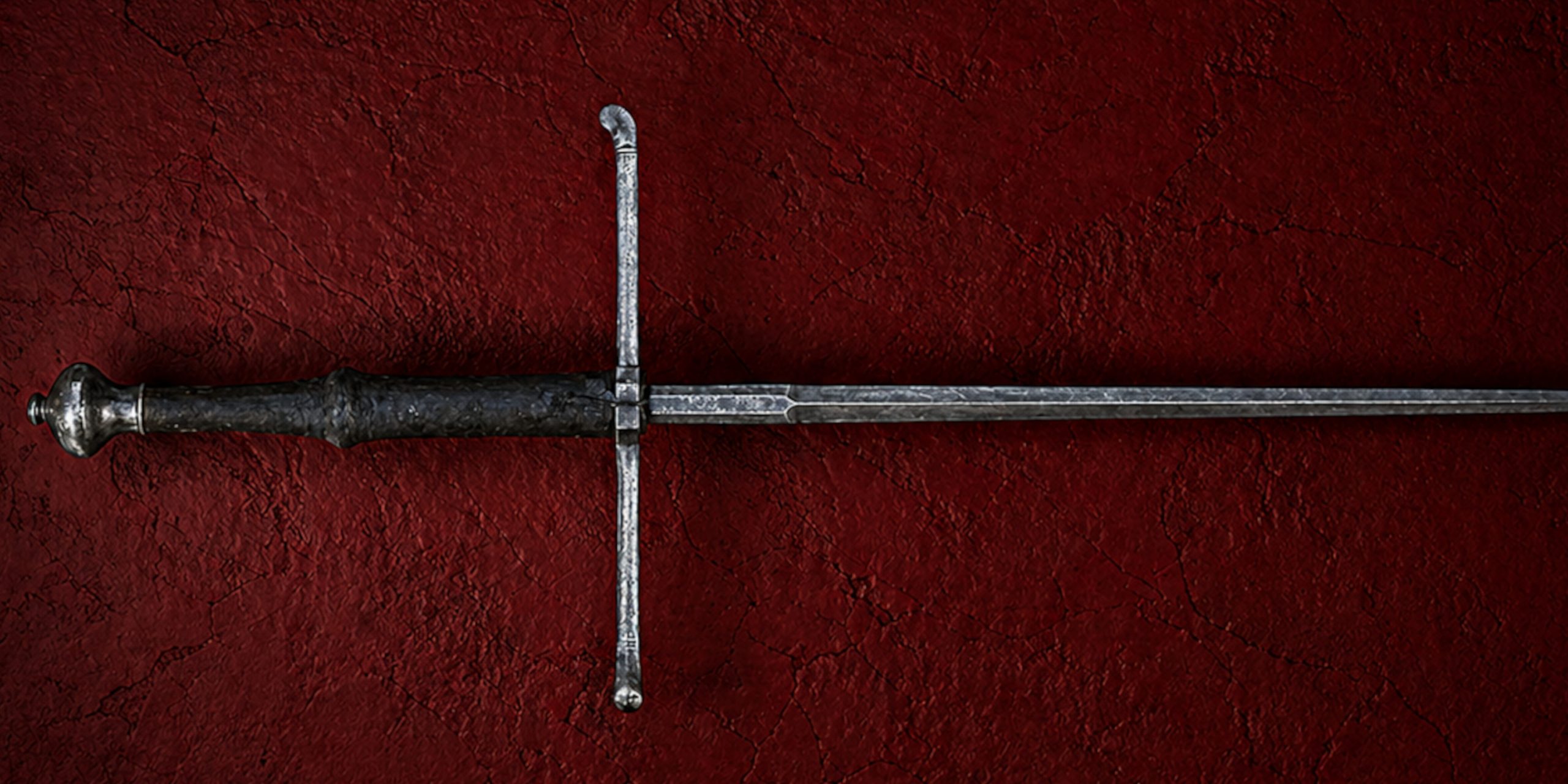
The tuck sword, more widely known as the estoc, sits in a narrow but fascinating corner of medieval weapon design. It is a blade built with a single purpose in mind, to defeat armour when cutting alone was no longer enough. Where earlier swords relied on edges, the tuck turned to the point.
As plate armour improved across the fourteenth and fifteenth centuries, swords had to adapt or become obsolete on the battlefield. The tuck represents that adaptation in its purest form. Long, rigid, often without sharpened edges, it was designed to find weaknesses rather than force them.
There is something slightly unforgiving about it. It does not reward flair. It rewards precision.
Specification
| Feature | Details |
|---|---|
| Blade Type | Narrow, rigid, often triangular or square cross section |
| Edge | Typically unsharpened or minimally sharpened |
| Length | 90 cm to 130 cm blade, sometimes longer |
| Overall Length | Up to 140 cm or more |
| Weight | 1.2 kg to 2 kg |
| Point | Acute, reinforced for thrusting |
| Fuller | Rare or absent |
| Hilt | Straight crossguard, long grip for two hands in some examples |
| Pommel | Disc, scent stopper, or wheel types |
Key Characteristics
- Exceptional stiffness for armour penetration
- Reduced cutting ability
- Optimised for thrusting into joints and gaps
- Often used with half-swording techniques
History and Evolution
The tuck sword emerges clearly in the late medieval period, particularly in the fourteenth century, when full plate armour became widespread across Europe. Earlier swords such as the arming sword and longsword could still cut effectively against mail and lightly armoured foes, but plate changed the equation.
Blades became narrower and more rigid. Edges lost importance. The geometry shifted towards triangular and square cross sections, increasing strength without adding excessive weight.
By the fifteenth century, the estoc had become a specialist weapon for armoured combat. It appears frequently in fencing manuals, particularly in German and Italian traditions, where it is used in conjunction with grappling and half-sword techniques.
Later developments saw the tuck carried into civilian life in modified forms, influencing thrust-focused swords like the rapier. Though not a direct ancestor, the philosophical shift towards the thrust is clear.
Advantages and Disadvantages
Advantages
- Highly effective against plate armour when used correctly
- Strong blade resists bending or breaking
- Precise control when targeting weak points
- Compatible with half-swording and grappling techniques
Disadvantages
- Limited cutting ability
- Requires skill and accuracy to be effective
- Less versatile against unarmoured opponents
- Can feel unwieldy compared to broader blades
Comparison with Similar Weapons
| Weapon | Key Difference | Strengths | Weaknesses |
|---|---|---|---|
| Longsword | Double edged, cut and thrust | Versatile, balanced | Less specialised against armour |
| Rapier | Civilian thrusting weapon | Speed, precision | Ineffective against armour |
| Rondel Dagger | Short thrusting weapon | Close combat effectiveness | Limited reach |
| Spear | Pole weapon | Reach, armour penetration | Less manoeuvrable indoors |
Observations
The tuck sword sits somewhere between the longsword and the spear in function. It sacrifices versatility for focus. Compared to a longsword, it feels almost clinical. Compared to a spear, it offers greater control in tight spaces.
Legacy
The tuck sword did not dominate battlefields in the way the longsword did, but its influence is clear. It represents a turning point in European arms, where the realities of armour forced a rethink of how swords were used.
It also helped shape fencing theory. Manuals from masters such as Fiore dei Liberi and later German traditions show how thrusting techniques, leverage, and control became central to combat.
In many ways, the tuck is less romantic than other swords. It lacks the sweeping cuts and dramatic arcs. Yet it reflects the reality of late medieval warfare with unusual honesty.
Where to See
Museums and Collections
- Royal Armouries
Extensive collection of late medieval weapons including estocs - Wallace Collection
Fine European arms with several thrust-oriented swords - Kunsthistorisches Museum
Rich Habsburg armoury with excellent examples of armour-piercing blades - Musée de l’Armée
Strong late medieval section with specialised weapons
Collector’s Guide
The tuck sword occupies a niche within the collector market. It attracts serious enthusiasts rather than casual buyers, largely due to its specialised design and relative rarity.
What to Look For
- Blade rigidity and geometry
- Original hilt components
- Evidence of period forging techniques
- Provenance or documented origin
Price Guide
| Type | Condition | Estimated Price |
|---|---|---|
| Original 15th century estoc | Museum quality | £25,000 to £80,000+ |
| Original but worn example | Fair condition | £8,000 to £20,000 |
| Later period reproductions | Good condition | £1,500 to £5,000 |
| Modern high-end replicas | Excellent | £400 to £1,500 |
Market Notes
- Authentic examples are scarce and often held in institutional collections
- Provenance can dramatically increase value
- Replicas vary widely in quality, particularly in blade stiffness
Takeaway
The tuck sword is not a weapon that tries to do everything. It does one thing very well. That clarity of purpose gives it a certain appeal, even now.
From a historian’s perspective, it feels like a response rather than an invention. Armour improved, so the sword adapted. There is a quiet logic to it.
Handled correctly, it is not elegant in the traditional sense. It is deliberate. And in the context of armoured combat, that is exactly what it needed to be.