The Kerrs built their power in a country where a neighbour might be a cousin, a rival, a cattle thief or, on an especially tiresome day, all three.
Rooted in the Scottish Borders, the family became influential landowners, March wardens and participants in the violent politics of the Anglo-Scottish frontier. Their principal houses, Ferniehirst and Cessford, shared a surname without consistently sharing a cause.
I find the Kerrs most interesting when the comfortable clan legends begin to unravel. Behind the left-handed swordsmen and romantic castles lies a harder history of royal service, local ambition and families trying to survive wars they did not always start, though they sometimes helped matters along.
Clan Kerr at a Glance
| Subject | What to know |
|---|---|
| Historical heartland | Roxburghshire and the central Scottish Borders, especially around Jedburgh and Kelso |
| Main houses | Kerr of Ferniehirst and Ker of Cessford |
| Common spellings | Kerr, Ker, Carr and Carre, although a shared spelling does not establish a shared pedigree |
| Political importance | Landholding, royal service and the wardenship of the Middle March |
| Principal strongholds | Ferniehirst Castle and Cessford Castle |
| Famous tradition | Left-handed warriors and supposedly specially designed staircases |
| Motto associated with the chief’s crest | Sero sed serio, usually translated as “Late but in earnest” |
| Modern chief | Ralph Kerr, 14th Marquess of Lothian |
The Standing Council of Scottish Chiefs lists the Marquess of Lothian as the Kerr chief. Ralph succeeded his brother Michael, better known in politics as Michael Ancram, in 2024. Older accounts naming Michael as the present chief need updating.
Where Did the Kerrs Come From?
The surname is commonly linked to northern English and Scots words for wet ground or brushwood, ultimately associated with Old Norse kjarr. That is an explanation of a name, not proof that every Kerr descends from one Viking settler.
Family histories also preserve a Norman origin and a migration from Lancashire into the Borders. Accounts of the founding brothers differ, which is a useful warning against treating the earliest pedigree as settled fact.
By the later Middle Ages, the family’s position in Roxburghshire is much clearer. Land, marriage and access to the Crown helped establish several powerful Kerr households.
Calling the Kerrs a clan is entirely normal today. Historically, however, they belonged to the world of Lowland riding surnames and landed kinship networks. Their followers included relatives, tenants, servants and dependants. This was a working system of protection and obligation, rather than a gathering of people who all possessed the same family tree.
Ferniehirst and Cessford: One Name, Competing Interests
The two principal houses are essential to understanding Kerr history.
| House | Main centre | Historical significance |
|---|---|---|
| Kerr of Ferniehirst | Jed Water valley, near Jedburgh | A powerful riding family, particularly associated with support for Mary, Queen of Scots |
| Ker of Cessford | Cessford, south of Kelso | Major landholders and March officers, ancestral to the Roxburghe peerage |
Their interests sometimes aligned. At other times they competed for office, land and influence.
The decline of Douglas power in the fifteenth century created opportunities for families able to provide the Crown with armed support and local authority. The Kerrs were well placed to benefit.
“Clan loyalty” is a poor explanation for every decision they made. A laird also had debts, marriages, neighbours and royal demands to consider. The surname on the letter did not guarantee agreement with its contents.
Were the Kerrs Border Reivers?
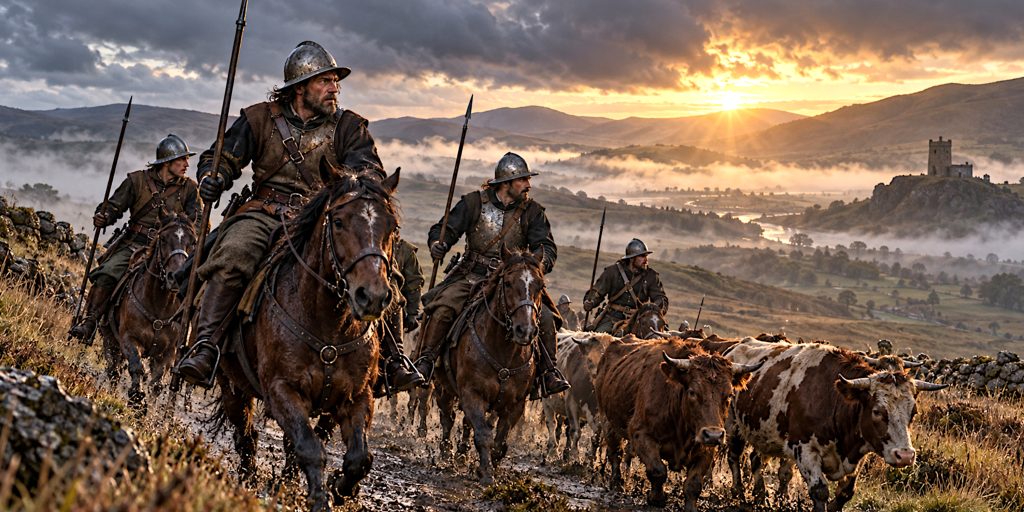
Members of Kerr riding networks participated in the raiding culture of the Borders. Reiving involved livestock theft, violent retaliation, ransom and the seizure of portable wealth.
Yet reducing the entire family to cattle thieves misses their importance. Prominent Kerrs also held official positions, including the wardenship of the Middle March.
Wardens dealt with frontier disputes, negotiations and the pursuit of offenders. Their effectiveness depended heavily on local influence and armed followers.
That arrangement carried an obvious weakness: the men responsible for controlling disorder could be entangled in the relationships that sustained it.
For ordinary households, reiving meant lost animals, damaged crops and insecurity. The picturesque version of Border history tends to leave the ruined farmer outside the frame.
Battles, Raids and the Rough Wooing
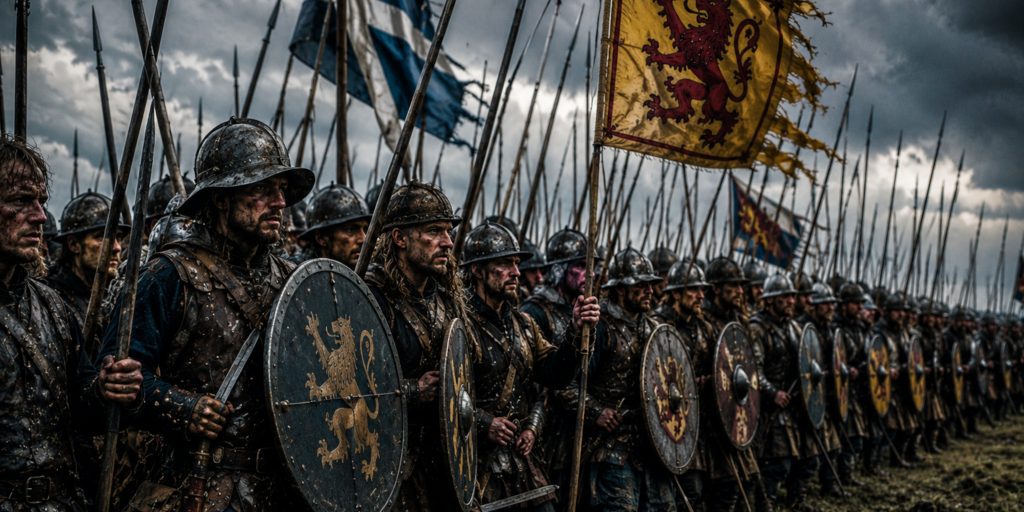
Kerr history runs through the larger Anglo-Scottish conflict, but there was no permanent, unified Kerr army.
Flodden, 1513: Kerr family histories place men of both principal houses in James IV’s campaign. The Scottish defeat destabilised the kingdom and intensified competition over authority on the frontier.
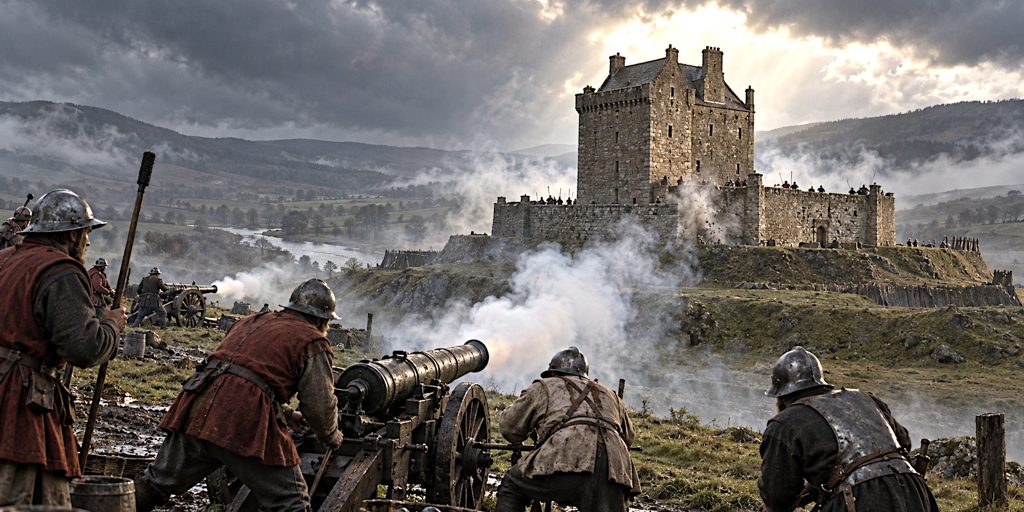
English attacks, 1523: Both Cessford and Ferniehirst suffered in the English campaign. Cessford’s siege is particularly revealing because records describe artillery and earth reinforcement around its defences.
Ancrum Moor, 1545: The Scottish victory belongs to the Kerrs’ wider military setting. The popular story that their motto originated in a dramatic change of sides should be presented as tradition, rather than an established explanation. Accounts of Scottish Borderers abandoning English service do not automatically prove every later family claim.
The Rough Wooing: English efforts to force a marriage between the young Mary, Queen of Scots, and Prince Edward brought repeated destruction to the Borders. Ferniehirst was recovered from English occupation by Franco-Scottish forces in 1549.
The Marian conflicts: Sir Thomas Kerr of Ferniehirst supported Mary. Cessford’s political interests could lead in another direction. Scotland’s civil struggles divided families as readily as they divided the country.
The Kerr and Scott Feud
The feud with the Scotts is among the best-known episodes in Kerr history, although its familiar retellings are often too tidy.
In 1526, Walter Scott of Buccleuch attempted to free James V from the control of the Earl of Angus. Andrew Ker of Cessford was killed in the fighting near Melrose and its aftermath.
It is misleading to state simply that Buccleuch personally killed him. Responsibility for the encounter and responsibility for the fatal blow are different questions.
In 1552, Buccleuch was killed in Edinburgh by men associated with the Kerr side. The killing became a defining act of retaliation.
Reconciliation developed through negotiation and marriage, rather than one universally effective peace ceremony. Thomas Kerr of Ferniehirst’s marriage to Janet Scott belongs to 1569, not 1602. Later agreements should not be confused with that wedding.
Nor did every Kerr and every Scott remain enemies throughout. Border relationships were more flexible, and more exhausting, than a two-colour family feud chart suggests.
Were the Kerrs Really Left-Handed?
This is the family’s most persistent legend. It deserves a careful answer.
The Kerrs have a longstanding association with left-handedness. Individual lairds, particularly Andrew “Dand” Kerr of Ferniehirst, appear in traditions about left-handed swordsmanship. Those traditions do not establish an inherited trait across an entire surname.
A 1974 survey suggested unusually high levels of left-handedness among Kerr and Carr families. A better-controlled study by Duncan Shaw and I. C. McManus, published in 1993, found no evidence of an increased incidence.
The staircase argument is equally insecure. Buildings archaeologist James Wright notes that Ferniehirst’s stair changes direction. Its arrangement cannot serve as proof that a predominantly left-handed household commissioned it for sword fighting.
A good anecdote should be able to survive without wearing a laboratory coat.
Arms and Armour of the Kerr Borderers
No single weapon belonged exclusively to Clan Kerr. Equipment varied with date, wealth and the job at hand.
| Equipment | Likely role in the Border setting |
|---|---|
| Spear or light lance | A practical weapon for mounted fighting |
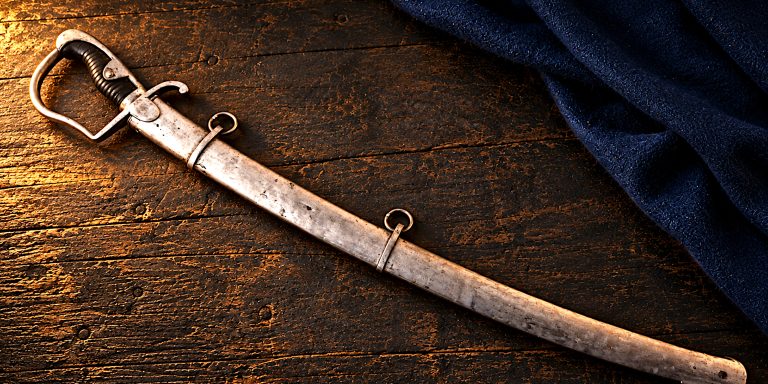
| Single-handed sword | A sidearm for close combat, with hilt forms changing over time |
| Dagger | A secondary weapon and useful everyday tool |
| Bow | Used in the earlier part of the period, with regional and personal variation |
| Pistol or shoulder firearm | Increasingly relevant during the sixteenth century |
| Steel bonnet or burgonet | Head protection suited to mobile warfare |
| Jack of plates | Protective clothing incorporating small metal plates |
| Mail and plate pieces | Additional protection according to means and circumstance |
For late sixteenth-century illustrations, a practical sword with a simple or developing protective hilt is more convincing than an enormous two-handed Highland sword.
Early basket-hilt forms belong within the broader Scottish picture, but the familiar later basket-hilted broadsword should not be imposed on every generation.
Nor should Kerr riders automatically wear matching tartan. Household identity did not produce a modern uniform.
Castles and the Archaeological Evidence
The strongest material evidence concerns buildings and their landscapes. It is less accommodating to legend than one might hope.
Cessford Castle preserves the remains of a substantial tower and surrounding defences. Historic Environment Scotland identifies archaeological potential in its enclosure and possible siegeworks. Documentary evidence also describes earth reinforcement intended to resist artillery in 1523. This was active adaptation to gunpowder warfare, rather than blind faith in thick stone.
Ferniehirst Castle contains work from several periods. The 1598 rebuilding is fundamental to the surviving structure, which also incorporates earlier fabric. Its present appearance cannot simply be projected backwards onto the castle attacked in 1523.
Neither a weapon found somewhere in the Borders nor an antique sold with a family story becomes a Kerr artefact without supporting provenance.
For me, the building phases are more revealing than a vaguely attributed sword. They show money being spent, damage being repaired and priorities changing.
How the Kerrs Became Aristocrats
The familiar journey “from reivers to nobles” sounds straightforward. In practice, leading Kerrs already combined landholding and royal service with the rougher business of the frontier.
Their later titles formalised and expanded existing influence.
The Lothian, Ancram and Roxburghe peerages emerged from different branches and inheritances. They should not be treated as interchangeable honours held by one continuous chief.
The Roxburghe dukedom dates to 1707. The later Innes-Ker succession followed a disputed inheritance resolved in 1812, rather than a simple family merger in 1805.
The Union of the Crowns in 1603 also changed the political environment. With James VI now ruling England as James I, the frontier lost much of its value as a contested boundary between hostile monarchies. Suppression of raiding became a more determined royal priority.
Kerr History Timeline
| Date | Event |
|---|---|
| Later Middle Ages | Kerr households establish substantial influence in Roxburghshire |
| Fifteenth century | Cessford and Ferniehirst become major local power centres |
| 1513 | Kerr family traditions record participation at Flodden |
| 1523 | English forces attack Cessford and Ferniehirst |
| 1526 | Andrew Ker of Cessford dies following the fighting near Melrose |
| 1545 | Scottish victory at Ancrum Moor during the Rough Wooing |
| 1549 | Franco-Scottish forces recover Ferniehirst from English occupation |
| 1552 | Walter Scott of Buccleuch is killed in Edinburgh |
| 1569 | Thomas Kerr of Ferniehirst marries Janet Scott |
| 1598 | Major rebuilding at Ferniehirst |
| 1603 | Union of the Crowns changes the frontier’s political role |
| 1707 | Creation of the Roxburghe dukedom |
| 1812 | Innes-Ker succession to Roxburghe resolved |
| 2024 | Ralph Kerr succeeds as 14th Marquess of Lothian |
Kerr Tartans, Heraldry and Associated Families
The sun crest and the motto Sero sed serio are familiar Kerr symbols. A clan crest badge expresses affiliation; a coat of arms belongs to its recognised bearer, rather than automatically to everyone sharing a surname.
Kerr tartans are meaningful expressions of later family identity. Their existence does not establish that medieval Kerr followers wore those patterns.
Similar care is needed with associated surnames. Tait families, for example, appear in discussions of Kerr connections, but a broad “sept list” cannot prove a particular person’s descent or historical allegiance.
For ancestry research, work backwards through parish registers, civil records, wills, estate papers and marriage contracts. A tartan shop can supply a scarf. It cannot supply a missing generation.
Where to Explore Kerr History
| Place | Why it matters |
|---|---|
| Ferniehirst Castle | The principal site for the Ferniehirst family, its architecture and traditions |
| Cessford Castle | The surviving stronghold of the Cessford house |
| Floors Castle | The later history of the Dukes of Roxburghe |
| Jedburgh and its surroundings | The landscape in which Ferniehirst power developed |
| Kelso and the central Borders | A useful setting for understanding the family’s landholding and frontier connections |
Check current access arrangements before travelling, particularly for privately owned buildings and castle ruins.
The landscape deserves time as well as the houses. Roads, valleys, grazing land and river crossings help explain why local power mattered so much.
What the Kerrs Left Behind
The Kerr legacy lies in castles, titles, family associations and the surviving record of a remarkably complicated frontier society.
There is courage in that history, but also coercion. Royal service sits beside private advantage. Marriage could repair a political relationship that violence had made almost unmanageable.
As a historian, I find the family more compelling with those contradictions intact. The Kerrs needed horses, tenants, land and influence to remain powerful. Whether a particular laird held his sword in his left hand was usually a smaller matter.
Sources and Further Reading
- Clan Kerr’s official website for family history, places and traditions.
- Historic Environment Scotland’s Cessford Castle record for the monument and its archaeological significance.
- Shaw and McManus, The handedness of Kerrs and Carrs for the 1993 study.
- James Wright, Left-handed Kerrs for analysis of the staircase tradition.
Further reading includes George MacDonald Fraser’s The Steel Bonnets, Alistair Moffat’s The Reivers and Maureen M. Meikle’s research on the landed families of the eastern Anglo-Scottish Borders.