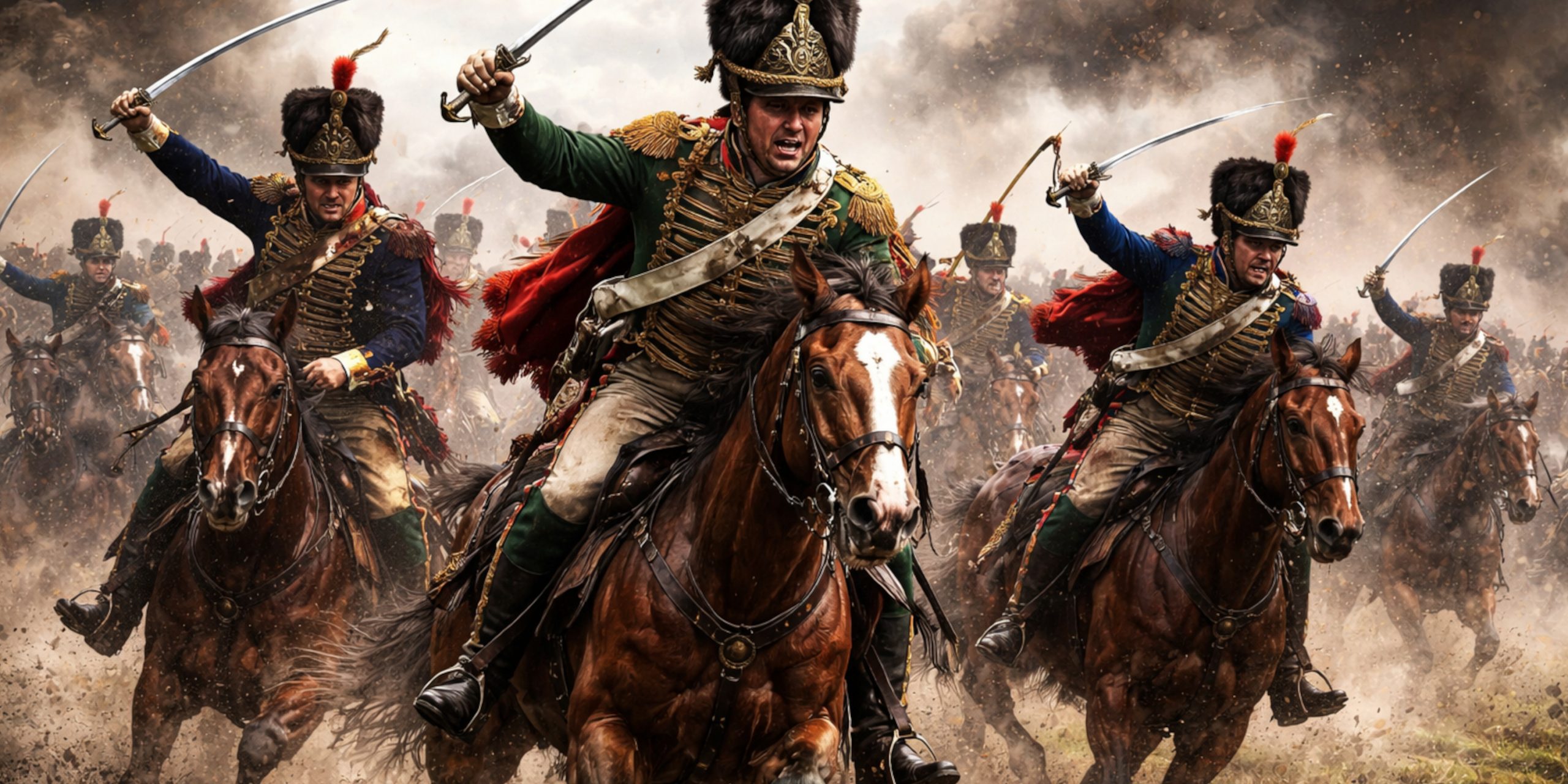
Few soldiers have left such a vivid mark on military history as the French hussars. They were cavalrymen with enough braid, fur and swagger to make an opera singer look underdressed. Beneath the extravagant uniforms, however, stood some of the finest light cavalry in Europe.
French hussars were scouts, raiders, pursuers and troublemakers. They screened the army, harassed retreating enemies, carried messages, seized bridges and occasionally charged into situations that would have seemed unwise to anyone with a firmer grasp of self-preservation.
Napoleon admired them enormously, though perhaps from a comfortable distance.
Origins of the French Hussars
The hussar tradition came from Hungary. Light cavalry from the Hungarian frontier had developed a style of warfare based on speed, surprise and aggression. Their distinctive dress travelled west with them, and by the eighteenth century most European armies wanted hussars of their own.
France first raised hussar regiments during the reign of Louis XV. Many of the earliest recruits were foreigners, especially Hungarians, Germans and men from eastern Europe who already understood hussar tactics.
By the time of the French Revolution and the Napoleonic Wars, the French army fielded thirteen hussar regiments. They became famous across Europe for their daring, their appearance and, occasionally, their alarming lack of restraint.
General Antoine Charles de Lasalle, perhaps the most famous hussar officer of them all, summed up the reputation perfectly:
“Any hussar who is not dead by thirty is a blackguard.”
Lasalle himself died at thirty-four, which suggests even he occasionally ignored his own advice.
What French Hussars Actually Did
French hussars were light cavalry. Unlike cuirassiers, they were not intended to smash directly into a formed infantry square. Their real value lay in movement.
Their duties included:
- Reconnaissance ahead of the army
- Screening friendly movements from enemy scouts
- Raiding supply lines and convoys
- Pursuing defeated troops after a battle
- Capturing prisoners and dispatches
- Skirmishing with enemy cavalry
- Seizing bridges, roads and river crossings
At their best, French hussars could turn an enemy retreat into a catastrophe. Once infantry began to break and run, hussars appeared with the speed and enthusiasm of tax collectors who had discovered an unpaid debt.
Famous French Hussar Regiments
Each French hussar regiment had its own colours and traditions. Their uniforms varied dramatically, making them easy to identify and impossible to forget.
| Regiment | Distinctive Colours | Notable Campaigns |
|---|---|---|
| 1st Hussars | Sky blue dolman and pelisse | Italy, Egypt, Austerlitz |
| 4th Hussars | Blue and red uniform | Peninsula, Waterloo |
| 5th Hussars | Sky blue with white details | Revolutionary Wars, Jena |
| 7th Hussars | Green with red facings | Spain, Russia |
| 10th Hussars | Sky blue with red collar | Ulm, Austerlitz, Russia |
| 13th Hussars | Brown uniform with blue details | Germany, France 1814 |
The 4th Hussars gained particular fame through Lasalle, whose men seemed to regard impossible odds as a mild inconvenience.
Arms and Armour
French hussars carried relatively light equipment. Their survival depended on speed and skill rather than heavy armour.
Clothing and Protective Equipment
The typical French hussar wore:
- A tightly fitted braided jacket known as a dolman
- A fur-trimmed pelisse, often slung over one shoulder
- Reinforced riding breeches with leather inner panels
- High cavalry boots
- A shako or fur busby with plume
- A sabretache hanging from the belt
The famous pelisse hanging from one shoulder was not simply for decoration. It could provide some limited protection against a sword cut, though perhaps not enough to justify quite how magnificent the officers insisted on making it.
Unlike cuirassiers, hussars did not wear metal breastplates. Officers occasionally wore concealed mail or silk waistcoats beneath their uniforms, but ordinary troopers relied on mobility.
Sword Types Used
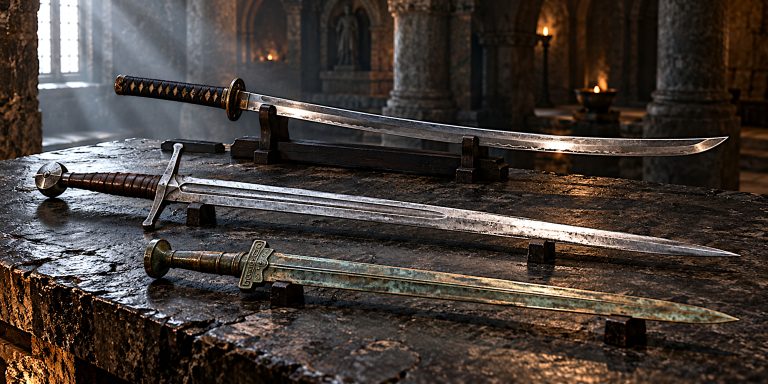
The chief weapon of the French hussar was the curved sabre.
The most common examples were:
| Sword Type | Description | Use |
| AN IV Light Cavalry Sabre | Curved blade, brass hilt, around 87 cm long | Early Revolutionary and Napoleonic period |
| AN IX Light Cavalry Sabre | Improved version with stronger blade and guard | Standard Napoleonic hussar sabre |
| AN XI Light Cavalry Sabre | Slightly altered version of the AN IX | Widely used after 1803 |
These sabres were designed for slashing attacks from horseback. A hussar riding at speed could cut with alarming force. The curved blade also drew more easily from the scabbard and was less likely to become stuck in an opponent, which was useful if one intended to survive the encounter.
In addition to the sabre, French hussars often carried:
- A cavalry carbine
- One or two pistols
- Occasionally a small straight sword or knife for camp use
Firearms were useful, but most hussars trusted their sabres far more. Many accounts from the period describe them throwing away carbines or leaving pistols unloaded in favour of charging with cold steel.
Hussar Tactics Under Napoleon
Napoleon used hussars constantly. They marched ahead of the army and rode behind it. When the French advanced, hussars found the roads. When the French retreated, hussars covered the withdrawal.
In battle, hussars were often used to:
- Attack exposed artillery crews
- Chase down routed infantry
- Drive off enemy light cavalry
- Exploit a gap after a major assault
During the 1805 campaign, French hussars helped keep Austrian forces blind and confused. At Jena in 1806 they swept across the battlefield after the Prussian collapse. In Spain they fought a harsher, more exhausting war of ambushes and raids.
The Russian campaign of 1812 proved especially brutal. Thousands of horses died, and the once splendid hussar regiments emerged in rags. Even the most flamboyant trooper can only do so much while freezing in a threadbare pelisse somewhere outside Smolensk.
Famous Hussar Officers
Antoine Charles de Lasalle
Lasalle was perhaps the embodiment of the French hussar spirit. Reckless, charismatic and absurdly brave, he led his cavalry with remarkable skill.
He reportedly told his men:
“Forward, my children. Every bullet that is not in your body is wasted.”
It was exactly the sort of thing one says when one is not especially concerned about statistics.
Lasalle died at the Battle of Wagram in 1809.
Joachim Murat
Before becoming King of Naples, Murat served as one of Napoleon’s greatest cavalry commanders. Although not strictly a hussar officer for most of his career, he adored hussar dress and often appeared on campaign looking like a peacock who had somehow acquired command of an army.
His battlefield leadership was considerably better than his tailoring was restrained.
Michel Ney
Marshal Ney began his career in the 5th Hussars. He later became one of Napoleon’s most famous marshals and earned the nickname “the bravest of the brave”. His hussar background never quite left him.
Archaeology and Surviving Artefacts
French hussar archaeology often comes from Napoleonic battlefields and military camps.
Archaeologists have uncovered:
- Sabre blades and scabbard fragments
- Brass shako plates and regimental buttons
- Buckles from sabretaches and harnesses
- Horse equipment including bits, stirrups and spurs
- Carbine parts and pistol balls
Excavations at sites such as Waterloo, Borodino and Leipzig have revealed hussar equipment buried among the remains of battle. Curved sabre blades are among the most recognisable finds.
At Waterloo, several French cavalry sabres have been recovered near the areas where French horsemen attacked the Allied lines. The pattern of damage on some blades suggests heavy use and, in a few cases, desperate close fighting.
Fragments of hussar uniforms are much rarer, though brass buttons and decorative braid occasionally survive in graves or camp sites.
Today, original French hussar artefacts can be seen in:
- Musée de l’Armée, Paris
- Musée de Waterloo 1815, Belgium
- National Army Museum, London
- Musée de l’Empéri, Salon-de-Provence
Contemporary Quotes About the Hussars
French hussars fascinated both allies and enemies.
A British officer wrote of them:
“The French hussars rode like demons, and looked as if they had stepped from a theatre.”
Another observer remarked:
“They were terrible in pursuit, magnificent in appearance, and impossible to keep in order.”
Napoleon himself appreciated their usefulness, though he knew their weaknesses:
“Hussars are excellent for reconnaissance and pursuit, but they are apt to become intoxicated with their own courage.”
That may be the politest way ever devised to say that they were inclined to gallop enthusiastically into danger and only later consider whether it had been a sensible idea.
Why French Hussars Became Legends
French hussars became legendary because they combined practical military value with unforgettable style. They looked extraordinary, fought ferociously and produced enough stories to fill a shelf of memoirs.
They were not the most heavily armed troops in Europe, nor the most disciplined. Yet few soldiers captured the imagination quite so completely.
Part of that appeal lies in the contrast. Beneath the glittering braid and theatrical moustaches stood men performing genuinely dangerous work. They rode first into unfamiliar country, first into pursuit and often first into trouble.
The French hussar was both a soldier and a symbol. He represented speed, confidence and a certain willingness to trust that tomorrow would take care of itself.
In fairness, tomorrow often had other ideas.
Further Reading
- Emir Bukhari, Napoleon’s Hussars
- Elting, Swords Around a Throne
- Philip Haythornthwaite, Napoleonic Light Cavalry
- Jean-Louis Vial, French Hussars 1792–1815