The Viking wars in Europe were not one neat conflict with a clear beginning, middle and end. They were a long sequence of raids, invasions, sieges, settlements and political struggles that stretched from the late 8th century into the 11th. They struck monasteries, towns, royal centres and river routes across England, Ireland, Francia, Scotland, the Low Countries, Iberia and beyond.
Popular culture loves to reduce this period to longships, axes and a great deal of shouting. The real history is far more interesting. Viking warfare mattered because it exposed the weaknesses of early medieval kingdoms, forced rulers to adapt and helped create new political worlds across Europe. It was destructive, certainly, but it was also transformative.
What were the Viking wars?
The Viking raids and battles in Europe were a series of conflicts involving Scandinavian raiders, settlers and rulers between the late 700s and the 1000s. They began with coastal attacks on exposed religious centres and developed into larger campaigns involving tribute, conquest, fortified camps and regional rule.
Early raids were fast, violent and opportunistic. A monastery or coastal settlement would be hit, valuables taken, captives seized and the attackers gone before a proper response could be organised. By the 9th century, however, Viking forces were pushing much deeper inland. Rivers such as the Thames, Seine, Loire and Rhine became military highways.
That was the real shift. These were no longer just raids from the sea. They became sustained wars that forced European rulers to confront an enemy who was mobile, unpredictable and increasingly willing to stay.
Why the Vikings were so dangerous
Mobility
The longship gave Viking forces extraordinary reach. It could cross open sea, hug coastlines, enter estuaries and travel up shallow rivers. That made defence painfully difficult. A kingdom might know danger was coming, but not where it would land.
Flexibility
Viking war bands adapted quickly. They could raid, besiege, fortify, negotiate, retreat and return. They were not locked into one style of fighting.
Leadership
The most successful Viking armies were led by ambitious, capable leaders who understood logistics, intimidation and political opportunity. They were not mindless mobs. They were often highly effective coalitions under strong command.
Weak opposition
This matters more than romantic legend likes to admit. Viking success often depended on attacking kingdoms that were divided, politically unstable or underprepared. A fractured realm is a standing invitation to trouble.
How the wars began
The traditional beginning of the Viking Age is the raid on Lindisfarne in 793. It remains the most famous early attack because it shocked Christian Europe and exposed how vulnerable major religious sites had become.
Lindisfarne was wealthy, prestigious and poorly defended. It was, from a raider’s point of view, an appallingly convenient target. Other monasteries and coastal sites in Britain and Ireland were attacked soon after.
Alcuin of York, reacting to the raid, wrote:
Never before has such terror appeared in Britain as we have now suffered from a pagan race.
That line captures the shock of the moment rather well. Monks tend not to approve when armed strangers arrive uninvited and set fire to the furniture.
Key figures of the Viking wars

Ragnar Lodbrok
Ragnar occupies the uncomfortable but fascinating space between history and legend. Later tradition turned him into a towering Viking hero, though the exact historical figure behind the name is still debated.
Ivar the Boneless
Ivar is closely associated with the Great Heathen Army and the Viking conquest of York. He appears in the sources as a formidable leader with real strategic skill.
Halfdan Ragnarsson
Halfdan was another major leader of the Great Heathen Army. He played a major role in campaigns across Northumbria and Mercia and is closely linked to both war and settlement.
Guthrum
Guthrum was one of the most important Viking leaders in England during Alfred’s reign. Defeated at Edington, he later converted and ruled in East Anglia. His career shows how quickly an invader could become an accepted ruler.
Alfred the Great
Alfred was the central defender against Viking conquest in England. His legacy rests not only on battlefield success, but on military reform, fortification and administration. He made survival possible, which is often more important than looking dramatic.
Rollo
Rollo became the most famous Viking war leader to turn raiding success into territorial rule. The lands granted to him in 911 became the foundation of Normandy.
Brian Boru
Brian Boru belongs in this story because Viking warfare in Ireland cannot be understood without him. His victory at Clontarf in 1014 became central to later Irish memory, even if the alliances involved were more complicated than the popular version suggests.
Swein Forkbeard
Swein pushed Viking warfare into the realm of kingship politics. His campaigns against England showed that Scandinavian rulers were now aiming for crowns, not just plunder.
Cnut
Cnut was perhaps the most successful ruler to emerge from the Viking world in western Europe. By 1016 he ruled England, and his wider empire linked England, Denmark and Norway.
Harald Hardrada
Harald Hardrada led the Norwegian invasion defeated at Stamford Bridge in 1066. He is often treated as the last great Viking warlord, and while that is slightly theatrical, it is not entirely wrong.
Main theatres of war
England
England became the main theatre of Viking warfare in western Europe. It was wealthy, politically divided and highly exposed through its coasts and rivers.
The arrival of the Great Heathen Army in 865 changed everything. Northumbria, East Anglia and Mercia were all hit hard. Wessex survived, largely because Alfred and his successors built systems capable of resisting further conquest.
The long-term result was the Danelaw, a region of strong Scandinavian political and legal influence in eastern and northern England.
Francia and the Low Countries
Francia suffered repeated attacks through its great river systems, especially the Seine and Loire. Viking fleets struck inland towns, monasteries and strategic centres, while Frankish rulers often responded with a mixture of force, tribute and political improvisation.
The siege of Paris in 885 to 886 became the most famous of these confrontations. Later, the grant of land to Rollo in 911 created the basis of Normandy, one of the most important political outcomes of the Viking Age.
Ireland and Scotland
In Ireland, Viking groups did not only raid. They also built fortified bases, established towns and entered Irish dynastic politics. Dublin became one of the major Norse centres in the west.
In Scotland and the Isles, Norse influence spread strongly through Orkney, Shetland and the Hebrides. Sea control mattered more than holding every piece of inland territory.
Iberia and the Baltic
Viking fleets also attacked Iberia, including Seville in 844. These operations showed the range of Scandinavian warfare, though Iberia was not as central a theatre as England or Francia.
In the Baltic and eastern Europe, Scandinavian warfare intersected with trade routes, settlement and the wider Rus world. This side of the Viking story is less familiar to casual readers, but it mattered enormously.
Major battles of the Viking wars
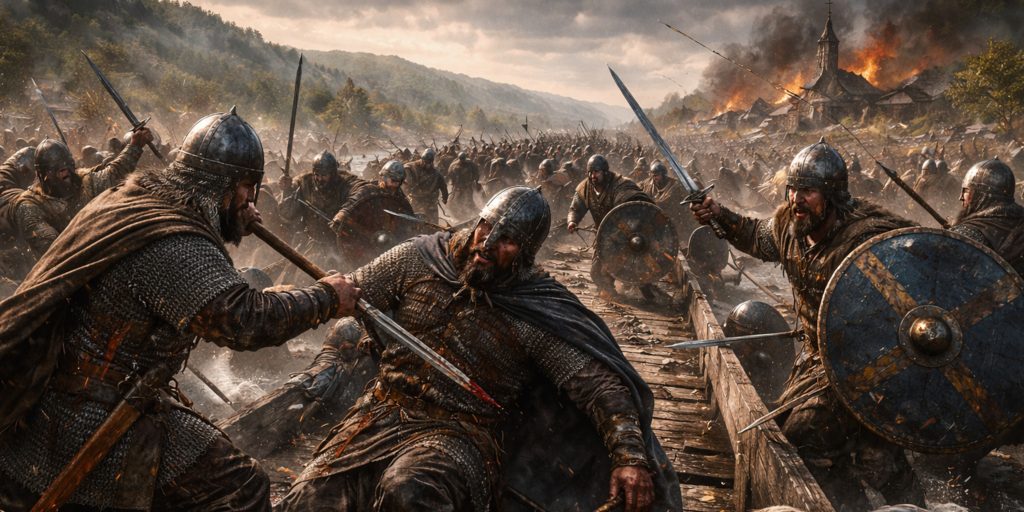
Edington, 878
Alfred defeated Guthrum in one of the defining battles of the age. The victory preserved Wessex and gave Alfred the chance to rebuild.
Why it mattered
Without Edington, the political future of England may have looked very different.
Paris, 885 to 886
The siege of Paris became one of the great military showpieces of the Viking Age in Francia.
Why it mattered
It showed the value of strong local defence and the weakness of wider Carolingian coordination.
Maldon, 991
The English were defeated at Maldon, but the battle became immortal through the Old English poem that commemorated it.
Mind must be the firmer, heart the more fierce, courage the greater, as our strength grows less.
It is stirring, noble and the sort of line one usually admires more from a safe distance.
Why it mattered
Maldon became a lasting literary symbol of courage and doomed loyalty.
Clontarf, 1014
Clontarf is often remembered as a clean Irish victory over the Vikings. The actual alignments were far messier, with Irish and Norse forces appearing on both sides.
Why it mattered
The battle weakened Norse political power in Ireland, even if it did not erase Scandinavian influence.
Stamford Bridge, 1066
Harold Godwinson defeated Harald Hardrada in September 1066 in one of the most famous battles in English history.
Why it mattered
It is widely treated as the symbolic end of the Viking Age in England.
Weapons and tactics
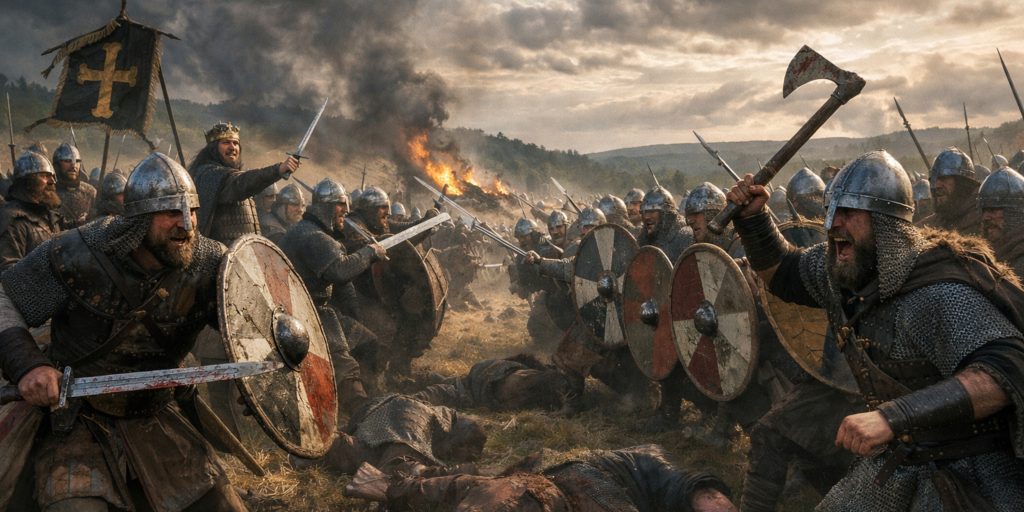
Viking-age warfare relied on weapons common across much of early medieval Europe.
Main weapons
- Spears
- Axes
- Swords
- Round shields
Armour
Mail shirts and helmets were mostly used by wealthier warriors. Equipment varied greatly depending on status and resources.
Tactical strengths
- Fast maritime movement
- River-based operations
- Surprise attacks
- Temporary fortified camps
- Ability to choose vulnerable targets
It is also worth saying plainly that horned helmets belong to fantasy, costume shops and very persistent bad ideas, not actual Viking battlefields.
Archaeology
Archaeology has done a great deal to rescue the Viking wars from cliché. Written sources tell us who was horrified. Excavation tells us how armies actually moved, camped, traded and fought.
Repton
Repton has yielded important evidence linked to the Great Heathen Army, including burial deposits and traces of winter occupation.
Torksey
Torksey has revealed a major Viking winter camp with signs of metalworking, trade and large-scale seasonal settlement.
Dublin
Excavations in Dublin have uncovered defences, workshops and imported goods, showing the overlap between warfare, urban growth and commerce.
Weymouth
A mass grave associated with executed Scandinavian men provides direct evidence for the violence of the period.
What archaeology tells us
Viking armies were not just raiding parties. They were mobile military communities with logistics, craft production and political structure.
Contemporary quotes
The written record of the Viking wars is vivid, frightened and often partisan. That does not make it useless. It simply means it must be read with care.
Alcuin of York wrote after Lindisfarne:
Never before has such terror appeared in Britain as we have now suffered from a pagan race.
The poem The Battle of Maldon gives us one of the most famous lines of heroic defiance:
Mind must be the firmer, heart the more fierce, courage the greater, as our strength grows less.
These voices matter because they preserve the emotional shock of the period. They also remind us that most surviving accounts were written by people who had every reason to dislike the Vikings intensely.
The impact of the Viking wars on Europe
Military reform
Rulers improved fortifications, mobilisation systems and local defence in response to repeated Scandinavian attacks.
Political change
The Danelaw, Norse Ireland and Normandy all emerged from the military pressures of the age.
State formation
Kingdoms that survived often did so by becoming better organised, better taxed and more defensible.
Cultural blending
Viking war led not only to destruction, but also to settlement, trade, intermarriage and long-term cultural exchange.
When did the Viking wars end?
There is no perfectly tidy end date, but 1066 is often used as the symbolic endpoint in England because of Stamford Bridge. In reality, the process was gradual. Scandinavian rulers converted, consolidated kingdoms and became part of mainstream European dynastic politics.
The raider became the settler. The settler became the ruler. The ruler became somebody’s illustrious ancestor.
Takeaway
The Viking wars are often flattened into one dramatic image, a longship on a grey sea and a monastery about to have an extremely unpleasant morning. The reality is richer than that. These wars reshaped Europe because they forced political systems to adapt. They exposed weakness, rewarded mobility and created new forms of rule.
What makes the period so compelling is not simply the violence, though there was plenty of that. It is the speed with which enemies became neighbours, rulers and founders of new political orders. Medieval Europe had a remarkable habit of turning invaders into landlords.
History, as ever, is less tidy than legend and much more interesting.
What the documentary:
FAQ
When did the Viking wars begin?
They are usually dated from the late 8th century, with the raid on Lindisfarne in 793 treated as the traditional starting point.
Who were the main Viking leaders?
Important figures include Ivar the Boneless, Guthrum, Swein Forkbeard, Cnut and Harald Hardrada, alongside opponents such as Alfred the Great and Brian Boru.
What was the Great Heathen Army?
It was a large Viking force that arrived in England in 865 and campaigned across multiple Anglo-Saxon kingdoms.
What was the Danelaw?
The Danelaw was the part of England under strong Scandinavian legal, political and cultural influence.
Did the Vikings only raid monasteries?
No. They also attacked towns, forts, ports and royal centres, and later pursued conquest and settlement.
What battle ended the Viking Age?
Many historians use Stamford Bridge in 1066 as the symbolic end of the Viking Age in England.