Few Roman emperors leave behind a reputation that feels genuinely human. Marcus Aurelius does.
He ruled from AD 161 to 180 during a turbulent period when the Roman Empire faced plague, rebellion, and relentless pressure along the Danube frontier. Yet he remains best known not for conquest but for reflection. His personal writings, later collected as Meditations, reveal a ruler wrestling with duty, mortality, and the burden of power.
That image of a thoughtful philosopher can sometimes obscure another truth. Marcus Aurelius spent much of his reign on campaign. The emperor who wrote about self discipline and humility also directed armies, built frontier defences, and fought a long and exhausting war against Germanic tribes.
In other words, the philosopher emperor was also a soldier emperor. Rome did not allow him the luxury of being anything else.
Early Life and Rise to Power
Marcus Aurelius was born in Rome on 26 April AD 121 as Marcus Annius Verus. His family belonged to the Roman aristocracy and enjoyed strong political connections. His grandfather served as consul, and the young Marcus grew up close to imperial power.
His life changed dramatically when Emperor Hadrian began arranging the imperial succession. Through a carefully designed chain of adoptions, Marcus was adopted by Antoninus Pius, who became emperor in AD 138.
Antoninus ruled peacefully for over two decades and carefully prepared Marcus for power. The young heir received a rigorous education in philosophy, rhetoric, and law. Stoicism in particular shaped his worldview.
When Antoninus died in AD 161, Marcus Aurelius became emperor. He immediately did something unusual. Rather than rule alone, he shared power with his adoptive brother Lucius Verus.
This arrangement helped stabilise the empire. It also meant Marcus inherited the throne at a moment when Rome’s borders were about to ignite.
The Roman World in Crisis
Marcus Aurelius did not enjoy the peaceful empire that earlier rulers had known. His reign quickly became defined by crisis.
The eastern frontier erupted first. Rome fought a major war against Parthia between AD 161 and 166. Lucius Verus led the campaign while Marcus remained in Rome overseeing administration.
Victory came at a heavy cost. Roman troops returning from the east carried a devastating disease now known as the Antonine Plague. The epidemic spread across the empire and may have killed millions.
At the same time, pressure grew along the Danube frontier. Germanic tribes such as the Marcomanni, Quadi, and others began crossing into Roman territory.
What followed became one of the most serious frontier wars Rome faced in the second century.
Battles and Military Acumen
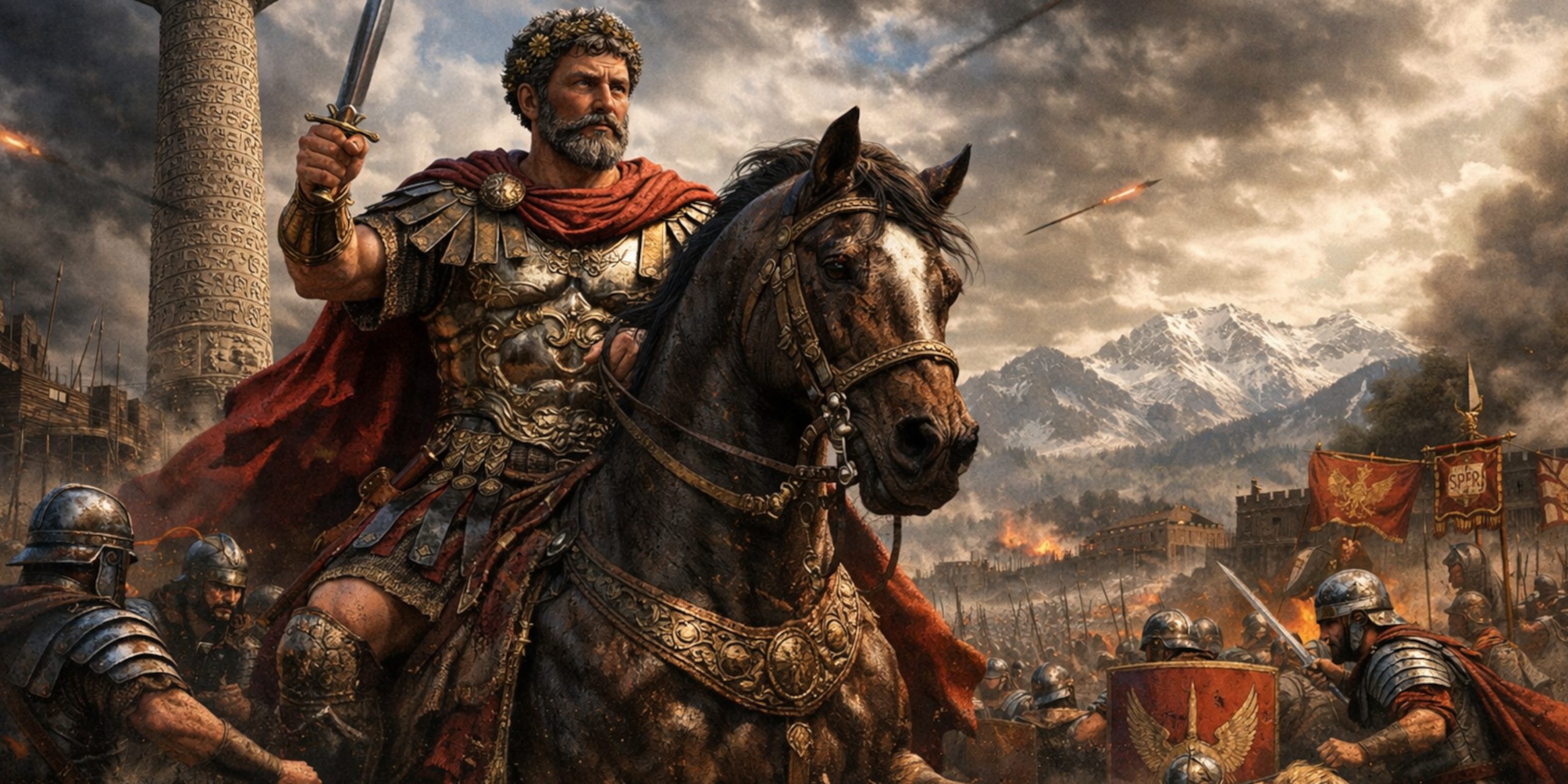
Marcus Aurelius spent large portions of the 170s campaigning along the Danube frontier in what historians call the Marcomannic Wars.
Unlike some emperors who preferred delegation, Marcus took direct command. Ancient sources describe him travelling with the army, supervising strategy, and enduring the harsh conditions of frontier warfare.
Major Campaigns
Marcomannic War (AD 166 to 180)
Germanic tribes crossed the Danube and raided deep into Roman territory, even threatening northern Italy.
Siege of Aquileia (AD 170)
Enemy forces advanced as far as northern Italy before Roman armies pushed them back.
Campaigns beyond the Danube
Roman forces counterattacked into tribal lands north of the river.
Military Strengths
Marcus Aurelius demonstrated several qualities as a commander:
- Strong logistical organisation across long frontier campaigns
- Willingness to maintain prolonged military presence along the Danube
- Strategic use of diplomacy with certain tribes
- Reorganisation of frontier defences and legion deployments
The wars were not glamorous victories in the style of Julius Caesar or Trajan. They were grinding conflicts against mobile tribal coalitions.
Still, Marcus stabilised the frontier. His campaigns likely prevented deeper incursions into Roman territory.
At one point he even considered creating new Roman provinces north of the Danube. Those plans died with him.
Arms and Armour of Marcus Aurelius’ Armies
Roman military equipment during the reign of Marcus Aurelius reflects the mature phase of the imperial army.
The Roman legions and auxiliary units used a combination of traditional weapons and evolving equipment adapted to frontier warfare.
Infantry Weapons
| Weapon | Description |
|---|---|
| Gladius | Short stabbing sword used by legionaries |
| Spatha | Longer sword increasingly used by cavalry and some infantry |
| Pilum | Heavy throwing spear designed to penetrate shields |
| Pugio | Roman military dagger |
The spatha began to replace the gladius more widely during the later empire. Cavalry had already adopted it because of its longer reach.
Defensive Equipment
| Armour | Description |
|---|---|
| Lorica segmentata | Articulated plate armour worn by legionaries |
| Lorica hamata | Chainmail armour widely used by auxiliaries |
| Lorica squamata | Scale armour used by officers and specialist troops |
| Scutum | Large curved shield of the Roman infantry |
Cavalry Equipment
Roman cavalry in Marcus Aurelius’ armies used:
- Spatha swords
- Contus style lances
- Oval shields
- Helmets with reinforced cheek guards
Heavy cavalry became increasingly important during frontier wars against fast moving tribal forces.
The Emperor as Soldier
Marcus Aurelius did not simply command from afar. Several ancient accounts suggest he spent years near the Danube frontier.
It was likely during these campaigns that he wrote portions of Meditations. The work reads like the private notebook of a tired commander reflecting in a quiet tent after a day of administration and war.
There is something striking about that image.
An emperor ruling the largest empire in the world, surrounded by soldiers and the constant threat of invasion, writing reminders to himself about patience and restraint.
Not exactly the stereotype of Roman imperial arrogance.
Personal Life and Succession
Marcus Aurelius married Faustina the Younger, daughter of Antoninus Pius. The couple had many children, though several died young.
One surviving son would later shape Marcus’ reputation in ways he could never have predicted.
That son was Commodus.
Marcus broke the long tradition of adoptive succession and named Commodus his heir. After Marcus died in AD 180, Commodus became emperor.
Ancient writers later judged this decision harshly. Commodus’ erratic rule damaged the stability Marcus had worked hard to maintain.
Some historians see the moment as the symbolic end of Rome’s golden age of stable rulers.
Artefacts from the Reign of Marcus Aurelius
Several important artefacts survive from his reign and can still be seen today.
Notable Surviving Objects
Equestrian Statue of Marcus Aurelius
One of the most famous Roman bronze statues ever created.
Column of Marcus Aurelius
A monumental column in Rome depicting scenes from the Marcomannic Wars.
Coins of the Antonine Dynasty
Imperial coinage showing Marcus Aurelius and members of his family.
Military equipment from Danube forts
Weapons and armour discovered at Roman frontier sites.
Where to See Them
| Artefact | Location |
|---|---|
| Equestrian Statue of Marcus Aurelius | Capitoline Museums, Rome |
| Column of Marcus Aurelius | Piazza Colonna, Rome |
| Roman military artefacts | Carnuntum Archaeological Park, Austria |
| Imperial coins | British Museum, London |
| Roman frontier artefacts | Hungarian National Museum, Budapest |
The equestrian statue survived largely because medieval Romans believed it represented Constantine rather than a pagan emperor. A fortunate misunderstanding.
Latest Archaeological Discoveries
Archaeology along the Danube frontier continues to shed new light on Marcus Aurelius’ wars.
Recent Findings
Roman Military Camps in Slovakia and Austria
Excavations have uncovered temporary Roman marching camps dating to the Marcomannic campaigns.
Carnuntum Discoveries
Archaeologists have revealed new sections of Roman military infrastructure and settlements tied to the frontier war effort.
Roman Battlefield Evidence
Weapon fragments, arrowheads, and armour pieces discovered north of the Danube suggest Roman armies pushed deeper into Germanic territory than once believed.
Frontier Infrastructure
Recent surveys show expanded fort networks and supply bases supporting long term Roman operations.
These discoveries reinforce something historians already suspected. Marcus Aurelius’ campaigns were not short punitive raids. They were sustained military operations across a vast frontier zone.
The Legacy of Marcus Aurelius
Marcus Aurelius died in AD 180 while still on campaign along the Danube frontier.
Ancient writers often described him as the last of Rome’s “Five Good Emperors”. Whether that label is fair or romanticised remains open to debate.
Still, his reign sits at a fascinating intersection.
He governed an empire that remained powerful yet increasingly strained. He led armies in brutal frontier wars while privately reflecting on philosophy and moral discipline.
Historians tend to admire him because he seems aware of the contradictions of power.
He knew the empire required violence to survive. Yet he spent his private thoughts reminding himself not to become cruel, arrogant, or careless with authority.
For a Roman emperor, that level of self awareness feels almost revolutionary.
Takeaway
Marcus Aurelius is often remembered as the philosopher on the throne. That image is true, but incomplete.
He was also a campaign hardened ruler who spent years stabilising Rome’s most dangerous frontier. His reign was marked by plague, invasion, and uncertainty.
What makes him remarkable is not that he faced these problems. Many emperors did.
What stands out is that he left behind a record of how he tried to face them with restraint, discipline, and a constant reminder that power does not make someone wise.
That is probably why his reputation still survives nearly two thousand years later.
Not many emperors earn that kind of longevity.
Watch the documentary: