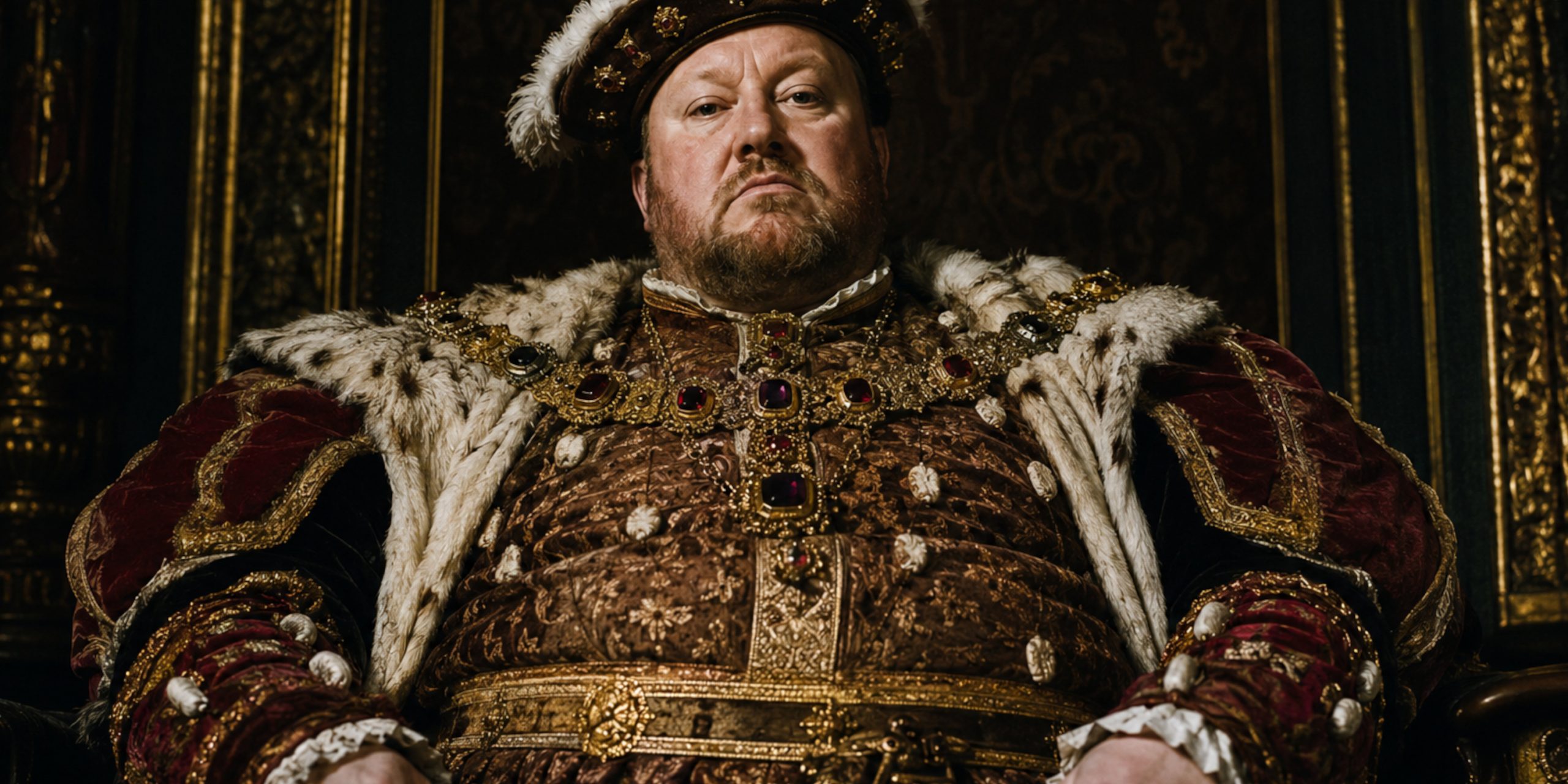
Few English kings have inspired more fascination, argument, or quietly horrified eyebrow raises than Henry VIII. School history often paints him as the large fellow with six wives and a talent for executions, but the more historians examine his later life, the more unsettling the picture becomes.
What exactly went wrong with Henry VIII?
The short answer is that something clearly did. The athletic, intelligent prince of the early sixteenth century became, by middle age, deeply obese, chronically ill, unpredictable, paranoid and prone to explosive cruelty. Contemporary observers noticed the transformation. Foreign ambassadors wrote about it with varying levels of diplomatic panic.
Modern historians and doctors have spent decades trying to explain the decline. There is no universal agreement, though several theories appear repeatedly. Some are convincing. Others wander into the territory of enthusiastic pub speculation.
What follows is what we actually know, what we strongly suspect, and what probably belongs in the same drawer as “Richard III definitely murdered the princes because someone on television said so”.
The Young Henry VIII
Before discussing illness, it helps to understand just how different the young Henry was.
Early accounts describe him as athletic, charismatic and remarkably educated. At over six feet tall, he towered above many contemporaries. He excelled in hunting, wrestling, dancing and jousting. He also composed music, spoke several languages and enjoyed theology enough to argue with Martin Luther himself.
One Venetian observer described him as:
“The handsomest potentate I ever set eyes on.”
That was not simply flattery. Young Henry projected physical power and confidence in a way Tudor monarchs desperately valued.
He was not born to be king. His elder brother Arthur was expected to inherit the throne. Arthur’s death in 1502 abruptly changed Henry’s destiny, and perhaps his psychology as well. There is often a slight hardness in second sons unexpectedly handed absolute authority. History has quite a collection of them.
The Jousting Accidents
The Turning Point
Many historians point to Henry’s jousting accidents as the beginning of his physical decline.
The most serious incident occurred in 1536 when Henry was thrown from his horse during a tournament. The horse then landed on him. He was reportedly unconscious for around two hours.
For a Tudor king, this was alarming enough. For modern readers, it sounds suspiciously like a traumatic brain injury.
After this point, observers increasingly described Henry as volatile, suspicious and emotionally unstable. His personality appears to have hardened dramatically during the late 1530s and 1540s.
This is also the period in which the executions accelerated.
That timing has led some researchers to wonder whether brain trauma altered his behaviour. It is impossible to prove conclusively, but the theory has gained serious support.
Repeated head injuries are now known to affect mood, impulse control and aggression. Tudor medicine, unfortunately, was better at applying leeches than diagnosing neurological trauma.
Henry’s Leg Ulcers
One of the best documented aspects of Henry’s later health was his chronic leg ulcers.
These painful wounds developed after injuries sustained during jousting and possibly worsened due to poor circulation and obesity. Contemporary reports describe ulcers that repeatedly opened, became infected and emitted foul-smelling discharge.
Court physicians struggled to treat them. At times they were lanced and drained. At others they were wrapped in poultices that probably achieved little beyond terrifying nearby servants.
The ulcers severely limited Henry’s mobility in later life. By the 1540s he could barely walk without assistance.
This matters because immobility changed his entire lifestyle. The active sportsman became increasingly sedentary, which worsened his weight gain and likely deepened his physical decline.
One ambassador grimly observed that the king’s legs were “covered with sores”.
Not exactly the image Holbein painted.
Obesity and Diet
Henry VIII became massively overweight during his final years.
Surviving armour demonstrates the scale of the change. His waist expanded from around 32 inches in youth to roughly 52 inches later in life.
Tudor royal diets were astonishingly heavy by modern standards. Henry consumed huge quantities of red meat, sweet foods and alcohol. Feasts involved multiple courses rich in fat, sugar and salt. Vegetables occupied a rather tragic supporting role.
Combined with reduced exercise, the result was predictable.
Obesity alone can contribute to:
- Diabetes
- Cardiovascular disease
- Chronic inflammation
- Poor wound healing
- Mood changes
- Reduced mobility
Many historians suspect Henry suffered from Type 2 diabetes, although there is no definitive proof. His leg ulcers and deteriorating health fit some symptoms, but Tudor medical records are frustratingly incomplete.
The Tudors were excellent at recording treason and surprisingly vague about blood sugar.
Did Henry VIII Have Syphilis?
This theory has floated around for centuries.
The argument usually points to Henry’s behaviour, reproductive problems and physical deterioration. Syphilis was widespread in Europe during the sixteenth century and could, in later stages, cause neurological symptoms.
However, the evidence is weak.
There are no reliable records showing Henry received mercury treatments commonly used for syphilis patients. Contemporary physicians also never clearly diagnosed him with the disease.
Most serious historians now view the syphilis theory with caution. It remains possible, but far from proven.
In truth, people often reach for syphilis because it offers a dramatic single explanation for everything. Human health is usually messier than that.
The Kell Blood Group Theory
One more unusual theory involves the Kell blood group.
Some researchers have proposed that Henry carried a rare blood antigen that may have contributed to repeated miscarriages among his wives. The idea attempts to explain the tragic reproductive histories of women like Catherine of Aragon and Anne Boleyn.
The theory suggests Henry’s immune system characteristics may also have been connected to physical and psychological problems.
It is an intriguing idea, though far from universally accepted. The evidence remains speculative because, somewhat inconveniently, nobody thought to preserve Tudor blood samples for future historians.
Mental Health and Personality
The hardest question is whether Henry suffered from mental illness.
He certainly displayed paranoia, narcissism and violent mood swings in later life. He became increasingly suspicious of advisers and friends. Former allies were imprisoned or executed with alarming regularity.
Yet absolute power itself can distort personality.
Henry ruled in a brutal political culture where fear and violence were normal tools of kingship. His father, Henry VII, was hardly a cheerful village baker either.
Still, the scale of Henry VIII’s transformation unsettled even contemporaries who lived in violent times.
The execution of Thomas More shocked Europe. The destruction of monasteries transformed England permanently. The fall of Thomas Cromwell demonstrated how quickly favour could turn to disaster.
One ambassador described the king as:
“So covetous of honour that he thinks everything belongs to him.”
Another remarked that no one at court felt safe for long.
It is difficult to separate illness from power, ego, grief and ageing. Henry endured repeated personal losses, political pressure and constant anxiety over succession. Those burdens alone could harden a ruler.
Though admittedly, most stressed middle-aged men do not respond by founding a national church and executing advisers.
The Final Years
By the final years of his reign, Henry VIII was physically broken.
He suffered chronic pain, severe mobility problems and recurring infections. He was carried around parts of his palaces and relied heavily on attendants.
Yet he remained politically formidable. Even late in life he retained sharp instincts in diplomacy and government.
Henry died in 1547 at the age of 55.
Contemporary reports suggest the atmosphere at court after his death was tense rather than openly mournful. Relief and fear often sat side by side in Tudor politics.
He was buried beside Jane Seymour at Windsor.
Ironically, the wife who gave him the long-desired male heir became the one he chose to rest beside for eternity.
What Historians Believe Today
Most historians avoid single-cause explanations.
The strongest interpretation is that Henry VIII suffered from a combination of factors:
- Serious jousting injuries
- Possible traumatic brain injury
- Chronic leg ulcers
- Obesity
- Limited mobility
- Chronic pain
- Possible diabetes
- Psychological strain from kingship and succession fears
Together, these conditions likely intensified the darker aspects of his personality over time.
The transformation from Renaissance prince to ageing tyrant was gradual, not sudden.
That may be the most unsettling conclusion of all. Henry VIII did not become a monster overnight. His decline unfolded over decades, shaped by injury, power, fear and the peculiar pressures of Tudor monarchy.
Also by an alarming quantity of roast meat.
Contemporary Quotes About Henry VIII
“His Majesty has become so fat that no one can any longer recognise him.”
Attributed to a French observer late in Henry’s reign.
“If the king could spare his subjects as he does his deer, few would need fear him.”
A hostile contemporary remark reflecting fears about Henry’s severity.
“He is affable and gracious rather than otherwise.”
Early description of the young Henry VIII by a Venetian diplomat.
The contrast between those descriptions says almost everything.
Henry VIII’s Legacy
Henry VIII remains one of the most influential monarchs in English history.
His break with Rome reshaped religion, politics and royal authority. His marriages transformed succession politics and produced the reigns of Mary I of England and Elizabeth I. His personality continues to dominate books, documentaries and television dramas nearly five centuries later.
Part of that fascination comes from the mystery.
We can see the physical collapse. We can trace the political violence. But the exact medical explanation remains elusive.
History occasionally refuses to hand over neat answers. Henry VIII is one of those cases.