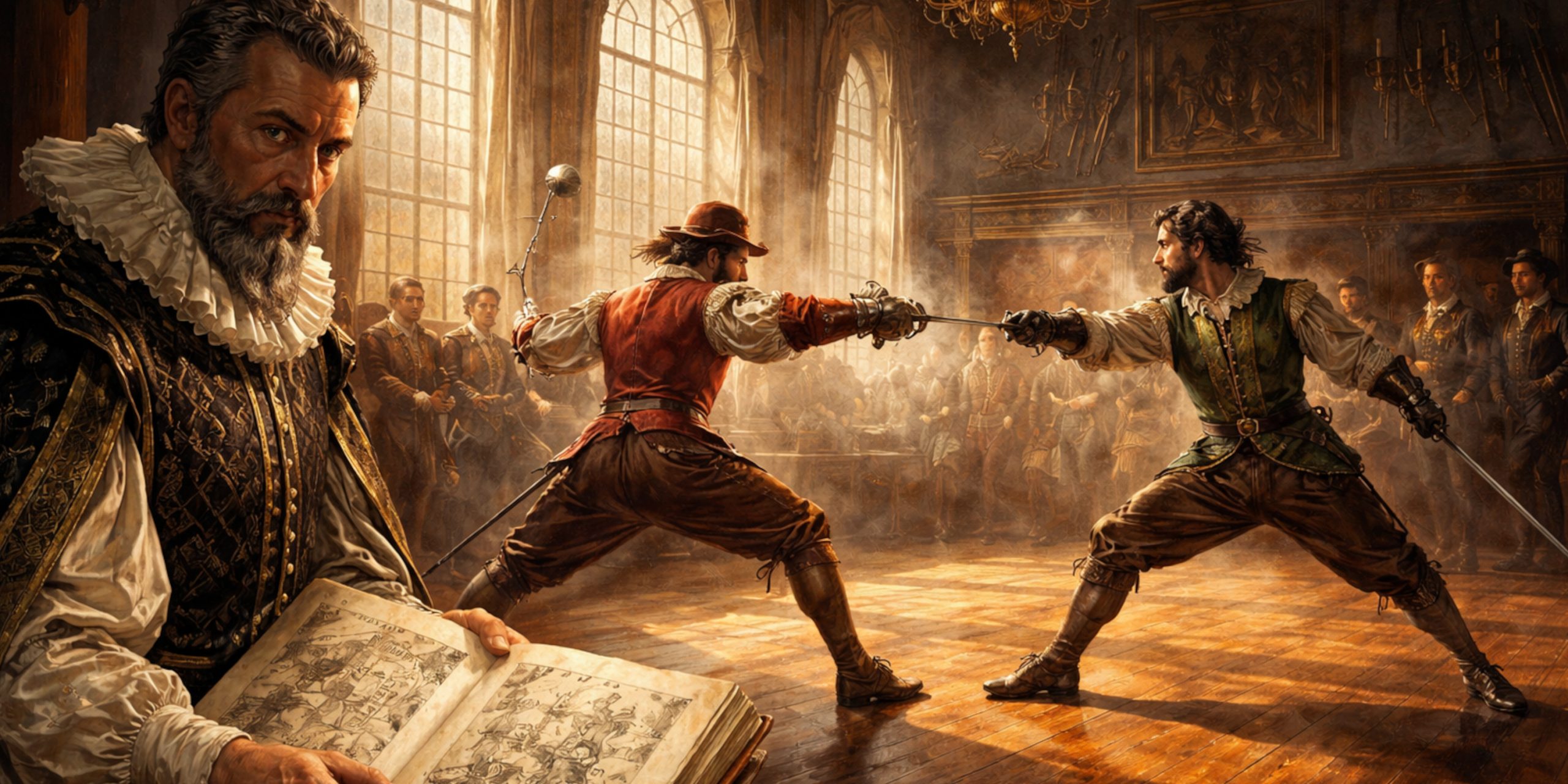
Ridolfo Capo Ferro stands among the small circle of fencing masters whose influence refuses to fade. He published little, taught quietly, and then left behind a book that refuses to shut up four centuries later. That book, printed in 1610, still argues with modern instructors and usually wins.
Capo Ferro worked at the hinge point between Renaissance bravado and early modern discipline. If medieval swordsmanship trusted courage and reach, Capo Ferro trusted geometry. He reduced violence to angles, timing, and distance, which is either deeply civilised or faintly unsettling depending on your mood.
Historical Context
Italy at the turn of the seventeenth century was a fencing laboratory. City states, universities, courts, and academies all needed men who could teach polite murder without scandal. The rapier had become a civilian weapon, worn daily and used often enough to make municipal authorities nervous.
Capo Ferro belonged to this professional world, not the tournament field or battlefield. His fencing assumes urban spaces, legal duels, and students who value survival over applause. Honour matters, but only if you live long enough to enjoy it.
Gran Simulacro dell’Arte e dell’Uso della Scherma
Capo Ferro’s reputation rests almost entirely on one work, Gran Simulacro dell’Arte e dell’Uso della Scherma. The title promises a grand system, and unusually for fencing manuals, it delivers.
The book contains clear prose and meticulously engraved plates. These illustrations are not decorative. They are diagrams of intent. Every stance, every extension of the arm, every lunge is frozen at the moment when physics takes sides.
Capo Ferro explains fencing as a science. Measure governs all actions. Tempo decides who lives. Line determines who bleeds. He writes with the confidence of someone who has tested every assertion with sharp steel.
Core Principles of Capo Ferro’s System
Capo Ferro’s fencing is built on restraint rather than flourish. He favours a narrow stance, a well extended sword arm, and a body positioned to minimise target area. He does not ask the fencer to be brave. He asks them to be correct.
The lunge is central, delivered with full commitment and precise timing. Attacks travel in straight lines, because straight lines reach the target sooner. Parries exist, but only as a means to restore control of the line before the riposte.
There is little interest in wide cuts or theatrical actions. Capo Ferro assumes the opponent is competent and dangerous. Any unnecessary movement is treated as a gift to the other man.
Weapons and Equipment
Capo Ferro’s system is designed for the rapier, typically long, narrow, and optimised for the thrust. He assumes the use of a dagger in the off hand, although the sword alone remains fully viable within his framework.
Protective equipment is minimal. The treatise presumes a real duel, not a salle exercise. This assumption explains the emphasis on first intention attacks and defensive positioning. When there are no second chances, you learn to treasure distance.
Comparison with Other Masters
Capo Ferro is often compared with Salvator Fabris, and the comparison is unavoidable. Fabris is more expansive, more athletic, and at times more demanding physically. Capo Ferro is quieter. He offers fewer options, but the ones he gives are brutally effective.
Where earlier Bolognese traditions favoured cuts and complex plays, Capo Ferro pares everything back. He is not interested in showing how much you know. He is interested in whether you are still standing.
Legacy and Influence
Capo Ferro’s ideas travelled far beyond Italy. His emphasis on measure and linear fencing fed directly into later Italian and French schools. Elements of his thinking can be traced through the development of the smallsword and into modern foil and épée.
Historical fencing practitioners return to Capo Ferro because his work remains readable and practical. It does not require heroic interpretation or charitable excuses. The system functions as written, which is a rare compliment in martial literature.
Personal Reflections from a Historian
Capo Ferro feels honest in a way that many masters do not. He never pretends fencing is beautiful or noble. It is efficient, necessary, and occasionally grim. There is no swagger in his prose, only confidence earned the hard way.
If I had to entrust my safety to one early modern fencing master, Capo Ferro would be a strong candidate. His system does not flatter the ego, and it does not care about reputation. It cares about geometry, timing, and the simple human desire to go home alive.
That may not be romantic, but it is persuasive.
Where to See and Study Capo Ferro Today
Original copies of Gran Simulacro survive in major European libraries, and high quality facsimiles are widely available. Museums rarely display his work directly, but his influence is visible wherever early modern rapiers are exhibited.
Modern historical fencing schools continue to study Capo Ferro closely, often using his plates as training tools. Four hundred years on, the lines still hold.
Watch this guide to Capo Ferro technique: