Few figures in medieval history cast a longer shadow than Osman I. His own life remains partly obscured by legend, yet the state he created would grow into one of the most powerful empires the world has ever seen. That contrast is fascinating. The man himself is elusive. The empire he founded transformed continents.
As a historian, I often find Osman particularly intriguing because he sits at the point where history and myth collide. The Ottoman Empire eventually ruled vast territories across Europe, Asia, and Africa, but its founder began as the leader of a relatively small frontier principality on the edge of a declining Byzantine world. The leap from one to the other feels almost improbable.
Yet that is exactly what happened.
Who Was Osman I?
Osman I, often called Osman Gazi, was born around 1258 and died in either 1323 or 1324. He was the son of Ertuğrul, a Turkic frontier leader who governed territory in north-western Anatolia.
The Ottoman dynasty takes its name directly from him. In Turkish, “Osmanlı” means “those of Osman.”
He ruled during a period of immense change. The Seljuk Sultanate of Rum was fragmenting under Mongol pressure, Byzantine authority in Anatolia was weakening, and numerous Turkish beyliks competed for power.
Osman emerged from this turbulent environment as one of several ambitious frontier rulers. Unlike most of his rivals, however, his dynasty survived.
The Historical Sources
One challenge when studying Osman is the scarcity of contemporary evidence.
Most Ottoman chronicles describing his life were written many decades after his death. These later writers often mixed historical events with dynastic propaganda and folklore.
Among the most famous stories is the Dream of Osman. According to later tradition, Osman dreamt of a moon rising from a holy man’s chest and entering his own body. From his navel grew an enormous tree whose branches covered the world.
The symbolism is not subtle.
The story was designed to present Ottoman rule as divinely ordained. Whether the dream occurred is impossible to determine, but its importance in Ottoman political culture cannot be overstated.
Modern historians generally treat such tales with caution while recognising their cultural significance.
The Frontier World That Shaped Osman
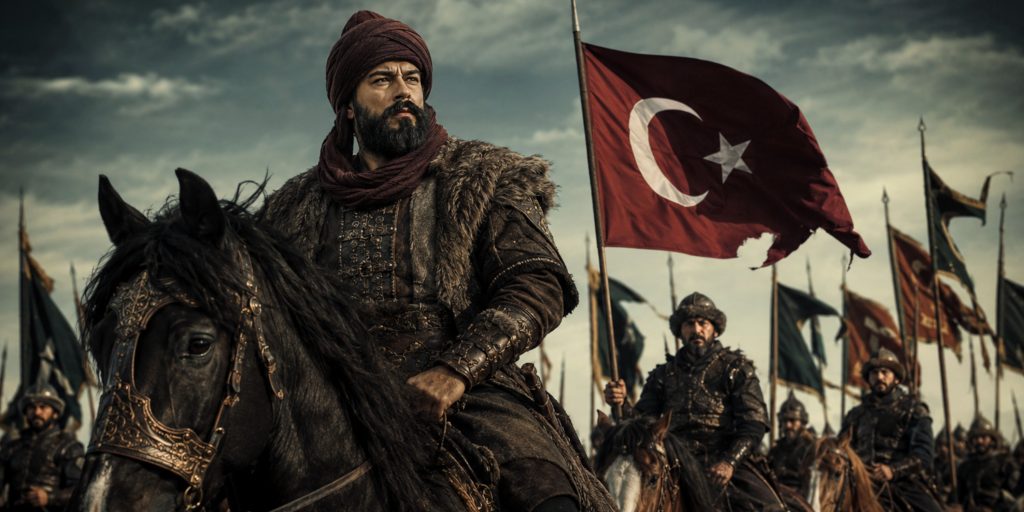
Osman’s rise occurred along the Byzantine frontier in Bithynia.
This borderland was unlike the stable kingdoms of western Europe. It was a place of raids, shifting alliances, religious diversity, and constant military activity.
Turkish warriors known as ghazis sought land, wealth, and prestige through warfare against neighbouring powers. Byzantine lords frequently fought one another as much as they fought external enemies.
In this environment, successful leadership depended on attracting followers.
Osman excelled at exactly that.
His reputation as a capable commander helped draw warriors, tribal groups, and adventurers into his orbit.
Osman I’s Rise to Power
Osman inherited leadership of his father’s domain around 1280.
Initially, his territory centred on Söğüt and nearby settlements in north-western Anatolia.
Over the following decades, he expanded steadily at Byzantine expense.
Rather than attempting dramatic conquests, Osman pursued a patient strategy. He targeted vulnerable fortresses, disrupted communication routes, and exploited Byzantine political divisions.
This gradual approach produced results.
By the early fourteenth century, his principality had become one of the most dynamic powers in the region.
Battles and Military Acumen
Osman was not remembered as a battlefield genius in the mould of Alexander or Napoleon. His strengths lay elsewhere.
He understood frontier warfare.
His campaigns combined mobility, persistence, and opportunism.
Battle of Bapheus (1302)
The most famous military engagement associated with Osman is the Battle of Bapheus.
A Byzantine army attempted to halt Ottoman expansion near Nicomedia.
Osman’s forces achieved a significant victory, demonstrating that the Ottomans had evolved beyond a collection of tribal raiders into a serious military power.
The battle had far-reaching consequences.
Many local Christian communities lost confidence in Byzantine protection, while Turkish settlers increasingly migrated into Ottoman-controlled territory.
Siege Warfare
Osman’s greatest successes often involved sieges rather than open battles.
Key objectives included:
- Karacahisar
- Bilecik
- Yarhisar
- Yenişehir
These settlements strengthened Ottoman control over regional trade routes and agricultural resources.
Strategic Strengths
Osman’s military leadership was characterised by:
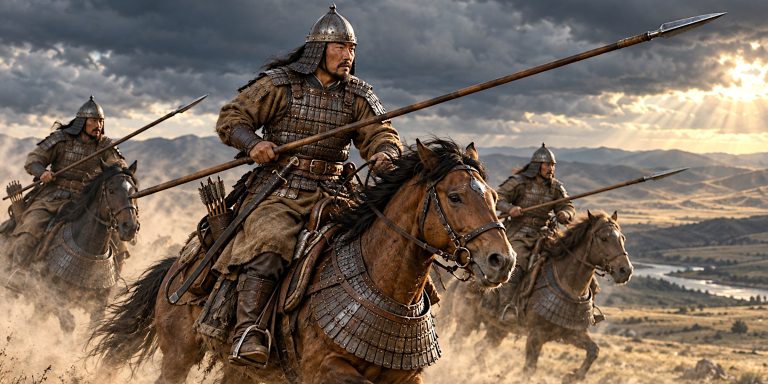
- Excellent use of light cavalry
- Flexible command structures
- Effective intelligence gathering
- Exploitation of enemy political divisions
- Gradual territorial consolidation
- Ability to attract loyal warriors
Perhaps his greatest achievement was organisational rather than tactical. He transformed a frontier warband into a durable political state.
That is often harder than winning a battle.
Arms and Armour of Osman’s Warriors
The armies led by Osman reflected the military traditions of Turkic steppe warfare while incorporating influences from neighbouring cultures.
Swords
Common sword types likely included:
- Early Turkic sabres
- Kilij predecessors
- Straight double-edged swords inherited from Seljuk traditions
These weapons prioritised speed and effectiveness from horseback.
Spears and Lances
The spear remained the principal battlefield weapon.
Mounted warriors relied heavily on lances during charges and raids.
Bows
The composite bow was arguably the most important weapon in Osman’s forces.
Constructed from wood, horn, and sinew, these bows delivered impressive power while remaining compact enough for mounted use.
Armour
Typical protection included:
- Lamellar armour
- Mail shirts
- Quilted textile armour
- Leather defences
- Iron helmets with nasal guards
Many frontier warriors probably possessed only partial armour due to cost.
Shields
Common shield forms included:
- Round wooden shields
- Leather-covered shields
- Light cavalry shields suitable for mounted combat
The emphasis remained mobility rather than heavy protection.
Administration and State Building
Military victories alone do not explain Osman’s success.
Many frontier rulers won battles. Most vanished within a generation.
Osman appears to have understood the importance of governance.
He distributed land among loyal followers, established administrative structures, and encouraged settlement in newly conquered territories.
Local populations often remained in place after conquest.
This pragmatic approach helped stabilise Ottoman rule and generated economic growth.
The foundations of later Ottoman administration can already be glimpsed during Osman’s reign.
Family and Succession
Osman married Malhun Hatun according to most accepted traditions, though sources remain debated.
His most important son was Orhan.
When Osman died, Orhan inherited a principality that was already expanding rapidly.
Under Orhan, the Ottomans captured Bursa and continued their advance into former Byzantine territories.
The transition was remarkably smooth by medieval standards.
This stability suggests that Osman successfully established dynastic legitimacy before his death.
Artefacts from Osman’s Reign
Authentic artefacts directly connected to Osman himself are exceptionally rare.
Nevertheless, visitors can explore material culture associated with the early Ottoman period.
Bursa
Bursa served as the first major Ottoman capital after its conquest by Orhan.
Museums in the city contain:
- Early Ottoman coins
- Military equipment
- Ceramics
- Architectural fragments
- Manuscripts from the formative Ottoman era
Söğüt
Söğüt remains closely associated with Osman and the dynasty’s origins.
Visitors can find:
- Ottoman commemorative monuments
- Traditional tribal heritage displays
- Artefacts linked to early Ottoman settlement
Istanbul Collections
Major museums preserve important early Ottoman material, including:
- Weapons
- Armour
- Coins
- Ceremonial objects
- Early administrative documents
Although most surviving items date from later reigns, they illuminate the culture that emerged from Osman’s frontier state.
Latest Archaeological Findings
Archaeology continues to reshape understanding of the early Ottomans.
Recent work has focused less on finding objects belonging directly to Osman and more on understanding the world in which he lived.
Frontier Settlements
Excavations across north-western Anatolia have revealed:
- Fortified settlements
- Byzantine defensive positions
- Early Ottoman occupation layers
- Agricultural infrastructure
These discoveries help reconstruct the environment of frontier warfare.
Karacahisar
Research at Karacahisar has provided evidence for occupation patterns associated with the earliest Ottoman expansion.
Finds include:
- Ceramics
- Coinage
- Structural remains
- Military features
Numismatic Evidence
Coins remain among the most important archaeological sources.
Early Ottoman coinage helps historians track:
- Political authority
- Economic development
- Territorial expansion
- Administrative sophistication
Each newly discovered coin can potentially refine our understanding of the dynasty’s earliest years.
Osman in Legend and Memory
For later Ottomans, Osman became more than a historical figure.
He represented the ideal founder.
Chronicles portrayed him as courageous, just, pious, and destined for greatness.
As the empire expanded, stories about Osman expanded with it.
Separating fact from legend can be frustrating. It can also be fascinating. The myths reveal how later generations wanted to understand their origins.
Sometimes the legend tells us almost as much as the man.
Legacy
Osman never ruled a vast empire.
He never saw Constantinople conquered.
He never commanded the immense armies associated with later Ottoman sultans.
Yet without Osman, none of those achievements would have occurred.
His real accomplishment was creating a political framework capable of surviving beyond his lifetime. Many frontier rulers built temporary realms. Osman founded a dynasty that endured for more than six centuries.
That alone places him among the most consequential figures of the medieval world.
When examining the origins of great empires, historians often search for dramatic turning points. In Osman’s case, the story is quieter. It is one of patience, persistence, and careful expansion.
Perhaps that is what makes it so remarkable.
The Ottoman Empire began not with a thunderclap, but with a frontier leader steadily building something that outlasted him by hundreds of years.