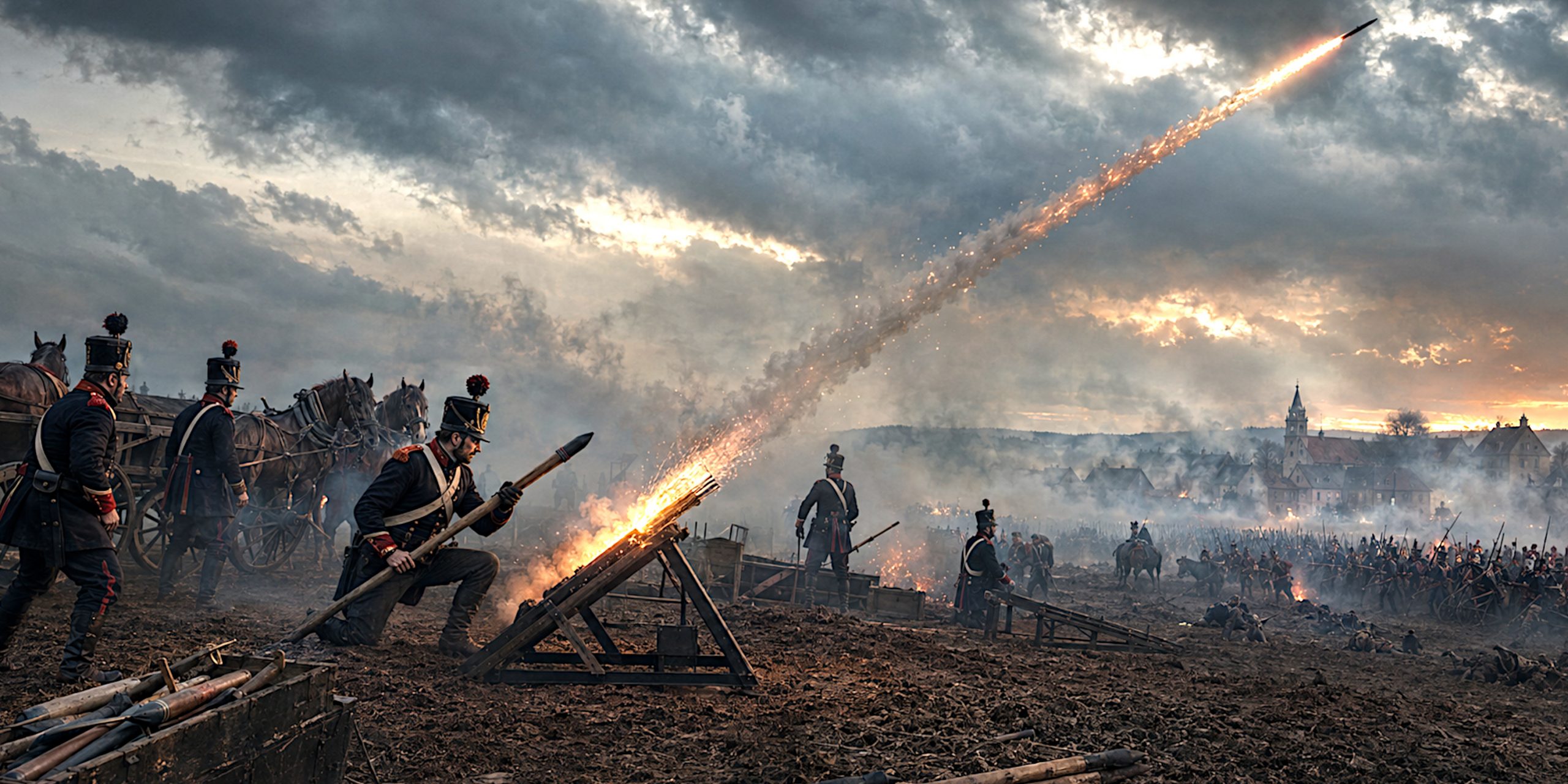
Napoleonic rocket troops occupied a place between artillerymen, cavalrymen and experimental technicians. Their Congreve rockets could cross broken ground without a gun carriage, shower a town with incendiaries and frighten horses half to death. They could also veer sideways, bury themselves harmlessly in mud or return towards the men who had fired them.
The weapon’s unpredictability has sometimes reduced rocket troops to a colourful footnote in Napoleonic history. That does them a disservice. They represented a serious attempt to create mobile rocket artillery, drawing heavily upon technology encountered by the British in India. At Leipzig in 1813, British rocketeers delivered a concentrated attack against French and Saxon troops. At Waterloo, the same weapon produced much smoke, considerable excitement and rather less military consequence.
Napoleonic rockets were neither useless curiosities nor the wonder weapons promoted by their inventor. Their real value lay somewhere between the two.
Napoleonic rocket troops at a glance
| Detail | Description |
|---|---|
| Principal weapon | Congreve iron-cased rocket |
| Primary British formation | Rocket Brigade, later the 1st and 2nd Rocket Troops, Royal Horse Artillery |
| Main period of service | 1805 to 1815 during the Napoleonic Wars |
| Important commanders | Sir William Congreve, Captain Richard Bogue, Captain Edward Charles Whinyates, Captain Thomas Lane |
| Typical rocket weights | 6, 12, 18, 24, 32 and 42 pounds |
| Specialist warheads | Explosive shell, incendiary carcass, case shot and solid shot |
| Launching methods | Troughs, frames, carts, boats and direct ground launch |
| Effective battlefield role | Harassment, incendiary bombardment, disruption and psychological shock |
| Main weakness | Serious inaccuracy, especially in wind or over uneven ground |
| Famous actions | Boulogne, Copenhagen, Göhrde, Leipzig, the Adour crossing, Toulouse and Waterloo |
| Uniform | Royal Horse Artillery dress, adapted for mounted and dismounted service |
| Sidearms | Royal Artillery gunner’s sword and officers’ sabres related to the 1796 Pattern light cavalry sword |
What were Napoleonic rocket troops?
Rocket troops were artillerymen trained to transport, prepare, aim and fire military rockets. Unlike conventional field artillery, they did not necessarily require heavy cannon barrels or substantial gun carriages. A rocket could be launched from a relatively light trough or frame, and some smaller examples could be fired directly along the ground.
Britain developed the best-known European rocket formations of the Napoleonic period. The Rocket Brigade of the Royal Horse Artillery was raised for active service in 1813 under Captain Richard Bogue. Separate detachments operated in Germany, the Iberian Peninsula, the Low Countries and North America.
The term “rocket troop” can be slightly misleading. These men were not infantry carrying something resembling a modern shoulder-fired missile. They belonged to the artillery and operated a complicated weapons system involving iron rocket bodies, long wooden stabilising sticks, fuses, launch frames, ammunition carts, horses and specialist tools.
Their work demanded nerve. Handling conventional black-powder ammunition was dangerous enough. Preparing a projectile which began spitting flame beside its operator and was known to depart in unexpected directions required a particular sort of professional composure.
Indian origins of the Congreve rocket
William Congreve did not invent military rocketry. Rockets had been used in Asia for centuries, while Indian armies developed particularly formidable iron-cased examples during the eighteenth century.
The forces of Hyder Ali and Tipu Sultan of Mysore deployed rockets against the British East India Company. Their use at battles such as Pollilur in 1780 demonstrated that iron rocket casings could withstand higher internal pressure than the traditional paper or soft-bodied forms used elsewhere.
The Mysorean rocket usually consisted of:
- A hammered iron tube containing black powder
- A sharpened or sword-like projectile in some versions
- A long bamboo guide stick
- A range reportedly reaching well beyond that of many earlier rockets
- Sufficient numbers to produce massed, disruptive fire
British troops captured hundreds of launchers, completed rockets and empty rocket cases when Seringapatam fell in 1799. Surviving Mysorean rockets are held by the Royal Artillery Museum collection and represent the clearest material link between Indian military engineering and the later British system.
Congreve studied the captured weapons at the Royal Arsenal, Woolwich. With access to British manufacturing facilities, he increased their size, experimented with warheads and created a more standardised family of rockets.
It is therefore more accurate to describe the Congreve rocket as a British industrial development of Indian military technology, rather than a wholly original European invention. The distinction matters. Imperial armies were perfectly capable of borrowing ideas from those they defeated, even if the official paperwork later became rather coy about the matter.
William Congreve and the development of the rocket system
William Congreve was the son of the Comptroller of the Royal Laboratory at Woolwich. Family connections gave him useful access, although he also spent his own money on early experiments.
His first trials took place during the opening years of the nineteenth century. By 1805 he was demonstrating military rockets at Woolwich, and by the following year he claimed that a 32-pound rocket could reach approximately 3,000 yards.
Congreve viewed the rocket as an entire weapons system rather than a single projectile. He developed different sizes, warheads, carriages and launching arrangements for land and naval service. He also produced extensive promotional writings comparing rockets favourably with conventional artillery.
His rockets were intended, in his own words, to provide stores “for the annoyance of the enemy”. This was a wonderfully restrained description of an iron tube filled with powder and designed to set fire to whatever unfortunate district it landed in.
Congreve’s position as both inventor and energetic salesman creates difficulties for historians. His technical writings contain valuable details, but his performance claims must be treated with care. Maximum range on a controlled test ground was not the same as effective range against a battalion on a windy European battlefield.
How a Congreve rocket worked
The Congreve rocket had an iron cylindrical body filled with a specially prepared black-powder propellant. Burning gases escaped through a vent at the rear, forcing the projectile forwards.
A long wooden stick was attached to the side of the early rocket body. This acted as a crude stabiliser. Later models experimented with central mounting, although the side-mounted stick remained common during the Napoleonic Wars.
The rocket could carry several different forms of payload.
| Warhead | Intended effect |
|---|---|
| Incendiary carcass | Set fire to buildings, ships, stores and defensive works |
| Explosive shell | Burst among troops or material |
| Case shot | Scatter small projectiles at relatively close range |
| Solid shot | Strike troops, horses or structures through impact |
| Illuminating charge | Provide battlefield or siege illumination |
| Signal rocket | Communicate or mark positions |
The iron body increased durability and internal pressure, but production tolerances were imperfect. Small variations in the powder, casing, vent or guide stick could alter the flight considerably.
A damaged stick might cause the rocket to tumble. Uneven powder combustion could pull it off course. Wind might carry it away from the aiming line. A rough launch surface could send a ground-fired rocket bouncing like an especially murderous hare.
Rocket specifications
Congreve produced several classifications rather than one standard battlefield rocket. Figures differ between surviving manuals, marks and experimental models, so measurements should be treated as representative rather than universal.
| Class | Common weights | Approximate stick length | Typical role |
|---|---|---|---|
| Light rocket | 6 to 18 pounds | 8 to 14 feet | Field use, case shot, shell and harassment |
| Medium rocket | 24 to 42 pounds | 15 to 20 feet | Bombardment, explosive and incendiary fire |
| Heavy rocket | 100 to 300 pounds | Up to 25 or 27 feet | Siege and naval bombardment |
| Waterloo field rocket | Commonly identified as 12-pounder | Long wooden guide stick | Mobile battlefield support |
The 100 and 300-pound rockets were impressive on paper but cumbersome in practice. A rocket requiring a guide stick roughly the height of a modest house had certain logistical disadvantages, even before someone tried carrying it through a hedge.
For field service, the lighter 6, 12 and 18-pound rockets were more manageable. Their range varied according to elevation, charge, weather and ammunition quality. Around 1,200 to 1,500 yards was a more credible effective field range for a 12-pound rocket than some of the more optimistic maximum figures.
Launchers, carts and battlefield equipment
Napoleonic rockets could be fired in several ways.
Launching troughs
A metal or wooden trough supported the rocket and guided its initial movement. Light troughs could be transported more easily than artillery pieces and placed on simple frames.
Ladder frames
Some rockets were launched from inclined frames resembling short ladders. Altering the angle changed the approximate range, although “approximate” did quite a lot of work in rocket service.
Rocket carts
Specialised carts carried ammunition, sticks, tools and launching equipment. The absence of a heavy gun barrel reduced the number of horses required, giving a rocket formation potentially greater mobility than an equivalent conventional battery.
Ground firing
Light rockets could be laid directly on the ground and fired at a low angle. This was particularly effective against cavalry or troops in relatively open terrain. The rocket might ricochet, skid or burst among horses and men.
Naval launchers
Ships and small boats carried rocket frames for attacking ports, shipping and coastal positions. Rockets were particularly suited to incendiary bombardment because naval crews could release large salvos without transporting siege guns ashore.
Organisation of the British Rocket Brigade
Experimental rocket personnel were training at Woolwich by 1811. Captain Richard Bogue, an experienced Royal Horse Artillery officer, took command of a detachment which developed into the Rocket Brigade.
In June 1813, the brigade was prepared for service with the Allied Army of the North in Germany. Its reported strength during the Leipzig campaign was approximately:
- 142 officers and men
- More than 100 horses
- Specialist ammunition and transport carts
- Rocket launch frames and ground-firing equipment
- Four accompanying women
- Two children
Families sometimes travelled with Napoleonic armies, although their presence seldom survives in heroic paintings.
Bogue’s formation became associated with what was later called the 2nd Rocket Troop, Royal Horse Artillery. Another detachment under Captain Thomas Lane served with Wellington’s army and became the 1st Rocket Troop.
Rocket troops were mounted or provided with sufficient transport to move rapidly alongside horse artillery. Their organisation nevertheless changed repeatedly as the Army tried to determine whether rockets were a revolutionary arm or merely an unusually elaborate way of missing the French.
Uniform and appearance
British rocket personnel wore Royal Horse Artillery uniform rather than a unique science-fiction costume dreamed up by the Ordnance Board.
Typical dress included:
- A dark blue jacket or dolman
- Red facings and trim
- Gold lace and decoration for officers
- Yellow lace for other ranks
- Dark blue or grey campaign trousers
- Riding boots or short boots depending upon duty
- A Tarleton-style helmet during the earlier period
- Later light dragoon-influenced headgear
- White belts and leather equipment
- Greatcoats for field service
- Sabretaches and sword belts for mounted officers
Campaign dress was less neat than parade illustrations suggest. Smoke, rain, churned soil and exhausted horses rapidly reduced the splendour of Royal Horse Artillery clothing. Rockets added sparks and soot to the usual mixture, which at least ensured that the men looked suitably experimental.
Arms and armour
Rocket troops were artillerymen first. Their rockets, fuses and launch equipment were their principal weapons, but they also carried personal arms for protection.
Royal Artillery gunner’s sword
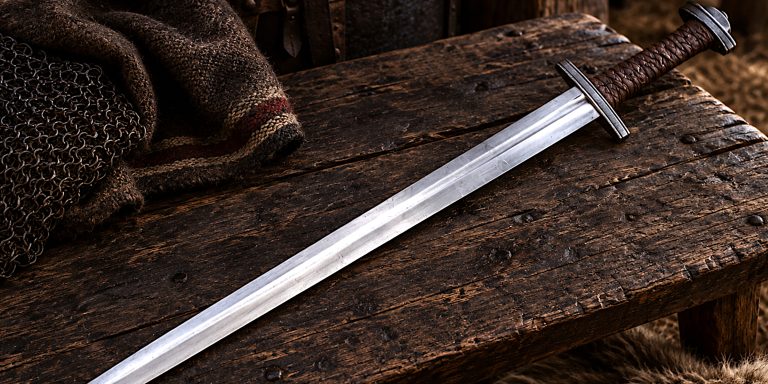
British rank-and-file artillerymen commonly carried a short, straight or only slightly curved gunner’s sword. Modern collectors sometimes refer to it loosely as an artillery hanger.
Its characteristics included:
- A blade of approximately 25 inches
- A cast brass hilt
- A short, robust design suitable for close defence
- A leather scabbard with brass fittings
- Sufficient weight for chopping ropes, brushwood and other materials around a battery
It has sometimes been described as a copy of the French sabre briquet, although the British weapon had its own combination of blade and hilt features.
The sword was preferable to a musket when artillerymen were working around horses, equipment and ammunition. Gunners could not easily serve launchers while burdened with full infantry equipment.
1796 Pattern light cavalry officer’s sword
Mounted Royal Horse Artillery officers often carried swords closely related to the 1796 Pattern light cavalry officer’s sabre.
This was a curved cutting sword featuring:
- A long, curved blade
- A stirrup-shaped guard
- A leather-covered grip
- A steel scabbard for field service
- Considerable variation in privately purchased officers’ examples
The 1796 Pattern was designed primarily for mounted cutting. It suited Royal Horse Artillery officers, who needed to ride between positions, direct detachments and defend themselves during cavalry attacks.
Pistols and carbines
Officers might carry privately purchased flintlock pistols. Some mounted personnel had access to carbines or other firearms, although the issue and use of personal firearms varied by formation and campaign.
Armour
Rocket troops wore no practical body armour. Their protection came from mobility, terrain, supporting troops and the hope that enemy cavalry would select a more inviting target.
Helmets offered limited protection against sword cuts, but they were not intended to resist musket balls or artillery fragments.
The first operational use at Boulogne
Congreve accompanied early attempts to use rockets against French shipping at Boulogne. An attack in 1805 achieved little, but a second operation in October 1806 was more destructive.
Boats fired large numbers of rockets into the harbour and town. Their inaccuracy mattered less against an extensive urban target than it would against a moving battalion. Once an incendiary rocket landed among roofs, timber or stores, its precise relationship with the original aiming point became rather academic.
Boulogne demonstrated the rocket’s most effective early role:
- Massed launch from boats
- Attack against a broad, combustible target
- Limited risk to the launching crews
- Psychological pressure combined with physical destruction
Copenhagen in 1807
Congreve rockets were used during the British bombardment of Copenhagen in September 1807. The operation aimed to compel Denmark to surrender its fleet before Napoleon could gain control of it.
Approximately 300 rockets were launched during the bombardment, alongside conventional shells and incendiary ammunition. Fires spread through the city, destroying civilian buildings as well as military targets.
Copenhagen established the Congreve rocket’s reputation, but it also exposed the moral and tactical problem at its heart. Inaccuracy became an advantage only when the intended target was sufficiently large and destruction across a wide area was acceptable.
The rockets contributed to terror and conflagration, yet they did not act alone. Conventional artillery carried much of the bombardment. Accounts crediting the destruction of Copenhagen entirely to rockets exaggerate their role.
Naval operations and the Walcheren Campaign
The Royal Navy adopted rockets more enthusiastically than the Army. Ships could transport large projectiles and their cumbersome sticks without forcing artillery horses to drag them across Europe.
Rockets appeared during:
- Operations against Boulogne
- The bombardment of Copenhagen
- The attack on the French fleet in the Basque Roads in 1809
- The Walcheren expedition
- Coastal raids and attacks on shipping
- The War of 1812 in North America
Their incendiary effect made them useful against wooden ships, dockyards and towns. Their smoke and visible flight also made them suitable for signals and illumination.
Lord Cochrane employed rockets during the attack in the Basque Roads, although fireships and conventional naval action were at least as important. As so often with the Congreve system, the rockets provided spectacle more reliably than decisive results.
The Battle of Göhrde
The Rocket Brigade entered land combat at the Battle of Göhrde on 18 September 1813. Allied forces defeated a French division operating in northern Germany.
The action provided Bogue’s men with their first serious battlefield trial. Early salvoes reportedly caused concern among nearby Allied troops, illustrating one of the system’s less advertised qualities. Rocket fire could alarm both sides with admirable impartiality.
Nevertheless, the brigade gained practical experience in:
- Rapid deployment
- Low-angle firing
- Ammunition handling under fire
- Cooperation with Allied cavalry and infantry
- Judging range without the familiar reference points used by gun batteries
This experience proved valuable at Leipzig a month later.
The Rocket Brigade at Leipzig
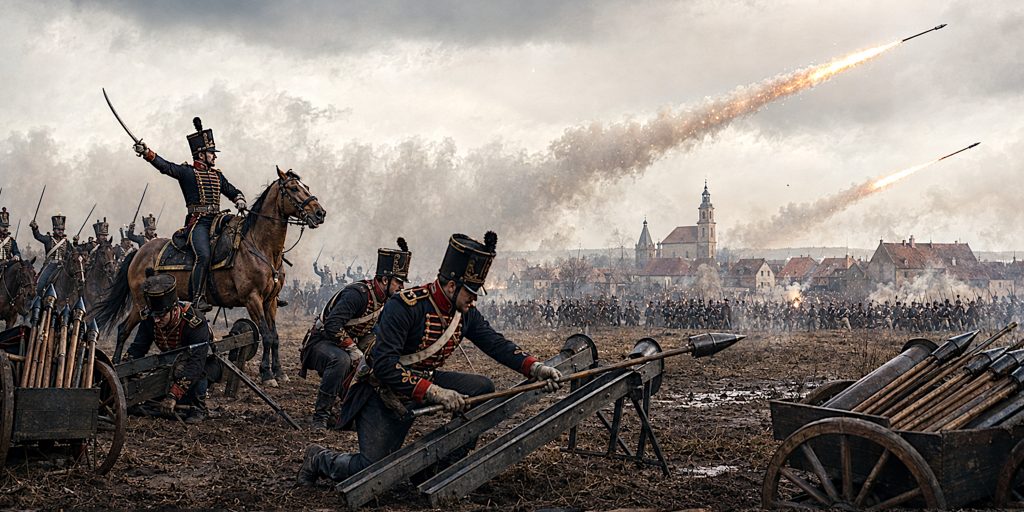
The Battle of Leipzig, fought from 16 to 19 October 1813, was the largest engagement of the Napoleonic Wars. Bogue’s Rocket Brigade was attached to the Allied Army of the North under the Crown Prince of Sweden.
On 18 October, Bogue requested permission to engage French and Saxon troops around Paunsdorf. Lieutenant John James, an aide-de-camp to Sir Charles Stewart, later described the attack:
“Captain Bogue lost no time in advancing to the village of Paunsdorf, then in possession of five of the enemy’s battalions, upon whom he opened, in advance of the whole army, a most destructive fire.”
James claimed that between 2,000 and 3,000 enemy troops eventually surrendered to a rocket formation numbering fewer than 200 men. That figure should not be taken as proof that rockets alone defeated five battalions. The wider Allied advance, the confused political position of Saxon troops and the presence of supporting cavalry all shaped the result.
Even so, the rockets appear to have caused genuine disruption. Their unfamiliar noise, smoke and erratic movement could be unnerving, particularly to horses and troops who had never encountered them.
Bogue then joined a cavalry charge. He was shot through the head and killed near Sellerhausen. His decision to lead mounted troops was gallant, though not an especially sustainable way to command specialist artillery.
The brigade suffered:
- Captain Richard Bogue and one other man killed
- Six men wounded
- Approximately 26 horses killed or wounded
Leipzig became the most celebrated action in the history of British Napoleonic rocket troops. The modern O Battery, Royal Horse Artillery, preserves the title “The Rocket Troop” and commemorates the battle.
Rocket troops in the Peninsular War
Wellington was deeply sceptical of Congreve’s invention. When offered a Rocket Brigade, he famously replied:
“The only reason why I wished to have it was to get the horses.”
He added:
“I do not want to set fire to any town, and I do not know any other use of the rockets.”
The remark neatly captures Wellington’s practical objection. His campaigns generally required controlled fire against troops and field positions. Congreve rockets were better suited to burning ports than supporting infantry at close quarters.
A rocket detachment under Captain Thomas Lane nevertheless joined the Peninsular Army. Rockets were used during the crossing of the River Adour in February 1814 and at the Battle of Toulouse in April.
At the Adour, their portability offered a real advantage. Launchers and ammunition could support operations across difficult terrain without requiring the same transport as heavy guns. Rockets also provided suppressive and distracting fire during a complicated river crossing.
Their Peninsular service showed that the weapon could be useful when matched to the right circumstances. It did not persuade Wellington that every battery should exchange its cannon for flying iron tubes.
Captain Whinyates and the Waterloo Campaign
Captain Edward Charles Whinyates commanded the 2nd Rocket Troop during the Waterloo campaign. Wellington remained doubtful about rockets and required the troop to bring five 6-pounder guns as well as approximately 800 rockets.
During the retreat from Quatre Bras on 17 June 1815, Captain Alexander Cavalié Mercer watched Whinyates fire a rocket along the road towards French artillery. Mercer described the projectile sputtering and wriggling before racing between the wheels of an enemy gun and exploding.
The success encouraged further firing. The later rockets proved less cooperative, swerving away from their targets and eventually prompting Wellington to order the practice stopped.
Mercer’s account illustrates the weapon perfectly. One rocket produced an astonishingly effective strike. The next refused to repeat the performance.
Rocket troops at Waterloo
Whinyates positioned his troop near the centre of Wellington’s line, in the area behind La Haye Sainte. The formation’s five 6-pounder guns performed conventional artillery service throughout the battle.
Only about 52 light rockets were fired, compared with approximately 560 rounds discharged by the troop’s guns. The rockets had little clearly documented effect on the outcome.
Several factors limited their employment:
- Wellington’s lack of confidence in the weapon
- Restricted fields of fire
- The danger of unpredictable flight near friendly troops
- Wet and muddy ground
- The reliability of the troop’s conventional guns
- The need to conserve ammunition and horses under heavy fire
The rockets may have disturbed French cavalry and skirmishers, but there is no firm evidence that they broke a major attack. Their presence at Waterloo has given them lasting fame, although the troop’s ordinary artillery work was far more important.
How rocket troops fought
A rocket detachment had to select a position with sufficient open ground behind and in front of the launcher. Long guide sticks made firing in woods, narrow streets and dense formations difficult.
A typical sequence involved:
- Unloading the rocket body and matching guide stick
- Attaching and checking the stick
- Selecting the warhead and fuse
- Setting the launching trough or frame
- Estimating range through elevation
- Aligning the launcher towards the target
- Igniting the fuse from the side or rear
- Taking cover from sparks, blast and unexpected movement
- Observing the fall and adjusting subsequent launches
Rockets were often fired in salvos because individual accuracy was poor. Concentrated fire increased the chance of striking a target and magnified the psychological effect.
The crew then had to relocate, reload or prepare another salvo. Mobility was essential because rocket smoke revealed the firing position almost immediately.
Advantages of Napoleonic rockets
Mobility
A rocket did not require a heavy bronze or iron gun barrel. Launching frames and ammunition could be carried on relatively light vehicles or pack animals.
Rapid concentration of fire
Several rockets could be launched in quick succession. A concentrated salvo created noise, flame, smoke and multiple points of impact.
Incendiary power
Rockets were particularly dangerous against:
- Wooden buildings
- Ships and boats
- Ammunition stores
- Dry vegetation
- Siege works
- Densely constructed towns
Psychological effect
The fiery trail, hissing flight and uncertain direction could frighten troops and horses. Unfamiliarity increased the effect.
Difficult terrain
Rocket detachments could operate where moving conventional guns was difficult, particularly during river crossings, coastal operations and raids.
Reduced recoil
A rocket launcher did not absorb the heavy recoil of a cannon. This allowed lighter equipment and improvised firing positions.
Disadvantages of Napoleonic rockets
Poor accuracy
The principal weakness was dispersion. Rockets might veer sideways, climb unexpectedly or fall short.
Weather sensitivity
Wind affected both the rocket body and its long stabilising stick. Damp conditions could interfere with fuses and powder.
Dangerous backblast
Flame and sparks made careless handling hazardous. Dry ground, ammunition and clothing could catch fire.
Awkward ammunition
The long sticks were fragile and cumbersome. Bent or damaged examples degraded accuracy further.
Limited precision
Rockets were poorly suited to firing close to friendly troops. Conventional guns could engage a known point with greater confidence.
Inconsistent battlefield damage
A rocket warhead might cause severe casualties if it struck a formation, but many missed entirely. Psychological effect was easier to claim than physical destruction.
Vulnerability of the crew
Rocket smoke revealed the launch site. Crews could be attacked by cavalry, skirmishers or counter-battery fire.
Rockets compared with conventional artillery
| Feature | Congreve rocket | Field gun | Howitzer |
|---|---|---|---|
| Transport weight | Relatively low | High | Moderate to high |
| Accuracy | Poor | Good by period standards | Moderate |
| Rate of launch | Potentially rapid | Slower, disciplined loading cycle | Slower |
| Incendiary ability | Strong | Limited with specialist ammunition | Strong with shells |
| Psychological effect | Very high | High | High |
| Suitability near friendly troops | Poor | Better | Moderate |
| Performance on rough ground | Useful if launch space available | Restricted by carriage movement | Restricted |
| Ammunition consistency | Variable | Generally more predictable | Generally more predictable |
| Siege value | Useful for starting fires | Strong against structures | Strong for plunging fire |
| Battlefield reliability | Uneven | Proven | Proven |
Congreve repeatedly argued that rockets could supplement or replace artillery. In practice they worked best as a specialist addition to guns, not a substitute for them.
Whinyates’s troop at Waterloo provides the clearest verdict. The formation arrived with both weapons. When the battle became serious, its cannon did most of the work.
Were Napoleonic rockets effective?
The answer depends upon the target.
Against a town, harbour or group of wooden vessels, rockets could be dangerous. A miss might still start a fire somewhere useful. Against a battalion in open country, their lack of precision made results uncertain.
They were most effective when:
- Fired in large numbers
- Used against broad targets
- Carrying incendiary warheads
- Employed at relatively close range
- Launched over open ground
- Directed against troops or horses unfamiliar with them
- Combined with artillery, cavalry or infantry pressure
They were least effective when:
- Expected to strike a precise target
- Fired near friendly formations
- Used in strong wind
- Launched through woodland or confined terrain
- Employed in small numbers
- Treated as replacements for disciplined gun batteries
The weapon’s psychological effect was real, but it is difficult to quantify. Historical accounts regularly describe fear and confusion, yet such descriptions were also useful to officers promoting the system.
Other nations and rocket development
Britain was the principal European user of organised rocket troops during the Napoleonic Wars. The weapon’s performance attracted international attention, and Congreve systems were copied or purchased by several states.
Austria developed a rocket corps during the years after the Napoleonic conflicts, eventually establishing light and heavy rocket batteries. Denmark, Prussia, the Netherlands, Spain and other European powers also experimented with Congreve-inspired weapons.
Russian officer Alexander Zasyadko began systematic rocket development around 1815. His work produced dedicated Russian military rockets and eventually contributed to the establishment of permanent rocket formations, although their first major operational employment came after the fall of Napoleon.
France examined captured and experimental rockets but did not field a comparable operational corps during Napoleon’s principal campaigns. French artillery was already highly developed, and the rocket’s poor accuracy offered little advantage over the Emperor’s well-served guns.
The British lead was therefore brief. Once other states acquired the technology, the Congreve system became part of a wider nineteenth-century European interest in rocket artillery.
Archaeology and surviving evidence
Rocket archaeology is difficult because the projectiles were made from relatively thin iron and were often destroyed, fragmented or heavily corroded on impact. Wooden guide sticks rarely survive in the ground.
Material evidence includes:
- Captured Mysorean rockets from Seringapatam
- Surviving Congreve rocket bodies
- Launching frames and troughs
- Technical drawings and ammunition manuals
- Iron fragments recovered from bombardment sites
- Battlefield finds associated with rocket positions
- Museum reproductions based on surviving examples
Seringapatam
The captured Mysorean material is central to understanding the weapon’s development. Hundreds of completed rockets and thousands of empty cases were reportedly discovered after the fortress fell in 1799.
Surviving examples show that Mysorean rocketry was an established military system rather than an exotic curiosity. The iron cases provide direct evidence for the technological principle adopted at Woolwich.
Copenhagen
The urban archaeology of the 1807 bombardment is complicated by conventional shells, later rebuilding and subsequent destruction. Burn layers and damaged buildings demonstrate the scale of the bombardment, but attributing a particular fire or fragment solely to a Congreve rocket can be difficult.
Leipzig
Rocket bodies and reproductions associated with the Leipzig campaign are held in German collections. Battlefield archaeology around Paunsdorf must contend with enormous quantities of musket balls, artillery fragments and later disturbance. A tubular iron fragment is not automatically a rocket, however much an auction description might wish it to be.
Waterloo
The Waterloo battlefield has produced vast numbers of military artefacts, but confirmed rocket remains are scarce. This is unsurprising. Only a limited number were fired, while thin iron casings corroded readily in Belgian soil.
Museum collections
Relevant material can be found or researched through:
- The Royal Artillery Museum collection
- The Royal Engineers Museum at Chatham
- The National Army Museum
- The Royal Armouries
- The National Air and Space Museum in Washington
- Fort McHenry National Monument and Historic Shrine
- German collections connected with Leipzig and Wittenberg
- The National Space Centre in Leicester
The National Air and Space Museum preserves a rare 100-pound Congreve rocket, while the National Space Centre explains the construction of the iron case, powder charge and guide pole.
Myths and misconceptions
Congreve invented the military rocket
He did not. His work built directly upon Indian rocket technology captured during the wars against Mysore.
Rockets were more accurate than artillery
They were generally far less accurate. Their advantages lay in portability, incendiary power and massed psychological effect.
Rockets won the Battle of Leipzig
Bogue’s brigade performed effectively around Paunsdorf, but Leipzig was decided by the operations of several vast Allied armies. The rockets formed one small part of the battle.
Wellington banned rockets at Waterloo
He permitted them but restricted their use. Whinyates’s formation carried both rockets and conventional guns.
The rocket stick was a fuse
The stick stabilised the projectile. The fuse and propellant system were housed around the rocket body and warhead.
Every Congreve rocket exploded
Some carried incendiary compositions, solid shot or case shot. Others failed, buried themselves or flew somewhere entirely unhelpful.
Contemporary opinions
Napoleonic observers rarely agreed about rockets.
Wellington saw them primarily as incendiary weapons and distrusted their battlefield precision:
“I do not want to set fire to any town, and I do not know any other use of the rockets.”
Captain Mercer’s account of the retreat from Quatre Bras captured their unpredictable nature. One rocket travelled directly towards a French gun and burst between its wheels, scattering the crew. Subsequent rounds wandered away from the target.
Lieutenant John James offered a far more enthusiastic judgement of the attack at Leipzig:
“The enemy, unable to withstand the very well directed fire of Captain Bogue’s brigade, fell into confusion and began to retreat.”
These accounts need not contradict one another. Rockets could produce an extraordinary success on one occasion and an embarrassing failure a few minutes later. That inconsistency was the system’s defining characteristic.
Legacy of the Napoleonic rocket troops
Congreve rockets did not replace cannon, but they established rocket artillery as a recognised branch of military technology.
Their influence can be traced through:
- European rocket corps of the nineteenth century
- Russian military rocket development
- Ship and coastal rescue rockets
- Signal and illumination systems
- William Hale’s later spin-stabilised rocket
- Modern multiple-launch rocket artillery
- The institutional history of the Royal Horse Artillery
The phrase “the rockets’ red glare” in the American national anthem came from the British bombardment of Fort McHenry in 1814. This has given the Congreve rocket a cultural afterlife far greater than its tactical record might otherwise have earned.
O Battery, Royal Horse Artillery, continues to bear the title “The Rocket Troop”. Its lineage preserves the memory of Bogue’s experimental brigade and its costly success at Leipzig.
There is also a broader legacy. The Congreve system demonstrates how military technology crosses cultures. Indian iron rockets were captured, studied, industrialised and presented to Europe as a British innovation. The resulting weapon then spread across European armies and inspired further development.
Final assessment
Napoleonic rocket troops were neither fraudulent showmen nor prophets of modern warfare. They were trained artillery specialists operating a temperamental but sometimes formidable weapon.
The Congreve rocket worked best against large, combustible targets or troops vulnerable to confusion. Its portability gave it genuine value during naval operations, raids and difficult crossings. Its inaccuracy prevented it from challenging conventional field artillery.
At Leipzig, rockets contributed to a successful attack and earned the brigade a lasting reputation. At Waterloo, conventional guns proved far more useful. Both episodes belong in the assessment.
I find the rocketeers compelling because their experience feels unusually modern. They were handed a heavily promoted new technology, sent into battle to discover what it could really do, and expected to remain cheerful when its performance differed from the brochure. Military procurement has changed in many ways since 1813. In others, continuity is remarkably strong.