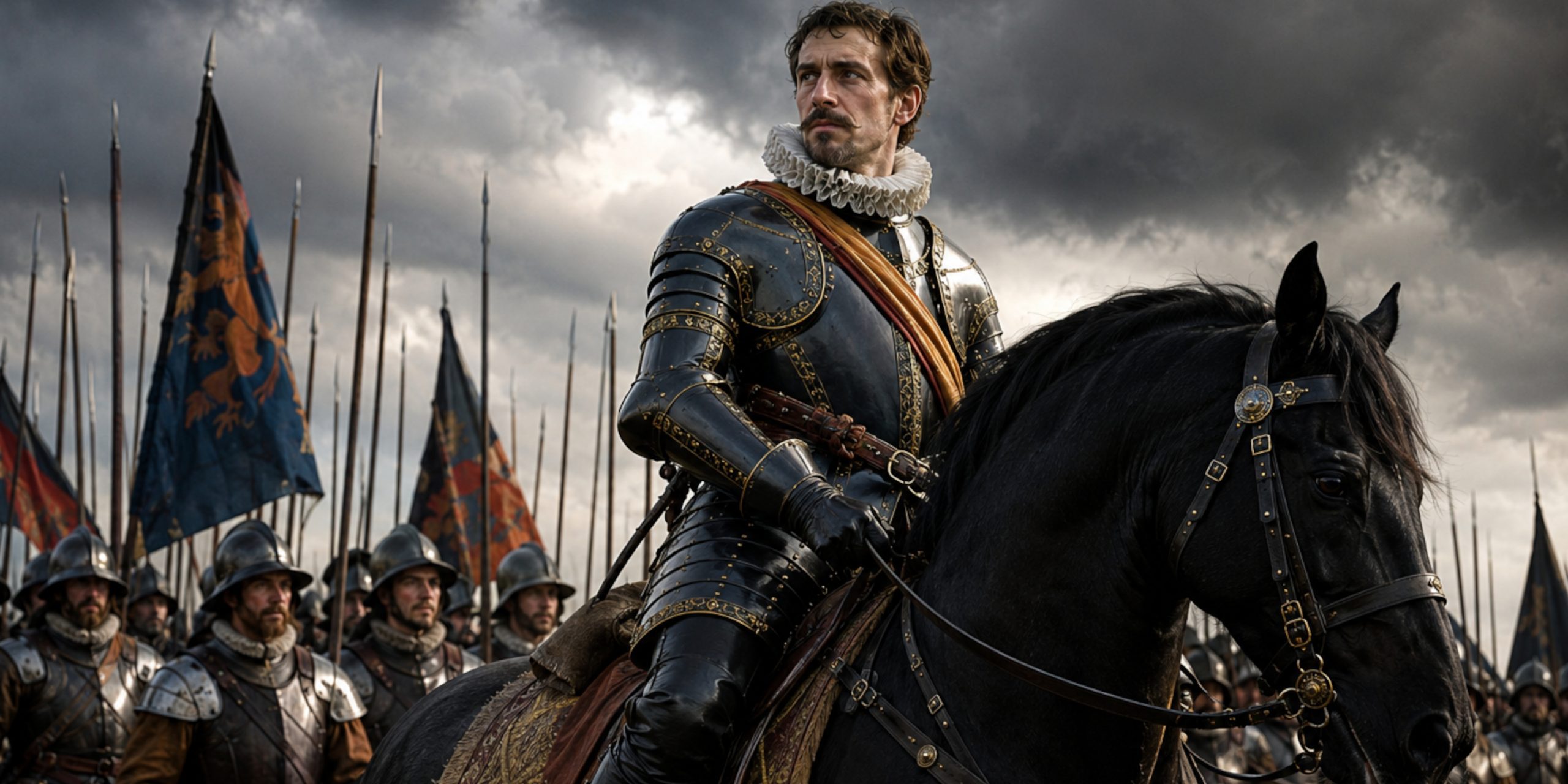
Maurice of Nassau (1567–1625), Prince of Orange from 1618, was not the most flamboyant commander of the early modern age. He lacked the romantic image of a sword-swinging conqueror charging through smoke and steel. His battlefield was often a place of geometry, discipline, engineering and patience.
That is exactly why he mattered.
During the Dutch struggle against Spanish rule, Maurice helped transform warfare from the medieval traditions of noble cavalry and loose formations into the organised, drilled armies of the seventeenth century. He studied classical writers, embraced mathematics, improved siegecraft and created a military system that influenced commanders across Europe.
If some generals are remembered for one glorious charge, Maurice is remembered for making sure his soldiers knew exactly what to do before anyone charged at all.
Early Life And The Dutch Revolt
Maurice was born on 14 November 1567 at Dillenburg Castle, the son of William the Silent and Anna of Saxony. His childhood was shaped by the growing rebellion of the Dutch provinces against Spanish Habsburg authority.
After the assassination of his father in 1584, Maurice inherited a dangerous political and military situation. The Dutch Republic was young, divided and facing one of the most powerful empires in the world.
He became stadtholder of several provinces and captain-general of the Dutch army. Despite his youth, he quickly showed a talent not only for command but for organisation. Maurice understood that defeating Spain required more than bravery. It required a professional military machine.
Military Reforms: The Making Of The Modern Army
Maurice’s greatest achievement was the reform of the Dutch army. Working closely with his cousin William Louis of Nassau, he studied ancient Roman military practices and adapted them for gunpowder warfare.
His reforms included:
- Regular and standardised drill
- Smaller, more flexible infantry formations
- Improved battlefield communication
- More effective use of firearms
- Professional training rather than relying purely on battlefield experience
- Detailed siege engineering and logistics
One of his most important developments was the refinement of volley fire. Musketeers were organised so ranks could fire and reload in sequence, maintaining pressure rather than delivering one chaotic opening blast.
The idea seems obvious today, but so does washing your hands before surgery. Someone still had to prove it worked.
Battles And Military Acumen
Maurice was a cautious commander, sometimes criticised for avoiding unnecessary risks. Yet this caution was part of his strength. He understood that the Dutch Republic could not afford reckless defeats against Spain.
His campaigns focused heavily on strategic gains, fortified towns and controlling territory.
Key Battles And Campaigns
| Battle / Campaign | Year | Opponent | Result | Significance |
|---|---|---|---|---|
| Capture of Breda | 1590 | Spanish garrison | Dutch victory | Famous operation using soldiers hidden in a peat boat |
| Siege of Zutphen | 1591 | Spanish forces | Dutch victory | Demonstrated Maurice’s improved siege methods |
| Capture of Deventer | 1591 | Spanish forces | Dutch victory | Strengthened Dutch control in the east |
| Siege of Groningen | 1594 | Spanish forces | Dutch victory | Secured northern Dutch territories |
| Battle of Turnhout | 1597 | Spanish army | Dutch victory | Showed effectiveness of disciplined cavalry and infantry |
| Battle of Nieuwpoort | 1600 | Spanish Army of Flanders | Dutch victory | Maurice’s greatest field battle victory |
| Siege of Groenlo | 1606 | Spanish forces under Spinola | Spanish success | Highlighted the challenge posed by an equally talented opponent |
Battle Of Nieuwpoort: Maurice’s Defining Victory
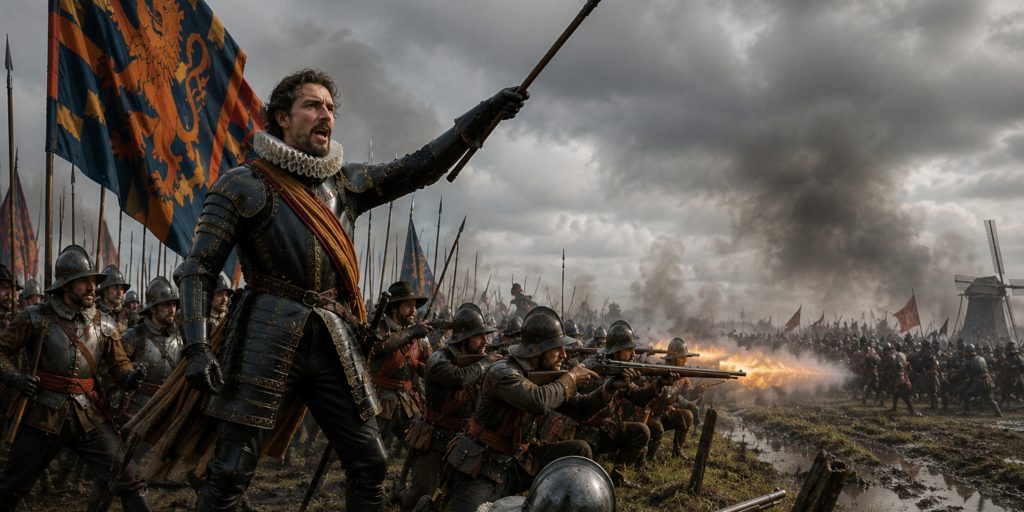
The Battle of Nieuwpoort in 1600 remains Maurice’s most famous battlefield success.
The Dutch army was placed in a dangerous position on the Flemish coast when Spanish forces under Archduke Albert moved against them. Maurice reorganised his army under pressure and used disciplined formations to absorb and counter Spanish attacks.
His troops included:
- Dutch infantry trained in new tactical systems
- English and Scottish soldiers fighting alongside the Republic
- Cavalry using firearms and controlled charges
- Artillery positioned for battlefield support
The victory was impressive because Maurice defeated the feared Spanish Army of Flanders, regarded as one of Europe’s finest military forces.
However, strategically the campaign achieved less than hoped. The Dutch won the battle but failed to secure the wider objectives in Flanders.
Arms And Armour
Maurice lived during a period when European warfare was rapidly changing. The knightly battlefield was fading, but armour and swords had not disappeared.
Infantry Weapons
| Weapon | Use |
| Matchlock musket | Increasingly important firearm used by drilled infantry |
| Caliver | Lighter firearm common among Dutch troops |
| Pike | Protected musketeers and formed defensive infantry blocks |
| Halberd | Used mainly by officers and guards |
| Rapier | Civilian and officer sidearm |
| Katzbalger-style short swords | Still seen among some infantry traditions |
| Early basket-hilt swords | Growing popularity among northern European soldiers |
Cavalry Weapons
Dutch cavalry under Maurice moved away from older heavy lancer traditions.
Typical equipment included:
- Wheel-lock pistols
- Cavalry swords
- Close helmets or burgonets
- Breastplates and backplates
- Buff coats
The cuirassier represented the changing age, still armoured like a knight but increasingly dependent on firearms.
Armour During Maurice’s Era
By the late sixteenth and early seventeenth centuries, full plate armour was becoming less practical. Firearms had changed the equation.
Common armour included:
- Morion helmets
- Burgonet helmets
- Steel cuirasses
- Tassets protecting the thighs
- Gorgets protecting the throat
- Officer-quality decorated armour
Maurice himself is often portrayed in elaborate armour, partly practical and partly symbolic. A commander needed protection, but portraits also had a message: leadership, status and legitimacy.
Early modern rulers understood branding long before anyone invented the word.
Political Rivalries And Later Years
Maurice’s military success did not prevent political conflict.
His relationship with Johan van Oldenbarnevelt, one of the Dutch Republic’s most important statesmen, collapsed during disputes involving religion, military authority and the future direction of the state.
The conflict ended with Oldenbarnevelt’s execution in 1619, a controversial moment that has remained one of the darker aspects of Maurice’s reputation.
His later campaigns against the Spanish commander Ambrogio Spinola were less successful. Spinola was intelligent, patient and skilled in siege warfare. Against such an opponent, Maurice’s advantages narrowed.
Maurice died in The Hague on 23 April 1625.
Contemporary Quotes
The reputation of Maurice spread across Europe, particularly among military thinkers.
Justus Lipsius, whose writings influenced Maurice’s reforms, argued:
“Discipline is the soul of an army.”
The English soldier and writer Sir Roger Williams recognised the growing importance of organised infantry warfare:
“The strength of battles consisteth chiefly in footmen.”
Dutch chroniclers praised Maurice’s ability to restore order and effectiveness to the Republic’s armies, presenting him as a commander who won through preparation rather than impulse.
Artefacts From Maurice Of Nassau’s Reign: Where To See Them
Several museums preserve objects connected to Maurice’s era and the Dutch Golden Age.
Rijksmuseum, Amsterdam
Collections include:
- Dutch armour from the sixteenth and seventeenth centuries
- Weapons from the Eighty Years’ War
- Portraits of Maurice and contemporary commanders
- Firearms and military equipment from the Dutch Republic
Royal Armouries, Leeds
Relevant collections include:
- Early modern European armour
- Wheel-lock firearms
- Swords and cavalry equipment similar to those used during Maurice’s lifetime
Dutch Military Museum, Soesterberg
Displays include:
- Dutch military development
- Weapons from the Republic period
- Material connected to the evolution of professional armies
Mauritshuis, The Hague
Although best known for paintings, it provides valuable context for the political and cultural world that emerged from the Dutch struggle for independence.
Archaeology And Recent Research
Modern study of Maurice’s campaigns often focuses less on lost treasure and more on battlefield archaeology, fortifications and military landscapes.
Important areas of research include:
- Excavations of Dutch defensive works from the Eighty Years’ War
- Analysis of siege lines and earthworks
- Study of musket balls and artillery remains
- Preservation of star forts influenced by Dutch military engineering
The remains of early modern fortifications show how much warfare changed during Maurice’s lifetime. Castles built for medieval sieges gave way to angled bastions designed to resist cannon fire.
Legacy: Why Maurice Of Nassau Still Matters
Maurice of Nassau was not a conqueror like Alexander or Napoleon. His influence was quieter but extremely important.
His reforms helped create the professional European army:
- Soldiers became systematically trained
- Officers relied increasingly on science and mathematics
- Siegecraft became a specialised discipline
- Infantry tactics became more controlled and flexible
Later commanders, including Gustavus Adolphus of Sweden, developed ideas that Maurice helped establish.
His career also shows the limits of military genius. Organisation and discipline could win battles, but politics, economics and equally skilled opponents still mattered.
Maurice did not simply fight wars. He changed how wars were fought.