Chinese sword history makes more sense when followed through time. The bronze blades of the Eastern Zhou, the straight steel swords of the Han, the military sabres of the Qing and the weapons of modern martial arts belong to a connected history, but they were not all designed to solve the same problem.
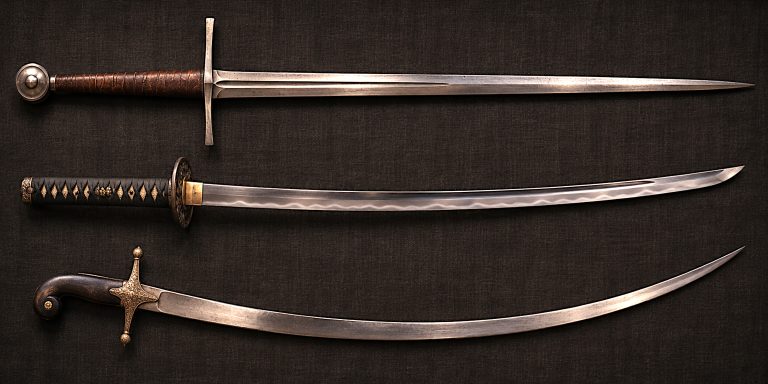
The two broad families are jian, usually straight and double-edged, and dao, single-edged blades that may be straight or curved. Within them sit changing forms, regional traditions and names whose meanings shifted over the centuries.
What I find most revealing is the persistence of older designs alongside new ones. Chinese armouries did not empty themselves whenever a new emperor arrived. A change of dynasty was disruptive enough without everyone having to order another sword.
Understanding Chinese Sword Names
A useful distinction is between a weapon’s blade form, its period and its use. Liuyedao describes a willow-leaf blade profile. Han jian identifies a sword through its historical context. Peidao describes a sword worn at the waist. These labels answer different questions and can overlap.
The examples below therefore include established types, broader historical forms and individual surviving swords. Where a name describes decoration, a training practice or a polearm rather than a separate sword type, that distinction is made clear.
Early Bronze Swords: Zhou and the Warring States, c. 1000–221 BCE

The early story centres on bronze jian. During the Eastern Zhou, 770–256 BCE, the straight, double-edged sword developed into an increasingly substantial weapon. Surviving examples show considerable variation in length, hilt design and decoration.
Bronze was cast rather than forged like a later steel blade. Making a useful sword required control of both the alloy and the blade’s structure. It is misleading to describe every early example as a ritual object simply because some are beautifully decorated.
Important Examples
| Example or form | What makes it significant |
|---|---|
| Short bronze jian | Compact, double-edged swords illustrating the earlier bronze tradition |
| Longer Warring States jian | More extended blades within the developing straight-sword family |
| Sword of Goujian | A celebrated inscribed bronze sword associated with the king of Yue |
| Disc-pommel bronze jian | A recognisable hilt arrangement preserved in excavated examples |

The Sword of Goujian, held by Hubei Provincial Museum, is especially valuable because its inscription associates it with a named ruler. It is an individual weapon, not a separate sword type called “Goujian”.
For a less famous comparison, the Metropolitan Museum holds a fifth- to fourth-century BCE bronze sword measuring 46.7 cm overall. Its original form included an integral disc-shaped pommel. Such objects help keep the discussion grounded in actual proportions rather than legends about exceptional blades.
Qin and Han Swords: Bronze, Steel and the Rise of the Dao, 221 BCE–220 CE
The Qin empire and its Han successors belong to a period of overlapping materials and changing military preferences. Bronze swords did not vanish at the first appearance of iron or steel.
A Qin bronze sword listed by the Western Australian Museum measures 90.2 cm, a useful reminder that ancient bronze swords were not invariably short. Alongside this continuing tradition, steel blades became increasingly important.
Important Types and Forms

| Example or form | Main characteristics |
|---|---|
| Qin bronze long sword | Long, straight, double-edged bronze blade |
| Han bronze jian | Continuation of bronze sword manufacture into the Han period |
| Han steel jian | Straight, double-edged steel sword, with varied proportions |
| Ring-pommel dao | Single-edged sword with a ring at the end of the grip |
| Straight-backed dao, or zhibeidao | Broad descriptive category for straight single-edged blades |
The ring-pommel dao is particularly important to the growing military role of single-edged swords. It should not be illustrated automatically as a later curved sabre.
The surviving text Evaluating Swords gives us something better than a general claim that Han smiths were skilled. Preserved on wooden strips from a frontier site, it discusses assessing blade quality. Other material from the same pit carries dates between 9 BCE and 21 CE.
I rather like finding practical judgement behind the prestige. Someone still had to decide whether the expensive sword was actually any good.
From the Six Dynasties to the Tang: Straight Blades and Wider Connections, 220–907 CE

Political fragmentation did not interrupt the movement of weapons, craftspeople and ideas. By the Sui and Tang periods, straight single-edged swords remained an important part of the story.
The temptation is to fill this section with every long sabre familiar from later Chinese warfare. That produces a more crowded list, but a less reliable history. The sixteenth-century military context of the changdao should not simply be moved back to the Tang.
Important Examples and Forms
| Example or form | Historical context |
|---|---|
| Straight single-edged dao | Continuation and development of the earlier military sword tradition |
| Zhibeidao | A useful description of straight-backed blades, rather than one uniform model |
| Sui sword with dragon ring pommel | An elaborate surviving example dated to around 600 CE |
| Straight double-edged jian | Continuing straight-sword tradition alongside single-edged weapons |
The Metropolitan Museum’s sword of around 600 CE is an excellent anchor for this period. Its ring pommel incorporates confronted dragons, while its scabbard suspension fittings reflect wider Eurasian connections.
Those mounts also feature in the history of Japanese sword suspension. This was a world of exchange through courts, trade, migration and conflict. Treating each country’s sword development as a completely separate invention misses much of what makes the evidence interesting.
Song and Yuan Swords: Changing Military Demands, 960–1368 CE
Song warfare against neighbouring powers and the subsequent Mongol conquest form the setting for further changes in military blades. Curved sabres became increasingly important within the wider Eurasian military world, although straight swords did not disappear.
This period also introduces a name that needs particular care: zhanmadao, usually translated as “horse-cutting blade”.
Important Types and Traditions

| Example or form | What to know |
|---|---|
| Song zhanmadao | A documented weapon name associated with military manufacture |
| Curved military sabres | Part of the developing sabre tradition and cross-border exchange |
| Jian | Continued use and cultural importance despite changing military preferences |
| Mongol-associated sabres | A wider Eurasian context influencing the weapons encountered in Yuan China |
A Song reference preserved by Wang Yinglin records the manufacture of zhanmadao in 1073. The name did not identify one unchanging weapon across later centuries: Ming illustrations and Qing regulations show different forms.
Nor does the translation establish that every weapon bearing it was designed to slice a horse in half. Historical names can express power as readily as a precise tactical specification. We should be particularly suspicious when the interpretation sounds like a film poster.
Ming Dynasty Swords: Military Sabres and Long-Sword Methods, 1368–1644 CE
The Ming period offers a richer combination of surviving weapons, illustrations and military writing. Sabres were important sidearms, while long swords acquired particular significance through encounters with Japanese-influenced fighting methods among coastal raiders.
General Qi Jiguang’s adoption of long sabres belongs in this context. The raiding groups were not uniformly Japanese, and the Chinese response involved adaptation rather than simple imitation.
Important Types and Forms

| Type or name | Main characteristics |
|---|---|
| Yanmaodao | Mostly straight blade curving upwards towards the point |
| Liuyedao | A more continuous, gentle curve along the blade |
| Wodao | Japanese or Japanese-style sword, with usage varying by source |
| Changdao | Literally “long sabre”, associated here with long two-handed weapons |
| Dandao | A method or designation for a single sabre, including long-sabre practice |
| Civilian jian | Straight, double-edged swords outside the principal military sabre tradition |
The goose-quill and willow-leaf profiles are useful comparisons. The former keeps much of its blade straight; the latter curves more continuously. Their boundaries are not always as tidy as modern diagrams suggest.
Dandao deserves a warning of a different sort. Its literal meaning, “single sabre”, does not necessarily mean a sword used in one hand. In long-sabre practice, both hands could be occupied by the same weapon.
The Ming section should not include the nineteenth-century ox-tail sabre as a standard contemporary military type. Moving it to its proper period gives the later history more substance as well as improving the chronology.
Qing Dynasty Military Swords: Waist Sabres and Great Sabres, 1644–1912 CE

Qing sword history includes more than one military system. Belt-worn sidearms coexisted with much larger weapons documented for the Green Standard Army.
The broad term peidao, also encountered alongside yaodao, refers to waist-worn swords rather than one blade profile. A willow-leaf sabre can therefore also be described as a peidao.
Military Sidearms
| Type or designation | Main characteristics |
|---|---|
| Peidao or yaodao | General designation for a waist-worn sabre |
| Yanmaodao | Goose-quill profile, continuing from earlier traditions |
| Liuyedao | Willow-leaf profile, important among surviving military sabres |
| Piandao | Strongly curved blade associated with slicing cuts and shield troops |
| Wodao | Continued Japanese-influenced sword tradition |
A probably eighteenth-century sabre in the Metropolitan Museum has a 72.4 cm blade and complex pattern welding. Its carrying arrangement also makes practical sense when considered with the rest of a mounted archer’s equipment: the hilt pointed towards the rear to accommodate the bow case.
Long Sabres of the Green Standard Army
Qing regulations offer more examples than a general label such as “two-handed dao” suggests.
| Recorded name | Broad identification |
|---|---|
| Zhanmadao | A substantial two-handed great sabre |
| Changren dadao | “Long-bladed great sabre” |
The eighteenth-century Huangchao Liqi Tushi records these weapons with dimensions and fittings. Converted measurements depend on the historical unit used, but published estimates place its zhanmadao at roughly 168 cm overall and the changren dadao at about 178.5 cm.
These are specified large weapons. They should not be used as the average dimensions of a Chinese sword, any more than a siege gun represents the usual firearm.
Qing Civilian Swords: Scholars, Militias and Regional Weapons
The civilian world supplies some of the most varied Chinese sword forms. Status, local defence, ritual and martial training all shaped the weapons that survive.
Important Types, Formats and Motifs

| Example or name | How it should be understood |
|---|---|
| Civilian jian | Straight, double-edged sword with widely varying quality and fittings |
| Tuanlian jian | Militia-associated jian, often comparatively plain |
| Duanjian | A short jian, describing size rather than a unique blade family |
| Shuangjian | Paired straight swords, sometimes sharing a scabbard |
| Niuweidao | Broad ox-tail sabre, chiefly a nineteenth-century civilian form |
| Hudiedao, or butterfly swords | Paired butterfly swords with enclosed handguards |
| Seven-star jian | Jian bearing a constellation motif, rather than a separate structural type |
The niuweidao deserves its place here. Its blade widens towards an upward-sweeping tip, creating the silhouette familiar from martial arts imagery. Its prominence today can obscure how late it is in this longer history.
Butterfly swords provide another distinctive example. Their enclosed guards and paired arrangement separate them visually from the longer military sabres. They should not be reduced to decorative miniatures simply because many modern examples are made for training.
Jian remained culturally prestigious, but “scholar’s sword” is not a synonym for “harmless ornament”. Civilian and military are contexts, not tests of whether a blade could injure someone.
Republican China and Modern Sword Traditions, 1912 to the Present
The end of imperial rule did not end sword use. It changed the institutions, meanings and practices around it. Martial arts schools, military training, performance and collecting all helped determine which forms remained familiar.
Important Examples
| Type or modern category | Main context |
|---|---|
| Republican-period dadao | Broad sabre associated with twentieth-century China |
| Miaodao | Now chiefly associated with a long, two-handed sabre |
| Taijijian | Jian used in taijiquan practice, rather than one fixed historical design |
| Modern wushu dao | Performance and training blades derived from sabre traditions |
| Modern wushu jian | Straight swords adapted to contemporary routines |
| Nandao | Southern-style sabre category in modern wushu |
| Wooden training jian | A practice implement rather than a historical combat-sword type |
Miaodao is particularly revealing. Modern practitioners generally use the name for a long two-handed sabre, but earlier documented usage could encompass narrower blades on shorter, one-handed weapons too.
Likewise, the familiar broad dadao should not be treated as the sole meaning of that term throughout Chinese history. “Big sabre” was useful language long before the Republican period.
Very flexible performance blades belong to the requirements of their routines. They should not be taken as evidence that historical Chinese fighting swords were all thin, whippy or incapable of a forceful cut.
Related Weapons: Hook Swords, Guandao and Podao

Some weapons commonly included in Chinese sword lists sit awkwardly within the jian-and-dao framework.
Hook swords, often encountered as paired weapons in martial arts, have hooked tips and distinctive guards. Their early history should be treated cautiously. Familiarity in modern demonstrations is not evidence that they were standard weapons in an ancient army.
Guandao, also called yanyuedao, and podao belong to the wider history of edged weapons but are better discussed as polearms. The shaft is fundamental to their reach and handling, rather than an oversized sword grip.
They are worth including because readers will encounter them, but a useful catalogue should explain those distinctions rather than flatten them.
What Changed Across Chinese Sword History?

The chronological approach reveals several developments more clearly than a single list of names. Bronze jian give way to a mixed material landscape and an expanding role for steel. Straight dao establish that single-edged swords need not be curved. Later sabres reflect both military requirements and exchange across Eurasia, while civilian and martial traditions preserve some forms and reshape others.
There is continuity throughout, but no single “Chinese sword” that represents every period. A Warring States bronze blade, a Ming long sabre and a nineteenth-century butterfly sword belong in the same history precisely because their differences tell us so much.
Sources
- Philip M. W. Tom, Some Notable Sabers of the Qing Dynasty at The Metropolitan Museum of Art, Metropolitan Museum Journal 36, 2001. Military sabres, straight dao and terminology. https://resources.metmuseum.org/resources/metpublications/pdf/Notable_Sabers_of_the_Qing_Dynasty_at_MMA_The_Metropolitan_Museum_Journal_v_36_2001.pdf
- Royal Armouries, Sword (jian) and scabbard, nineteenth century. Jian and its later cultural associations. https://royalarmouries.org/collection/object/object-1871
- Metropolitan Museum of Art, Sword, bronze, object 25653. https://www.metmuseum.org/art/collection/search/25653
- Evaluating Swords: Introduction and Translation of a How-To Guide from the Han-Xin Period, Early China. https://www.cambridge.org/core/journals/early-china/article/evaluating-swords-introduction-and-translation-of-a-howto-guide-from-the-hanxin-period/2DDF916CF4ED0B063B46F1F13BDF6AE8
- Philip M. W. Tom, Military Sabers of the Qing Dynasty. Goose-quill and willow-leaf blade profiles. https://www.mandarinmansion.com/articles/Philip%20Military%20Sabers%20of%20the%20Qing.pdf
- Peter Dekker, A Typology of Chinese Sabers. Piandao, niuweidao and the limitations of modern classification. https://www.mandarinmansion.com/article/typology-chinese-sabers
- Peter Dekker, Miaodao. Historical terminology and long sabres. https://www.mandarinmansion.com/glossary/miaodao
- Peter Dekker, On Weight and Balance. Measurements of surviving sabres. https://www.mandarinmansion.com/blog/weight-and-balance
- Mandarin Mansion, Chinese arms glossary. Butterfly swords and descriptive weapon names. https://www.mandarinmansion.com/glossary/asia-east/china
- Andy Johnston, Identifying Chinese Swords, Forde Military Antiques. Jian variations, decorative motifs and identification. https://www.fordemilitaryantiques.com/articles/2023/8/26/identifying-chinese-swords-by-andy-johnston
- Metropolitan Museum of Art, Sword with Scabbard Mounts, around 600 CE, object 30.65.2. https://www.metmuseum.org/art/collection/search/23352
- Metropolitan Museum of Art, Saber (Peidao) with Scabbard, object 14.48.1a, b. https://www.metmuseum.org/art/collection/search/22412
- Metropolitan Museum of Art, Saber with Scabbard and Belt Hook, object 36.25.1477a, b. https://www.metmuseum.org/art/collection/search/31110
- Hubei Provincial Museum, Sword of Goujian, King of Yue. https://hbww.org.cn/treasureofmuseum/p/11497.html
- Western Australian Museum, Terracotta Warriors: Legacy of the First Emperor, provenance list. Qin bronze sword measurements. https://visit.museum.wa.gov.au/sites/default/files/2025-04/Terracotta-Warriors-Legacy-of-the-First-Emperor-Provenance-List.pdf
- Rediscovering Ancient China’s Sword-Making Techniques: Insights from Reconstructing a Han-Dynasty Ring-Pommel Dao. https://doi.org/10.1007/978-981-19-2037-0_7
- Peter Dekker, Zhanmadao. Changing historical meanings and illustrated period sources. https://www.mandarinmansion.com/glossary/zhanmadao
- Peter Dekker, Chinese Long Sabers of the Qing Dynasty. Translations and illustrations from equipment regulations. https://www.mandarinmansion.com/article/chinese-long-sabers-qing-dynasty
- International Wushu Federation, 17th World Wushu Championships Regulations. Modern short-weapon competition categories. https://www.iwuf.org/xhimg/soft/250528/17th-WWC-Regulations-V3.pdf