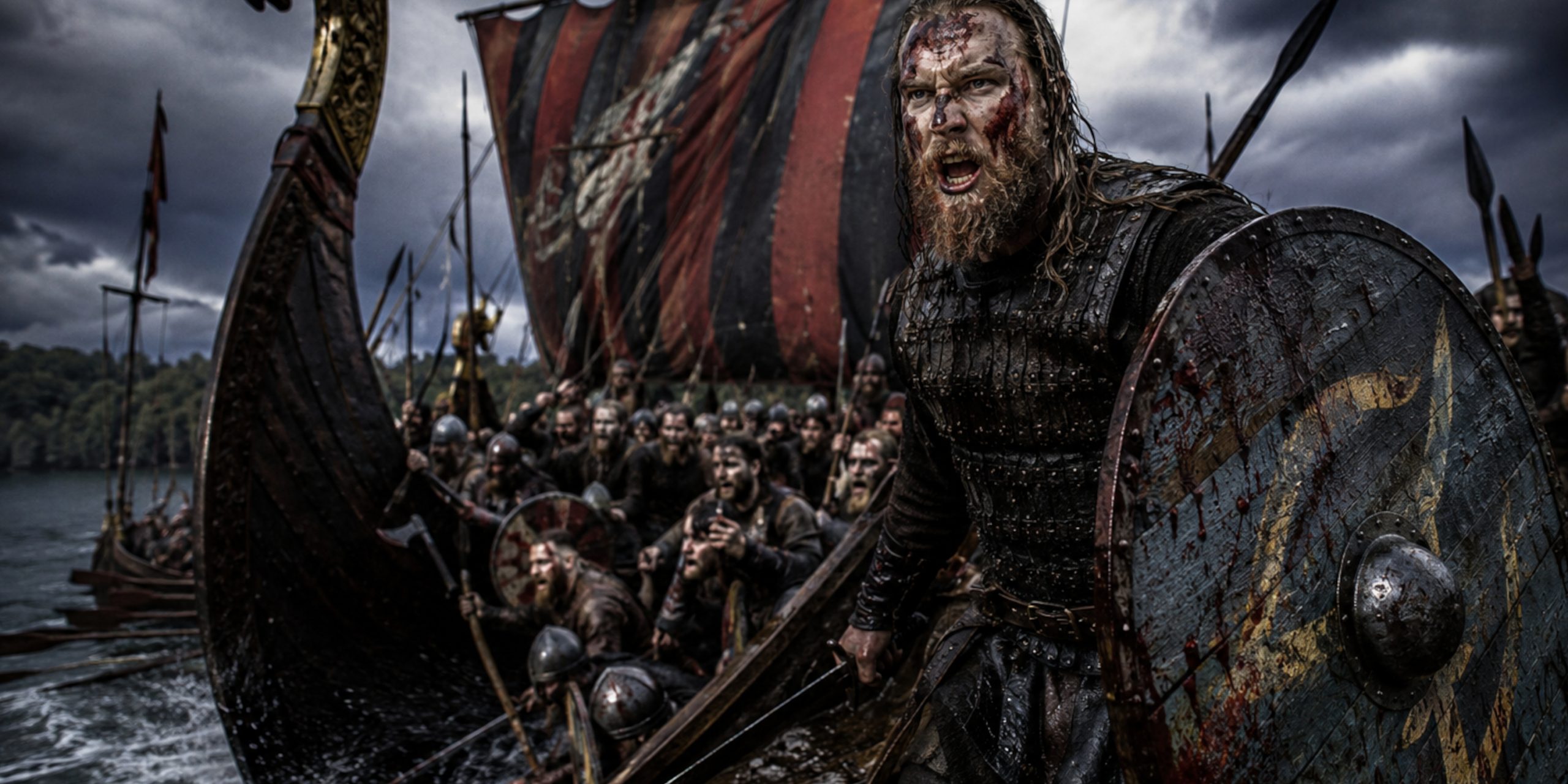
The Battle of Svolder sits somewhere between hard history and Viking legend, which is precisely why historians cannot leave it alone. It has kings hiding behind islands, war fleets drifting through narrow waters, betrayals disguised as diplomacy, and a doomed Norwegian ruler making one final stand aboard an enormous longship while half of Scandinavia closes in around him.
If Hollywood had written it, scholars would probably complain it was unrealistic.
Fought around the year 1000, likely in the Baltic Sea near the western Baltic approaches, Svolder became one of the defining political moments of the Viking Age. Norway’s King Olaf Tryggvason was ambushed by a coalition led by Denmark and Sweden, aided by the Norwegian noble Erik Hakonsson. The result reshaped power across Scandinavia and effectively ended Olaf’s attempt to forcefully Christianise Norway.
The difficulty is this: almost everything we know comes from later Icelandic sagas written generations after the battle. They are vivid, dramatic, and deeply entertaining. They are also prone to embellishment, heroic speeches, and the occasional suspiciously cinematic coincidence.
Still, beneath the saga flourishes lies a very real political and military confrontation.
Background to the Battle
By the late tenth century Scandinavia was changing rapidly. Kings were consolidating power, Christianity was spreading, and regional chieftains increasingly found themselves squeezed between older pagan traditions and emerging monarchies.
Olaf Tryggvason had seized the Norwegian throne around 995. He was energetic, ambitious, charismatic, and apparently not especially patient with disagreement. The sagas portray him as a fierce Christian ruler who demanded conversion from local leaders with varying combinations of persuasion, intimidation, and blunt violence.
That approach won him enemies quickly.
Among them were:
- King Sweyn Forkbeard of Denmark
- King Olof Skötkonung of Sweden
- Erik Hakonsson, son of the former ruler of Norway, Hakon Sigurdsson
These rivals formed a coalition against Olaf. According to the sagas, they learned that Olaf was returning from Wendland with a relatively small fleet. The allies prepared an ambush near Svolder.
Precisely where Svolder was located remains disputed. Suggested locations range from the Baltic Sea near Rügen to the Øresund. Historians still debate it vigorously, which is academic language for “nobody has settled the argument and everyone has maps.”
Foces
Coalition Forces
| Leader | Kingdom or Faction | Estimated Ships | Notes |
|---|---|---|---|
| Sweyn Forkbeard | Denmark | Unknown, possibly 30+ | Senior coalition leader |
| Olof Skötkonung | Sweden | Unknown | Swedish royal contingent |
| Erik Hakonsson | Norwegian nobles | Significant contingent | Experienced naval commander |
Coalition Strengths
- Numerical superiority
- Coordinated ambush strategy
- Experienced regional commanders
- Ability to isolate Olaf’s fleet piecemeal
Olaf Tryggvason’s Forces
| Leader | Kingdom | Estimated Ships | Notes |
|---|---|---|---|
| Olaf Tryggvason | Norway | Perhaps 11 ships | Returning from Wendland |
Olaf’s Key Ships
| Ship | Description |
|---|---|
| Long Serpent | Olaf’s massive flagship |
| Crane | Important supporting warship |
| Short Serpent | Earlier royal vessel |
The Long Serpent dominates most saga accounts. It was supposedly among the greatest longships ever built, famed for its size and height. Whether the descriptions are exaggerated is another matter entirely, though large prestige warships certainly existed.
Arms and Armour
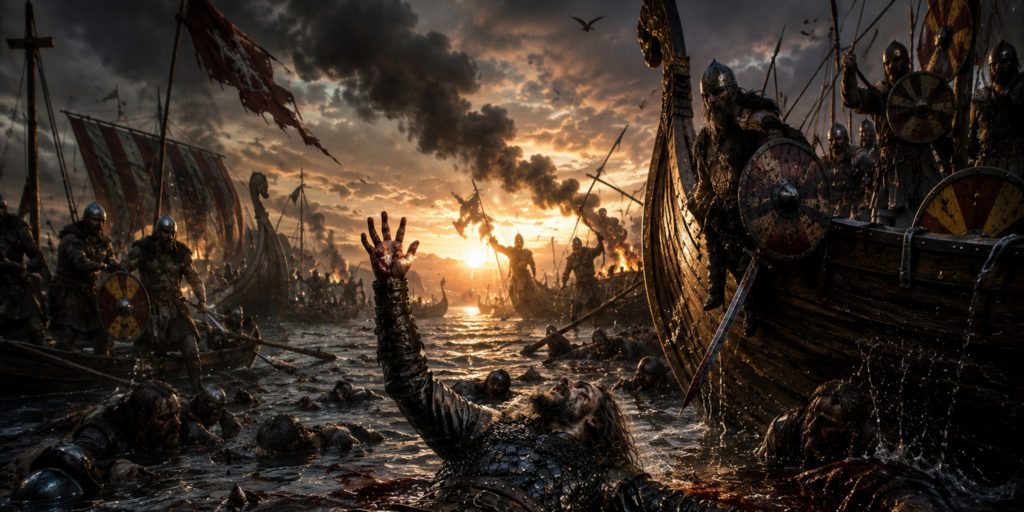
The Battle of Svolder was fought at sea, but this did not resemble later naval artillery battles. Viking naval warfare was essentially infantry combat conducted atop floating timber platforms while men screamed insults across shield rails.
Boarding actions were decisive.
Weapons Used
Swords
| Sword Type | Description |
|---|---|
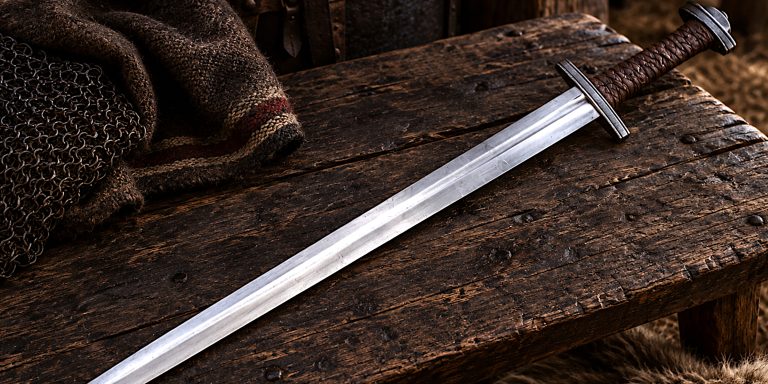
| Petersen Type S | Broad Viking sword suited to slashing |
| Petersen Type H | Decorated elite sword common among nobles |
| Pattern-welded swords | Prestigious blades still circulating among elites |
| Ulfberht-type swords | High-status imported Frankish blades |
Swords remained status weapons. Most warriors probably relied more heavily on spears and axes, but elite retainers and kings would almost certainly have carried fine blades.
Other Weapons
- Spears
- Dane axes
- Hand axes
- Seaxes
- Javelins
- Bows for ship-to-ship missile fire
Archery played a substantial role before boarding actions began. Saga accounts describe heavy missile exchanges between ships before close combat.
Armour and Protection
| Equipment | Notes |
|---|---|
| Mail shirts | Expensive, mainly elite warriors |
| Iron helmets | Rare but present among nobles |
| Round shields | Essential for naval defence |
| Leather garments | Common among ordinary fighters |
| Cloaks and padded tunics | Added limited protection |
The shield wall remained central even aboard ships. Crews lashed vessels together to create floating battle platforms. Once connected, combat became brutally close.
One can imagine the footing was not ideal. Wet planks, blood, broken oars, and heavily armed Scandinavians tend to create difficult working conditions.
The Battle Timeline
Early Morning
- Coalition fleet hides near the battle zone
- Olaf’s fleet sails through in column formation
- Allied leaders reportedly allow smaller Norwegian ships to pass
Midday
- Olaf’s flagship and core vessels identified
- Coalition fleet launches coordinated attack
- Norwegian ships begin forming defensive line
Main Engagement
- Ships are lashed together
- Missile exchanges begin
- Boarding actions spread across the fleet
- Olaf’s outer ships gradually overwhelmed
Collapse of Olaf’s Position
- Coalition forces capture ships one by one
- The Long Serpent becomes isolated
- Fighting intensifies around Olaf’s flagship
Final Moments
Saga traditions differ slightly, but most claim Olaf refused capture and leapt into the sea, disappearing beneath the water in full armour.
Others insisted he survived and escaped. Medieval kings had a remarkable tendency to become mysteriously “unconfirmed dead” when followers preferred hope to reality.
Contemporary and Near-Contemporary Quotes
The Battle of Svolder survives largely through saga literature, especially Heimskringla by Snorri Sturluson.
One famous line attributed to Olaf during the fighting reads:
“Never shall we flee from this battle.”
Another memorable description concerns Einar Tambarskelfir, Olaf’s famed archer. When his bow snapped during battle, Olaf supposedly asked:
“What broke there so loudly?”
Einar replied:
“Norway from thy hands, King.”
Whether the exchange happened exactly like this is doubtful. Whether it sounds magnificent is beyond dispute.
Adam of Bremen, writing in the eleventh century, also refers to Olaf’s death and the conflict surrounding Scandinavian rulers, though his account is less dramatic than the Icelandic sagas.
Archaeology and Evidence
No confirmed archaeological site for Svolder has been identified.
That has not stopped historians, archaeologists, and enthusiastic Scandinavians from trying.
Archaeological Evidence Relevant to the Battle
Viking Ship Finds
Important discoveries help contextualise the naval technology used at Svolder:
| Ship Find | Location | Importance |
|---|---|---|
| Gokstad Ship | Norway | Demonstrates elite Viking warship construction |
| Oseberg Ship | Norway | High-status vessel with advanced craftsmanship |
| Skuldelev Ships | Denmark | Evidence of specialised Viking naval vessels |
These finds reveal:
- Clinker-built hull construction
- Flexible but durable ship design
- Fast rowing and sailing capability
- Capacity for boarding warfare
Weapon Finds
Archaeological discoveries from Viking Age Scandinavia include:
- Pattern-welded swords
- Iron spearheads
- Mail fragments
- Shield bosses
- Arrowheads
Many closely match the weapons described in saga literature.
The Problem with Saga Sources
The major issue for historians is chronology.
Most saga accounts were written in the thirteenth century, more than two centuries after the battle itself. That does not make them useless, but it does require caution.
The sagas blend:
- Oral tradition
- Political memory
- Heroic storytelling
- Genuine historical detail
The result is a narrative that feels emotionally truthful even when exact details remain uncertain.
Frankly, medieval Icelanders knew how to tell a story.
Why the Battle Mattered
Svolder changed the political map of Scandinavia.
After Olaf’s defeat:
- Norway was divided among victorious rulers
- Danish influence expanded dramatically
- Erik Hakonsson gained control in Norway
- Christianisation slowed temporarily
- Regional aristocrats regained influence
The battle also reinforced the importance of naval warfare during the Viking Age. Control of sea routes meant control of trade, tribute, communication, and political authority.
A king without ships was often a king with very limited future prospects.
The Legacy of Svolder
The Battle of Svolder became one of the great legendary clashes of Norse history. It appears in sagas, poetry, and later Scandinavian nationalism.
Olaf Tryggvason himself became an almost mythic figure:
- Warrior king
- Christian zealot
- Adventurer
- Martyr-like ruler
- Symbol of Norwegian kingship
Modern historians are understandably more cautious than saga writers, but the battle still holds enormous significance because it captures a Scandinavia in transition.
The old Viking world was beginning to harden into medieval kingdoms. Kings became more centralised, Christianity became entrenched, and regional sea raiders increasingly transformed into organised states.
Svolder stands right on that threshold.
And somewhere beneath the saga exaggerations and heroic speeches, one can still glimpse the reality of terrified men fighting across splintering decks under a cold Baltic sky while kings gambled entire realms on the outcome of a single afternoon.