Updated: September 2026
Chronicles: Medieval is shaping up to be one of the most serious challengers to Mount & Blade II: Bannerlord. Here is everything confirmed about its campaign, battles, factions, co-op plans and 2027 Early Access release.
There is an obvious reason Chronicles: Medieval keeps being compared with Mount & Blade II: Bannerlord. Both games offer the fantasy of starting as an unknown traveller, gathering soldiers, earning influence and eventually commanding an army from horseback. Both mix a strategic sandbox with third-person combat. Both understand that issuing a cavalry charge is considerably more satisfying when you can join it yourself and immediately regret your position in the front rank.
The comparison is fair, but it can also be misleading. Raw Power Games is not simply making Bannerlord with prettier fields. Chronicles: Medieval appears to place much more weight on battlefield command, unit cohesion, cultural doctrine and a campaign rooted in the Hundred Years’ War. Its battles look closer to a meeting between action RPG combat and a proper real-time tactics game.
That makes it a credible rival. It does not yet make it a proven one.
Chronicles: Medieval at a Glance
| Detail | Confirmed information |
|---|---|
| Developer and publisher | Raw Power Games |
| Genre | Action, strategy and sandbox RPG |
| Setting | Medieval Europe during the Hundred Years’ War |
| Early Access | Early 2027 on PC through Steam |
| Console release | Planned after the PC version, with no date announced |
| Playable powers shown | England, France and the Holy Roman Empire |
| Perspective | Third-person exploration, combat and command |
| Multiplayer | Online co-op custom battles confirmed for Early Access |
| Campaign co-op | A goal for the full release, not yet guaranteed |
| Mod support | Planned, with more extensive tools targeted for version 1.0 |
| Technology | Unreal Engine 5 with Raw Power Games’ proprietary Asgard technology |
The current official plan is to launch in Steam Early Access in early 2027. Raw Power expects Early Access to last roughly a year, although the studio has sensibly left room for that schedule to move. Anyone who has followed ambitious sandbox games will recognise this as the part where calendars become works of speculative fiction.
Why Is Chronicles: Medieval Compared with Bannerlord?
The shared structure is impossible to miss. You create a character, begin without land or status, travel through a changing world, recruit troops and build a reputation through trade, diplomacy, quests and war. When armies meet, you command your soldiers while personally fighting in third person.
That is the central Mount & Blade formula, and Bannerlord remains its best-known modern expression. The important question is not whether Chronicles resembles it. It plainly does. The question is where Raw Power intends to push the formula further.
The answer appears to be command. Bannerlord lets the player organise formations and issue battlefield orders, but much of its pleasure comes from the chaos of leading a warband in person. Chronicles is building a denser tactical layer around that personal involvement. Before a major battle, players can arrange battle lines, choose standing orders and give initial orders. During combat, they can issue broad commands or select individual units for precise movement, facing and target instructions.
In other words, it wants you to feel like both the person swinging the poleaxe and the unfortunate soul responsible for the entire plan.
Battlefield Command Is Its Strongest Advantage
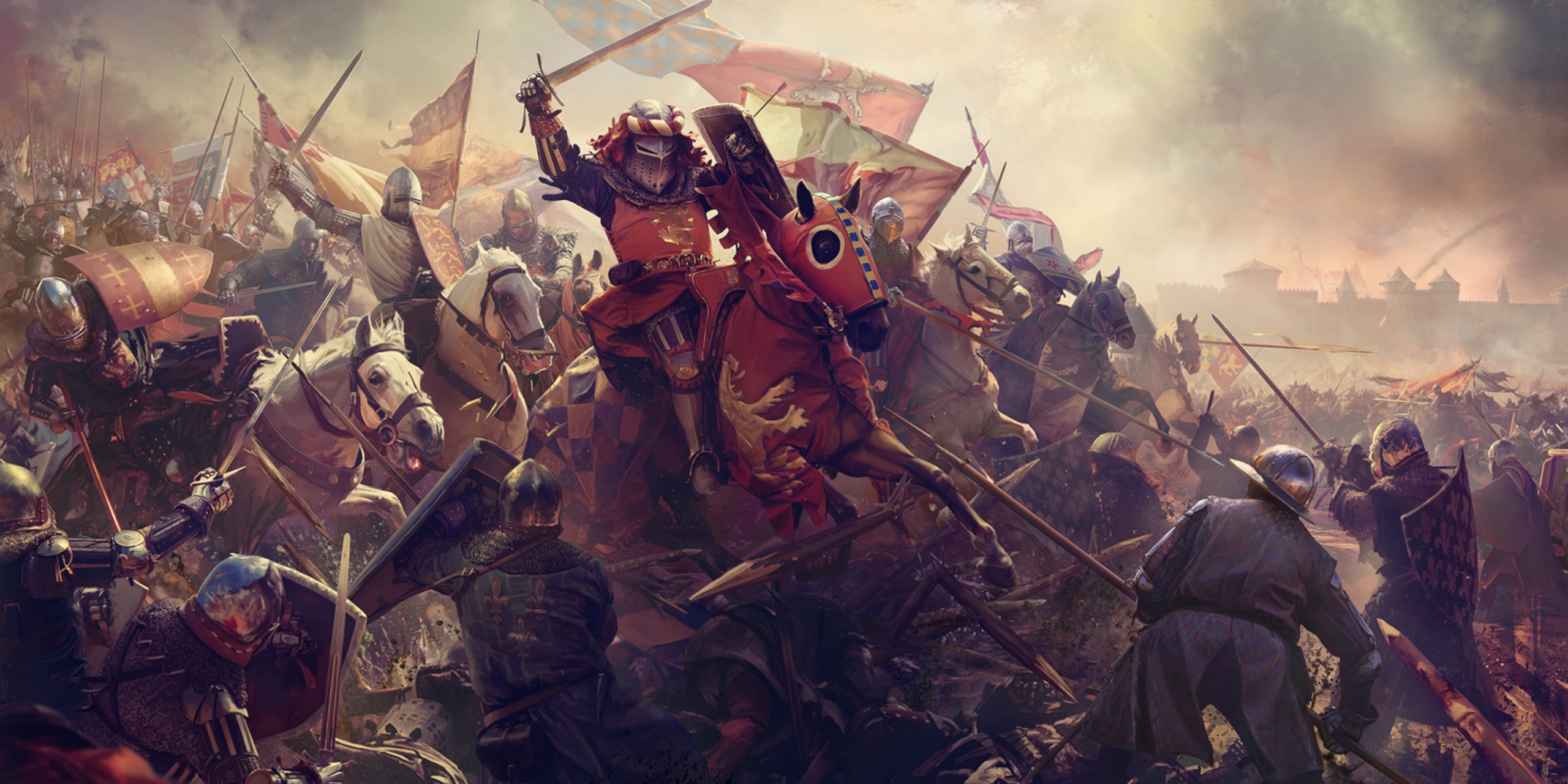
The most convincing material shown so far concerns the battles. Armies are divided into a Vanguard, Middle Guard, Rearguard and Flanks, while units have culturally influenced deployment preferences. English longbowmen favour positions with clear lines of fire, French heavy cavalry lean towards aggressive forward deployment, and Holy Roman Imperial forces prefer a dense armoured centre.
This matters because faction identity is being expressed through battlefield behaviour rather than a slightly different troop list. If it works, armies should require different methods of command. An English force ought to feel structurally different from a French one before anybody has been introduced to the business end of a lance.
The official battle breakdown describes several tactical systems:
- Battle planning before larger engagements
- Cultural preferences affecting unit deployment
- Local orders for movement, facing and target selection
- Standing orders that govern how units behave
- Morale states ranging from Inspired to Broken
- Ordered retreats that preserve surviving troops
- Rout mechanics that can remove a unit before every soldier is killed
- Terrain generated to reflect where armies met on the campaign map
Morale may be the most important of these. Units lose confidence through casualties, flank attacks, nearby routs and the fall of the player character. Fighting visibly alongside them can improve morale, while impressive kills can raise nearby soldiers to the Inspired state.
That neatly connects action and strategy. Personal combat is not a separate minigame taking place beneath the tactical layer. Your behaviour on the field can affect whether a formation holds. It is a clever answer to an old problem in commander games: why would the person responsible for the army risk being hit in the face with agricultural equipment?
Battles Could Be Larger and More Deliberate
Raw Power demonstrated a Gamescom 2026 battle involving around 900 soldiers, with roughly 450 on each side. The studio told Wccftech that it is targeting as many as 2,000 troops in a single battle for the Early Access launch.
Raw numbers are not automatically impressive. Two thousand confused soldiers running into a hedge would still be two thousand confused soldiers running into a hedge. What makes the target interesting is the supporting simulation.
Shield size can affect whether a physically simulated arrow strikes the shield or the soldier. Formation cohesion changes how tightly troops hold together, how quickly they respond and how well they resist charges. Cavalry is designed for impact and repositioning rather than indefinitely circling inside an infantry block. Units also have defined armour, penetration, attack and block characteristics.
These systems suggest battles designed around formation integrity and timing. Bannerlord can create excellent spectacle, especially during sieges and large field engagements, but Chronicles is aiming for a more formal tactical rhythm. The player should have to read the field, manage reserves and recognise when a line is close to breaking.
A Historical Setting Gives It a Different Identity
Bannerlord takes place in the fictional world of Calradia. Its factions borrow heavily from real cultures, but TaleWorlds has the freedom to combine eras and reshape history for the sandbox.
Chronicles: Medieval is tied to fourteenth and fifteenth-century Europe, with its opening chapter covering 1313 to 1348. England, France and the Holy Roman Empire have been confirmed as playable powers, each with regional units, political interests and military traditions.
That narrower historical frame could be a genuine advantage for players who care about material culture, arms and armour, heraldry and the political mess surrounding the Hundred Years’ War. It allows the developers to make regional recruitment, equipment and military organisation part of the game’s structure.
It also creates a risk. Historical grounding is easy to advertise and rather harder to sustain across hundreds of weapons, settlements, troop types and social systems. Raw Power has already acknowledged that some unit names are deliberately anachronistic for clarity. That is not a scandal. A game still has to communicate with its players, preferably before the cavalry arrives.
Army Recruitment Has More Social Structure
Armies are divided into Levy, Mercenary and Household categories. According to Raw Power’s army management diary, players recruit and replenish units through quartermasters found in settlements and castles.
The categories affect where troops are found, what they cost and when they become practical:
| Troop category | Expected role |
|---|---|
| Levy | Affordable early forces raised mainly from settlements |
| Mercenary | Flexible professional troops likely to become important in the middle game |
| Household | Expensive, well-equipped retainers recruited from castles |
Settlement size, local culture and available buildings influence the troops offered. A castle with stables, a barracks and a blacksmith should produce different possibilities from a modest settlement. Mercenaries may also belong to foreign cultures, allowing a commander to build a mixed army.
Units gain experience and can be promoted through tiered development paths. Cohesion represents their training, loyalty and ability to act together, so progress involves more than turning recruits into increasingly expensive men wearing increasingly shiny metal.
This could give army building a stronger sense of place than Bannerlord’s familiar village recruitment loop. It also raises questions about pacing. A richly modelled recruitment system is only enjoyable if replacing losses remains meaningful without becoming an administrative tour of every quartermaster in Burgundy.
The Campaign Is More Than a Sequence of Battles
The exploration map is the campaign layer where players travel, trade, accept quests, conduct diplomacy and encounter other forces. Raw Power says factions can shift in power, armies patrol the map and unexpected events can alter a journey.
The terrain where armies meet helps determine the battle environment. A clash near woodland, a settlement or open country should therefore create different tactical conditions. This connection between strategic movement and battlefield geography is promising because it makes choosing where to fight almost as important as choosing whom to annoy.
Castle construction and sieges are also part of the wider plan. Players will be able to build and defend strongholds, while later Early Access updates are expected to add higher building tiers and more advanced siege engines. Crafting, diplomacy, tournaments and the economy are all listed for expansion on the road to version 1.0.
This is where caution is most necessary. The campaign has been described in broad and exciting terms, but battles have received far more detailed public demonstrations. Bannerlord already has functioning kingdoms, clans, workshops, caravans, marriage, fiefs, sieges and a mature modding scene. Chronicles needs its campaign systems to interact convincingly, not merely exist as attractive menu headings.
Co-op Could Be the Feature Bannerlord Players Have Wanted
The Steam listing confirms online co-op, but the scope needs careful explanation. Custom co-op battles are planned for Early Access, allowing friends to fight together against an opposing army.
Raw Power has designed the campaign architecture with multiplayer in mind and wants to add campaign co-op by the full release. However, the studio has stopped short of promising that it will definitely arrive. That distinction matters.
If campaign co-op works, it could become Chronicles: Medieval’s clearest advantage over Bannerlord. A shared campaign in which friends command separate formations, develop characters and participate in the same political sandbox has been a long-standing wish among Mount & Blade players.
It is also technically awkward. Time progression, travel, battles, menus and players pursuing different goals all need to coexist. The idea is excellent. The implementation will decide whether it becomes a defining feature or a brave paragraph in an old development diary.
Modding Could Decide Its Long-Term Future
Bannerlord’s modding community is one of its greatest strengths. Total conversions, new troop trees, diplomacy systems, combat changes and campaign overhauls have extended the game far beyond its standard form.
Raw Power clearly understands the importance of that ecosystem. The developer says its systems are being designed with modders in mind, while more powerful tools are planned for version 1.0. This includes Ymir, the internal tool used to build battlefields during development.
The intention is encouraging, but Bannerlord has years of released mods, accumulated knowledge and an established audience. Chronicles cannot rival that on launch through enthusiasm alone. Accessible documentation, stable tools and updates that do not repeatedly break community projects will matter far more than a warm declaration of affection for modders.
Chronicles: Medieval Versus Bannerlord
| Feature | Chronicles: Medieval | Mount & Blade II: Bannerlord |
|---|---|---|
| World | Historical Europe during the Hundred Years’ War | Fictional Calradia inspired by several historical cultures |
| Battlefield role | Third-person fighter and detailed formation commander | Third-person fighter and army commander |
| Tactical emphasis | Cohesion, morale, cultural doctrine, battle lines and standing orders | Formations, troop composition, terrain and direct battlefield orders |
| Campaign status | In development for Early Access | Fully released and substantially updated |
| Co-op | Custom battle co-op planned for Early Access, campaign co-op is a longer-term goal | Multiplayer battles, no official co-op campaign |
| Army structure | Levy, Mercenary and Household units shaped by culture and location | Culture-based troop trees recruited mainly from settlements and prisoners |
| Modding | Planned, with full tools expected later | Large and established modding community |
| Greatest strength | More ambitious tactical command and historical focus | Breadth, proven sandbox systems and years of playable content |
| Greatest weakness | Unproven scope and Early Access uncertainty | Campaign repetition and systems that can feel broad rather than deep |
The rivalry therefore looks less like a direct replacement and more like a difference in emphasis. Bannerlord offers a broad, established sandbox with an enormous community. Chronicles is trying to make command, morale and historical army organisation more consequential.
What Still Has Not Been Proven?
Several important questions remain unanswered:
- How deep will diplomacy, trade and politics be at Early Access launch?
- Will battles remain responsive with close to 2,000 troops?
- Can the combat feel precise amid large formations?
- How varied will quests, settlements and peacetime activities become?
- Will campaign co-op survive the journey from ambition to finished feature?
- How much content will be available in the first chapter?
- Will the economy make army losses meaningful without turning replenishment into a chore?
- How stable and accessible will the promised mod tools be?
There is also the ordinary danger of scale. Chronicles wants action combat, tactical command, diplomacy, trade, crafting, exploration, castle building, sieges, co-op and modding. That is less a feature list than a small medieval government. Early Access should reveal which systems have real depth and which are still waiting for their turn at the forge.
Is Chronicles: Medieval Really a Bannerlord Rival?
Yes, although the word “rival” should describe its potential rather than its present condition.
Chronicles: Medieval has identified several areas where Bannerlord leaves room for competition. It offers a recognisable rise-to-power sandbox, then adds more deliberate army deployment, stronger morale mechanics, culturally specific battlefield doctrine and the prospect of co-op. Its Hundred Years’ War setting also gives it a clearer historical identity than Calradia.
What impresses me most is the connection between command and personal combat. Your position, survival and visible actions can influence the confidence of nearby troops. That feels like a thoughtful development of the genre rather than cosmetic imitation.
Still, Bannerlord is already here. It has a vast campaign, large battles, functioning kingdom systems and a formidable catalogue of mods. Chronicles must prove that its impressive battle design can support a complete sandbox over dozens or hundreds of hours.
For now, it is the strongest-looking challenger Bannerlord has faced in years. The armour shines, the formations make sense and the cavalry appears to understand that horses are not bumper cars. Early 2027 will tell us whether the campaign behind those battles is equally convincing.
Frequently Asked Questions
When will Chronicles: Medieval be released?
Chronicles: Medieval is scheduled to enter Steam Early Access on PC in early 2027. Console versions are planned for a later date.
Is Chronicles: Medieval a Bannerlord sequel?
No. It is an original game developed and published by Raw Power Games. The comparison comes from its mixture of sandbox campaigning, army management, third-person combat and large-scale battles.
Will Chronicles: Medieval have co-op?
Online co-op custom battles are planned for Early Access. Campaign co-op is a goal for the full version, but Raw Power has not guaranteed it.
Is Chronicles: Medieval historically accurate?
The game is historically grounded in Europe during the Hundred Years’ War. Its equipment, cultures and military structures draw from the period, although the developers have made some concessions for gameplay and clarity.
How many soldiers can appear in a battle?
A Gamescom 2026 demonstration featured around 900 troops. Raw Power has said it is targeting up to 2,000 soldiers on one battlefield for Early Access, although performance and final limits may change during development.
Will Chronicles: Medieval support mods?
Yes. Mod support is part of the development plan, with more powerful tools expected by version 1.0.