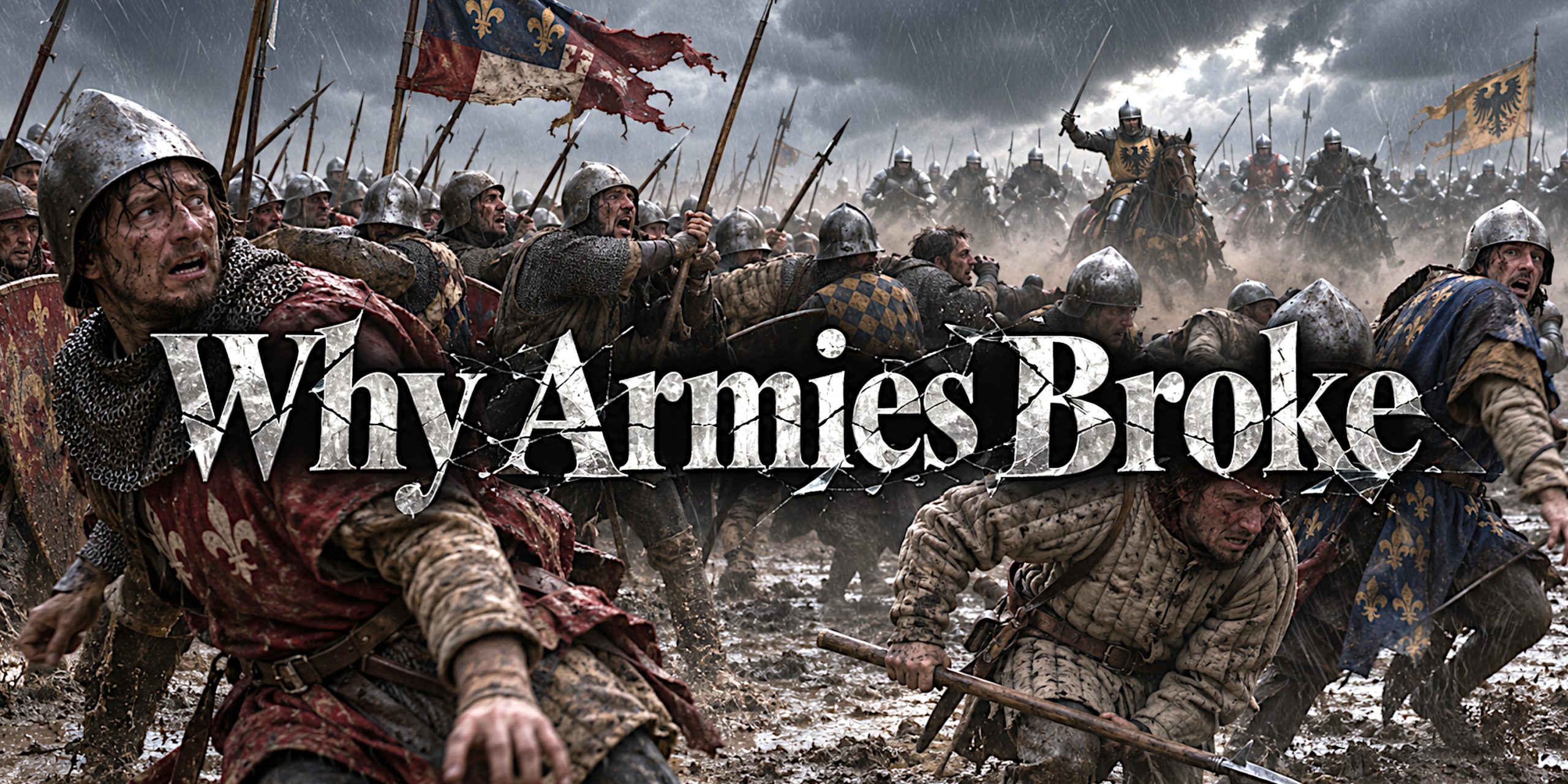
A medieval army could still have thousands of men alive, weapons in their hands and plenty of fighting strength left when it lost the battle.
What disappeared was the confidence that staying together offered a better chance of survival than leaving.
That is what makes battlefield morale so fascinating. We tend to picture medieval warfare through its hardware: swords, armour, longbows and horses with frankly unreasonable running costs. Yet all that equipment depended on people continuing to cooperate while frightened, exhausted and often unsure what was happening twenty paces away.
Armies broke when enough soldiers lost the ability, or the willingness, to keep fighting as a coordinated force. Casualties mattered, but so did leadership, formation, fatigue, rumours and the behaviour of neighbouring troops.
The difficult part was that these pressures reinforced one another. A small withdrawal could expose a flank. An exposed flank could provoke panic. Panic could turn a local setback into an army running for its life.
What Did It Mean for a Medieval Army to Break?
An army breaking was different from an army retreating.
A controlled withdrawal required soldiers to follow orders, maintain some formation and protect one another while moving away. A rout meant that this control had substantially collapsed. Individuals and groups prioritised escape, while commanders struggled to restore collective action.
The distinction matters because moving backwards was not automatically evidence of cowardice or defeat.
| Battlefield behaviour | What was happening | Likely consequence |
|---|---|---|
| Ordered withdrawal | Troops moved back under control | The force might regroup and fight again |
| Local collapse | One part of the army lost cohesion | Nearby troops faced new dangers |
| General rout | Control failed across much of the force | Pursuit and heavy losses could follow |
Nor did everyone necessarily flee at once. One contingent might run while another continued fighting, unaware that its support had disappeared.
From a modern map, a battle looks like one event. From inside it, the experience was much more fragmented.
Morale Was About Trust as Much as Courage
It is tempting to divide medieval soldiers into brave men who stayed and frightened men who ran. That makes a tidy story, but a poor explanation.
A soldier could be terrified and remain in formation. Another could have considerable personal courage yet withdraw because he believed his position had become hopeless.
The useful question is: what made people trust that holding together would work?
That confidence could rest on familiar companions, experienced leaders, reliable equipment and a position that appeared defensible. It also depended on whether soldiers believed their commanders were making sensible decisions.
Medieval military writers recognised fear as a practical problem. Training, provisioning, discipline and emotional control all featured in discussions of preparing men for war. Courage needed support from the organisation around it. Apparently, even chivalry benefited from lunch and a competent manager. Oxford Academic
We should also avoid treating “medieval armies” as one uniform institution. A household retinue, an urban militia and a hastily assembled levy could have very different relationships with their leaders and with one another.
How Pressure Turned into Battlefield Panic
There was no universal breaking point. A formation might withstand serious losses in one situation and give way much sooner in another.
The same casualties meant different things depending on what soldiers thought would happen next.
| Pressure | Immediate effect | Why it could undermine morale |
|---|---|---|
| Sustained casualties | Gaps, wounded men and reduced fighting strength | Holding position appeared increasingly costly |
| Attack on a flank | Troops had to respond in a vulnerable direction | Existing protection and formation became less useful |
| Loss of leadership | Orders and coordination became harder | Soldiers could doubt whether anyone remained in control |
| Exhaustion | Slower reactions and reduced physical capacity | Resistance became harder to sustain |
| Friendly troops fleeing | Support disappeared or seemed to disappear | Defeat looked more likely |
These were interacting pressures, rather than a checklist that every battle followed.
Imagine holding a position while the troops beside you begin moving backwards. You may not know whether they have received orders, spotted an enemy force or simply had enough.
You do know that the space they occupied is becoming empty.
That creates an ugly decision. Staying may expose you. Leaving may expose someone else. Once enough people make that calculation, their individual attempts to survive can dismantle the formation that was protecting them.
Rumours Could Be as Dangerous as Weapons
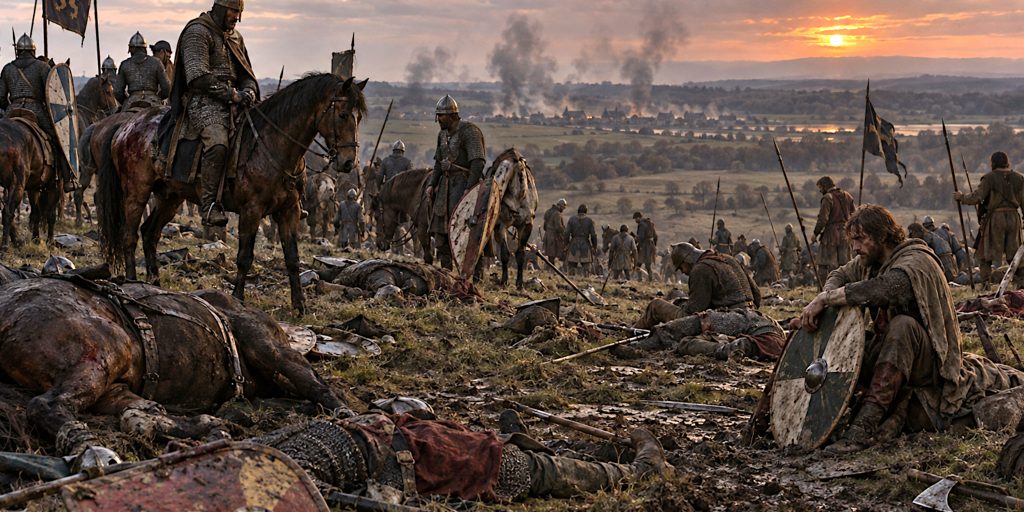
A medieval soldier had no reliable overview of the battlefield. Noise, terrain, weather and bodies obstructed both sight and communication.
A missing banner or an unfamiliar movement could be interpreted as evidence that something had gone badly wrong. A rumour about a commander’s death was especially dangerous because it raised two questions at once: who was giving orders, and was the cause already lost?
Hastings provides a famous example.
During the fighting in 1066, part of William’s army retreated amid reports that he had been killed. William’s appearance with his face exposed helped rally his men by demonstrating that he was alive.
The accounts require care. They were written for particular audiences, and there is no surviving direct eyewitness narrative. Even so, the episode illustrates how visible leadership could counter a crisis of confidence. The army had suffered a setback, but its collapse was not inevitable. English Heritage
For me, this is more revealing than the usual image of a commander delivering a magnificent speech. Before inspiring anyone, William had to correct some very consequential misinformation.
Why a Flank Attack Could Change Everything
A formation’s protection depended partly on where the enemy was.
Shields, spear points and the attention of the men carrying them were directed towards an expected threat. An attack from another direction forced soldiers to turn, move or reorganise while already under pressure.
That could produce a physical problem and a psychological one.
The physical problem was immediate: men might struggle to bring their weapons to bear or maintain mutual support. The psychological problem was uncertainty. Had the neighbouring formation gone? Was the army being surrounded? Was an escape route about to close?
A flank attack did not guarantee a rout. Troops could respond effectively, especially with warning and support. Its danger lay in forcing difficult adjustments at precisely the moment clear information and spare capacity were scarce.
Fresh troops could have a similar disproportionate effect. Their arrival changed the military balance while also changing what exhausted opponents believed about their prospects.
Towton: When Defeat Became a Disaster
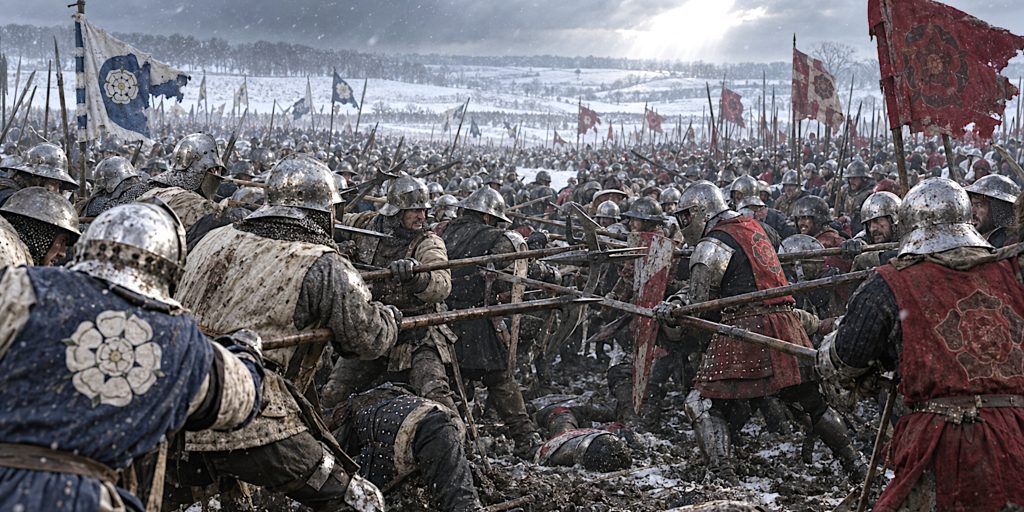
Towton in 1461 shows why the breaking of a line and the killing that followed must be considered together.
In the broad reconstruction of the battle, the arrival of Yorkist reinforcements under the Duke of Norfolk helped turn the fighting against the Lancastrians. Their eventual flight became especially dangerous because the surrounding landscape restricted escape.
The Cock Beck and its approaches hindered fugitives while pursuers pressed them. Historic England identifies the difficulty of crossing the beck as a factor increasing Lancastrian losses.
The sequence and casualty totals remain debated, and the surviving accounts do not provide a complete, consistent narrative. What matters here is the relationship between battlefield collapse, pursuit and terrain. Losing cohesion could transform an already bad position into something much worse. Historic England
A stream that seemed a useful boundary before battle might become a lethal obstruction afterwards. Geography did not change its mind. The army’s circumstances changed around it.
Why Running Could Be More Dangerous Than Standing
A formation offered protection through cooperation. Soldiers could cover one another, present weapons together and make it harder for an opponent to isolate individuals.
Flight weakened those advantages.
Men moving at different speeds became separated. Some stopped to fight, others sought cover, and others crowded towards the same crossing or road. Mounted pursuers could exploit that disorder where the ground allowed.
This helps explain why a rout could be so destructive. Troops were losing both their collective defence and their ability to choose where the next encounter happened.
It does not mean every defeated army was massacred. Darkness, difficult ground, exhausted pursuers or surviving organised troops could limit pursuit. Some fugitives escaped and later returned to service.
But escape was not a clean transition from danger to safety. It could be the most dangerous part of the battle.
Could Commanders Stop an Army from Breaking?
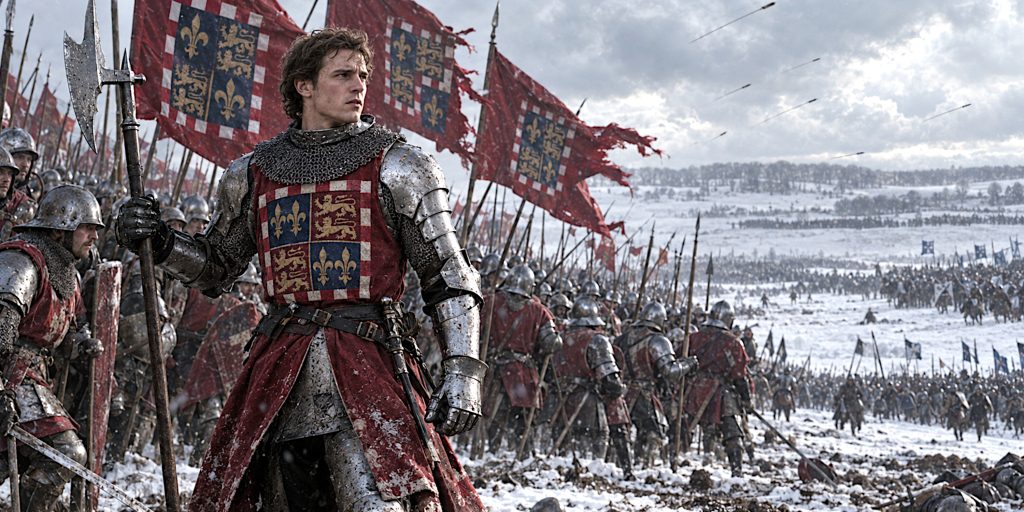
Sometimes. The Hastings rally is a reminder that panic could be interrupted.
The difficulty was timing. Restoring confidence while a formation still existed was a different task from gathering scattered fugitives across several miles.
Commanders could improve their chances by maintaining visible leadership, keeping support available and choosing positions that reduced the danger of being outflanked. Clear orders mattered, as did avoiding unnecessary exhaustion before the decisive fighting.
Success itself could restore confidence. Seeing an enemy attack repulsed gave soldiers evidence that their formation and weapons were working.
Yet no commander could guarantee obedience under every condition. Medieval armies were human organisations operating under extreme pressure. Their behaviour could be resilient, erratic or both within the same afternoon.
I find that considerably more convincing than the idea that one side simply arrived with superior bravery.
How Morale Works in Levy & Lance
Levy & Lance turns battlefield confidence into explicit rules. Its current field manual distinguishes ordinary morale failures from routing.
- Morale starts at 5, increased by experience and kit, up to 10. Roll a d10 at or below the score to pass.
- An ordinary failure causes a two-square retreat and disorder. Blocked retreats cost strength. Disorder reduces Attack by 1; a successful rally removes it.
- Elite troops reroll their first failed morale check each round.
- Commanders provide support: attached commanders grant +1 morale; separate commanders support within two squares.
- Capture has wider consequences: army-wide morale falls by 1. Allies seeing the captive within six squares test once at a further −1, routing on failure.
- Flank and rear attacks impose morale penalties of −1 and −2 respectively.
- In Field battle, losing half your starting strength breaks the army.
Routing counts as removal in every mode. Destroying or routing an enemy company rallies the victorious unit and resets its fatigue.
These mechanics make position and command protection matter alongside damage. Ordinary morale failure is a setback you can recover from, provided your deployment leaves room to do so. Free Historical Wargame
How to Apply That in Your First Battle
The practical lesson is to plan for a fight that becomes messy.
Protect your commander, support vulnerable flanks and consider where a pressured company could withdraw. A deployment that works only while every unit holds perfectly is asking rather a lot of everyone involved.
When attacking, look beyond the strongest enemy formation. Threatening its support or approaching from an awkward direction may create a better opportunity than repeatedly striking its front.
When defending, resist the urge to treat every backward movement as a disaster. Recoverable setbacks become much harder to manage when you answer them with another unsupported attack.
That is also the historical point worth keeping in mind. Medieval battles were fought by people trying to understand danger with incomplete information. An army might endure extraordinary punishment while its soldiers still trusted their companions, leaders and position.
The moment those connections failed, even men who had fought hard could decide that staying was no longer survivable. And once they began leaving, everyone around them had a new reason to make the same decision.