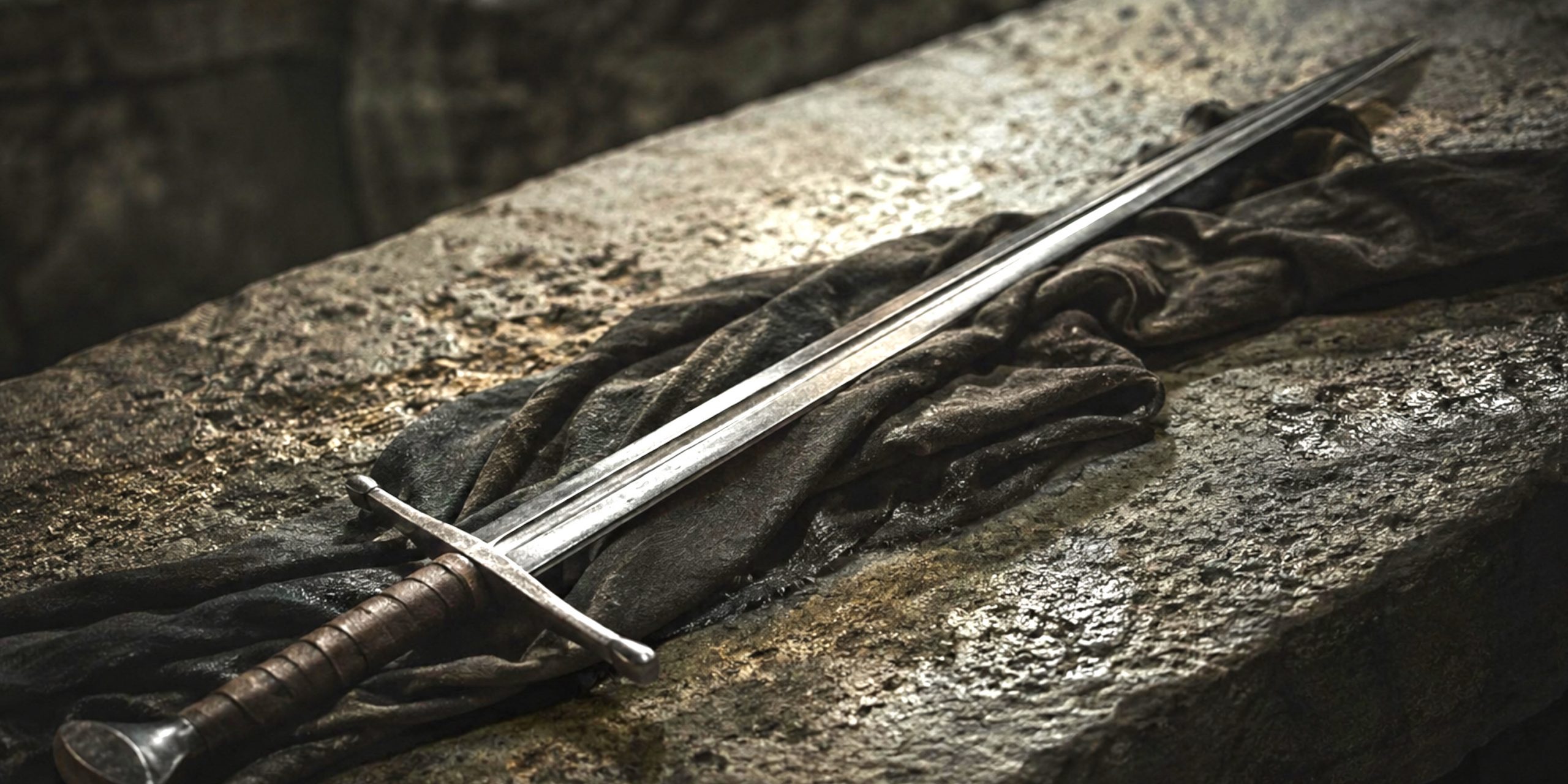
Caesura is one of the most interesting weapons in The Kingkiller Chronicle, partly because Patrick Rothfuss refuses to treat it like a piece of fantasy loot.
Kvothe does not pull it from a dragon’s hoard. It does not burst into blue flame. Nobody announces that it was forged from the last star to fall before the moon was stolen.
Instead, he is given an old sword with a history longer than his own civilisation seems capable of remembering.
Its Adem name is Saicere. Kvothe later calls it Caesura, a decision which is very Kvothe: intelligent, meaningful, aesthetically satisfying and potentially irritating to almost everyone whose opinion he ought to respect.
By the time we meet the older Kvothe at the Waystone Inn, however, there is another sword hanging behind the bar.
And it is not quite Caesura.
That small discrepancy has become one of the more intriguing unresolved details in the series.
What Is Caesura?
Caesura is the sword Kvothe receives during his training among the Adem in The Wise Man’s Fear.
The weapon belongs to the Adem tradition rather than the more familiar pseudo-medieval sword culture seen elsewhere in fantasy. This matters. Among the Adem, swords are not disposable possessions. They are inherited objects with recorded histories, previous bearers and names.
Kvothe is entrusted with the sword after demonstrating sufficient progress in the Ketan and the Lethani.
Its established name is Saicere.
Kvothe, however, hears something different in it.
He associates the sound with caesura, the poetic term for a deliberate pause or break within a line of verse. Because he is a musician, performer and relentless namer of things, the association appeals to him immediately.
So Saicere becomes Caesura in Kvothe’s mind.
That distinction is worth preserving. Caesura is not necessarily the sword’s original or universally accepted name. It is Kvothe’s name for it.
And names in this world are rarely harmless.
Saicere Before Kvothe
One of the strongest details surrounding the sword is its documented lineage.
When Kvothe receives Saicere, he is shown its history through the Adem practice of recording its previous owners. The list stretches back for thousands of years.
That immediately changes how we should think about the weapon.
Saicere is older than Kvothe, older than the University as he knows it and potentially older than several political institutions scattered across the Four Corners. It has passed through generations of Adem warriors who lived, fought and died while the sword remained.
There is something wonderfully humbling about this.
Kvothe spends much of his life becoming legendary. Saicere has already survived enough legends to be unimpressed.
The Adem treat that continuity seriously. A sword is temporarily entrusted to a bearer rather than simply purchased and owned.
Kvothe therefore becomes another entry in Saicere’s history.
Or at least he is supposed to.
What Does Caesura Look Like?
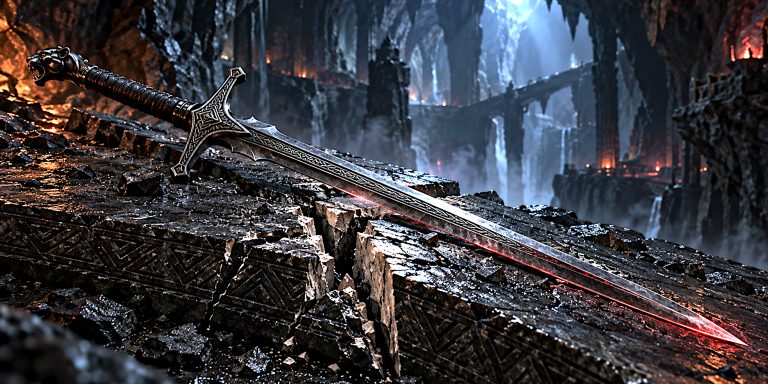
Caesura is not described as an excessively ornate fantasy weapon.
That fits the Adem perfectly.
The sword is practical, balanced and made for serious use. Its significance comes from craftsmanship, age and history rather than decoration.
The exact dimensions are not presented with the sort of technical detail that would allow us to reconstruct a museum replica with complete confidence. Any claim that Caesura corresponds precisely to a historical European or Asian sword type therefore goes further than the text allows.
Broadly, however, it can be understood as a relatively light, straight sword suited to the controlled martial system Kvothe learns in Ademre.
Caesura at a Glance
| Feature | Description |
|---|---|
| Original name | Saicere |
| Kvothe’s name | Caesura |
| Culture | Adem |
| Bearer | Kvothe |
| Weapon type | Straight sword |
| Age | Thousands of years old |
| Fighting tradition | Ketan and Adem martial practice |
| Special quality | Exceptional age, craftsmanship and recorded lineage |
| Magical powers | None explicitly established |
| Later status | Uncertain |
The lack of obvious magical effects is important.
Caesura does not need enchantment to matter.
In a genre stuffed with swords that glow whenever something unpleasant enters the postcode, an exceptionally well-made old blade is almost refreshing.
Why Kvothe Calls Saicere “Caesura”
The name tells us nearly as much about Kvothe as it does about the sword.
A caesura is a pause within a line of poetry or verse. It interrupts rhythm without necessarily ending it.
Kvothe is a musician before he is a swordsman. His instinctive relationship with the world is shaped by sound, rhythm, language and performance. When he hears Saicere, he connects the name to a concept he already understands intimately.
That is classic Kvothe.
He encounters something from another culture and interprets it through himself.
There is beauty in that, but also arrogance.
The Adem have preserved the sword and its history for generations. Kvothe arrives, carries it for a relatively brief period and immediately finds a name that feels more appropriate to him.
Tempi would probably have an expression for this.
Unfortunately, Kvothe might interpret the expression as approval.
Caesura and the Importance of Names
Names sit near the centre of The Kingkiller Chronicle.
The University teaches Naming as a profound form of understanding. Elodin repeatedly suggests that knowing a thing’s true nature is different from merely attaching a convenient label to it.
Kvothe is unusually talented at both.
He names Auri. He gives names to objects. He creates identities for himself. Other people create names for him in return.
Kvothe the Bloodless.
Kvothe the Arcane.
Kvothe Kingkiller.
The problem is that Kvothe does not always understand the consequences of the names he creates.
Caesura fits neatly into this pattern.
Saicere already possesses a name embedded within Adem history. Kvothe nevertheless reshapes it according to his own linguistic and musical instincts.
Whether that act has deeper metaphysical significance remains unresolved.
In Rothfuss’s world, though, casually dismissing the importance of a name feels like a fairly reliable way to regret something three hundred pages later.
Is Caesura Magical?
There is no clear evidence that Caesura possesses conventional magical abilities.
It does not behave like a weapon enchanted through sympathy. It is not explicitly described as a product of sygaldry. Nor does it display supernatural powers comparable to the more spectacular weapons found in conventional fantasy.
Its extraordinary qualities are subtler.
The sword is extremely old.
It remains functional despite that age.
Its provenance is unusually well documented.
It belongs to a culture possessing knowledge and traditions outsiders poorly understand.
That leaves room for speculation about its manufacture, but speculation is exactly what it remains.
There is a temptation with fantasy weapons to assume that anything ancient and suspiciously durable must secretly be magical. Sometimes an old sword is simply an extremely good old sword.
Admittedly, this is Temerant, so I would not bet the house on it.
Caesura as a Fighting Sword
Kvothe’s swordsmanship develops considerably during his time in Ademre.
He learns the Ketan, a sophisticated martial discipline closely associated with the philosophy of the Lethani. Fighting is therefore not reduced to collecting techniques. Movement, judgement, timing and appropriate action are bound together.
Caesura becomes an extension of that training.
This makes it fundamentally different from Kvothe’s earlier weapons and improvised violence.
His greatest natural weapon has always been his mind. After Ademre, he possesses something more dangerous: technical discipline.
Not perfect discipline, obviously.
This is still Kvothe.
But enough to make a difference.
Caesura suits him because it rewards precision rather than brute force. Kvothe is fast, inventive and frighteningly good at identifying opportunities. A sword built around controlled movement complements those qualities.
Caesura and the Sword Tree
Kvothe’s acquisition of a sword follows his confrontation with one of Ademre’s most memorable tests: the Sword Tree.
The tree’s violently moving branches create an apparently impossible obstacle. Charging through it by force would be a good way to become considerably less handsome.
The solution demands perception and control.
Kvothe must understand movement rather than simply overpower it.
That lesson reflects the broader logic of Adem martial training and the Lethani. Victory does not necessarily come from greater strength. Correct action can matter more than aggression.
This is useful context for Caesura.
Kvothe does not earn the sword by proving that he is the strongest fighter in Ademre. He earns his position through learning, adaptation and an incomplete but genuine engagement with Adem philosophy.
The sword therefore represents achievement, but not mastery.
That distinction becomes rather important whenever Kvothe starts believing his own publicity.
How Caesura Compares With Historical Swords
There is no perfect historical equivalent for Caesura.
Its straight blade and emphasis on speed and controlled swordsmanship can invite comparison with several real traditions, but the Adem are fictional and their martial culture deliberately resists easy classification.
The weapon should therefore not simply be labelled a longsword, arming sword, jian or katana with the serial numbers filed off.
If searching for visual comparisons, a restrained single-handed straight sword probably comes closer to the spirit of Caesura than the enormous fantasy blades commonly associated with heroic characters.
The important characteristics are balance, efficiency and simplicity.
Caesura should look dangerous because somebody competent is holding it, not because the blade requires its own planning permission.
The Adem Sword Lineage
The recorded history attached to Saicere is one of Rothfuss’s cleverest pieces of worldbuilding.
It suggests that Adem culture maintains historical continuity through objects as well as oral teaching.
A sword can therefore function almost like an archive.
Each bearer adds another human life to its history.
That creates an unusual relationship between warrior and weapon. The bearer is temporary. The sword continues.
For Kvothe, whose personality is deeply concerned with reputation and immortality through story, this is a fascinating inversion.
He wants his name remembered.
The Adem hand him an object which has already remembered countless names.
Caesura and Cinder
Caesura becomes especially significant because Kvothe is carrying it while pursuing answers about the Chandrian and Cinder.
There is an obvious narrative appeal to imagining Caesura eventually being used against Cinder.
Yet the published books do not establish that such a confrontation occurs.
This distinction matters because fan discussion can easily harden theory into supposed fact.
Kvothe’s hatred of Cinder is deeply personal. Cinder is associated with the destruction of Kvothe’s troupe and the central mystery driving much of his life. A confrontation involving Caesura would therefore carry considerable symbolic weight.
But until the story actually gives us that scene, it belongs in the theory drawer.
It is a very crowded drawer.
Is Caesura the Sword at the Waystone Inn?
This is where things become particularly interesting.
In the frame narrative, the older Kvothe keeps a sword mounted at the Waystone Inn.
It is called Folly.
The obvious assumption is that Folly might be Caesura under another name.
The text complicates that interpretation.
The sword at the inn does not appear to match Caesura perfectly. Details surrounding its appearance and presentation have encouraged readers to suspect that Folly is a different weapon.
If so, something happened to Caesura between Kvothe’s adventures and his life as Kote.
Several possibilities remain open:
- Caesura was returned to the Adem.
- Caesura was lost.
- Caesura was destroyed.
- Kvothe surrendered it.
- Folly is connected to Cinder or another major figure.
- The apparent differences are less important than readers assume.
None has been conclusively established in the published story.
The uncertainty feels deliberate.
Rothfuss shows us the older Kvothe first. We know his legendary career ends badly before we know precisely how it happens.
A missing sword is therefore more than an inventory problem.
It may be evidence.
Why “Folly” Matters
The word folly means foolishness, particularly the kind involving poor judgement and consequences.
That is not exactly an encouraging thing for Kvothe to place above the bar.
If Caesura represents the confident young Kvothe becoming a capable warrior, Folly seems to represent the man looking backwards.
The contrast is powerful.
Caesura evokes rhythm, interruption and an unfinished line.
Folly evokes regret.
One belongs to a young man moving towards his legend. The other hangs above an older man who appears to have survived it.
Whatever happened between those swords may contain a substantial part of the missing story.
Could Caesura Foreshadow Kvothe’s Fate?
The literary meaning of the name becomes particularly tempting here.
A caesura is a break.
Kvothe’s life contains a rather enormous one.
There is the legendary Kvothe of the stories, then there is Kote at the Waystone Inn.
Musician and silent innkeeper.
Arcanist and man apparently unable to perform the feats once associated with him.
Hero and possible disaster.
The story itself has effectively paused.
This does not prove that Rothfuss selected the name Caesura specifically as a coded explanation of Kvothe’s eventual fate. Literary interpretation becomes very slippery when treated as forensic evidence.
But the resonance is difficult to ignore.
Kvothe has not necessarily reached the end of his story.
He may simply be caught in the pause.
Why Caesura Is Such a Good Fantasy Sword
Caesura works because its importance comes from context rather than a list of powers.
It carries history.
It connects Kvothe with Ademre.
It reflects his obsession with language.
It marks his development as a fighter.
And its apparent absence from the frame narrative creates another mystery.
That is considerably more interesting to me than another legendary blade capable of firing lightning at conveniently evil people.
The sword also exposes something uncomfortable about Kvothe.
He is extraordinarily good at making things part of his own story.
Songs, women, enemies, names and eventually an ancient Adem sword all become woven into the legend of Kvothe.
Saicere existed long before him.
Yet most readers know it as Caesura.
Kvothe has effectively renamed it for us too.
That may be the most Kvothe thing imaginable.
What Happened to Caesura?
As of the published novels, we do not know.
The frame narrative tells us that something catastrophic happened between Kvothe’s youth and his life as Kote. His powers appear diminished or inaccessible, his music has largely disappeared, his reputation has become legend and the world outside the Waystone Inn is deteriorating.
Caesura’s fate belongs among those unanswered questions.
Its disappearance could be mundane.
It could also be central to whatever transformed Kvothe into Kote.
Given the importance the Adem place upon a sword’s lineage, losing Saicere would not merely mean losing a weapon. It could represent a failure of responsibility towards an entire tradition.
That would hurt.
And The Kingkiller Chronicle has never exactly been shy about finding new and inventive ways to make Kvothe’s decisions hurt.
Takeaway
Caesura is compelling precisely because it does not arrive with an instruction manual explaining why it is legendary.
It begins as Saicere, an ancient Adem sword with a lineage extending through generations of warriors. Kvothe receives it, renames it and carries it into the increasingly dangerous portion of his life.
Then, somewhere between Kvothe and Kote, it apparently disappears.
A different sword hangs in the Waystone Inn.
Folly.
Those names feel almost like punctuation marks around Kvothe’s life.
Caesura is the pause.
Folly may be the explanation.
Until the remaining story is told, Saicere’s final entry remains unwritten. For a sword whose history has been carefully preserved across thousands of years, that silence feels suspiciously important.