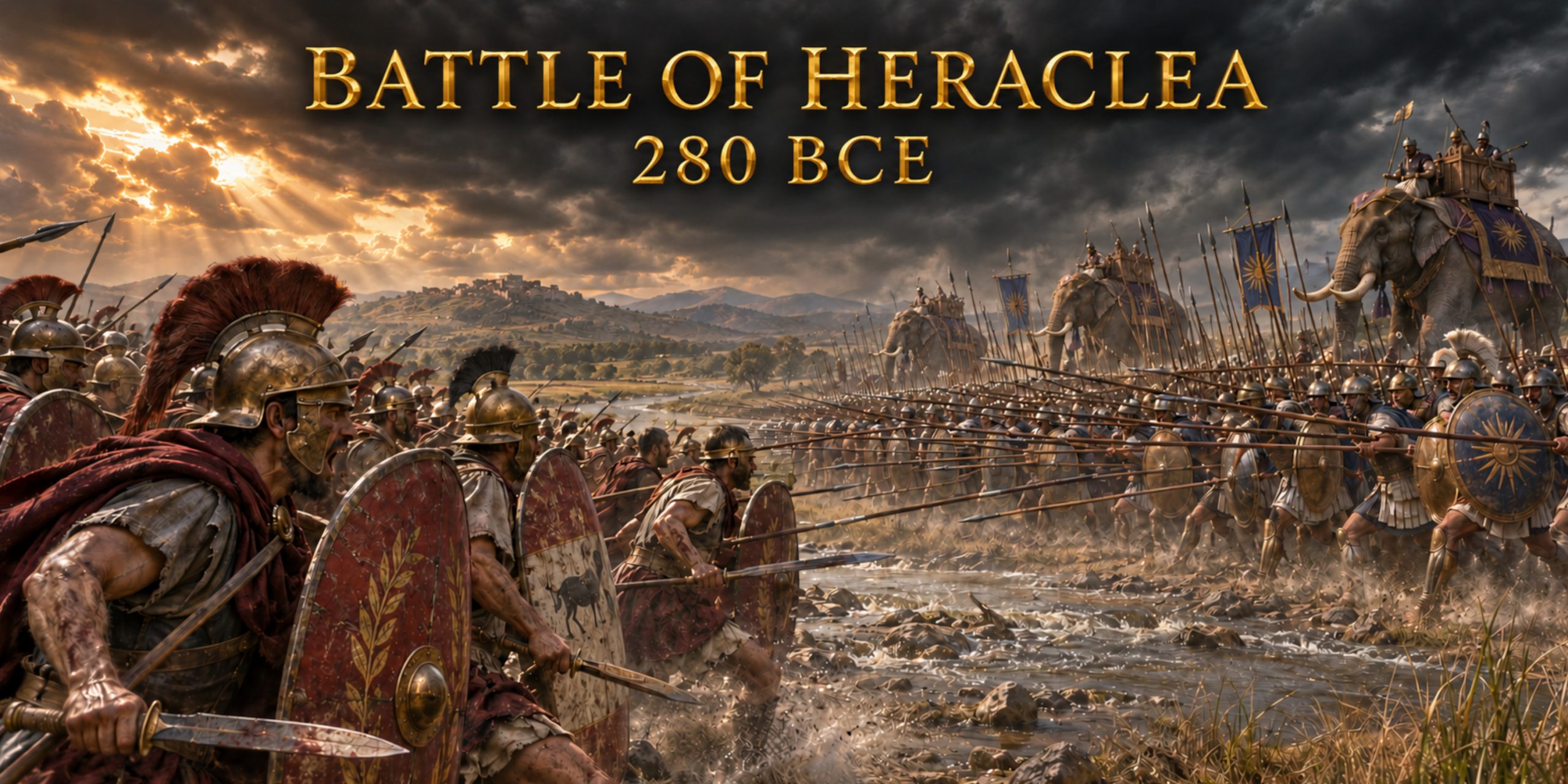
In 280 BCE, a Roman army marched towards the Greek cities of southern Italy and met a king who had brought pikes, cavalry and war elephants across the sea. Near Heraclea, beside the River Siris, Pyrrhus of Epirus won his first battle against Rome. He also discovered how difficult it would be to finish the war.
The elephants tend to get top billing. Fair enough: they made a memorable entrance. Yet Heraclea was fought for hours before they helped decide it, and the Romans proved considerably harder to shift than Pyrrhus had expected.
| At a glance | Detail |
|---|---|
| Date | 280 BCE |
| Location | Near Heraclea and the River Siris, in Lucania, southern Italy |
| Combatants | Pyrrhus of Epirus and his allies against the Roman Republic and its Italian allies |
| Commanders | Pyrrhus; consul Publius Valerius Laevinus |
| Result | Victory for Pyrrhus |
| Lasting consequence | Rome lost the battle but continued the war |
Why Pyrrhus Came to Italy
The Greek city of Tarentum, modern Taranto, was increasingly alarmed by Roman power in southern Italy. After relations broke down, its citizens sought help from Pyrrhus, king of Epirus. He was an experienced Hellenistic commander with ambitions of his own, and Italy offered rather more than a chance to settle a local quarrel.
Pyrrhus crossed to Italy with a professional army. Plutarch lists 20 elephants among the forces he transported, alongside infantry, cavalry, archers and slingers. That is useful evidence for the scale of his expedition, though it does not tell us exactly how many men or elephants stood at Heraclea on the day of battle.
Laevinus advanced through Lucania. Pyrrhus camped between Pandosia and Heraclea, while the Romans took position across the Siris. According to Plutarch, Pyrrhus inspected their camp and was impressed by its order. The Romans, he observed, did not conduct themselves like the undisciplined opponents he might have hoped to find.
Forces
The surviving sources do not support a reliable headcount for either army at Heraclea. Figures for Pyrrhus’s expedition are often repeated as if they were a roll call for this particular battle. They were not.
| Force | Command | Troops and equipment securely associated with the campaign |
|---|---|---|
| Pyrrhus and the Tarentines | King Pyrrhus of Epirus | Pike phalanx, cavalry including Thessalians, light troops and war elephants |
| Roman Republic and Italian allies | Publius Valerius Laevinus | Roman and allied infantry, cavalry and troops capable of contesting the river crossing |
Plutarch says Pyrrhus fought the battle before the Lucanians and Samnites came to join him. Their presence should therefore not be quietly added to his fighting line at Heraclea.
Leaders and Troop Composition
Pyrrhus and his army
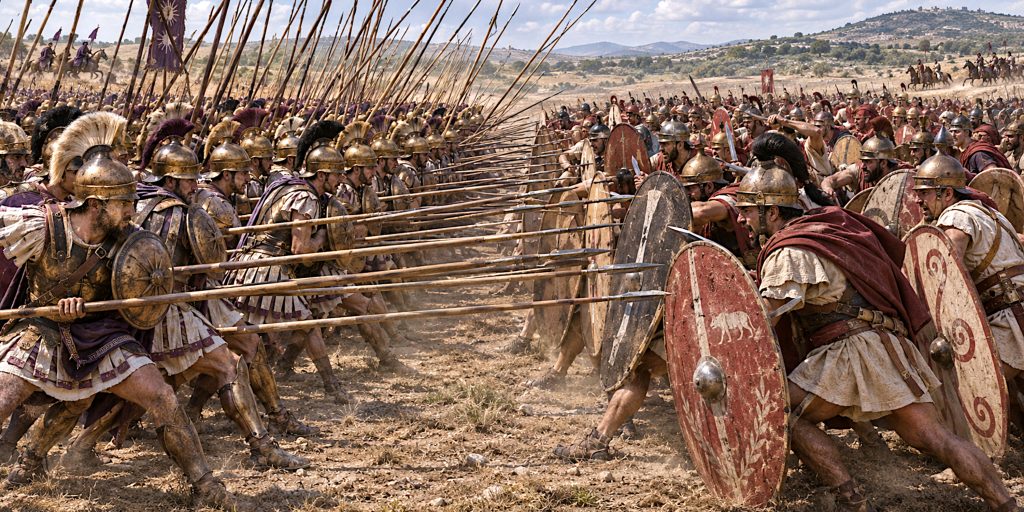
Pyrrhus commanded in person, moving between the cavalry action and his infantry. His army brought together several ways of fighting:
- Phalanx infantry carried long sarissas, presenting a dense front of pikes.
- Cavalry offered speed and the means to exploit a broken enemy line. Plutarch specifically describes a decisive charge by Thessalian horsemen.
- Light troops, including archers and slingers in the expedition, could harass an enemy before close combat.
- War elephants were an unfamiliar threat to Roman horses and became crucial late in the fighting.
Laevinus and the Romans
Laevinus led Roman citizens and Italian allies. Roman infantry fought with shields, throwing spears and thrusting or cutting weapons, while cavalry guarded and contested the flanks. We should be careful about assigning the later, neatly standardised legion to every man on this field. Our account of the battle does not give that level of detail.
The Romans crossed the Siris and pressed the attack. Whatever happened afterwards, this was no army that stood still waiting to be frightened by elephants.
Arms and Armour
| Troops | Principal weapons | Protection | Sword types and cautions |
|---|---|---|---|
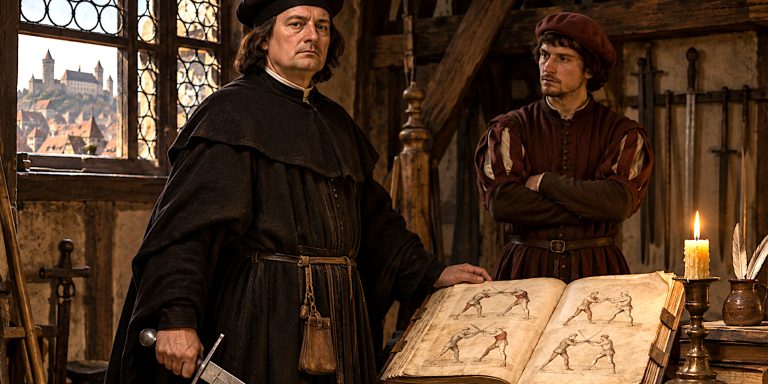
| Epirote phalanx | Long sarissa pikes | Helmets, body armour and smaller shields suited to pike fighting | A xiphos, a straight double-edged sword, was a plausible secondary weapon. Its presence in the battle cannot be established for individual units. |
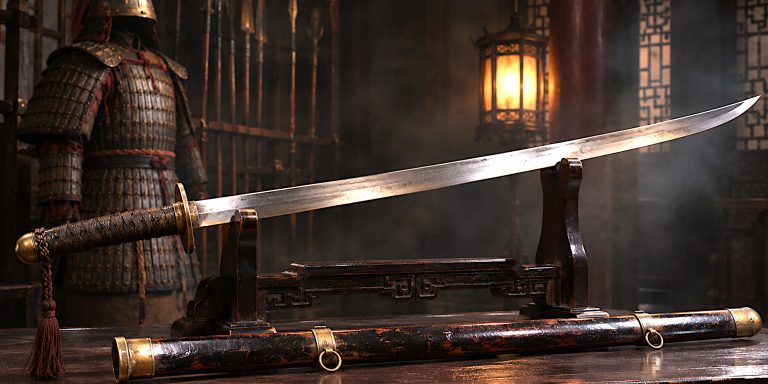
| Greek and allied cavalry | Spears and other close-combat weapons | Equipment varied by rider | Curved kopis or machaira blades belonged to the wider Greek martial tradition, but no source identifies a particular sword carried by Pyrrhus’s cavalry at Heraclea. |
| Roman and Italian infantry | Throwing spears and close-combat weapons | Shields, helmets and armour of varying kinds | Early Italian straight swords are more defensible here than naming the later gladius Hispaniensis as standard Roman equipment in 280 BCE. |
| War elephants | Their mass, movement and the troops accompanying them | Equipment varied | Their effect on horses and formations mattered far more than any weapon carried on their backs. |
Heraclea is often presented as a tidy trial of phalanx against legion. The armies were more mixed than that, and the battle was decided through the interaction of infantry, cavalry and elephants. A pike is impressive until a formation loses its order; a sword is useful when an opponent gets close enough to make the pike awkward. Neither observation supplies a complete account of this particular fight.
How the Battle Unfolded
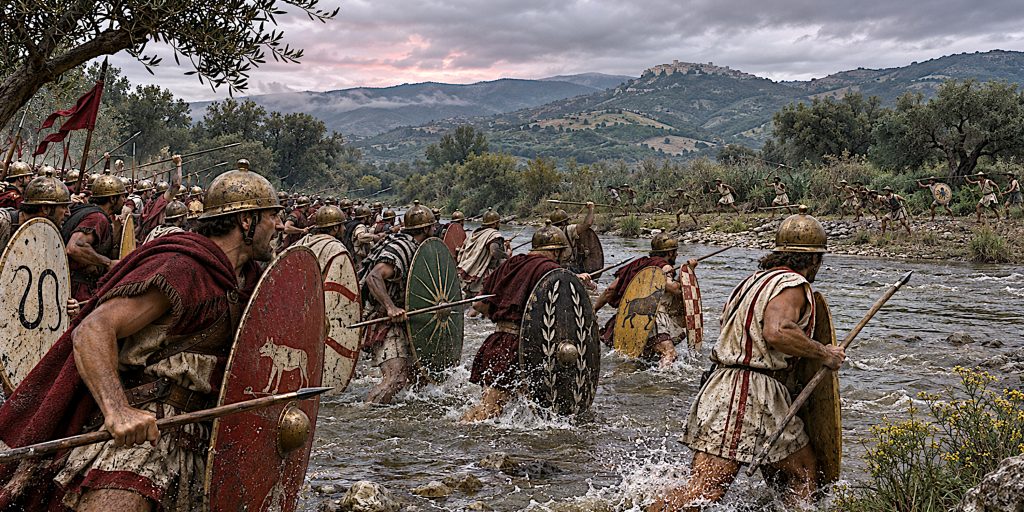
The Romans crossed the Siris and challenged Pyrrhus before all the allies he expected had arrived. Plutarch describes fierce cavalry fighting and a direct threat to Pyrrhus himself: an Italian horseman struck down the king’s horse before being killed.
Pyrrhus then brought up his phalanx. The infantry struggle remained uncertain, with Plutarch reporting repeated changes of fortune. In the confusion, Pyrrhus exchanged his distinctive armour with his companion Megacles. When Megacles was killed, Romans displayed the captured helmet and cloak and announced that the king was dead. Pyrrhus had to ride along his line with his face uncovered to prove otherwise. It is a striking episode, although, like the reported number of reversals, it comes to us through a much later literary account.
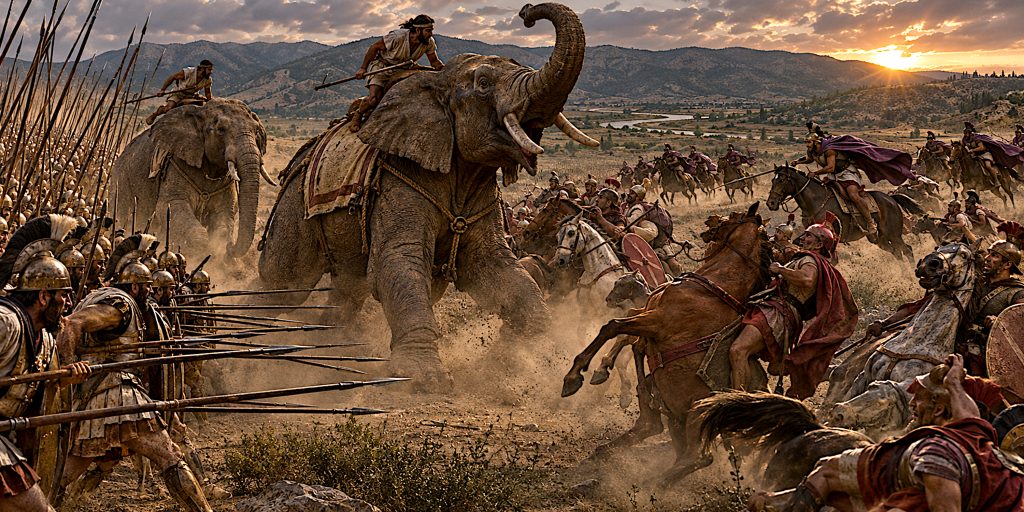
The turning point came when the elephants pressed the Romans. Their horses recoiled, and Pyrrhus sent in his Thessalian cavalry against the disorder. The Romans withdrew, leaving their camp to the victors. Pyrrhus had won the field, but he had lost experienced men whom he could not readily replace.
Battle Timeline
The sources describe a sequence of events, not a reliable hour-by-hour schedule.
| Stage | Event |
|---|---|
| Before battle | Pyrrhus positions his army near Heraclea; Laevinus approaches from across the Siris. |
| Opening | Roman forces cross the river and fighting develops, including a cavalry encounter. |
| Main engagement | Pyrrhus commits his phalanx. The infantry struggle remains contested. |
| Crisis | Megacles is killed while wearing Pyrrhus’s armour; a false report spreads that the king has fallen. |
| Turning point | Elephants disrupt the Roman force, particularly its horses. Thessalian cavalry exploits the confusion. |
| Aftermath | The Romans retreat and abandon their camp. Pyrrhus gains allies but has suffered serious losses. |
Casualties and Outcome
Pyrrhus won. The casualty figures are considerably less certain.
Plutarch preserves two sharply different accounts. He says Hieronymus reported 7,000 Roman dead and fewer than 4,000 on Pyrrhus’s side. Dionysius, as quoted by Plutarch, put the losses at nearly 15,000 Romans and 13,000 of Pyrrhus’s men. Neither set should be presented as a confirmed count. Both, however, convey a costly battle.
Victory opened opportunities for Pyrrhus. Some cities and communities joined him, and he advanced towards Rome. But the Republic raised further forces and refused to treat one defeat as the end of the matter. Pyrrhus could win a battle against Rome. Making Rome accept his terms was another undertaking altogether.
Archaeology: What Can We Place on the Ground?
Ancient accounts place the battle near Heraclea and the River Siris, in the area of modern Policoro. That provides a broad geographical setting, not a securely mapped battlefield. The course of the fighting, the position of each formation and the precise crossing point cannot currently be traced from a confirmed battlefield assemblage.
Finds from ancient Heraclea illuminate the city and its wider region, but an isolated weapon or coin does not become evidence of this battle simply because it was found nearby. Claims that excavated Roman camps, elephant remains or named armour pieces prove particular episodes at Heraclea need a documented find context before they can carry that weight. Here the written sources tell us far more than the ground has yet yielded.
Voices from the Ancient Sources
No surviving eyewitness transcript lets us hear the commanders at Heraclea. The following words are reported by Plutarch, writing centuries after the event, rather than securely recorded contemporary quotations.
“The discipline of these Barbarians is not barbarous.”
Plutarch attributes this observation to Pyrrhus after he inspected the Roman camp. It captures the surprise in his account, though we cannot verify the king’s exact words.
“The Romans neither chose Pyrrhus as a mediator nor feared him as a foe.”
This is Plutarch’s account of Laevinus’s reply when Pyrrhus proposed to arbitrate before battle. It is a later writer’s rendering of Roman defiance, not a stenographer’s record.
The familiar remark that one more victory over the Romans would ruin Pyrrhus belongs to accounts of Asculum in 279 BCE, not to a securely recorded statement after Heraclea. It makes a neat closing line, which is perhaps why it so often turns up a battle early.
Why Heraclea Matters
Heraclea showed that a Hellenistic army under a capable commander could defeat Rome in Italy. It also showed that the Romans could fight such an army hard enough to make victory expensive. The elephants helped settle the battle; they did not win it alone.
What stays with me is Pyrrhus’s predicament after the fighting. He held the field, captured the Roman camp and gained new support. Across from him stood a republic already preparing to raise more men. A king could count the ground he had taken. Counting how many victories it would take to end the war was rather less comfortable.
Sources
- Plutarch, Life of Pyrrhus, chapters 15–18. The principal surviving narrative used here. Plutarch wrote long after the battle and preserves differing casualty reports.
- Dionysius of Halicarnassus, Roman Antiquities, Book XIX. Survives in excerpts; Plutarch also reports Dionysius’s casualty estimate.
- Roman Warfare in the Age of Pyrrhus, World History Encyclopedia. Background on the armies and the wider campaign.