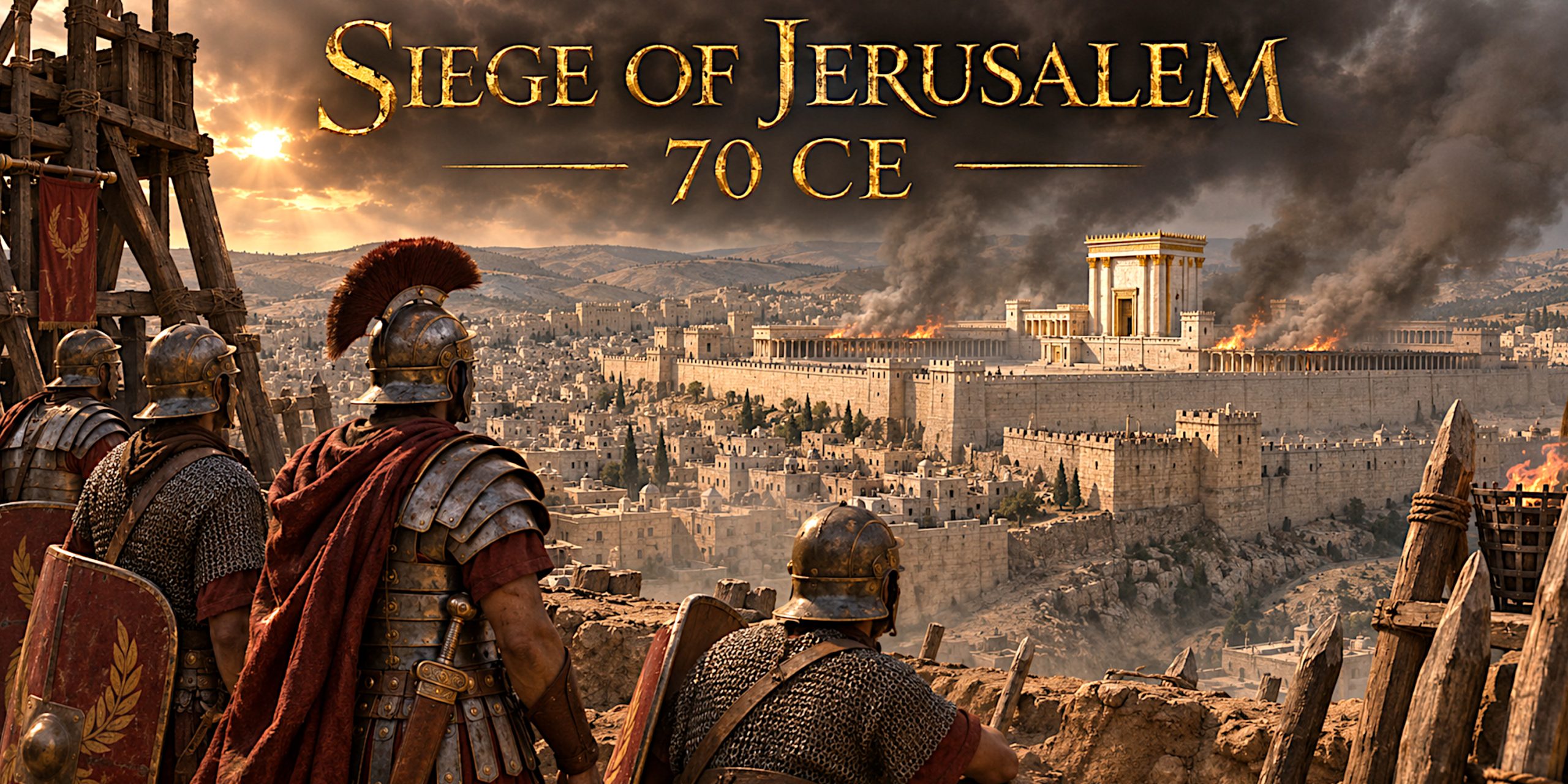
In the spring of 70 CE, Titus brought a Roman army to Jerusalem to finish a war his father had begun. By September, the city had fallen, the Second Temple had been destroyed, and an immense number of people had been killed or taken captive.
The siege was a Roman military victory and a catastrophe for the city’s Jewish population. It also became a foundation of Flavian imperial prestige. Rome displayed the Temple’s treasures in triumph; the people from whom they had been taken faced the destruction of their principal sanctuary and the collapse of their capital.
What troubles me most about this siege is how easily its human history disappears beneath its famous ending. Jerusalem did not fall in a single spectacular assault. Its defenders contested walls, streets and courtyards over months, while civilians endured hunger, coercion and an increasingly hopeless search for safety.
Siege of Jerusalem at a Glance
| Detail | Summary |
|---|---|
| Date | Spring to September 70 CE |
| Location | Jerusalem, Roman Judaea |
| War | First Jewish Revolt, 66–73/74 CE |
| Roman commander | Titus |
| Principal Jewish leaders | Simon bar Giora and John of Gischala |
| Outcome | Roman capture of Jerusalem |
| Defining consequence | Destruction of the Second Temple |
Background: Why Rome Besieged Jerusalem
The revolt began in 66 CE amid oppressive administration, religious tensions and violence between communities. The defeat of the Syrian governor Cestius Gallus gave the insurgents a substantial early success. Rome responded with a larger campaign under Vespasian, supported by his son Titus.
Roman operations steadily reduced resistance outside Jerusalem. Then imperial politics interrupted the campaign. Nero died in 68 CE, and the ensuing civil wars eventually brought Vespasian to power in 69 CE. Titus inherited responsibility for completing the conquest.
Victory mattered to the new dynasty. The Flavians had acquired the throne through civil war; an external triumph offered a more comfortable subject for public celebration. Roman public relations rarely suffered from excessive modesty.
Inside Jerusalem, meanwhile, resistance had fractured into competing armed movements. Their leaders differed in loyalties and ambitions, and their struggles damaged the city’s ability to withstand the approaching army. That does not mean its inhabitants shared a single political programme, or that everyone trapped there had chosen war.
Forces
Ancient figures are not surviving muster rolls. Roman totals depend on assumptions about legionary strength, detachments, auxiliaries and allied contingents. The defenders’ numbers are particularly uncertain.
| Side | Estimated strength | Main components |
|---|---|---|
| Roman army and allies | Often estimated at roughly 50,000–60,000; uncertain | Four principal legions, auxiliaries, cavalry and allied troops |
| Jewish defenders | Approximately 20,000–25,000 in common reconstructions | Rival armed factions, Idumaeans and other fighters |
| Civilian population | No secure total | Residents, refugees and festival visitors |
The four principal Roman legions were V Macedonica, X Fretensis, XII Fulminata and XV Apollinaris. These formations supplied heavy infantry and the organisation needed to sustain siege operations. Auxiliary and allied forces added missile troops, cavalry and further infantry.
The Jewish force should not be described as a uniform army of Sicarii. That name identifies a particular movement within the wider revolt, rather than a convenient label for every armed opponent of Rome.
Leaders and Troop Composition
Roman command
- Titus: Overall commander, subsequently emperor from 79 to 81 CE.
- Tiberius Julius Alexander: Senior adviser and commander, bringing substantial administrative and military experience.
- Legionary officers and specialists: Directed infantry assaults, artillery, construction and the protection of siege works.
- Auxiliaries and allies: Supplied capabilities beyond those of the legionary infantry, including mounted and missile forces.
Jewish command
- Simon bar Giora: Led a major force associated with much of the city, including the Upper City, with Idumaean support.
- John of Gischala: Controlled another principal faction, increasingly centred on the Temple area.
- Eleazar son of Simon: Initially headed a separate Temple faction, which John absorbed early in the siege.
- Other defenders: Included experienced insurgents alongside fighters whose training and equipment are much harder to establish.
Factional conflict weakened resistance, but the defenders could still cooperate against Roman attacks. Their ability to destroy siege works and fight repeated close actions deserves more attention than the familiar shorthand of religious fanaticism allows.
Jerusalem’s Defences
Jerusalem’s topography was a formidable military asset. Deep valleys protected much of its eastern, southern and western approaches. The more accessible northern sector became the principal direction of Roman attack.
The city’s walls were not three neat concentric rings. Successive fortifications enclosed different districts, while the Temple enclosure, Antonia fortress and Upper City created further defensive problems.
A breach therefore did not deliver Jerusalem to Titus. It opened another stage of the fighting. Streets restricted movement, buildings sheltered defenders, and an advancing force could find itself exposed to missiles from above.
Arms and Armour
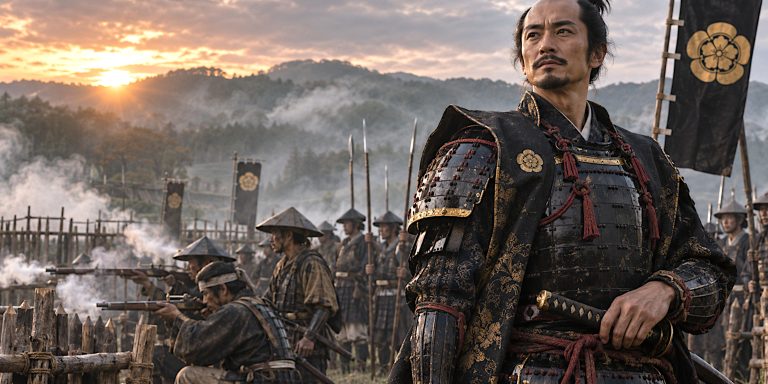
The Roman army possessed a substantial advantage in equipment, supply and specialist labour. Its appearance was nevertheless more varied than the identical segmented cuirasses of many screen reconstructions suggest.
| Equipment | Roman use | Jewish defenders |
|---|---|---|
| Swords | Gladii for infantry; longer spathae associated with cavalry | Mixed swords, including captured Roman weapons |
| Spears and javelins | Pila, auxiliary spears and other throwing weapons | Spears, javelins and reused military equipment |
| Missile weapons | Bows, slings and torsion artillery | Bows, slings and captured artillery |
| Shields | Curved rectangular scuta and other shield forms | Varied shields; no secure universal pattern |
| Body armour | Mail, segmented armour and some scale armour | Uneven provision, including captured equipment |
| Siege equipment | Rams, towers, protective structures and earthworks | Fire attacks, countermining and attacks on works |
Specific Sword Types
The Pompeii-type gladius, with parallel edges and a relatively short triangular point, is appropriate to the later first-century Roman army. Mainz-type gladii, with longer points and more shaped blades, belong to the preceding and overlapping equipment tradition. Their relevance to the period does not establish which pattern every unit carried at Jerusalem.
The spatha, a longer sword associated with Roman cavalry, also belongs in the wider military picture. The pugio was a dagger rather than a sword and should be identified separately.
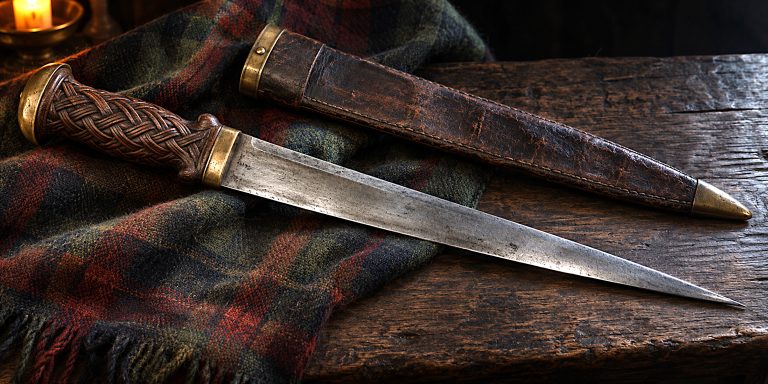
For the Jewish defenders, the evidence does not support a single named national sword type. Roman blades could pass into insurgent hands through capture, purchase or earlier service. Nor does a curved dagger automatically identify its owner as a member of the Sicarii.
I would also avoid dressing the defenders collectively in leather armour. Where the evidence is thin, a confident costume description merely gives uncertainty a wardrobe.
How the Siege Unfolded
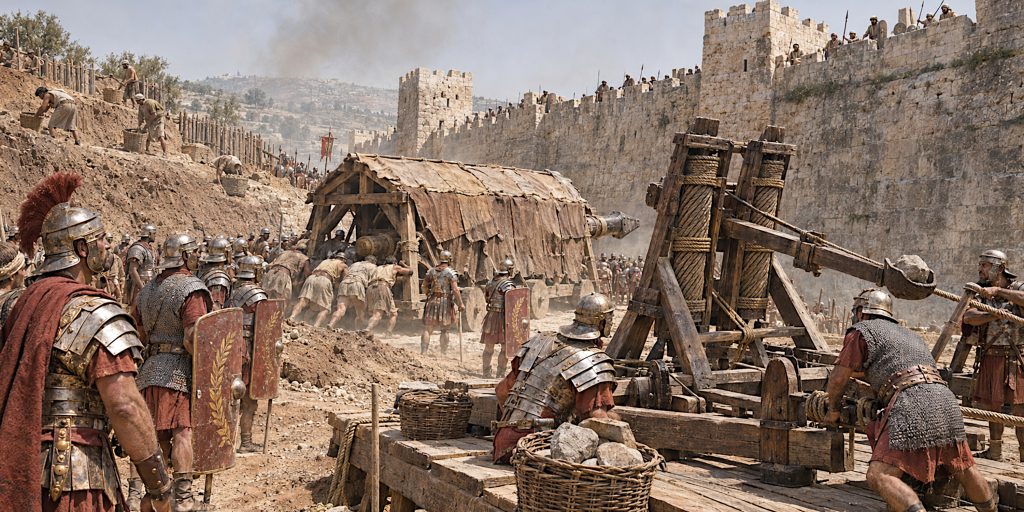
Fighting Through the Northern Defences
Titus approached around Passover, when visitors were present in Jerusalem. Roman assaults concentrated on the northern walls, supported by artillery and engineering works. The defenders answered with sorties and close fighting rather than waiting passively behind the masonry.
Capturing successive positions required repeated effort. Roman discipline mattered, but so did the practical ability to replace damaged works, maintain supplies and keep men labouring under attack.
Encirclement and Famine
After serious setbacks to Roman siege works, Titus imposed a tighter blockade through a surrounding barrier, usually called a circumvallation. Its purpose was to obstruct escape and the movement of provisions.
Hunger became a weapon. People attempting to find food or flee faced danger from both the besieging forces and armed groups within the city. Civilian suffering was central to the operation, not incidental to it.
Josephus’s descriptions are harrowing, but they also serve his argument that the insurgent leaders brought disaster upon their own people. We can recognise coercion inside Jerusalem without allowing that argument to absolve the army starving it from outside.
The Temple and Upper City
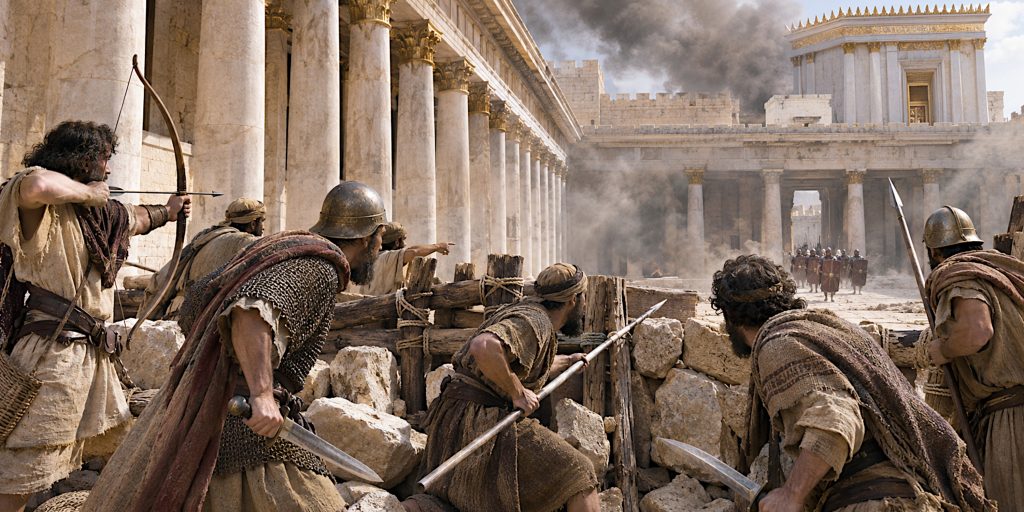
The capture of the Antonia position brought Roman troops against the Temple complex. Fighting spread through its courts and porticoes before the sanctuary burned in August.
Resistance continued elsewhere. The Upper City fell in September after further Roman preparations, assaults and the progressive collapse of organised defence.
Did Titus Order the Temple’s Destruction?
Josephus presents Titus as wishing to preserve the sanctuary, with soldiers disregarding his orders during the fighting. That account may preserve real events, but it also protects the reputation of the author’s imperial patron.
It is therefore unsafe to present Titus’s wish to save the Temple as settled fact. Whether the decisive fire followed an explicit order, an individual act or a wider breakdown of control remains disputed.
The essential responsibility is clearer than the precise command sequence. The Temple was destroyed during the Roman conquest, and the victorious dynasty publicly celebrated the spoils taken from it.
Battle Timeline
Ancient calendar dates do not always translate neatly into modern ones. This table uses broad dating where apparent precision would conceal uncertainty.
| Date | Event |
|---|---|
| 66 CE | Revolt begins; Cestius Gallus’s expedition suffers defeat |
| 67–68 CE | Vespasian’s campaigns reduce resistance outside Jerusalem |
| 69 CE | Vespasian gains the imperial throne |
| Spring 70 CE | Titus advances on Jerusalem around Passover |
| May–June | Successive northern defences are breached; Roman works face counterattacks |
| Late spring–summer | Tighter encirclement intensifies famine |
| July | Roman capture and clearance of Antonia opens the Temple approach |
| August | Temple complex falls and the sanctuary burns |
| September | Upper City falls; organised resistance in Jerusalem ends |
| 71 CE | Vespasian and Titus celebrate their triumph in Rome |
| 73/74 CE | Masada falls in a later operation |
Archaeology: What Survives of the Siege?
Archaeology brings the destruction back to the scale of streets and households. It also requires care: a Roman object found in Jerusalem need not have been deposited during the siege itself.
The Burnt House
The Burnt House in the Jewish Quarter preserves a domestic destruction context associated with 70 CE. Excavation recorded collapsed and burnt material sealing household remains, including stone vessels.
This is valuable evidence of violent destruction in the Upper City. It cannot independently identify every person involved or verify every scene described by Josephus.
Streets, Masonry and Military Finds
Collapsed masonry beside the Temple enclosure, damaged streets and destruction deposits contribute to the wider picture. Their precise sequence must be assessed context by context. Archaeological excavation reports are more useful here than a general claim that every fallen stone landed during one dramatic afternoon.
Weapons and projectiles can illuminate the conflict, while later military inscriptions and building materials help trace the Roman occupation. Those are related questions, but they are not interchangeable.
What the Western Wall Represents
The Western Wall is part of the retaining structure supporting the enlarged Temple platform. It is not a surviving wall of the sanctuary itself. The distinction matters both architecturally and when describing what Rome destroyed.
The Arch of Titus
In Rome, the Arch of Titus depicts the Temple’s menorah and other spoils being carried in procession. Erected after Titus’s death under Domitian, it offers evidence of how the Flavian dynasty commemorated the conquest.
It is an imperial monument, designed to honour the victors. Its perspective is as deliberate as Josephus’s prose.
Contemporary Quotes and Their Limitations
Our fullest surviving account comes from Flavius Josephus, a former Jewish commander who surrendered to the Romans and later wrote under Flavian patronage. His proximity to events makes him indispensable; his loyalties make critical reading essential.
Describing the Temple fighting, he writes:
“each one’s own passion was his commander at this time.”
Josephus, The Jewish War, Book VI, chapter 4, William Whiston translation, with spelling modernised.
The passage conveys uncontrolled violence while supporting Josephus’s presentation of Titus as unable to restrain his soldiers. It should be read with both purposes in mind.
Tacitus, writing several decades later rather than as an eyewitness, also acknowledges the defenders’ determination:
“Both men and women showed the same determination”
Tacitus, Histories, Book V, chapter 13, Clifford H. Moore translation.
Tacitus’s surrounding account contains pronounced anti-Jewish prejudice and unreliable ethnographic claims. A useful observation does not make the whole narrative trustworthy.
Casualties and the Fate of the Survivors
The death toll cannot be calculated securely. Josephus gives 1.1 million dead at Jerusalem and 97,000 captives across the war. Those figures should be reported as his claims, rather than accepted statistics. His population assumptions and the rhetorical force of enormous numbers require particular caution.
The scale of suffering nevertheless remains beyond reasonable doubt. People died through combat, massacre and starvation. Survivors faced enslavement, forced labour and other forms of captivity. Simon bar Giora was subsequently executed at the Roman triumph; John of Gischala received imprisonment for life.
Uncertainty about totals is a reason for honest accounting, not for minimising the destruction.
Why the Siege Matters
The destruction of the Second Temple ended its sacrificial worship and transformed the conditions of Jewish religious life. Over subsequent generations, Jewish communities developed institutions and practices within a world profoundly altered by that loss.
The siege did not begin the Jewish diaspora. Substantial Jewish communities had existed outside Judaea for centuries. Nor did it remove every Jew from Jerusalem’s surrounding region or end Jewish life in the land.
It also did not immediately end the revolt. Roman operations continued against remaining strongholds, including Masada.
For military history, Jerusalem demonstrates the interaction of difficult terrain, determined resistance, engineering and blockade. For Jewish history, it marks the destruction of a sanctuary whose significance cannot be reduced to its value as a fortified position.
I find the contrast between the Burnt House and the Arch of Titus especially revealing. One preserves the consequences within a home; the other displays the conquest as imperial achievement. Both belong in the history of the siege. Neither should be allowed to speak for everyone who lived through it.
Sources and Further Reading
- Flavius Josephus, The Jewish War, Books V–VI: Main narrative for the siege, its factions, assaults and civilian suffering. Book V and Book VI, William Whiston translation.
- Tacitus, Histories, Book V, chapters 1–13: Later Roman account, useful for comparison but requiring caution over its prejudices and figures. Read the translation.
- Israel Antiquities Authority, “Jerusalem, the Old City – the Jewish Quarter, the ‘Burnt House’”, Hadashot Arkheologiyot, volume 117, 2005: Excavation report on the domestic destruction context. Read the report.
- Trimontium Museum, “Gladius: NMS ref X.FRA 138”: Comparative evidence for Roman sword forms, including the Pompeii type. This is not a Jerusalem find. Museum record.
- Parco archeologico del Colosseo, “Arch of Titus”: Official account of the monument and its representation of the Temple spoils. Monument guide.
- Martin Goodman, Rome and Jerusalem: The Clash of Ancient Civilizations: Further reading on the wider relationship between Roman and Jewish society.
- Jodi Magness, Jerusalem Through the Ages: From Its Beginnings to the Crusades: Further reading on the city’s archaeological and historical development.