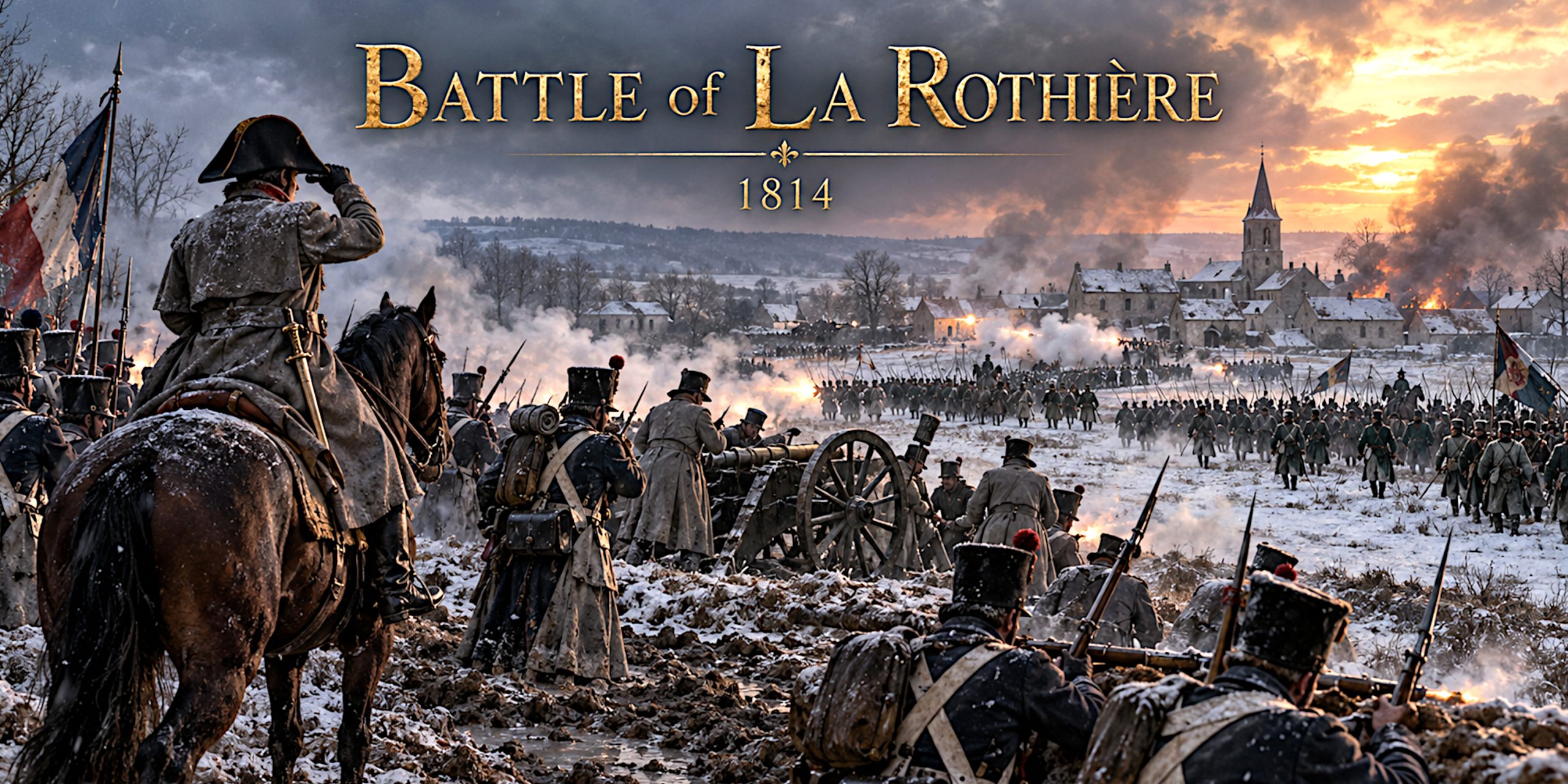
On 1 February 1814, Napoleon’s army fought a much larger Coalition force around La Rothière in Champagne. Snow obscured the battlefield, artillery struggled through waterlogged ground, and French troops defended villages that became increasingly difficult to support. By nightfall, Napoleon had to withdraw.
La Rothière was a serious defeat, particularly because of the guns the French lost. It did not, however, settle the campaign. Within days, Napoleon would exploit divisions between his opponents and recover much of his battlefield confidence.
What interests me most about La Rothière is how stubbornly it resists a tidy explanation. Coalition numbers mattered, but so did French dispositions, Allied initiative and the difficulty of moving anything heavier than a disappointed infantryman through winter mud.
Battle of La Rothière at a Glance
| Detail | Summary |
|---|---|
| Date | 1 February 1814 |
| Location | La Rothière and neighbouring villages, near Brienne, north-eastern France |
| War | War of the Sixth Coalition |
| French commander | Napoleon Bonaparte |
| Coalition battlefield commander | Gebhard Leberecht von Blücher |
| Senior Coalition commander | Karl Philipp, Prince of Schwarzenberg |
| Result | Coalition victory and French withdrawal |
| Principal significance | A costly French reverse during the defence of France in 1814 |
Blücher directed the battle, although many of the formations involved belonged to Schwarzenberg’s Army of Bohemia. Describing the action simply as Napoleon against a Prussian army misses the multinational character of the force that defeated him.
Why the Battle Happened
The invasion of France followed the collapse of Napoleon’s position in Germany during 1813. Defeat at Leipzig, the loss of German allies and the retreat beyond the Rhine left him rebuilding an army while Coalition forces approached.
Napoleon left Paris on 25 January 1814 to take command. Four days later, he attacked Blücher at Brienne, where he had attended military school. The French secured a limited victory, but failed to prevent their opponents from withdrawing towards supporting forces.
The opportunity Napoleon wanted was a battle against an isolated enemy. The danger was that Blücher and Schwarzenberg would combine.
At La Rothière, that danger became immediate. Napoleon was preparing to move towards Troyes when reports of an Allied advance forced him to turn his attention back to the south. Some French reserves had already begun marching away and had to be recalled.
Forces
Strength figures vary because accounts count different combinations of troops present, troops engaged and reserves within supporting distance. A range is more useful than an impressive-looking total built from incompatible returns.
| Army | Approximate strength | Artillery | Important qualification |
|---|---|---|---|
| French | Roughly 36,000–45,000 men | About 128 guns commonly cited | Estimates differ over attached formations and men available during the action |
| Coalition | Roughly 80,000 men involved or immediately supporting the battle | Around 200 guns commonly cited | Larger totals include additional reserves and nearby formations |
The French were substantially outnumbered, but the Coalition could not deploy its entire strength simultaneously. Roads, woods, villages and winter conditions restricted how quickly its formations could enter the fighting.
Leaders and Troop Composition
| Commander | Formation or responsibility | Role at La Rothière |
|---|---|---|
| Napoleon Bonaparte | French army | Directed the defence and eventual withdrawal |
| Marshal Victor | II Corps | Held much of the centre, including troops defending La Rothière |
| General Étienne Maurice Gérard | French right wing | Defended Dienville and the approaches beside the Aube |
| Marshal Auguste de Marmont | VI Corps | Held the exposed French left around Morvilliers |
| Marshal Michel Ney | Young Guard formations | Provided reserves and support during the crisis |
| General Étienne de Nansouty | Guard cavalry | Directed mounted action near the centre |
| General Emmanuel de Grouchy | Cavalry formations | Supported the French line |
| Field Marshal Blücher | Coalition battlefield command | Coordinated the attack |
| General Fabian von Osten-Sacken | Russian corps | Attacked La Rothière |
| General Zakhar Olsufiev | Russian corps | Supported the central advance |
| General Ignác Gyulay | Austrian III Corps | Attacked towards Dienville |
| Crown Prince William of Württemberg | Württemberg IV Corps | Advanced through the La Giberie sector |
| General Carl Philipp von Wrede | Bavarian-Austrian V Corps | Threatened and turned the French left |
The formations included line infantry, light infantry, cavalry and artillery. Wrede’s command contained Austrian as well as Bavarian troops, while Blücher’s own attacking corps were Russian. National labels require rather more care than the flags on a battle map suggest.
The Battlefield and Winter Conditions
The French position connected several villages, with Dienville beside the Aube on the right and Marmont’s troops extending towards Morvilliers on the left.
Villages offered shelter and defensive positions. The intervals between them were harder to secure. Napoleon had insufficient infantry to make the whole front equally strong, leaving cavalry to cover gaps.
Rain had soaked the ground before frost formed a thin crust. Snow squalls then reduced visibility. Beneath the wintry surface remained mud capable of exhausting horses and delaying guns.
These conditions affected both armies. They hindered Coalition deployment, but also made French reinforcement and withdrawal more difficult. Winter supplied neither side with a convenient exemption from logistics.
Arms and Armour

Muskets, bayonets and artillery caused the principal battlefield effects. Swords remained important for mounted troops, particularly during charges, counter-charges and the pursuit of broken formations.
The following patterns describe equipment associated with the armies and troop types involved. They should not be read as an inventory of weapons recovered at La Rothière.
| Troop type | Weapons and equipment | Battlefield purpose |
|---|---|---|
| French line infantry | Model 1777 and corrected An IX family flintlock muskets, socket bayonets | Volley fire, skirmishing and village defence |
| French light cavalry | Curved An IX and An XI light cavalry sabres, carbines and pistols | Reconnaissance, screening and mounted combat |
| French dragoons | Straight An XI family dragoon swords, firearms | Mounted shock action and support |
| French heavy cavalry | Straight An XI and An XIII family heavy cavalry swords; cuirasses for cuirassier units | Charges and close mounted fighting |
| Selected French infantry and Guard troops | Short infantry sabres, including briquet patterns | Secondary sidearms |
| Russian infantry | Model 1808 muskets among a mixed supply of service arms, socket bayonets | Infantry assaults and defensive fire |
| Russian light cavalry | Curved sabres, including the Model 1809 pattern | Charges, pursuit and protection of infantry |
| Austrian, Bavarian and Württemberg troops | National-pattern flintlocks, bayonets, cavalry swords and sabres | Combined infantry, cavalry and artillery operations |
The French An XI light cavalry sabre is documented in France’s national heritage catalogue. The Polish Army Museum identifies the Russian Model 1809 sabre with hussar, uhlan and Life Cossack service. These are firmer descriptions than assigning every mounted soldier a generic “Napoleonic sword”.
Armour was limited. Cuirassiers wore metal body protection, but most soldiers relied on uniforms, greatcoats and whatever shelter they could find. A shako was headgear, not a dependable answer to artillery.
It is also misleading to make the Prussian Model 1811 “Blücher sabre” the defining weapon of this battle merely because Blücher commanded it. The identity of a commander does not establish the equipment of his army.
How the Battle Unfolded

The Coalition advance developed around midday, with major fighting beginning in the early afternoon.
In the centre, Russian cavalry and artillery became heavily engaged with French mounted troops near La Rothière. Russian counter-charges captured French guns, weakening a defence that depended on artillery support.
Sacken’s infantry pressed into the village. French troops resisted among houses and gardens, while further fighting developed around La Giberie and Petit-Mesnil. Victor’s counter-attacks recovered ground, but could not remove the wider danger.
On the French right, Gérard held Dienville against Gyulay’s Austrians. This sector remained comparatively secure.
The decisive pressure came on the opposite flank. Wrede’s advance forced Marmont back and threatened the connections between French formations. Napoleon committed reserves, but restoring the entire position was beyond the strength available. French resistance continued into darkness before the army withdrew.
Battle Timeline
Times are approximate. Accounts differ over the timing of individual attacks.
| Time | Event |
|---|---|
| 29 January | Napoleon fights Blücher at Brienne |
| 30–31 January | Coalition forces concentrate south of the French |
| Morning, 1 February | Napoleon prepares a movement towards Troyes |
| Around midday | Reports reveal a substantial Coalition advance; French reserves are recalled |
| Early afternoon | Cavalry and artillery fighting develops near La Rothière |
| Mid to late afternoon | Russian infantry presses into La Rothière; fighting intensifies around La Giberie |
| Late afternoon | Wrede’s advance places Marmont’s left wing under severe pressure |
| Evening | French reserves support threatened sectors and help prevent a collapse |
| Night, 1–2 February | Napoleon withdraws through the Brienne area towards Troyes |
| 10 February | Victory at Champaubert begins Napoleon’s Six Days’ Campaign |
The main battle was an afternoon and evening action, rather than a general offensive beginning at dawn.
Contemporary Voices
Contemporary reports are useful here because they describe the physical difficulty of fighting, rather than supplying suspiciously polished battlefield speeches.
The Crown Prince of Württemberg, reporting to Schwarzenberg, described the movement of cavalry and artillery through a defile:
“It was not without difficulty”
Major Prince Thurn und Taxis, an officer on Wrede’s staff, described conditions as:
“frightful with eddies of snow obscuring the skyline”
Both extracts appear in English translation in Maurice Weil’s later campaign study, which reproduces and cites contemporary reports and journals. They convey the restricted movement and visibility that shaped the action.
Casualties and Equipment Losses
| Loss | French | Coalition |
|---|---|---|
| Killed, wounded, missing and captured | Approximately 5,600–6,000 | Approximately 6,000–7,000 |
| Artillery | Around 50–73 guns lost, depending on the account | No comparable loss of guns generally reported |
These figures are estimates, particularly where missing men and prisoners are concerned.
The artillery losses made the French defeat especially damaging. A lost gun represented more than a barrel and carriage: trained crews, horses, ammunition and transport were all part of the system Napoleon struggled to maintain.
Archaeology and Surviving Evidence
The battlefield can still be studied through its landscape, settlements, historical maps and documentary record. A memorial on Rue Haute in La Rothière commemorates the battle. TracesOfWar.com
Claims about excavated weapons require greater caution. The sources checked for this article do not establish a published systematic excavation supporting the earlier claims about recovered cuirassier sword parts.
A useful distinction is between:
- Documented archaeological finds, recorded with their location and context.
- Objects attributed to the battlefield, whose provenance may be incomplete.
- Period weapons in collections, which illustrate equipment without proving use at La Rothière.
A musket ball without a recorded findspot can tell us something about ammunition. It has considerably less to say about which battalion stood in a particular field.
Why La Rothière Mattered
La Rothière demonstrated what the Coalition could achieve when its armies concentrated against Napoleon. It forced a retreat, cost the French valuable equipment and weakened their position during the defence of France.
Yet the victors subsequently separated their main armies. Schwarzenberg advanced towards Troyes, while Blücher moved along a more northerly axis. The distance between them gave Napoleon an opportunity to attack isolated formations during the Six Days’ Campaign.
My reading of La Rothière is therefore less fatalistic than the familiar description of it as the beginning of the end. Napoleon’s empire was already in profound trouble. This battle exposed those difficulties without making the subsequent campaign inevitable.
The French army retained enough cohesion to fight again. What it increasingly lacked was the capacity to replace what each battle consumed.