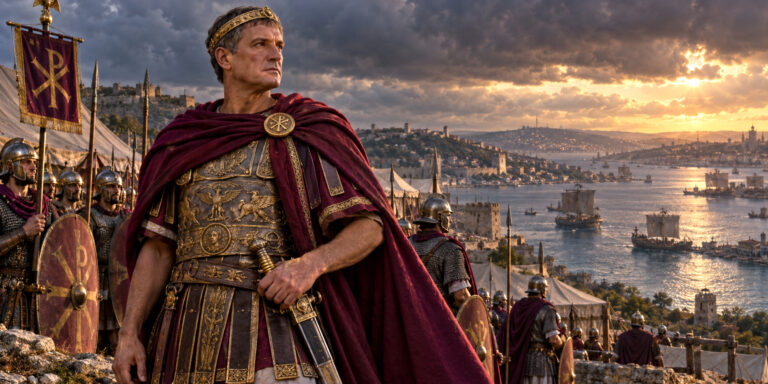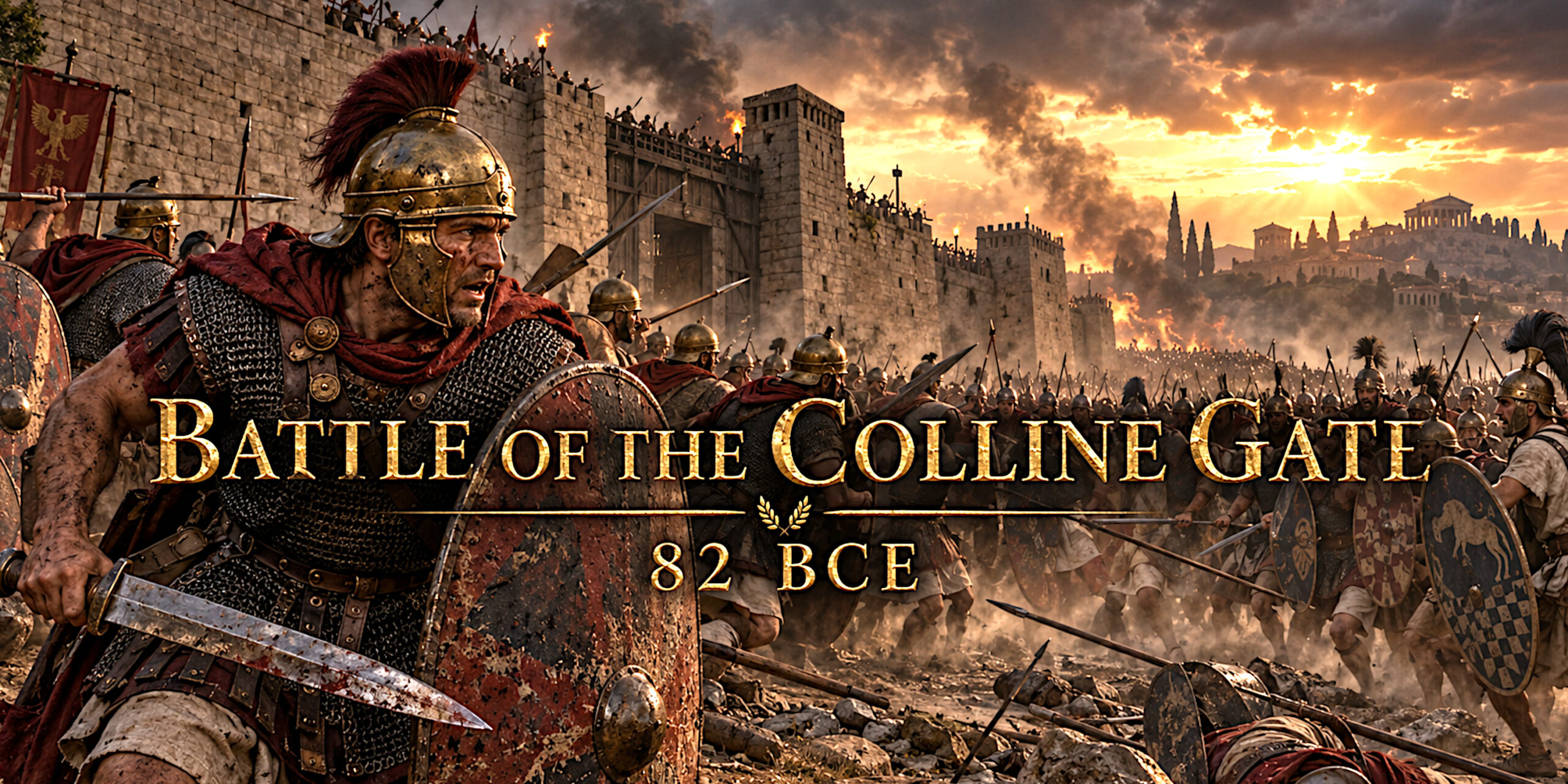
The Battle of the Colline Gate, fought on 1 November 82 BCE, secured Lucius Cornelius Sulla’s control of Rome. Outside the city’s northern defences, his army defeated a coalition of Samnite, Lucanian and Roman opponents. The victory helped clear his path to dictatorship, although fighting against his enemies continued elsewhere.
What interests me most about this battle is how close the outcome appears to have been. Sulla’s eventual dominance can make his victory feel inevitable. On the day itself, part of his army collapsed, his opponents threatened the approaches to Rome, and reports circulated that he was dead. History looks considerably tidier when the survivors have finished writing it.
Why Was the Battle of the Colline Gate Fought?
The battle brought together two overlapping conflicts: Rome’s civil war and the unfinished grievances of its Italian allies.
During the Social War, which began in 91 BCE, Italian communities had fought Rome over their political position and access to citizenship. Subsequent concessions changed Italy’s legal landscape, but they did not erase regional loyalties, military resistance or fear of Roman retaliation.
Meanwhile, Sulla’s struggle with the supporters of Gaius Marius had turned political competition into open warfare. By late 82 BCE, Marius the Younger was besieged at Praeneste, modern Palestrina. Attempts to relieve him had failed.
An anti-Sullan army, including substantial Samnite and Lucanian forces, then moved against Rome. Threatening the capital offered a chance to overturn an increasingly desperate military situation. Sulla hurried to intercept it. The fighting outside the Colline Gate followed.
Calling the attackers simply “the Marian army” obscures their different interests. Roman commanders were fighting for political survival; Italian contingents had their own reasons to resist Sulla.
Where Was the Colline Gate?
The Porta Collina, or Colline Gate, stood in the northern section of Rome’s Republican defences, conventionally called the Servian Wall. Roads leading towards the Via Salaria and Via Nomentana passed through this strategically important approach.
Its location falls within modern Rome, around the junction of Via Venti Settembre and Via Goito, near the Ministry of Economy and Finance.
This was principally a battle outside the city’s fortifications. Describing it as a street battle gives the wrong impression, although retreating troops and fighting around the entrance brought the violence dangerously close to Rome’s interior.
Forces
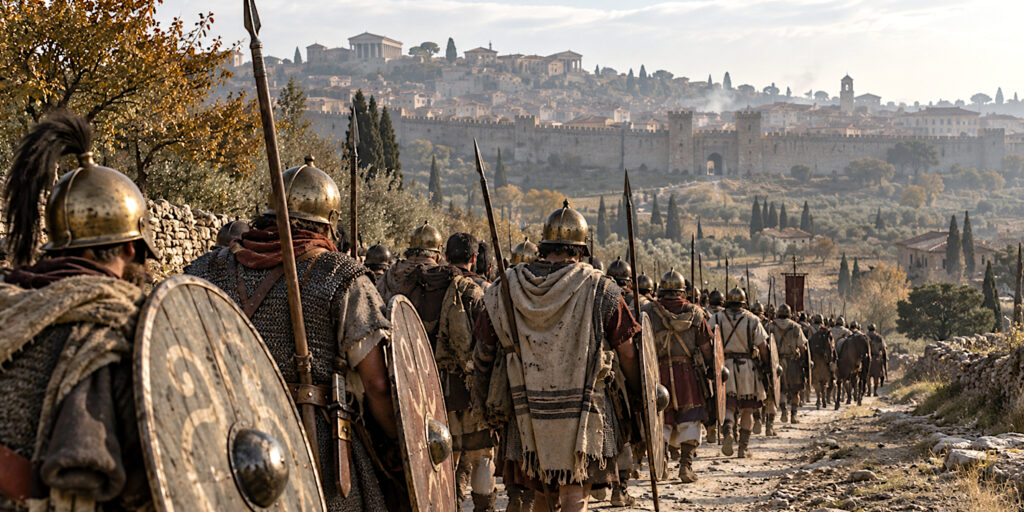
No reliable muster rolls survive. Ancient totals should be treated as estimates rather than exact headcounts.
| Side | Principal commanders | Troop composition | What can be said about numbers? |
|---|---|---|---|
| Sullan army | Lucius Cornelius Sulla; Marcus Licinius Crassus | Roman legionary infantry, including experienced soldiers, with cavalry | Exact strength at the battle is uncertain |
| Anti-Sullan coalition | Pontius Telesinus; Marcus Lamponius; Roman commanders associated with the opposing faction | Samnite and Lucanian infantry, Roman troops and mounted elements | Velleius Paterculus attributes approximately 40,000 men to Telesinus’ force, but the figure cannot establish a complete, secure order of battle |
Velleius’ account supports the presence of a substantial army. It does not justify presenting a precise numerical advantage for either side. Ancient military arithmetic has an unfortunate habit of becoming more confident as its evidence becomes less visible.
Leaders and Troop Composition
Sulla’s commanders
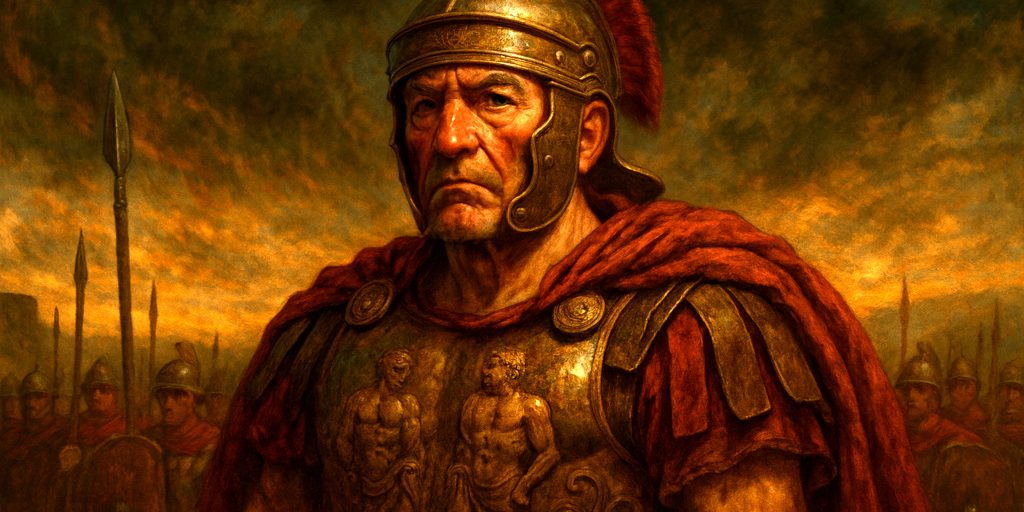
- Lucius Cornelius Sulla: Overall commander. His personal efforts could not prevent the collapse of his left wing in Plutarch’s account.
- Marcus Licinius Crassus: Commanded the successful right wing. His victory was essential to the Sullan outcome.
- Experienced legionaries: Sulla possessed a strong core of campaign veterans, although experience did not make every formation immune to defeat.
The opposing coalition
- Pontius Telesinus: Samnite commander and the most prominent leader associated with the attack on Rome.
- Marcus Lamponius: Lucanian commander involved in the attempt to relieve Praeneste and the subsequent advance.
- Roman contingents: The coalition also contained Roman soldiers and officers. It was not an exclusively Samnite army.
There is little justification for treating the Italian infantry as an undisciplined mass facing an orderly Roman military machine. These communities had extensive experience of warfare with and alongside Rome. Plutarch himself presents Telesinus as an experienced and capable opponent.
Arms and Armour
There is no securely identified equipment assemblage from the battle that allows us to reconstruct either army soldier by soldier. The following represents a historically informed reconstruction from Republican military evidence.
| Equipment | Likely use | Important qualification |
|---|---|---|
| Gladius Hispaniensis | Principal sword type expected among Roman legionaries | A double-edged cutting and thrusting weapon, often longer than later imperial gladii |
| Pila | Heavy javelins used by Roman infantry | Their presence does not prove that every formation delivered an orderly opening volley |
| Spears and other javelins | Suitable for infantry and mounted troops within the coalition | Exact distributions are unknown |
| Scuta | Large shields protecting infantry in close combat | Republican examples were commonly oval or elongated, rather than the familiar rectangular imperial form |
| Mail armour, or lorica hamata | Protection for soldiers able to obtain it | Equipment quality and coverage varied |
| Montefortino-type helmets | A plausible helmet family for Republican troops | They should not be treated as a universal uniform |
Polybius describes the Roman military equipment of an earlier Republican generation, so his account provides context rather than an inventory for 82 BCE. Museum evidence also demonstrates the widespread Italian use of Montefortino-type helmets.
Which swords were used?
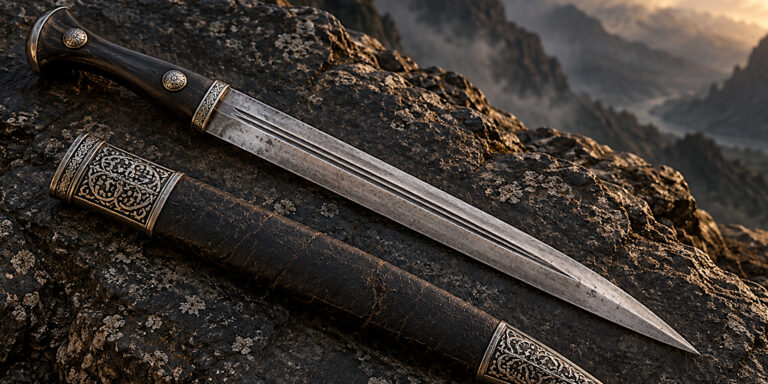
The strongest identification is the gladius Hispaniensis. Surviving Republican examples include blades approximately 60–69 cm long, sometimes with slight waisting and a pronounced point. It was capable of effective cuts as well as thrusts.
Roman-style swords could also have been carried by Italian opponents. Cambridge Core
Battle Timeline
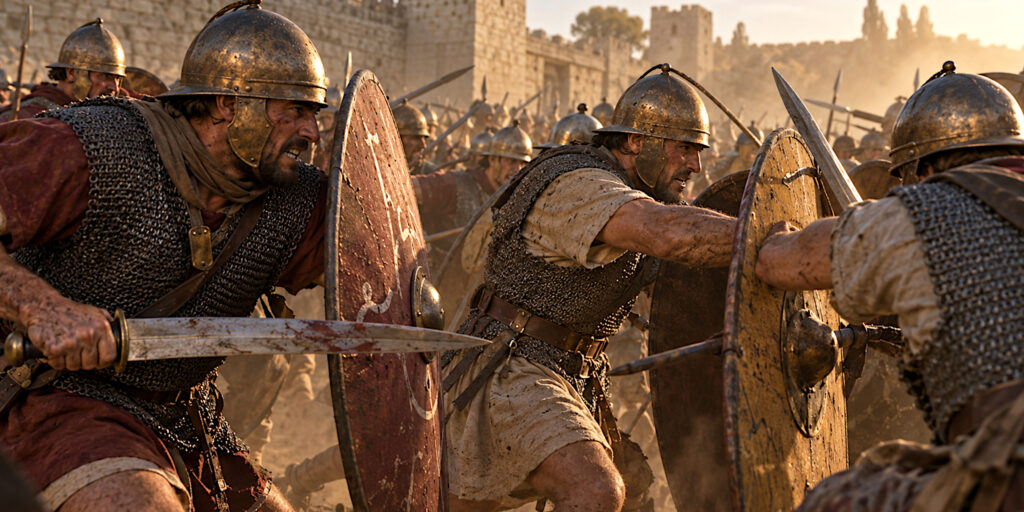
The broad sequence is recoverable, but the sources do not provide a consistent, minute-by-minute narrative.
| Stage | Events |
|---|---|
| Before the battle | Attempts to relieve Marius the Younger at Praeneste fail. The coalition redirects its effort towards Rome |
| Approach to Rome | Telesinus’ forces threaten the northern approaches. Sulla sends cavalry ahead and follows with his army |
| Late afternoon, 1 November 82 BCE | The main engagement begins outside the Colline Gate |
| Opening struggle | Sulla’s left wing suffers a serious reverse, while his right wing under Crassus succeeds |
| Evening and night | Fighting continues. Confusion and fleeing troops make the overall situation difficult to judge |
| By the following morning | The Sullan victory is established, with defeated forces killed, captured or dispersed |
| After the battle | Executions follow, and news of the defeat helps bring about the collapse of resistance at Praeneste |
Appian supplies the prolonged fighting and the retreat towards the gates; Plutarch gives particular emphasis to the contrasting fortunes of the two Sullan wings. Combining them produces a useful outline, but not a fully agreed battlefield reconstruction.
Why Did Sulla Win?
The clearest tactical explanation is the success of Crassus’ right wing. Sulla’s army could survive a major reverse on one flank because the other achieved a decisive victory.
Beyond that, caution is necessary. We lack the detailed deployment evidence needed to demonstrate an elaborate encirclement, identify every reserve movement or reconstruct a perfectly timed counterattack.
The battle is a useful reminder that a commander could win without knowing, for a considerable period, that he was winning. Dust, darkness and frightened messengers were poor substitutes for an overhead view.
Casualties and the Execution of Prisoners
Appian reports 50,000 dead across both sides and more than 8,000 prisoners subsequently killed. These are ancient claims, not verified casualty totals.
Plutarch describes a related sequence involving prisoners collected after the fighting and the events at Antemnae. He places approximately 6,000 victims in a massacre carried out while Sulla addressed the Senate nearby.
The accounts differ in their numbers and arrangement of events. They nevertheless preserve a consistent distinction that matters: men died in combat, and other men were deliberately killed after they could no longer resist. Those categories should not disappear into a single dramatic battlefield total.
Archaeology: What Has Actually Been Found?
Archaeology helps establish the setting more securely than the course of the fighting.
Remains associated with the Colline Gate were uncovered in 1872, with further investigation in 1996. They support its identification within Rome’s northern defensive system.
What they do not provide is a complete battlefield plan. The evidence cited here does not establish a securely attributed mass grave, weapon deposit or destruction layer from the battle itself.
The distinction is straightforward:
- The gate’s location: Supported by archaeological and topographical evidence.
- The general battlefield setting: Established chiefly through ancient accounts.
- Individual formations and movements: Uncertain.
- A particular sword or skeleton belonging to the battle: Requires evidence beyond geographical proximity.
Rome has been rebuilt repeatedly. Finding Republican material near a Republican gate is valuable, but it does not automatically identify a casualty of 1 November 82 BCE.
Contemporary Evidence and Ancient Quotes
No surviving verbatim battlefield speech can confidently be treated as an eyewitness transcript. The distinction between contemporary testimony and later historical writing is essential here.
Cicero: a contemporary voice from the aftermath
Opening his defence of Sextus Roscius in 80 BCE, Cicero described prominent men who supported the accused but remained silent:
“because they are desirous of avoiding danger.”
This concerns a trial rather than the battle. It offers contemporary evidence for the atmosphere of fear in the years following Sulla’s victory.
Telesinus’ reported threat
Velleius Paterculus attributes this declaration to Telesinus:
“The last day is at hand for the Romans.”
Velleius wrote generations later. The words illuminate the tradition surrounding Telesinus, but cannot securely establish his exact language or the intentions of every soldier in the coalition. Book II, Chapters 1‑28
Plutarch’s judgement on Sulla’s victory
Writing much later, Plutarch described the political outcome as:
“an exchange, but not a deliverance.”
It is a pointed assessment of a victory followed by repression. It is also an interpretation by a later biographer, rather than contemporary testimony. Life of Sulla
Legacy: What Did the Battle Change?
The Colline Gate broke the coalition threatening Rome and strengthened Sulla’s position immeasurably. The fall of Praeneste followed, while surviving opponents elsewhere still had to be defeated.
Sulla’s subsequent dictatorship and proscriptions made military victory the foundation of a political settlement enforced through confiscation, exclusion and killing. His claim to restore order deserves to be read alongside the methods used to achieve it. Book I
For me, the battle’s significance lies in that uncomfortable relationship between survival and power. Sulla had faced a real military danger. Defeating it did not require every subsequent act of repression, nor does that danger excuse them.
The Colline Gate belongs among the decisive battles of the late Republic because it determined who could impose the next settlement. Whether that settlement made Rome more secure is a considerably harder question.