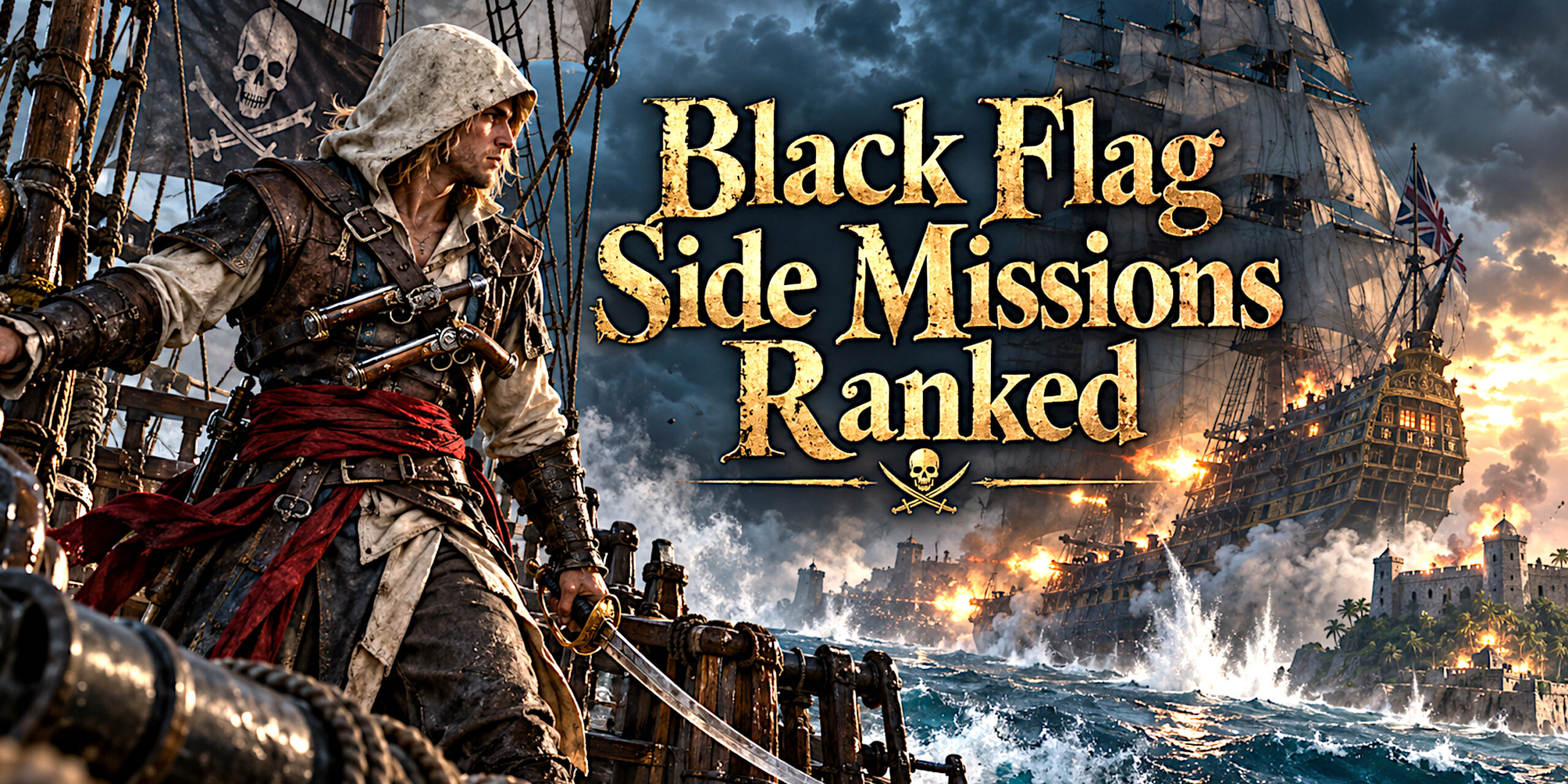
The best side missions in Assassin’s Creed IV: Black Flag give Edward Kenway something worth getting distracted by. A family feud in Nassau. A half-submerged ruin. An enemy warship large enough to make your recent cannon upgrade feel slightly embarrassing.
There is plenty of busywork scattered across the Caribbean, but the strongest optional content earns its place through memorable characters, useful rewards or the freedom to attempt something spectacularly ill-advised.
The Legendary Ships take first place for their naval combat, while the Travers brothers’ Templar Hunt is my pick for the best optional story. This ranking covers the original Black Flag, combining named mission chains with substantial side activities. Main campaign missions and the separate Freedom Cry adventure are excluded. Minor side-story spoilers follow.
Black Flag’s Best Side Missions at a Glance
| Rank | Mission or activity | Main appeal | Best suited to |
|---|---|---|---|
| 1 | Legendary Ships | Demanding naval battles | Experienced captains |
| 2 | The Travers brothers’ Templar Hunt | Betrayal and character drama | Story-focused players |
| 3 | Underwater wrecks and caves | Atmosphere and valuable discoveries | Explorers |
| 4 | Antó’s Templar Hunt | A stronger sense of purpose | Players interested in the Brotherhood |
| 5 | Naval fort assaults | Ship combat followed by fighting ashore | Players who enjoy variety |
| 6 | Rhona Dinsmore’s Templar Hunt | Defence, sabotage and assassination | Fans of urban missions |
| 7 | Mayan stelae puzzles | Environmental puzzles and a useful reward | Patient explorers |
| 8 | Opía Apito’s Templar Hunt | Hunting, sailing and pursuit | Players wanting a varied adventure |
| 9 | Treasure map hunts | Proper buried-treasure exploration | Pirate traditionalists |
| 10 | Naval contracts | More reasons to use the Jackdaw | Players building their naval confidence |
The order favours enjoyment, atmosphere and variety over completion rewards alone. A lucrative task can still feel like admin, even when you arrive by pirate ship.
10. Naval Contracts
Naval contracts provide structured jobs for the Jackdaw, from attacking enemy vessels to protecting ships and acquiring cargo. In the original game, they become available at captured forts. playstationtrophies.org
Their biggest strength is that they give your sailing a purpose without demanding a lengthy commitment. You can take a job, test your latest upgrades and return to the campaign with a little more confidence.
The limitation is repetition. These assignments rarely offer the character work of a Templar Hunt or the tension of a Legendary Ship encounter. Some feel like a formal request to do what you were probably going to do anyway.
Still, Black Flag’s naval combat carries them remarkably well. Sometimes an excuse to fire the cannons is sufficient.
Why they rank here: Dependable naval entertainment, with fewer memorable moments than the activities above them.
9. Treasure Map Hunts
Following a treasure map is one of Black Flag’s simplest pleasures. You find a map, identify its destination and use the illustrated landmarks to locate a buried chest. Rewards include money and, in some cases, Jackdaw upgrade plans..
I like that the final search asks you to pay attention to the landscape. A coastline or distinctive structure becomes something to examine rather than scenery to sprint past.
The discoveries are rarely elaborate enough to feel like full quests, which keeps treasure hunting below the more substantial adventures. Its appeal depends on how much you enjoy the journey between finding the clue and reaching the right patch of sand.
My advice is to resist opening a walkthrough immediately. Give the map a chance to work. Edward can survive a few minutes without satellite navigation.
Why they rank here: Excellent pirate atmosphere, although the searches are often brief.
8. Opía Apito’s Templar Hunt
Opía Apito’s mission chain begins in Cayman Sound with a hunting competition, then moves through surveillance, pursuit and a confrontation involving Lucía Márquez.
Its variety is the main attraction. The chain keeps changing what it asks of you, making it feel closer to a small adventure than a repeated assignment.
Opía also brings a different perspective to Edward’s travels. Her presence helps broaden a game whose loudest personalities tend to be European pirates arguing about money and leadership.
The opening hunting challenge is the weak point for me. It establishes her abilities, but it is less compelling than the later pursuit. The travelling between stages can also interrupt the momentum.
Why it ranks here: A worthwhile, varied Templar Hunt that takes a little time to find its rhythm.
7. Mayan Stelae Puzzles
The Mayan stelae ask you to align an on-screen pattern with features in the surrounding landscape. Solving them yields stones used to obtain the Mayan outfit, whose substantial benefit is protection from enemy gunfire.
The puzzles themselves are modest. You are unlikely to spend an evening hunched over handwritten diagrams.
What makes them appealing is the pause they create. Black Flag frequently encourages speed, pursuit and destruction. These locations ask you to stand still and look carefully at the environment.
The eventual outfit provides a satisfying incentive, although collecting the full set can become tiring if you leave everything until late in the game.
Treat the stelae as discoveries during your travels and they work much better.
Why they rank here: A welcome change of pace, supported by a reward with practical value.
6. Rhona Dinsmore’s Templar Hunt
Rhona Dinsmore’s Havana missions include defending the Assassin bureau, pursuing a thief, destroying powder reserves and hunting down a Templar.
This is probably the easiest Templar Hunt to recommend to someone who wants a compact stretch of varied action. The setting holds it together, while the changing objectives stop it becoming a prolonged exercise in following suspicious men at walking speed.
The sabotage is particularly enjoyable because it leaves room for different approaches. Careful infiltration has its appeal. So does watching a plan unravel and deciding that the explosion was technically the important part.
Rhona herself gives the chain some bite, although the story is less distinctive than the Travers brothers’ troubles.
Why it ranks here: Strong pacing and satisfying urban action, with enough flexibility to encourage improvisation.
5. Naval Fort Assaults
Fort assaults combine two of Black Flag’s strengths. First, you bombard the defences from the Jackdaw. Then you land and fight through the fort to its officers and commander. Capturing a fort also reveals the surrounding region and its collectibles.
That transition from ship to shore is the reason they sit this high. The assault feels like a continuous operation, with Edward personally finishing the job his cannons started.
There is also a pleasing sense of consequence. The fort changes hands, the map becomes clearer and the region feels more accessible.
Repetition eventually catches up with the formula, particularly once your equipment makes the easier targets comfortable. The more demanding forts retain their appeal longer because your approach and ship preparation matter.
Why they rank here: Some of the game’s most satisfying combinations of naval combat, climbing and close fighting.
4. Antó’s Templar Hunt
Antó’s Kingston missions involve freeing enslaved people, defending allies and pursuing the Templar Kenneth Abraham.
This chain gives Edward’s involvement a stronger purpose than personal enrichment. The stakes make the Brotherhood feel connected to people living under colonial power, rather than existing solely to conduct rooftop meetings.
For me, that context makes familiar mission mechanics more engaging. A rescue carries more weight when the people involved matter beyond their usefulness to Edward.
There are limits. The short chain has little room to explore its subject fully, and some objectives rely on the same following and defence routines found elsewhere.
Even so, Antó deserves your attention. His missions offer a valuable shift in perspective within Edward’s adventure.
Why it ranks here: Familiar gameplay gains substance from its setting, characters and purpose.
3. Underwater Wrecks and Caves
Black Flag’s underwater exploration changes the mood almost immediately. Below the surface, oxygen, narrow passages and marine hazards replace the confidence of commanding an armed ship.
Dive sites open through the Sequence 6 story mission involving the diving bell. Several contain elite Jackdaw upgrade plans, including valuable improvements to its weapons.
The atmosphere earns this activity its position. Wrecked hulls and submerged ruins make the Caribbean feel as though it contains a history beyond whichever ship Edward has most recently robbed.
There is genuine tension in deciding whether to investigate one more opening before returning for air. Greed becomes a surprisingly effective difficulty setting.
The swimming controls can be awkward, and collecting every object is less enjoyable than exploring selectively. I would prioritise discoveries and useful plans over forcing a perfect completion run.
Why they rank here: Distinctive, tense exploration with rewards that support your adventures above water.
2. The Travers Brothers’ Templar Hunt
The Nassau Templar Hunt involving Upton and Vance Travers brings family conflict, questionable loyalties and the pirate Jing Lang into Edward’s orbit.
This is my choice for Black Flag’s best optional story because the interest comes from people behaving badly for recognisable reasons. Greed and misplaced trust are entirely capable of causing trouble without an ancient artefact helping them along.
The brothers give the chain a personality that routine contracts lack. Edward becomes involved in a messy dispute, and the uncertainty surrounding it creates a reason to continue beyond collecting the eventual reward.
The mission design still leans on familiar surveillance and pursuit. Anyone exhausted by tailing objectives will feel that here too.
Yet the surrounding drama makes those mechanics easier to forgive. Nassau is an excellent place for a family argument to become everyone else’s problem.
Why it ranks here: The most engaging optional character drama, despite some routine objectives.
1. Legendary Ships
The Legendary Ships are Black Flag’s finest optional challenges because they demand that you understand the Jackdaw.
These are four encounters involving five vessels, with HMS Fearless and Royal Sovereign fighting together. The battles introduce threats such as El Impoluto’s aggressive ramming and La Dama Negra’s reinforced hull, making preparation and positioning essential.
What places them above everything else is how effectively they give purpose to your earlier adventures. The resources you gathered and upgrades you purchased suddenly feel necessary.
A normal engagement can let you recover from a careless approach. These battles are much less accommodating. You need to watch your angles, recognise danger and choose when to attack rather than simply firing whenever something comes into view.
Their weakness is the upgrade barrier. Arriving too early can feel punishing, and earning the necessary resources may become a grind if you rush towards them.
They work best as a late-game ambition. Build the ship, learn its weapons and then go looking for trouble.
Why they take first place: They turn Black Flag’s naval systems into demanding, memorable encounters worthy of the preparation.
Which Black Flag Side Missions Should You Do First?
The ranking is about quality, but the best playing order is more practical.
Take on manageable forts as your ship improves, follow Templar Hunts when you reach their locations and investigate treasure maps during nearby journeys. Once diving becomes available, seek useful upgrade plans rather than trying to clear every underwater collectible immediately.
Save the Legendary Ships until the Jackdaw is heavily upgraded. They make a much better finale than an early lesson in the structural limits of wood.
If story is your priority, begin with the Templar Hunts. Completing all four supplies the remaining keys needed for the Templar armour at Great Inagua, which reduces damage taken by Edward.
And collect a few sea shanties along the way. Chasing airborne sheet music is a peculiar recruitment policy, but the crew’s expanded repertoire makes those long voyages better.