In 52 BCE, Julius Caesar trapped the Gallic leader Vercingetorix inside the hilltop stronghold of Alesia. Then a vast Gallic relief army arrived and trapped Caesar in turn. The Romans found themselves fighting on two fronts, enclosed between an enemy inside the oppidum and another beyond their own siege lines.
That is what makes Alesia extraordinary. It was not simply a battle won by a better sword or a sterner line of infantry. It was a contest of food, labour, earthworks, intelligence and nerve. Caesar’s men built one fortified circuit facing inwards and another facing outwards, then defended both at once. The engineering was formidable. The human cost was worse.
Alesia became the decisive victory of the Gallic Wars, although resistance did not vanish overnight. It also became part of Caesar’s carefully managed legend. Fortunately, archaeology has recovered enough of the landscape, fortifications, coins and weapons to test his account rather than merely admire it.
Battle of Alesia at a glance
| Detail | Information |
|---|---|
| Date | 52 BCE, probably late summer into early autumn |
| Location | Alesia, generally identified with Alise-Sainte-Reine on Mont Auxois, Burgundy, France |
| War | Gallic Wars |
| Roman commander | Gaius Julius Caesar |
| Principal Gallic commander | Vercingetorix of the Arverni |
| Outcome | Decisive Roman victory and surrender of Vercingetorix |
| Strategic importance | Broke the main coalition assembled against Caesar, though further campaigns followed in 51 BCE |
Why was the Battle of Alesia fought?
Caesar had invaded and campaigned across Gaul since 58 BCE. By 52 BCE, Roman violence, tribute, political interference and the demands placed upon allied communities had helped provoke a much broader revolt. Vercingetorix, an aristocrat of the Arverni, emerged as the leading figure in a coalition that crossed older tribal divisions.
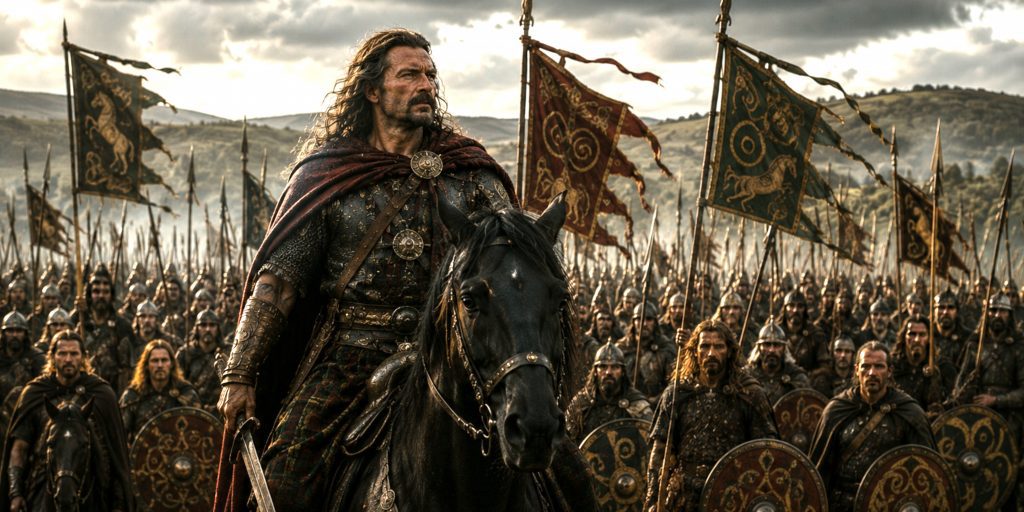
He was not simply a brave warrior placed conveniently opposite Caesar. Vercingetorix adopted a hard and intelligent strategy. Settlements and supplies were destroyed to deny the Romans food, while Gallic cavalry threatened their movements. At Gergovia, Caesar suffered a serious reverse. The Roman commander was not marching towards Alesia in serene possession of the answer sheet.
After a cavalry battle, however, Vercingetorix withdrew into Alesia with his main army. The choice offered strong high ground and expected support from across Gaul, but it also surrendered freedom of movement. Caesar recognised the opportunity. Rather than attempt an expensive assault up the slopes, he decided to starve the stronghold.
The battlefield and the stronghold

Alesia occupied the plateau of Mont Auxois, rising above the valleys of the Oze and Ozerain. Steep slopes protected much of the site, while neighbouring ridges and plains shaped the Roman encirclement.
Caesar described the town as standing on a high hill in a position that could not be taken except by siege. Below the settlement, Vercingetorix’s troops constructed their own camp and defensive wall. The Romans then occupied the surrounding heights with camps, forts and connecting fieldworks.
This was a large landscape rather than a tidy ring around a castle. Visibility, gradients, rivers and access routes mattered. One weak sector below Mont Réa would later become the focus of the final Gallic assault.
Forces, leaders and troop composition
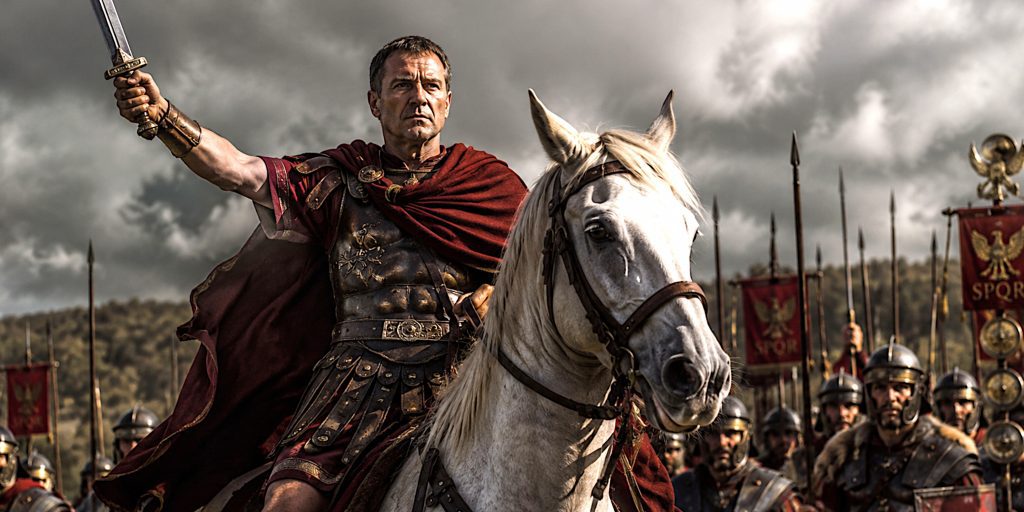
Ancient troop figures at Alesia must be handled carefully. Caesar gives 80,000 fighting men inside the stronghold and lists levies which together imply roughly 250,000 infantry and 8,000 cavalry in the relief army. Such numbers served the literary needs of a commander who wanted Rome to understand the scale of his achievement.
Modern reconstructions vary. The Roman army probably contained ten to twelve legions, many of them below nominal strength, supported by cavalry, light troops, engineers, servants and other auxiliaries. A force of roughly 40,000 to 50,000 combatants is plausible, but no surviving document provides a reliable parade return.
| Side | Principal leaders | Reported or estimated strength | Main elements |
|---|---|---|---|
| Roman army | Julius Caesar; Titus Labienus; Mark Antony; Gaius Trebonius; Gaius Fabius; Decimus Junius Brutus Albinus | Probably about 40,000 to 50,000 combatants; ten to twelve legions plus auxiliaries | Legionary heavy infantry, Germanic and allied cavalry, archers, slingers, engineers and artillery crews |
| Gauls inside Alesia | Vercingetorix | Caesar claims 80,000 warriors, plus the inhabitants of Alesia; the true total is uncertain | Tribal infantry, cavalry at first, missile troops and the local Mandubii population |
| Gallic relief army | Commius; Vercassivellaunus; Viridomarus; Eporedorix | Caesar’s levy list suggests about 250,000 infantry and 8,000 cavalry; modern historians generally treat this as inflated | Infantry and cavalry drawn from numerous Gallic communities, with archers and other light troops |
Roman command
Caesar directed the siege and moved reserves between threatened sectors. Labienus held a critical role during the final assault and was authorised to launch a counterattack if the position could not otherwise be saved. Antony and Trebonius commanded sections of the works during the night attack, while Brutus and Fabius brought reserves into the climactic fighting.
Gallic command
Vercingetorix controlled the besieged army and coordinated sorties from Alesia. The relief host had several senior commanders rather than one undisputed commander-in-chief. Vercassivellaunus, a kinsman of Vercingetorix, led the force selected for the decisive attack against the Roman weakness near Mont Réa. Commius of the Atrebates, Viridomarus and Eporedorix also held prominent commands.
This divided structure did not mean the Gauls were incapable of planning. Their final operation combined attacks from outside with a sortie from within. Coordinating armies across broken ground without modern communications was, admittedly, the sort of undertaking that makes a committee meeting look restful.
Arms and armour
The fighting at Alesia ranged from missile exchanges across ditches to close combat on ramparts. Swords mattered, especially when formations collided, but spears, javelins, slings, bows, artillery and field defences did much of the killing before a blade came within reach.
| Equipment | Roman forces | Gallic forces |
|---|---|---|
| Swords | Gladius Hispaniensis and related late Republican forms, suited to both cut and thrust | Late La Tène swords, generally longer than Roman infantry swords and carried in metal scabbards |
| Spears and javelins | Pilum for legionaries; lighter javelins and spears among auxiliaries | Thrusting spears and throwing spears used by infantry and cavalry |
| Shields | Curved wooden scutum with central boss, probably oval or transitional in form rather than the later imperial rectangle | Large oval or elongated wooden shields with iron bosses and spines |
| Body armour | Mail shirts were common among legionaries; some officers and troops may have used scale armour | Mail among wealthier warriors; many troops probably fought with limited body protection |
| Helmets | Iron and bronze late Republican types, including Montefortino and Coolus families | Varied iron and bronze La Tène helmets, concentrated among better-equipped warriors |
| Missile weapons | Bows, slings, pila, javelins and torsion artillery bolts | Bows, slings, stones and javelins |
The Roman gladius

The legionary sword of Caesar’s period is usually described as the gladius Hispaniensis, although Republican sword typology is less orderly than modern labels suggest. It was longer than many later Roman gladii and capable of forceful cuts as well as thrusts. During the last battle, Caesar says his soldiers put aside their pila and fought with swords once the struggle closed.
The Gallic La Tène sword
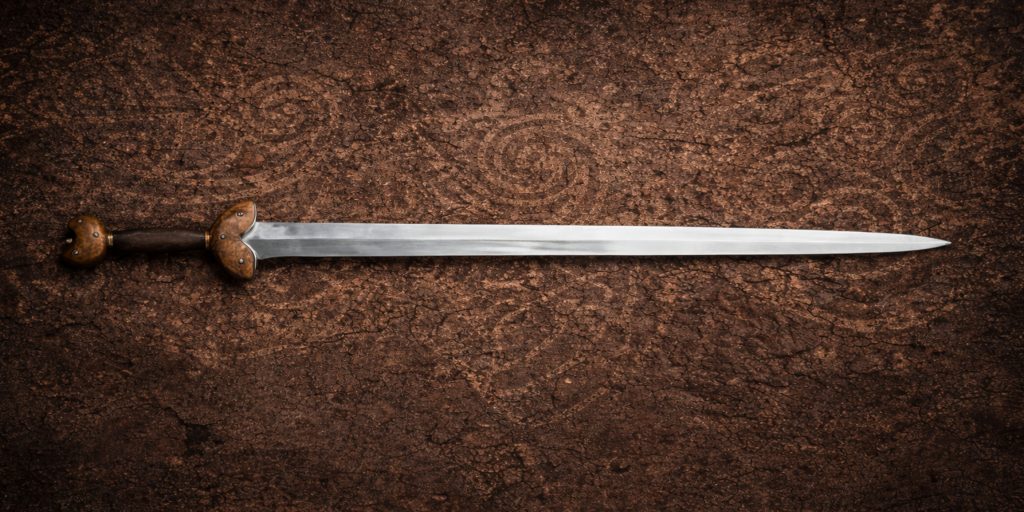
Gallic warriors used iron swords descended from the La Tène tradition. Many were relatively long, double-edged weapons carried in metal scabbards suspended from a belt or chain. They are too often reduced to crude slashing blades. Surviving weapons show sophisticated ironworking, while their length and balance varied according to date, region and intended use.
The sword was also a marker of status. Not every Gallic fighter carried one, and mail armour was even less evenly distributed. The familiar image of an entire army of helmeted swordsmen owes rather more to later art than to Iron Age quartermasters.
Roman field defences as weapons
Caesar’s fortifications turned the ground itself into an offensive system. His account describes:
- Deep ditches, including one filled with water where the terrain permitted
- A rampart and palisade protected by towers
- Cippi, interlocked sharpened branches fixed into trenches
- Lilia, concealed pits containing fire-hardened stakes
- Stimuli, small buried stakes fitted with iron hooks
- Artillery and missile troops positioned to cover approaches
The Latin nicknames sound almost playful. The experience of falling into them was unlikely to have encouraged the joke.
Caesar’s double line of fortifications
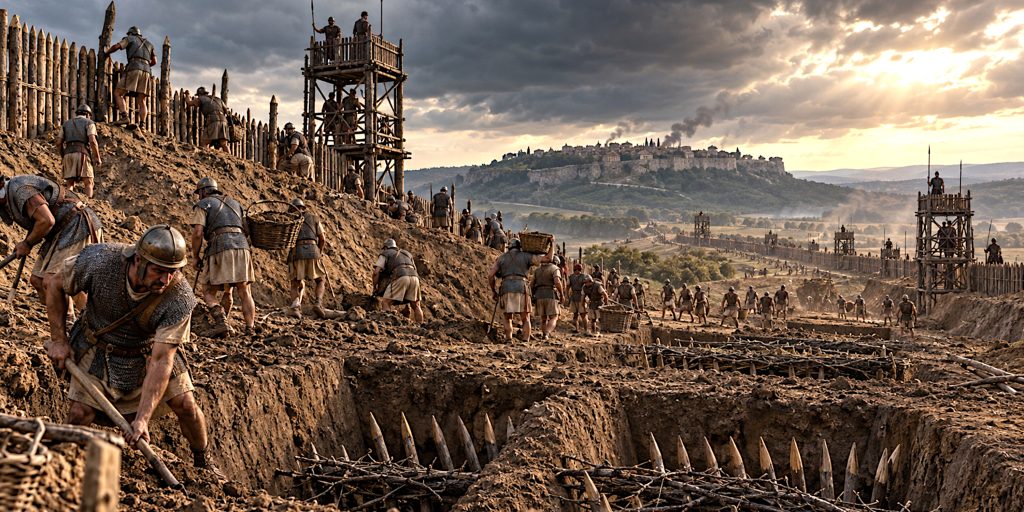
The terminology is easily confused. At Alesia, the contravallation was the inward-facing line intended to contain Vercingetorix. The circumvallation faced outwards against the expected relief army.
Caesar gives the inner circuit as about 11 Roman miles, roughly 16 kilometres, and the outer circuit as about 14 Roman miles, roughly 20 to 21 kilometres. Modern descriptions often round these figures to approximately 15 and 21 kilometres. The precise traced routes vary by reconstruction because later agriculture and development have altered or erased sections.
The system incorporated camps, smaller forts, towers, banks, palisades and multiple ditches. It was not one continuous stone wall. Earth, timber and disciplined labour allowed the Romans to construct defences rapidly with the materials at hand.
The strategic idea was brutal and clear:
- Prevent Vercingetorix from escaping
- Protect the Roman camps and supply areas
- delay attackers long enough for reserves to reach threatened points
- Use obstacles and missiles to compensate for the enormous perimeter
The works did not make the Roman position comfortable. Caesar still had to feed tens of thousands of men and animals while guarding two fronts. He ordered supplies for thirty days, a detail that reveals both preparation and anxiety.
The siege begins
Before the Roman ring closed, Vercingetorix sent his cavalry out to summon a national relief effort. Those remaining in Alesia faced diminishing supplies. The presence of the Mandubii inhabitants made the shortage still more severe.
When food failed, the besieged council considered surrender, a mass breakout and, according to Caesar, the appalling proposal of Critognatus that the defenders consume those unable to fight. The council rejected immediate cannibalism but expelled the Mandubii civilians. Caesar refused them passage through his lines.
They were left between the defences with nowhere to go. Caesar reports the episode briefly and offers no sentimental detour. It remains one of the most disturbing moments in the campaign, precisely because neither army chose to save them.
The relief army arrives
The arrival of the Gallic relief army transformed the siege. Its cavalry spread across the plain while infantry occupied the higher ground. From Alesia, the besieged could see their allies and prepared to attack the inner line.
The first major engagement was a cavalry battle fought in view of both armies. Gallic light infantry and archers supported their horsemen, initially placing the Romans under pressure. Caesar then committed his Germanic cavalry, which drove back the Gallic horse and overran the archers.
The result mattered beyond casualties. The defenders inside Alesia had watched hope arrive and then watched it recoil.
The night assault
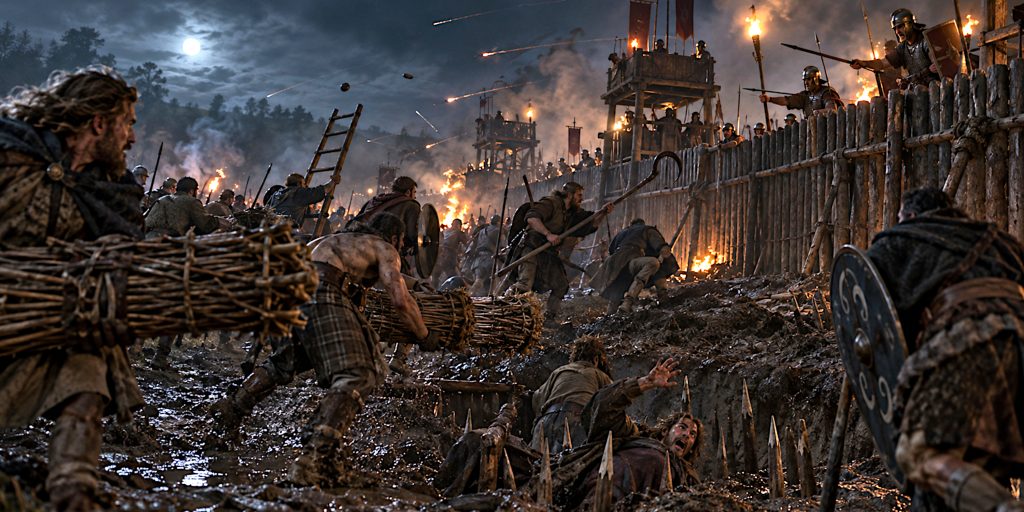
After a day spent preparing ladders, hooks and fascines, the relief army attacked the outer works at night. Vercingetorix responded to the noise and launched a sortie from the stronghold.
Darkness reduced Roman visibility and made the scale of each threat difficult to judge. Antony and Trebonius drew men from quieter redoubts and sent them towards the hardest fighting. The Gallic attackers filled ditches and showered the defenders with stones, sling bullets and arrows, but the concealed obstacles broke up their approach.
The external army withdrew near dawn. The force from Alesia had been delayed while negotiating the inner defences and could not achieve a decisive breach. Coordination had come close, but close is a particularly unrewarding measurement in siege warfare.
The final assault at Mont Réa
The Gallic commanders identified a weakness where the Roman outer line ran below high ground near Mont Réa. Caesar says Vercassivellaunus took 60,000 selected troops on a concealed march and attacked the position around midday. That number is almost certainly rhetorical inflation, but the assault was plainly large and dangerous.
At the same time, cavalry and infantry demonstrated elsewhere, while Vercingetorix led another attack from inside Alesia. Roman troops were stretched across both defensive circuits. At Mont Réa, attackers filled the ditches with earth and fascines, covered buried obstacles and pressed onto the ramparts.
Caesar sent Labienus with six cohorts, followed by further reinforcements under Brutus and Fabius. When the crisis deepened, Caesar moved towards the threatened sector wearing the conspicuous red cloak of a commander. His appearance was meant to be seen by his own men, and presumably by posterity as well.
Labienus prepared a sortie. Roman cavalry rode around the outer defences and appeared behind the Gallic attackers, while cohorts struck from the lines. Caught between counterattacks, the Gallic force broke. Vercassivellaunus was captured, Sedullus of the Lemovices was killed and the relief army withdrew.
From Alesia, Vercingetorix could see the collapse. The final attempt had failed.
Battle timeline
The exact calendar dates are not securely known. Ancient narratives provide a sequence, not a modern operations diary.
| Stage | What happened |
|---|---|
| Summer 52 BCE | Caesar recovers from the setback at Gergovia and reunites with Labienus |
| Before Alesia | Roman and allied cavalry defeat Vercingetorix’s cavalry during the Gallic attempt to obstruct Caesar’s march |
| Arrival at Alesia | Vercingetorix withdraws into the oppidum; Caesar begins the inward-facing contravallation |
| Construction phase | Romans build camps, forts, ditches, ramparts, towers and concealed obstacles |
| Before encirclement is complete | Gallic cavalry leaves Alesia to summon a relief army |
| Siege tightens | Caesar adds the outward-facing circumvallation and gathers supplies for thirty days |
| Food crisis | The Mandubii civilians are expelled and refused passage by the Romans |
| Relief army arrives | Gallic cavalry fights on the plain but is defeated after intervention by Caesar’s Germanic horsemen |
| Night assault | External and internal Gallic forces attack both Roman lines but fail to coordinate a breach |
| Final assault | Vercassivellaunus attacks near Mont Réa while Vercingetorix sorties from Alesia |
| Roman counterstroke | Labienus attacks from the works; Roman cavalry reaches the Gallic rear; the relief army breaks |
| Following day | Vercingetorix surrenders and Caesar takes prisoners |
| 51 BCE | Roman campaigning continues against remaining centres of resistance in Gaul |
Contemporary account and quotations
Caesar’s Commentarii de Bello Gallico, Book VII, is the only detailed account written by a participant and near-contemporary to the events. It is essential evidence, but never neutral evidence. Caesar wrote in the third person, a useful grammatical device when one is both commander and publicity department.
“The town itself was situated on the top of a hill, in a very lofty position, so that it did not appear likely to be taken, except by a regular siege.”
This description explains Caesar’s decision to blockade Alesia instead of storming it.
“The idea uppermost in the minds of both parties is, that the present is the time in which they would have the fairest opportunity of making a struggle.”
Caesar places this judgement at the climax, when attacks struck several parts of the Roman system.
“Our troops, laying aside their javelins, carry on the engagement with their swords.”
The line captures the transition from missiles and engineering to close combat during the final counterattack.
On the surrender, Caesar is notably restrained:
“Vercingetorix was delivered up, and his arms were cast before him.”
The more theatrical image of Vercingetorix riding around Caesar and dramatically throwing down his weapons comes from later authors, especially Plutarch. It should not be presented as an eyewitness scene.
Archaeology at Alesia
The identification of Alesia with Alise-Sainte-Reine was once fiercely contested and still attracts alternative claims. The archaeological case for Mont Auxois is nevertheless substantial.
Nineteenth-century excavations
Excavations ordered under Napoleon III began in 1861. The Commission de Topographie des Gaules traced siege ditches around the oppidum and recovered large quantities of weapons and other objects. The imperial sponsorship naturally encouraged suspicion that archaeology was being asked to salute before it had finished digging.
That criticism is fair as a warning, but it does not dispose of the evidence. The excavators recorded plans and sections, and later researchers could revisit their conclusions.
Franco-German research
Major Franco-German investigations between 1991 and 1997 re-examined the Roman military works around Mont Auxois. They used excavation, aerial archaeology and renewed study of the artefacts. The research confirmed substantial late Republican siege works and placed the fortifications within the wider topography.
Not every ditch or proposed camp from the nineteenth-century reconstruction survived scrutiny. That is a strength of the modern case rather than a weakness. Archaeology is most useful when it corrects the old plan, not when it politely colours it in.
What has been found?
Finds associated with the siege landscape include:
- Roman and Gallic coins, including issues useful for dating and identifying participating groups
- Iron weapons and fittings, including spearheads, arrowheads and artillery bolts
- Sling bullets and other missile evidence
- Late La Tène swords, scabbard elements and Roman sword material
- Shield fittings and military equipment
- Hobnails from Roman military footwear
- Horse equipment, tools, amphora fragments and animal remains
- Ditches, banks, camp entrances and defensive features consistent with a large Roman encirclement
The weapon assemblage is especially important, although its interpretation requires care. Some objects collected in early campaigns lack modern excavation records, and not every Iron Age weapon found around a long-occupied oppidum must belong to the weeks of the siege. Recent study has continued to add weapons to the recognised corpus, including a Celto-Germanic sword published in 2022.
Does archaeology prove Caesar’s account?
It supports the location, date and reality of a major Roman siege with extensive fieldworks. It does not verify every measurement, troop figure or dramatic decision in Book VII. Text and soil overlap impressively, but they are not identical witnesses.
The surrender of Vercingetorix
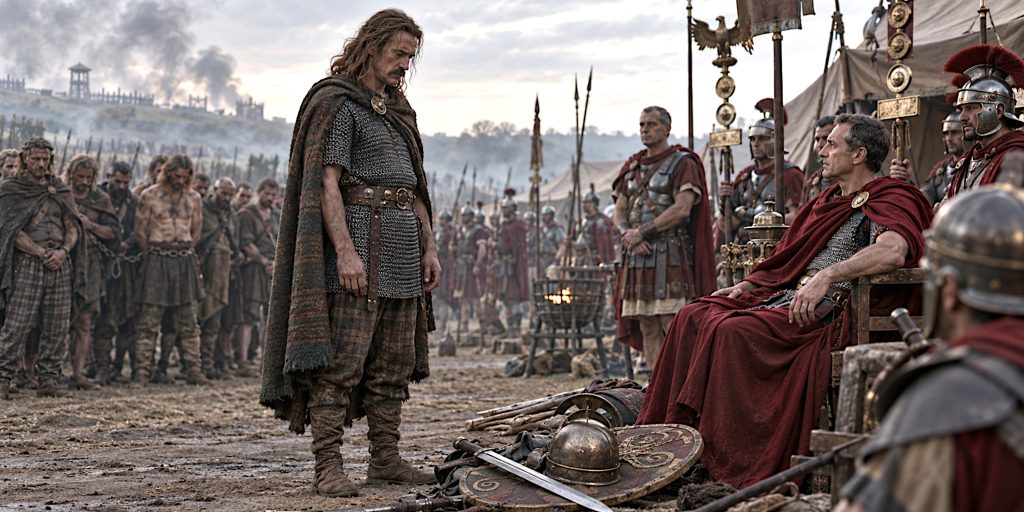
After the relief army’s defeat, continued resistance inside Alesia offered little prospect beyond starvation. Vercingetorix convened a council and surrendered. Caesar took him prisoner and distributed many other captives among his soldiers.
Vercingetorix remained in Roman custody for several years. He was displayed in Caesar’s triumph at Rome in 46 BCE and was probably executed afterwards, as was customary for a defeated enemy leader in such a spectacle.
The surrender did not make Gaul instantly peaceful. Caesar fought further campaigns in 51 BCE, most notoriously at Uxellodunum. Alesia shattered the broad coalition and removed its most effective leader, but conquest still required punishment, negotiation and garrisons.
Casualties and prisoners
Reliable casualty totals do not survive. Caesar describes heavy losses among the relief army and states that relatively few returned safely after the decisive battle. Such language communicates scale without supplying evidence that can be checked.
The consequences for prisoners were severe. Caesar says captives were distributed to his soldiers as booty, one per man apart from those he reserved for political purposes. Enslavement was not an incidental aftermath. It was part of the economic machinery of Roman campaigning.
For the Mandubii civilians expelled from Alesia, even the outcome is unclear. Caesar leaves them stranded between the lines and then loses interest in their fate. History often preserves the men who gave orders rather better than the families who suffered them.
Why did Caesar win at Alesia?
Engineering under pressure
The Romans created a connected defensive system on a huge scale while exposed to sorties and supply problems. Camps and redoubts allowed troops to hold ground, while ditches and obstacles slowed attackers until reserves arrived.
Flexible reserves
Caesar did not spread every man evenly along the perimeter. Commanders transferred cohorts from quieter sectors and reinforced the points under greatest pressure. At the climax, those reserves prevented local success from becoming a general breach.
Cavalry
Allied and Germanic cavalry played a decisive role in the early cavalry battle and in the final attack on the relief army’s rear. Alesia was not won by legionaries alone, however much Roman sculpture preferred the simpler version.
Gallic supply and coordination problems
Vercingetorix had chosen a position dependent on relief. Once the Roman ring closed, hunger worked for Caesar. The external and internal Gallic attacks were intelligently conceived, but delays and difficult terrain prevented them from producing a simultaneous breakthrough.
Command and morale
Caesar, Labienus and the subordinate commanders responded effectively to crises. Caesar’s visible arrival during the final battle strengthened morale, though our source for its effect is Caesar. One should allow the commander his courage while keeping a hand on one’s purse.
Outcome and historical legacy
Alesia destroyed the most dangerous united resistance Caesar had faced in Gaul. It secured enormous political prestige, prisoners and leverage, helping Caesar present his campaigns as a sequence of victories against immense odds.
For Rome, the conquest accelerated the incorporation of Gaul into its political, military and economic systems. The process was uneven and did not erase local identities. Roman rule reshaped them over generations through cities, taxation, service, trade, law and elite cooperation as much as through battlefield defeat.
Vercingetorix later became a French national symbol, particularly in the nineteenth century. The statue erected on Mont Auxois under Napoleon III tells us as much about modern France as the historical Vercingetorix. A defeated coalition leader was recast as the first champion of a united nation that did not yet exist in its modern form.
Alesia deserves its fame, but not because it proves Romans were naturally destined to win. Caesar took a dangerous gamble. His army survived because its soldiers could build as effectively as they fought, because cavalry allies repeatedly rescued critical situations and because commanders moved reserves at the right moments. Victory was earned at the edge of failure.
Frequently asked questions
Where was the Battle of Alesia?
The battle is generally accepted to have taken place around the oppidum on Mont Auxois at modern Alise-Sainte-Reine in Burgundy, France. The topography, siege works, coins and military finds form a strong cumulative case.
Who won the Battle of Alesia?
Julius Caesar’s Roman army won. The Gallic relief force was defeated and Vercingetorix surrendered soon afterwards.
How many soldiers fought at Alesia?
The exact totals are unknown. Caesar claims 80,000 Gallic warriors inside Alesia and implies roughly 250,000 infantry plus 8,000 cavalry in the relief force. These figures are widely considered exaggerated. Caesar probably commanded roughly 40,000 to 50,000 combatants, but this also remains an estimate.
What swords were used at Alesia?
Roman legionaries used forms of the late Republican gladius, commonly grouped under the term gladius Hispaniensis. Gallic warriors used double-edged Late La Tène swords, often longer than Roman infantry swords. Spears and missiles were more widespread than swords on both sides.
Did Vercingetorix throw his sword at Caesar’s feet?
Caesar says only that Vercingetorix was handed over and his weapons were cast down. The elaborate mounted surrender familiar from paintings comes from later literary tradition, not a contemporary eyewitness description.
Sources and further reading
- Julius Caesar, The Gallic War, Book VII, especially sections 68 to 90
- Michel Reddé and Siegmar von Schnurbein, editors, Alésia: fouilles et recherches franco-allemandes sur les travaux militaires romains autour du Mont-Auxois, 1991–1997
- Alain Duval, “Les armes d’Alésia au musée des Antiquités nationales”, Revue historique des armées, 1987
- Claude Grapin, “Une épée celto-germanique et quelques autres armes: Addendum au corpus de l’arsenal du siège d’Alésia”, Revue archéologique de l’Est, 2022
- French Ministry of Culture, Aux sources de l’Archéologie nationale: The Alesia Question