A sword can be valuable because of its age, craftsmanship or famous owner. Some become priceless for a harder reason to measure: the stories people attach to them. A blade linked to a coronation, a royal dynasty or a national legend can carry far more meaning than its metal and workmanship alone.
That does not mean every famous attribution is fact. Several swords on this list have uncertain owners, later alterations or histories that blur into legend. That makes them more interesting, not less. Here are seven celebrated swords, and what the evidence can actually tell us.
At a glance
| Sword | Associated with | Where to find it |
|---|---|---|
| Joyeuse | Charlemagne and French coronations | Louvre, Paris |
| Honjo Masamune | The Tokugawa family | Lost after the Second World War |
| Sutton Hoo sword | An elite early Anglo-Saxon burial | British Museum, London |
| Tizona | El Cid | Museum of Burgos, Spain |
| Zulfiqar | Ali ibn Abi Talib | A sword attributed to Zulfiqar is displayed at Topkapi Palace |
| Wallace Sword | William Wallace | National Wallace Monument, Stirling |
| Sword of Goujian | King Goujian of Yue | Hubei Provincial Museum, Wuhan |
1. Joyeuse: a coronation sword with a royal reputation
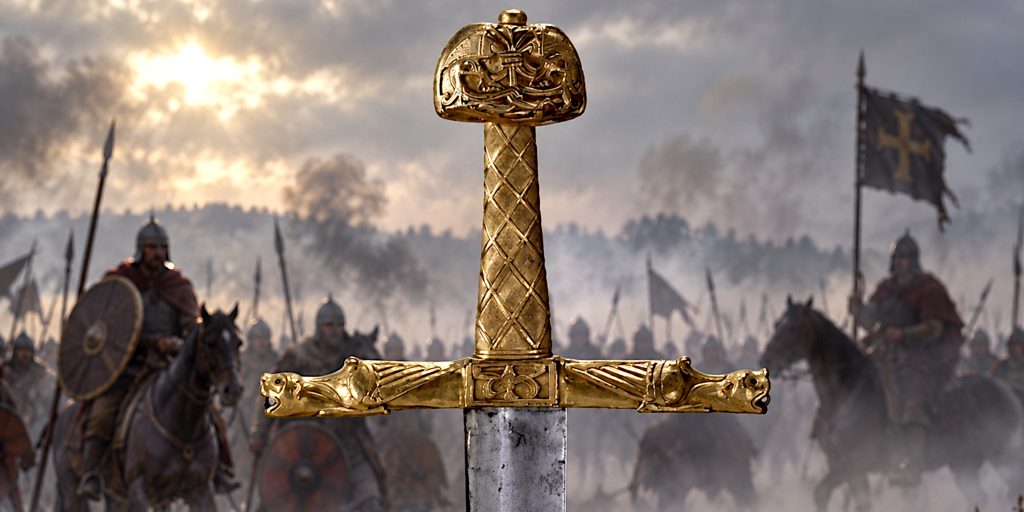
Joyeuse is traditionally identified as the sword of Charlemagne, the Frankish ruler crowned emperor in 800. That association is famous, but the surviving sword should not be treated as a single, untouched object from Charlemagne’s lifetime. Its components belong to different periods, and its importance is firmly tied to its later role in French royal ceremony.
The sword was used in the coronation processions of French kings for centuries. It became one of the objects through which monarchy presented itself: old, sacred and apparently blessed by history. Whether Charlemagne ever held this particular blade is a separate and much less certain question.
The Louvre lists it as the coronation sword of the kings of France, also known as the sword of Charlemagne or Joyeuse. The museum’s description is a useful reminder that an artefact’s ceremonial history can be better documented than its legendary first owner.
Where to see it: The Louvre’s collection entry for Joyeuse.
2. Honjo Masamune: the missing masterpiece
The Honjo Masamune is attributed to Masamune, the celebrated Japanese swordsmith whose work is associated with the Kamakura period. The blade passed through powerful samurai families and became part of the Tokugawa shogunate’s treasured inheritance.
Its modern story ends in uncertainty. After Japan’s surrender in 1945, swords were handed over under the occupation authorities’ disarmament measures. The Honjo Masamune was reportedly among the swords surrendered by the Tokugawa family, then disappeared from the record. Claims about a particular American serviceman or the sword’s present location remain unverified.
That distinction matters. “Lost after the war” is compelling enough; it does not need an invented trail to a secret vault. The Honjo Masamune’s absence has made it famous, but no confirmed sighting has settled its fate.
3. The Sutton Hoo sword: a burial object, not a named king’s weapon
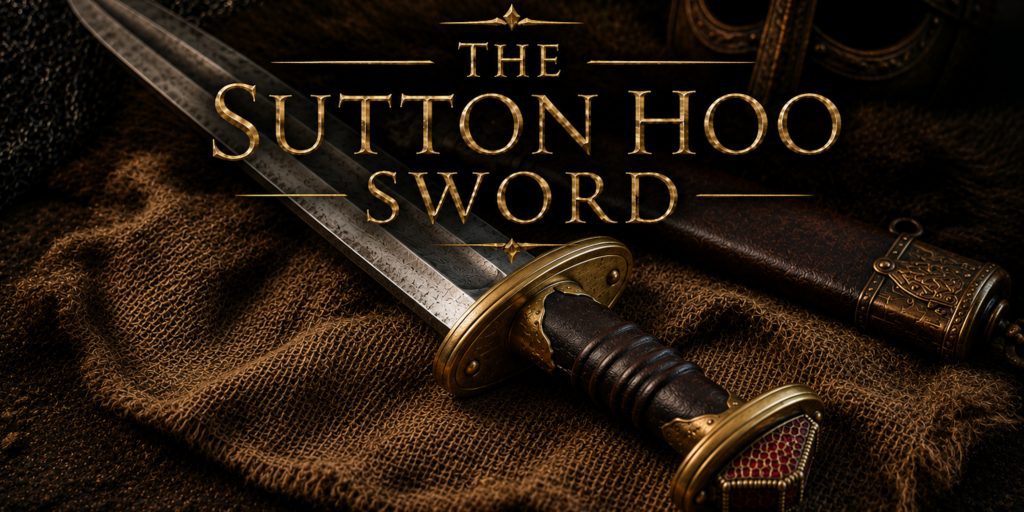
The sword from the Sutton Hoo ship burial is one of the most striking surviving weapons from early Anglo-Saxon England. It was richly furnished, with gold and garnet fittings, and buried in a chamber associated with an exceptionally high-status person in the early seventh century.
The burial is often linked to Rædwald, king of the East Angles, but the identity of the person buried there is not certain. The sword itself cannot settle the question. It does, however, show the wealth, skilled metalworking and long-distance connections available to the burial’s owner.
The British Museum notes that the sword was recovered as a solid but heavily corroded object, rather than assembled from fragments. Its study has also revealed details of how it may have been worn and carried. Those small traces can tell us more than a grand name attached without proof.
Where to see it: The British Museum’s Sutton Hoo collection explains the wider burial and its finds.
4. Tizona: El Cid’s sword, with a complicated attribution

Tizona is traditionally identified as one of the swords of Rodrigo Díaz de Vivar, better known as El Cid, the eleventh-century Castilian military leader. The sword is displayed at the Museum of Burgos and has long been wrapped in the stories surrounding its famous supposed owner.
Its attribution is debated. The museum and heritage descriptions preserve the traditional connection, while historical discussion points out that the sword’s visible fittings and inscriptions are later than El Cid’s lifetime. Some analyses have suggested that parts of the blade may be older than the present assembly. The safest description is that Tizona is a historically important sword associated with El Cid, not a securely authenticated weapon he is known to have carried.
That is hardly a downgrade. The sword’s long life as a relic of the Cid legend is itself part of its history. It tells us how later generations remembered a celebrated warrior, and how objects can become evidence for a legend as well as for the period in which they were made.
5. Zulfiqar: a sacred symbol and a contested artefact
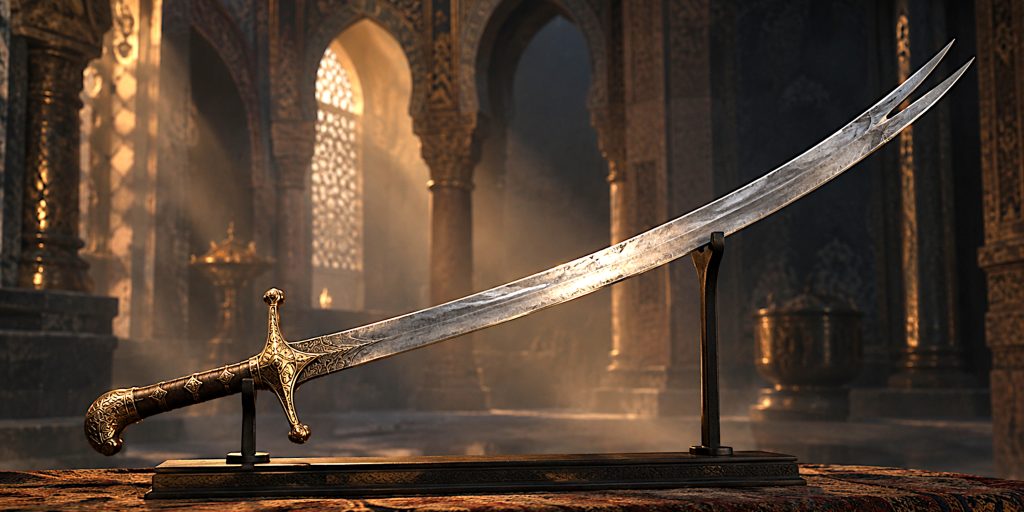
Zulfiqar is the sword associated in Islamic tradition with Ali ibn Abi Talib, the cousin and son-in-law of the Prophet Muhammad. It has become a powerful symbol, particularly within Shia Islam, where it is linked with Ali’s justice, courage and spiritual authority.
Images often show Zulfiqar with a split or forked blade. But the famous shape is an artistic and symbolic convention, not proof that a single surviving sword can be identified as the original. A sword attributed to Zulfiqar is displayed in the Topkapi Palace collection in Istanbul, though its identification as the historical weapon is not certain.
It is worth approaching this object with care. The sword’s religious and cultural meaning is real; the precise chain of ownership is not established to the same standard as a modern museum accession record. Those are different kinds of historical claim, and neither needs to erase the other.
6. The Wallace Sword: national symbol, uncertain owner

The large sword displayed at the National Wallace Monument is traditionally associated with William Wallace, the Scottish leader executed in 1305. It has become a potent symbol of Scottish resistance and national memory.
The surviving sword cannot be securely proven to have belonged to Wallace. Its dating and history have prompted debate, and it may have been altered over time. The association is part of the sword’s cultural history, but the object is not a signed possession with an unbroken chain of custody. History, irritatingly, did not provide us with a receipt.
The sword has been kept at the monument since 1888. The National Wallace Monument’s account of its transfer gives the object a documented modern history, even as its medieval ownership remains uncertain.
Where to see it: The National Wallace Monument’s Hall of Arms.
7. The Sword of Goujian: bronze, workmanship and an excellent burial

The Sword of Goujian is a bronze sword excavated in 1965 from a tomb in Hubei, China. It is associated with Goujian, king of Yue, who ruled in the fifth century BCE. Its crisp decoration and remarkably well-preserved surface have made it one of the best-known ancient Chinese weapons.
The name links the blade to the king, but its archaeological context is more precise than any claim that Goujian personally carried it. The Hubei Provincial Museum records its discovery in a Chu tomb. The sword’s excellent condition has inspired popular explanations about extraordinary ancient technology, but its preservation should be discussed through the evidence of its materials, burial conditions and conservation, not turned into a miracle story.
The museum describes the blade as retaining a sharp, lustrous appearance with little visible corrosion. It is a remarkable survival, though the real achievement is the skill and material knowledge behind its manufacture.
Where to see it: The Hubei Provincial Museum’s collection page.
What makes a sword priceless?
A sword’s value can come from several sources:
- Historical significance: It may be linked to a major political or military period.
- Craftsmanship: Materials, decoration and construction can reveal exceptional skill.
- Documented history: A reliable record of where an object came from can matter as much as its appearance.
- Cultural or religious meaning: Some swords hold importance beyond their physical form.
- Public heritage: Museum collections preserve objects for study and public access.
“Priceless” is therefore not a precise valuation. It describes an object whose importance cannot be reduced to an auction estimate. Some swords have been sold or transferred between owners; others are lost, held in public collections or valued primarily as sacred and cultural symbols.
Seven blades, seven different histories
These swords do not all tell the same kind of story. Joyeuse is tied to royal ceremony. The Sutton Hoo sword belongs to an archaeological context. Zulfiqar is a sacred symbol whose meaning reaches beyond the uncertain identity of any surviving blade. The Wallace Sword and Tizona show how later generations can attach a powerful national memory to an object.
That mixture of fact, tradition and uncertainty is part of their appeal. A famous sword is rarely just a weapon on a plinth. It is also a record of what people chose to remember, and sometimes of what they wished had happened.
Image credit: Joyeuse at Le Louvre in Paris (Wikimedia Commons)