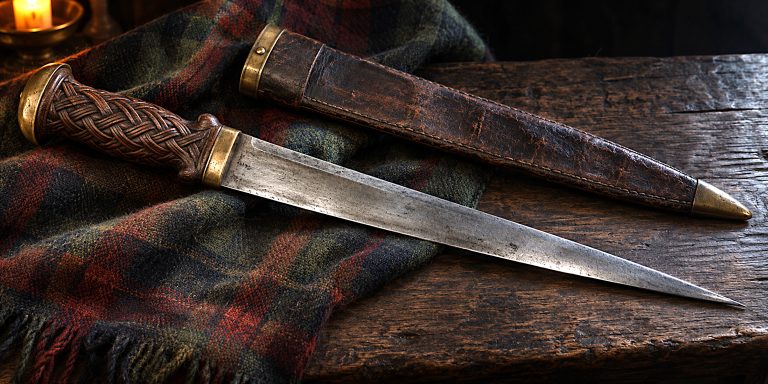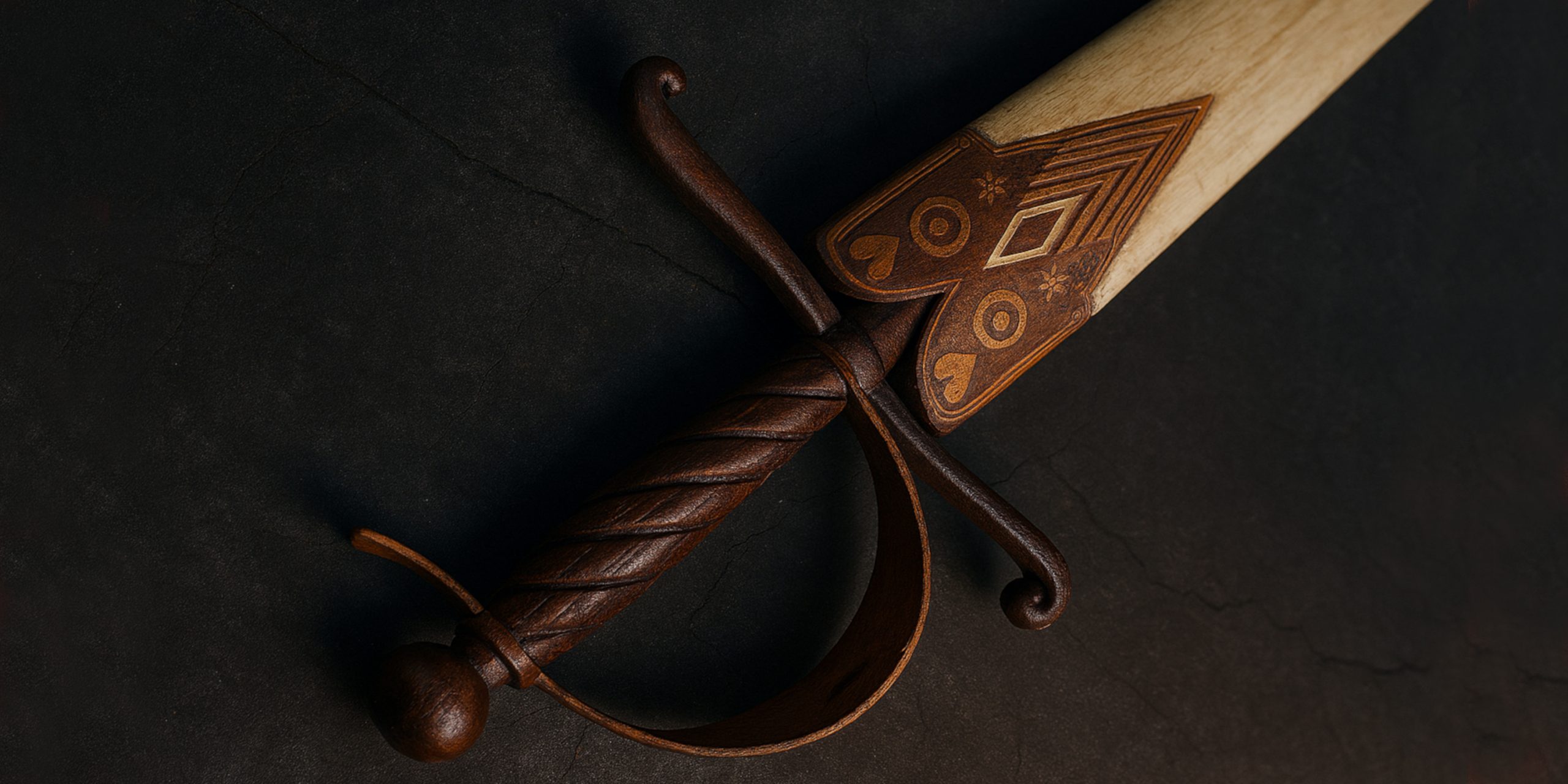
The term Inuit bone sword needs careful handling. Long bone and ivory knives survive in museum collections, but their shape alone does not establish that they were swords made for fighting. Several securely catalogued examples are snow knives, used to cut the blocks from which winter shelters were built.
That distinction changes the story considerably. A long blade can be an essential construction tool without having spent its working life in combat. Museum records support a rich history of Arctic craftsmanship, rather than a single, standardised Inuit sword type.
Bone, antler and ivory also need to be distinguished from one another. They are different materials, and an object with a bone handle may have a stone or metal cutting edge. Before discussing how an alleged bone sword performed, we need to establish what it actually is.
Specification
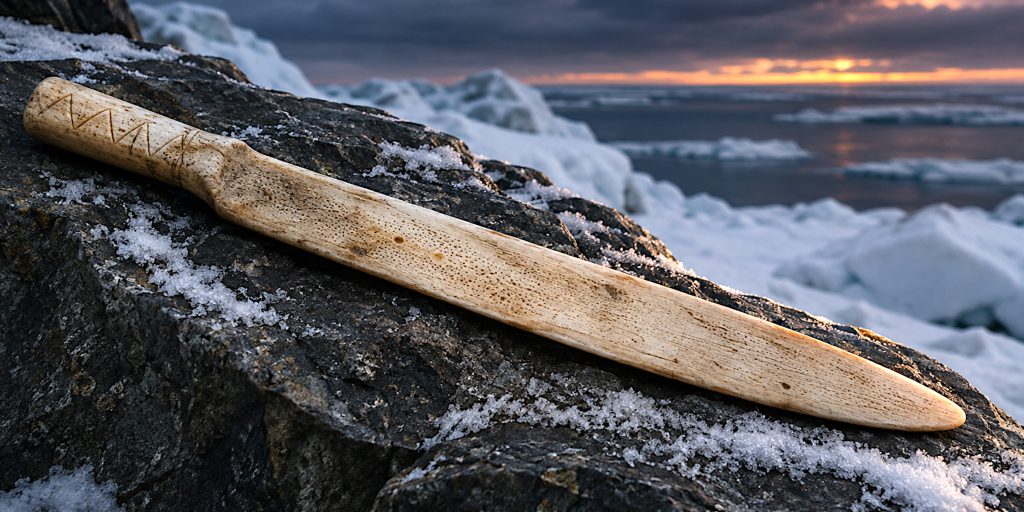
There is no securely established specification for an Inuit bone sword as a distinct weapon class. The following details describe documented knives and the limits of what they tell us.
| Feature | Evidence and interpretation |
|---|---|
| Object category | Long knife, snow knife or composite cutting tool, depending on the individual object |
| Blade materials | Bone or ivory in documented snow knives; other Arctic knives use stone or metal blades |
| Handle materials | Bone and ivory are documented; some handles have slots or fixing holes for separate blades |
| Length | Object-specific. Reading Museum’s bone snow knife is 44.7 cm long; the Met’s ivory example measures 27.7 cm |
| Blade form | Varies by purpose and material; length or a pointed profile does not prove combat use |
| Decoration | May include incised lines or other surface decoration; ornament alone does not establish ceremonial use |
| Weight and balance | No reliable standard figures for an “Inuit bone sword” |
| Principal documented use | Cutting snow blocks for snow knives; other knives require separate identification |
The two measurements above are examples, not the boundaries of a universal size range. Claims that these swords were typically 50–90 cm long require a documented group of objects to support them.
History and Evolution
Bone and ivory in Arctic craftsmanship
Inuit makers used animal materials with considerable technical skill. A handle, blade, harpoon component and fitting could each demand a different combination of toughness, shape and working properties. Treating all pale organic objects as “bone weapons” conceals those choices.
The museum evidence is particularly useful here. Reading Museum identifies a bone snow knife from Kugaaruk, Nunavut, made before 1968. Its function was cutting snow blocks for winter shelters. The Metropolitan Museum of Art holds an ivory snow knife from Alaska, dated to the 19th–20th century.
Earlier traditions and composite tools
Cambridge’s Museum of Archaeology and Anthropology holds a Thule-period bone snow-knife handle from Nuqsarnaq on Southampton Island. It has fixing holes for an attached blade, demonstrating why a surviving handle should not be mistaken for a complete all-bone implement.
The same museum records a Dorset-period composite knife, dated around 1000, with a surviving fragment of meteoritic iron in a bone handle. Dorset and Inuit cultural histories should not be collapsed into one, but this object provides an instructive comparison within the wider history of Arctic technology.
Metal before and after European contact
The familiar explanation that Arctic peoples used bone because they had no access to metal is too simple. Archaeological research documents meteoritic iron and other metal sources in precontact Arctic tools. Access varied considerably by place and period.
European contact added further supplies of metal, but there was no single Arctic-wide moment when steel replaced bone. Different materials continued to serve different purposes. A metal cutting edge could be combined with an organic handle rather than replacing the whole object.
Were these fighting swords?
The sources examined for this article do not establish a widespread tradition of standardised Inuit bone fighting swords. That is a limit of the available evidence, rather than proof that no long organic blade was ever used violently.
Individual auction descriptions also need scrutiny. A Tennants lot described as an unusual Inuit sword had a European steel blade and a bone hilt. Even if its cultural attribution is accepted, it is plainly not evidence for a sword with a bone blade.
Advantages and Disadvantages
These points concern the practical properties of organic knives. They should not be read as a reconstructed sword-fighting manual.
Advantages
- Useful for a specific task: A bone snow knife could cut snow blocks without needing a steel sword’s edge.
- Material suited to shaping: Bone and ivory could be carved and finished into handles, blades and fittings.
- Flexible construction: Composite designs allowed makers to combine an organic handle with another blade material.
- Regional material resources: Animal products offered valuable manufacturing materials, although availability varied.
Disadvantages
- Limited cutting performance: A worked bone edge does not offer the fine edge or cutting durability of a well-made steel knife.
- Risk of damage: Thin sections, points and attachment holes can chip, split or fail under unsuitable loads.
- Restricted shape and dimensions: The original bone or tusk constrains what can be made from it.
- Difficult interpretation: Wear, incomplete survival and uncertain collecting histories can obscure an object’s original function.
There is no sound basis here for claiming that bone swords were superior to metal weapons in extreme cold. Such a comparison would require specific materials and testing conditions.
Comparison with Similar Tools and Weapons
| Object | Main distinction |
|---|---|
| Bone or ivory snow knife | A long cutting tool for snow; a sword-like outline does not establish a military purpose |
| Ulu | A distinct cutting tool, commonly associated with processing tasks; historic examples include metal blades with organic handles |
| Composite Arctic knife | Combines materials, such as a bone handle and iron blade; the handle does not identify the blade material |
| Harpoon | A hunting system whose head and fittings must be understood as parts of a larger implement |
| Steel sword with bone hilt | A metal-bladed weapon; should not be catalogued as a bone-bladed sword |
Comparisons with the macuahuitl or shark-tooth weapons can be visually tempting. They do not demonstrate a shared construction method, combat role or historical connection. Evidence for those belongs to their own cultural contexts.
Legacy
The strongest historical interest lies in the objects’ actual functions. A carefully made snow knife records practical knowledge of materials, winter construction and the demands of a particular environment.
Calling it a sword may make a striking caption, but it can obscure the maker’s achievement. A tool that helped build shelter hardly needs an invented battlefield career to justify our attention.
Inuit craftsmanship also belongs to living cultures. Historic collection labels should be read critically, with attention to community, place, maker and collecting history wherever those details survive.
Where to See Documented Examples
These are verified collection records for relevant tools, rather than a list of museums said to possess bone fighting swords. A catalogue entry does not guarantee gallery display.
| Collection | Documented object |
|---|---|
| Reading Museum, Reading | Bone snow knife from Kugaaruk, Nunavut; 44.7 cm long; object 2009.122.1 |
| Metropolitan Museum of Art, New York | Ivory snow knife, Alaska, 19th–20th century; 27.7 cm; object 1979.206.881; listed as not on view |
| Museum of Archaeology and Anthropology, Cambridge | Thule-period bone snow-knife handle from Nuqsarnaq; reference Z 46197.74 |
| Museum of Archaeology and Anthropology, Cambridge | Dorset-period bone-handled knife with meteoritic iron fragment; reference 1950.358; a comparative Arctic object |
Check current display arrangements before travelling. For research, quote the object number when contacting the collection.
Collector’s Guide and Auction Prices
Identification comes before valuation
An object sold as an Inuit bone sword may be a snow knife, a later carving, a composite knife or a steel blade with an organic hilt. These categories cannot sensibly share one price range.
Ask for:
- A material assessment: Bone, antler and ivory should be identified separately, with specialist advice where necessary.
- A documented history: Earlier invoices, collection records, labels and photographs are more useful than an unsupported age estimate.
- A precise attribution: A named community or locality should have evidence behind it.
- A condition report: Look for cracks, replacement components, adhesive repairs and damage around fixing holes.
- An explanation of function: Ask why the cataloguer calls it a sword rather than a snow knife or another tool.
Recorded auction results
The following results provide context, not a valuation formula. Auction attributions are reproduced as the auctioneers’ descriptions and are not independent authentication.
| Auction record | Reported result | What the price covers |
|---|---|---|
| Acreman St. Antiques, 28 September 2023: knife catalogued as Inuit, with bone blade and two-part bone sheath, 25 cm | £150 hammer | One knife and sheath; fees extra |
| Tennants, lot 320: snow knife and four other Inuit-attributed knives, Graham Turner Collection | £100 sold price | The entire five-knife group; no individual snow-knife value can be extracted |
| Tennants, 21 September 2022, lot 2411: mixed group including three harpoons and an Inuit-attributed sword with European steel blade | £220 sold price | The whole eight-item lot; not the sword alone |
The Tennants records display “sold for” figures. Confirm the auctioneer’s fee basis when comparing them with hammer prices elsewhere. Buyer’s premium, shipping and other charges can materially change the total paid.
These examples do not support a general valuation of several thousand pounds for an Inuit bone sword. Equally, three sale records cannot establish the upper limit for an exceptional, securely documented object.
Buying in the UK
Material identification also affects legal checks. Current government guidance distinguishes walrus ivory from species listed under the Ivory Act, while warning that other rules may apply. Government scrutiny documents identify separate controls on trade in seal products, including walrus ivory.
Before buying or arranging international transport, check the current requirements for the actual species, object and route. An old auction listing or an “antique” description does not settle those questions.
Looking after an example
Support the object along its length, handle it sparingly and avoid abrupt environmental changes. Do not sharpen it, test its cutting ability or apply household oils and cleaners. For a significant piece, obtain advice from a conservator experienced with organic materials.
Sources and Further Reading
GOV.UK: Ivory Act 2018 post-legislative scrutiny.
Reading Museum: bone snow knife, object 2009.122.1.
Metropolitan Museum of Art: Snow Knife, 1979.206.881.
Cambridge Museum of Archaeology and Anthropology: Thule snow-knife handle.
Cambridge Museum of Archaeology and Anthropology: Dorset knife with meteoritic iron.
Methods for determination of the source of iron in precontact Inuit and Dorset culture artifacts from the Canadian Arctic, research paper.
Canadian Archaeological Association: Thule Epimetallurgy and the Consequences of Elizabethan Contact, research abstract.
Acreman St. Antiques via Easy Live Auction: bone-bladed knife and sheath, 28 September 2023.
Tennants: lot 320, snow knife and four knives.
Tennants: lot 2411, mixed group including steel-bladed sword.
GOV.UK: Deal in items made of or containing ivory.