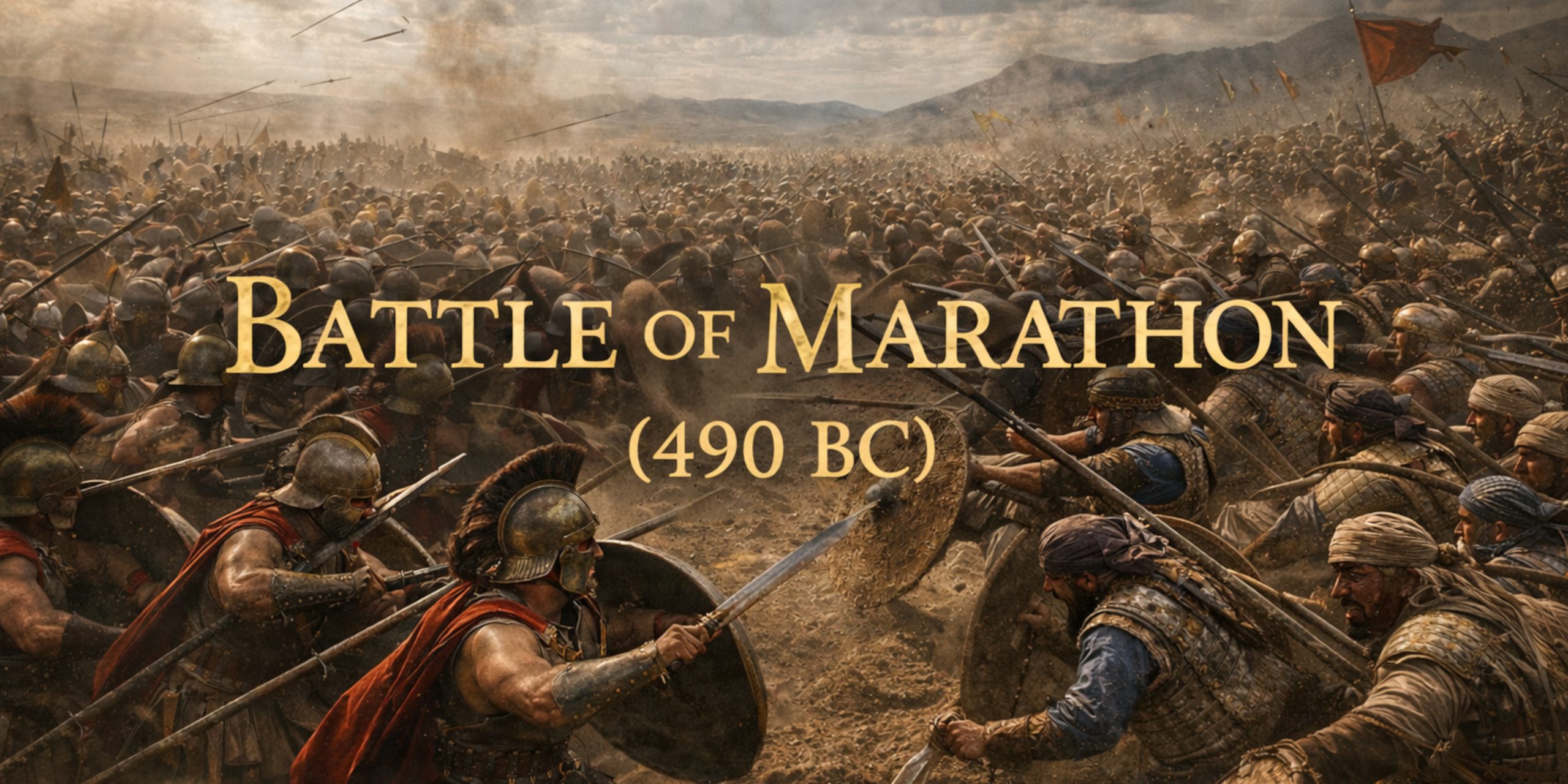
The Battle of Marathon is one of those battles that seems almost too neat to be true. A smaller Greek force faces the might of the Persian Empire and somehow wins, decisively and rather dramatically. It is the sort of episode that later generations polish into legend, yet the core of it remains stubbornly real.
In 490 BC, the Athenians and their Plataean allies met a Persian expeditionary force on the plain of Marathon, northeast of Athens. What followed was not just a victory but a statement. The Persian advance into mainland Greece had been checked, and Athens had discovered something important about itself, namely that it could stand and win.
Background
The roots of the battle lie in the Ionian Revolt. Greek cities in Asia Minor had risen against Persian rule, and Athens had the audacity to help them. The Persian king Darius I did not forget.
The campaign that followed was designed to punish Athens and reassert Persian authority across the Aegean. The Persians crossed the sea, subdued islands along the way, and eventually landed at Marathon, a location chosen for its open terrain and suitability for cavalry.
Athens suddenly found itself in a position that was deeply uncomfortable. Sparta, their most powerful potential ally, was delayed by religious observance. That left the Athenians and a small contingent from Plataea to face a far larger imperial army.
Forces
Estimating numbers is always a slightly hazardous exercise, especially when ancient historians had a tendency to round things up to the nearest dramatic figure.
Greek Forces
| Component | Estimated Numbers |
|---|---|
| Athenian Hoplites | 8,000–9,000 |
| Plataean Hoplites | ~1,000 |
| Total | ~10,000 |
Persian Forces
| Component | Estimated Numbers |
|---|---|
| Infantry | 20,000–25,000 |
| Cavalry | Present but uncertain role |
| Total | ~20,000–25,000 |
The Persian cavalry remains a point of debate. Some accounts suggest it was temporarily absent during the main engagement, which would go some way to explaining how the Greeks managed to close the distance without being shredded beforehand.
Leaders and Command Structure
Greek Command
- Miltiades, the key strategist behind the aggressive plan
- Callimachus, the polemarch who held overall authority
- Athenian tribal generals, rotating command but ultimately deferring to Miltiades
Persian Command
- Datis, a Median admiral and general
- Artaphernes, a Persian noble and commander
The Greek command structure is interesting in itself. It was not a single general issuing orders in the modern sense. Decisions were debated, argued over, and then finally executed. One suspects the atmosphere before the battle was not exactly calm.
Arms and Armour
Greek Hoplite Equipment
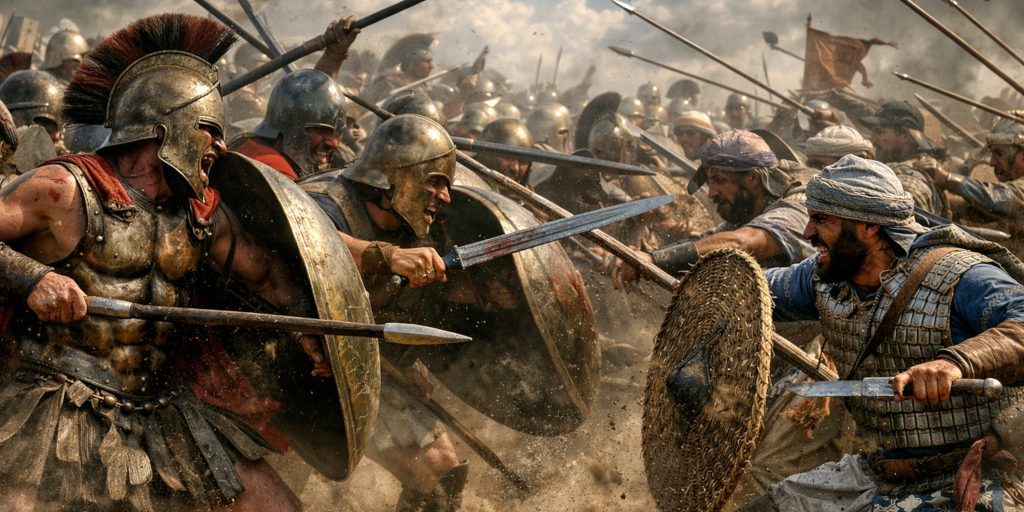
- Primary weapon: Dory spear, typically 2 to 3 metres long
- Secondary weapon: Xiphos short sword
- Shield: Aspis, large bronze-faced round shield
- Armour:
- Bronze helmet, often Corinthian style
- Bronze cuirass or linen thorax
- Greaves protecting the lower legs
Persian Equipment
- Primary weapons:
- Short spear
- Composite bow
- Secondary weapons:
- Akinakes short sword or dagger
- Shield: Wicker shield, lighter and less durable than Greek bronze shields
- Armour:
- Light tunics or scale armour for elite troops
- Minimal protection compared to hoplites
Key Differences
- Greeks fought as heavily armoured infantry in a tight formation
- Persians relied on mobility, archery, and lighter equipment
- Close combat strongly favoured the Greeks once contact was made
The Xiphos deserves a brief mention. It was not a glamorous weapon, but when the spear broke or the fighting became too cramped, it was exactly what a hoplite needed. Short, double edged, and very efficient at close quarters.
The Battlefield at Marathon
The plain of Marathon offered a mix of open ground and difficult terrain. To one side lay marshes, to the other hills. It was not an entirely forgiving battlefield, but it was suitable enough for a decisive engagement.
The Greeks positioned themselves to block the route to Athens. The Persians, meanwhile, had the advantage of choosing the landing site but not complete freedom of movement once ashore.
Battle Timeline
Initial Standoff
- Both armies face each other across the plain
- Days pass without engagement
- Athenians await Spartan support that never arrives in time
Greek Decision to Attack
- Miltiades persuades the Athenians to take the initiative
- The Greek line is deliberately thinned at the centre and strengthened on the wings
The Advance
- Greek hoplites advance at speed across open ground
- Persian archers have limited time to inflict damage
Main Engagement
- Persian centre pushes back the thinner Greek centre
- Greek wings overpower the Persian flanks
Encirclement
- Greek wings wheel inward
- Persian centre becomes surrounded and collapses
Persian Retreat
- Persians withdraw towards their ships
- Fighting continues at the shoreline
Aftermath
- Greeks secure the field
- Persian fleet sails around Cape Sounion, possibly aiming for Athens
- Athenians march back rapidly to defend the city
Archaeology
The most prominent archaeological feature is the burial mound, or tumulus, which still stands on the plain. It contains the remains of the Athenian dead, a rare honour in Greek warfare where bodies were often returned home.
Finds from the area include:
- Arrowheads, likely Persian
- Pottery fragments from the period
- Evidence of cremation within the tumulus
There is no vast scatter of weapons as one might hope for. Ancient battlefields are often disappointingly quiet archaeologically. Looting, reuse, and time tend to tidy things away.
Contemporary Accounts
Our main source is Herodotus, writing a few decades after the battle. He gives a narrative that is detailed, though not beyond question.
A famous line attributed to the Athenians captures the mood:
“We will fight, and we will conquer, or we will die.”
Herodotus also records the remarkable Athenian confidence after the battle, marching straight back to defend their city without pause. It is the sort of detail that feels almost cinematic, which is usually a sign that it may be at least partly true.
Why the Greeks Won
Several factors combined in a way that favoured the Athenians:
- Heavy infantry advantage in close combat
- Tactical flexibility from Miltiades
- Aggressive decision to attack rather than wait
- Possible absence or limited use of Persian cavalry
- Strong morale, driven by defending their homeland
There is also something less tangible. The Athenians were fighting for their city in a very direct sense. The Persians were executing an imperial campaign. Motivation is difficult to measure, but it tends to matter.
Casualties
Ancient figures should always be treated with caution, but the traditional numbers are:
- Greek losses: 192 Athenians, 11 Plataeans
- Persian losses: approximately 6,400
Even allowing for exaggeration, the disparity suggests a decisive outcome.
Legacy
Marathon became more than a battle. It turned into a symbol.
- It demonstrated that Persian forces were not invincible
- It strengthened Athenian confidence and identity
- It laid part of the groundwork for later victories, including Salamis
The famous story of the messenger running from Marathon to Athens, collapsing after delivering news of victory, is probably apocryphal or at least embellished. Still, it gave us the modern marathon race, which is not a bad legacy for a single afternoon of fighting.
Seven Swords Takeaway
There is a temptation to see Marathon as inevitable in hindsight. Greek courage, Persian overconfidence, a clever plan, and everything falls neatly into place.
In reality, it was a gamble. Had the Persian centre broken through decisively, or had their cavalry been fully engaged at the right moment, the outcome might have been very different.
Instead, the Athenians ran forward, quite literally, and changed the course of their own history. It is one of those moments where a decision made in a few tense hours echoes for centuries.
And, quietly, it also reminds us that sometimes the bold option is the sensible one, though one suspects that was not particularly comforting to the men actually doing the running.eserved the fledgling democratic structures of Athens and inspired future resistance against overwhelming odds. Its memory resonated through antiquity and remains one of the most studied battles in military history.