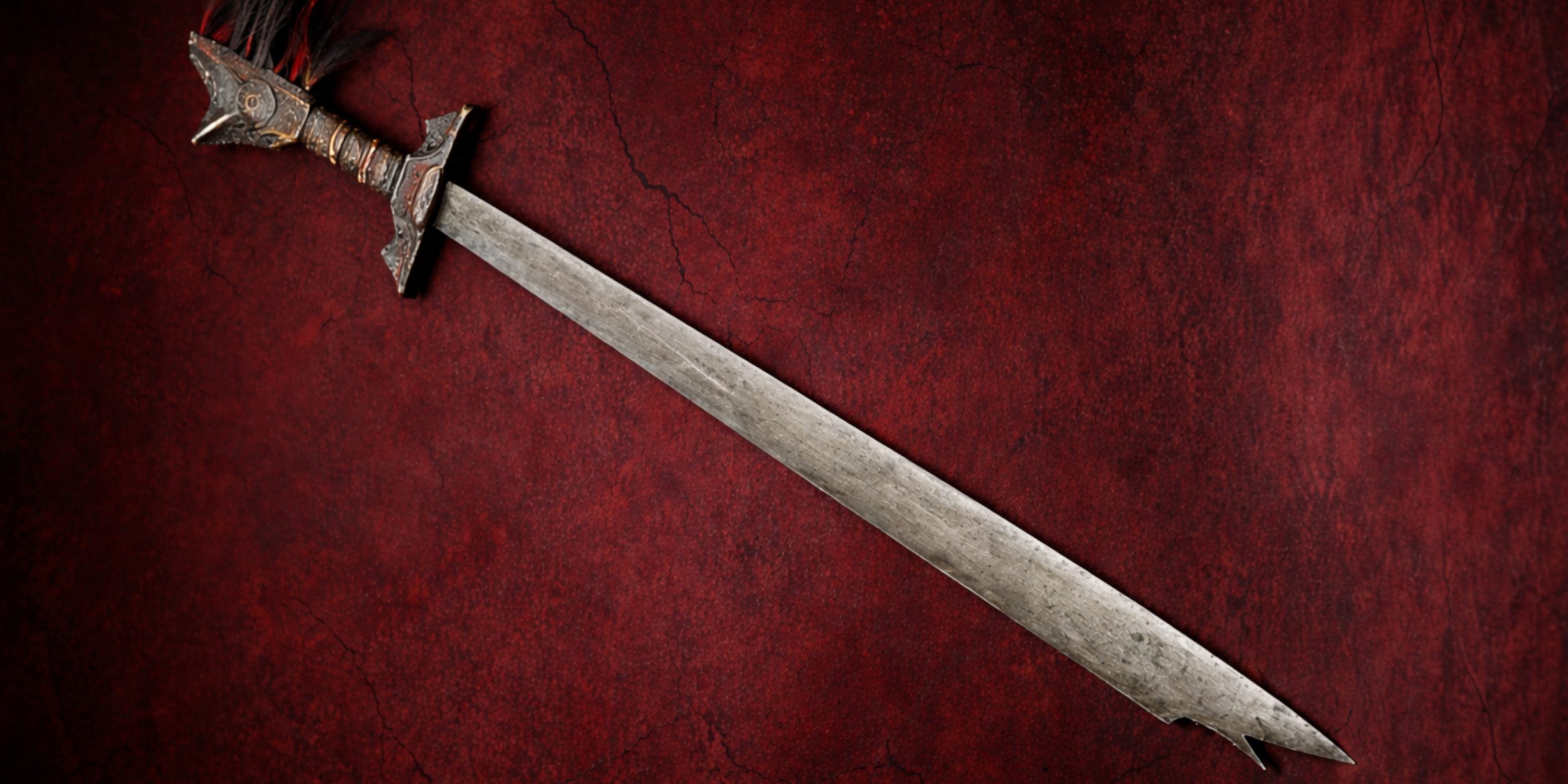
Few Southeast Asian weapons look as dramatic as the Kampilan. Long, slightly widening toward the tip and often fitted with a carved pommel that resembles a mythical creature, the weapon has a presence that borders on theatrical. Yet this is no ceremonial curiosity. The Kampilan was a serious battlefield sword used by warriors of the southern Philippines for centuries.
It became closely associated with Moro warriors, particularly among the Maguindanao, Maranao, Tausug and Visayan groups, where it served as a weapon of prestige as well as war. Spanish chroniclers described it with equal parts fascination and fear, often remarking on the sheer cutting power of the blade.
One famous tradition links the sword to Lapu-Lapu, the chieftain who defeated Ferdinand Magellan in 1521. Whether the blade used in that battle was truly a Kampilan remains debated, but the story captures the weapon’s symbolic role in resistance and martial culture.
Specifications
The Kampilan differs from many Southeast Asian swords in scale. It is longer than the kris and designed primarily for powerful chopping cuts.
| Feature | Typical Measurement |
|---|---|
| Blade Length | 60 to 90 cm |
| Overall Length | 90 to 110 cm |
| Blade Shape | Single edged, widening toward the tip |
| Blade Profile | Slight curve or straight |
| Weight | 900 g to 1.4 kg |
| Materials | Pattern welded steel or layered iron |
| Grip | Hardwood wrapped in fibre or rattan |
| Pommel | Carved wood often shaped as animals or mythical forms |
Distinctive Design Features
- Broad blade that flares slightly near the tip
- Long handle allowing two handed leverage
- Elaborate carved pommels, often depicting crocodiles, birds, or naga motifs
- Scabbards made from two wooden halves bound with rattan
The blade geometry is designed for deep cutting power, rather than the thrust oriented combat of many European swords.
History and Evolution
The Kampilan likely emerged between the 13th and 15th centuries, during a period of strong maritime trade networks across Southeast Asia. Cultural exchange between Mindanao, Borneo and the Malay world shaped its development.
Early forms were probably shorter and simpler. Over time the weapon grew larger and more elaborate, becoming both a practical weapon and a symbol of warrior identity.
Early Use
- Used by pre colonial Philippine warriors in tribal conflicts
- Associated with seafaring raiders and coastal fighters
- Often carried alongside shields such as the kalasag
Spanish accounts from the 16th and 17th centuries describe the sword in detail. Colonial soldiers wrote that Moro fighters could deliver devastating blows capable of splitting helmets or shields.
Influence of Islamic Sultanates
As Islamic sultanates developed in Mindanao and Sulu, martial traditions became more formalised. The Kampilan emerged as a weapon carried by elite warriors and noble retainers.
Decorative elements also evolved during this period:
- Larger carved pommels
- Hair tassels attached to the hilt
- More refined blade forging techniques
By the 18th and 19th centuries the sword had become a recognised symbol of southern Philippine martial culture.
Advantages and Disadvantages
Advantages
- Exceptional cutting power due to blade width and weight distribution
- Long reach compared with most Southeast Asian swords
- Two handed grip allows strong downward blows
- Psychological presence due to its size and elaborate appearance
Disadvantages
- Less agile than shorter swords such as the kris
- Limited thrusting ability because of blade geometry
- Large size makes it harder to carry in confined spaces
- Requires considerable strength and skill to use effectively
In practical combat the weapon excelled in decisive strikes, especially against lightly armoured opponents.
Comparison With Similar Weapons
The Kampilan sits within a diverse family of Southeast Asian swords, each with a different combat philosophy.
| Weapon | Region | Key Features | Combat Style |
|---|---|---|---|
| Kampilan | Philippines | Long, flared blade | Powerful chopping strikes |
| Kris | Indonesia / Philippines | Wavy blade, thrust capable | Close combat and stabbing |
| Barong | Philippines | Short, heavy leaf shaped blade | Strong slashing in confined spaces |
| Mandau | Borneo | Narrow curved blade | Fast slashing cuts |
| Dha | Mainland Southeast Asia | Straight single edge blade | Mixed cut and thrust |
Compared with the kris, the Kampilan is far less ceremonial and far more suited to battlefield engagements.
Compared with the barong, it sacrifices manoeuvrability in favour of reach and momentum.
Legacy and Cultural Significance
Today the Kampilan holds an important place in Philippine history and identity.
It appears in:
- Historical reenactments
- Filipino martial arts demonstrations
- Cultural festivals and museum displays
Within martial arts traditions such as Eskrima, Arnis and Kali, the sword often represents the archetype of a long cutting weapon. Modern training usually substitutes wooden replicas for safety.
The weapon also appears in films, historical art, and occasionally fantasy media that draws inspiration from Southeast Asian weaponry.
Where to See Kampilan Swords Today
Authentic examples survive in museum collections across the world.
Major Museums
- National Museum of the Philippines, Manila
- Ayala Museum, Makati
- Metropolitan Museum of Art, New York
- British Museum, London
- Musée du quai Branly, Paris
Many of these pieces date from the 17th to 19th centuries and retain original scabbards and carved hilts.
Private collections in Southeast Asia also contain remarkable examples, though these are rarely displayed publicly.
Collector’s Guide
Interest in Southeast Asian weapons has grown steadily among collectors. Authentic Kampilan swords attract strong attention due to their dramatic appearance and cultural significance.
Factors That Affect Value
- Age and provenance
- Quality of blade forging
- Condition of carved pommel
- Original scabbard survival
- Historical documentation
Typical Auction Prices
| Type | Price Range |
|---|---|
| 19th century Kampilan, basic condition | £900 to £1,800 |
| High quality example with intact scabbard | £2,000 to £4,500 |
| Museum grade or early examples | £5,000 to £10,000+ |
Notable auction houses that occasionally sell Kampilan swords include:
- Bonhams
- Christie’s
- Hermann Historica
- Czerny’s
Collectors should also watch specialist ethnographic weapon auctions.
Buying Advice
- Verify the age and origin carefully
- Examine the blade for modern reproductions or reshaping
- Check that the rattan binding and scabbard appear period correct
- Avoid heavily restored examples unless documented
Because reproductions are common in the tourist trade, careful authentication is essential.
Seven Swords Takeaway
The Kampilan stands apart among Southeast Asian swords. Its length, flared blade, and striking carved hilt give it a dramatic silhouette that few weapons match. Yet behind that visual impact lies a practical and formidable war sword shaped by centuries of conflict and cultural exchange.
From coastal raids in the southern Philippines to museum collections across the world, the Kampilan remains one of the most recognisable blades of the region. For historians, martial artists, and collectors alike, it represents both a weapon and a story of resistance, craftsmanship, and identity.